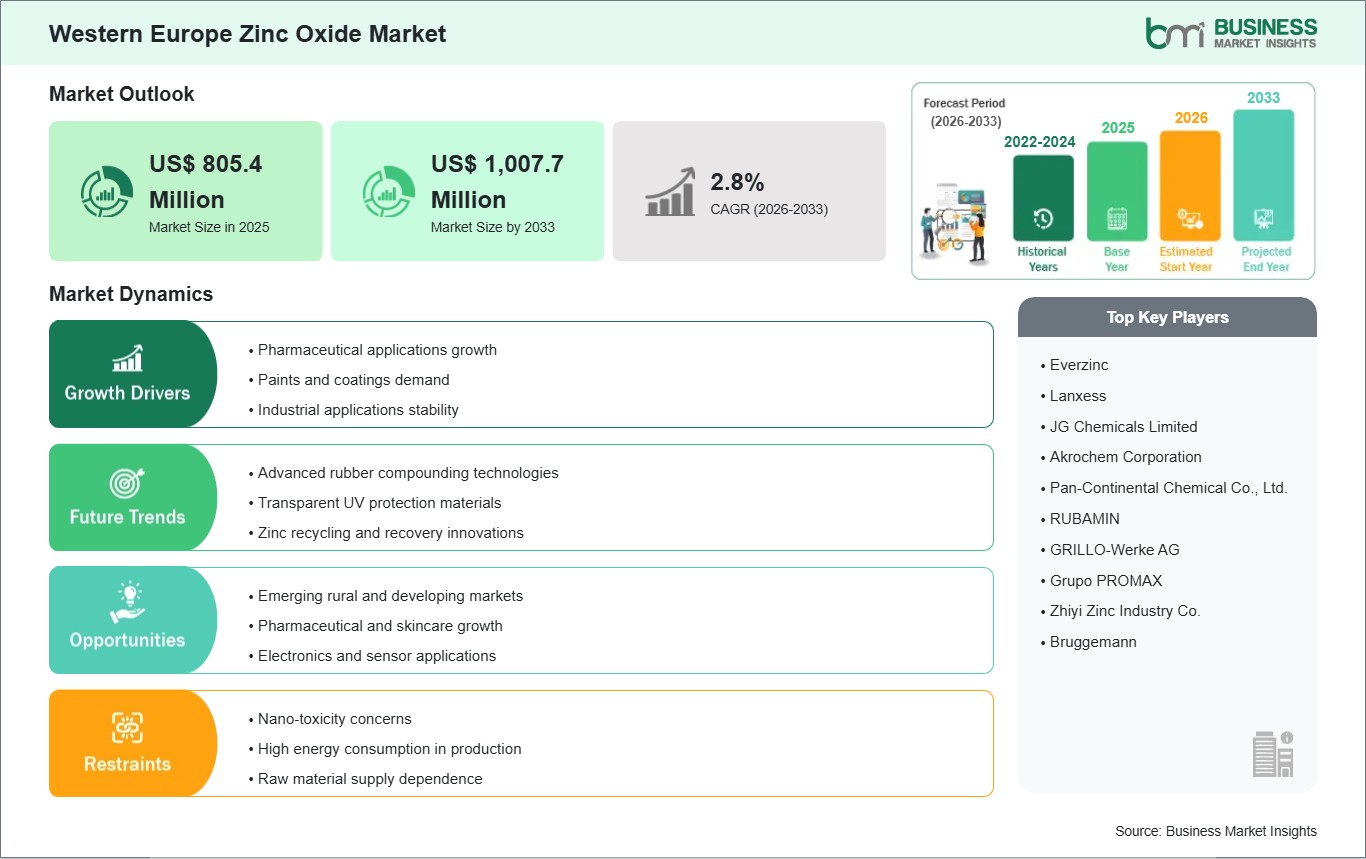
The Western Europe zinc oxide market size is expected to reach US$ 1,007.7 million by 2033 from US$ 805.4 million in 2025. The market is estimated to register a CAGR of 2.8% from 2026 to 2033.
Western Europe represents an extensively matured and innovative market space, where high-end regulatory norms, sophisticated material engineering, and robust demand for the material are key traits. In this region, zinc oxide is used in rubber, chemicals, pharma, cosmetics, and paints and coatings sectors. The region's industrial framework has placed great focus on product performance and quality, which results in high usage of specialty zinc oxide. In the existing automotive manufacturing chain, zinc oxide plays a crucial role in manufacturing tires and in their rubber compounding. The cosmetics and personal care product industry creates a solid basis for high demand for zinc oxide as an ingredient of sunscreens and dermatological products due to its properties. Restraining factors include tough environmental regulations related to manufacturing processes and chemical emissions, especially those connected with metal-based industries. Relocation of the manufacturing process to other regions due to their lower costs becomes a restriction for growth in the bulk zinc oxide segments. Western Europe plays a major role in innovations in this field and focuses on zinc oxide nano-engineering and environmentally friendly manufacturing techniques.

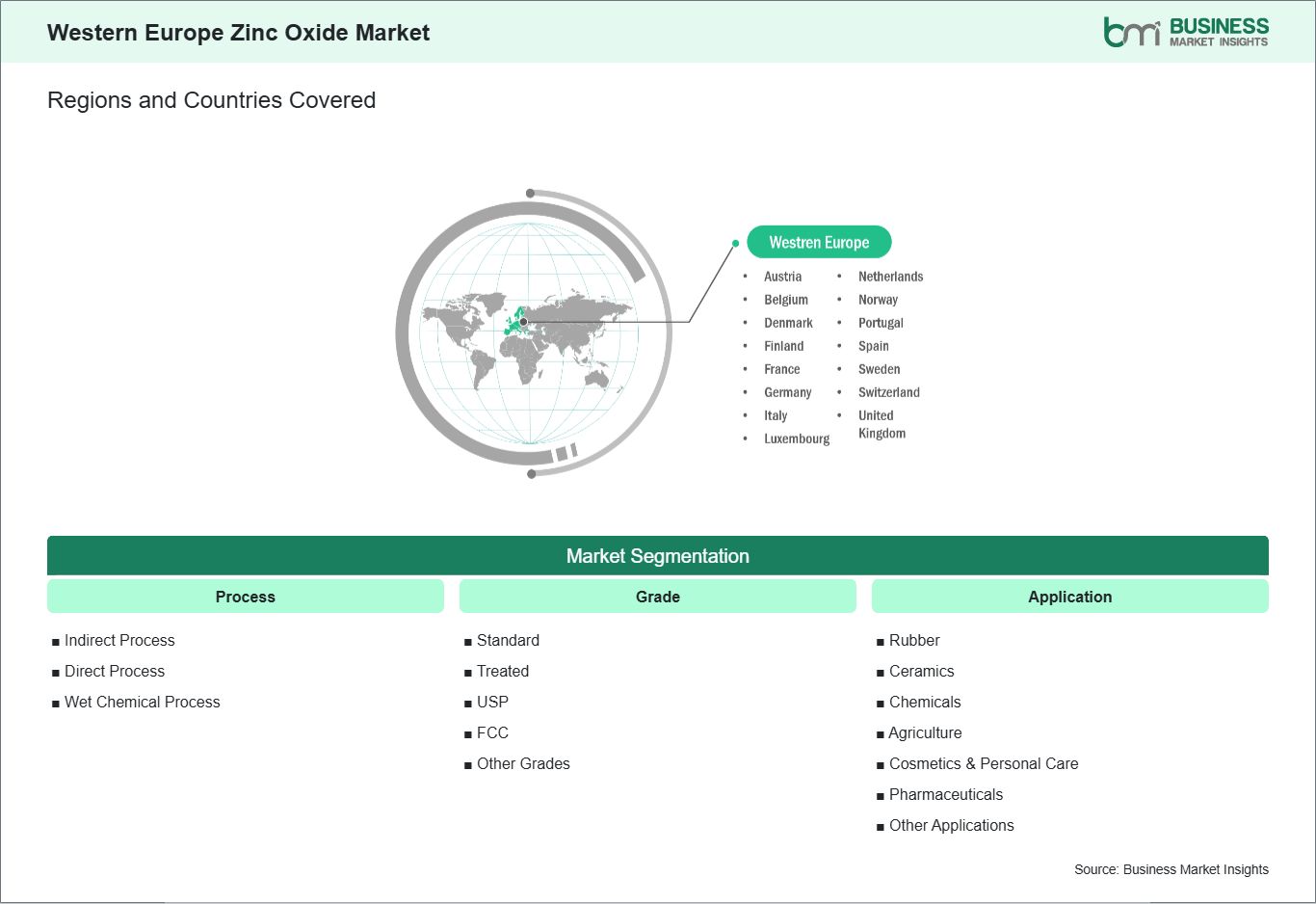
Key segments that contributed to the derivation of the Western Europe Zinc oxide market analysis are process, grade, and application.
There is widespread usage of zinc oxide in dermatological creams, antiseptic ointments, calamine lotions, wound healing preparations, and pharmaceutical powders owing to its anti-inflammatory and antibacterial properties. Germany, Switzerland, France, and Belgium are leading centers for the manufacture of pharmaceutical drugs and specialty chemicals, which means that there will be steady demand for zinc oxide with very low content of impurities.
An increasing number of patients suffering from irritation, decubitus, eczema, and other diseases causes growing sales of skin protection preparations. More than one-fifth of the German population is above retirement age, which means that pharmaceutical companies need to increase production of skin protection formulations. Zinc oxide is used in medicinal applications since it creates an effective protective layer and has low reactivity.
The increasing importance placed on safety and tracing of raw materials used in pharmaceuticals is leading to investment in better manufacturing processes for zinc oxide. Manufacturers from the Netherlands and France are employing techniques that will help ensure compliance with the European pharmacopeia standards, which are stringent when it comes to purity requirements. There is a rising popularity of natural and mineral products in healthcare products, wherein zinc oxide is seen as a safer substitute for chemical additives.
The growth of industries in Southern Italy, Spain, Portugal, and Eastern Germany through financial investments in their infrastructures, as well as the presence of local manufacturers and small-scale chemical processors, is one reason for increased zinc oxide utilization in various products, including rubber products, ceramics, animal feeds, and agriculture products.
Use of zinc oxides in agriculture has gained significance as a result of micronutrient deficiencies in the rural parts of Western Europe through products that contain zinc oxides. Zinc oxides are being used in the manufacture of fertilizers and animal feeds in rural farms found in France and Spain, among other countries, due to the importance of increasing soil fertility in such regions.
Regional manufacturing clusters continue to grow, resulting in an increased market share. As far as small- and medium-sized manufacturers of paints, adhesives, ceramic products, and rubber products, they continue to slowly boost their output volumes in inexpensive rural regions thanks to their better economic attractiveness compared to the large urban centers. In countries like Portugal or southern Spain, industrial decentralization policies help attract investments to semi-rural manufacturing districts, thus contributing to the growing local demand for zinc oxide as a versatile industrial raw material.

The Western Europe zinc oxide market is experiencing steady growth, with market size and share analysis reflecting evolving treatment preferences and competitive dynamics among key players. The report evaluates important subsegments categorized within process, grade, and application, highlighting their respective contributions to overall market performance.
By process, the indirect subsegment dominated the market in 2025, because it produces high-purity zinc oxide, which is essential for rubber, pharmaceuticals, and cosmetics. It ensures uniform particle size and better performance consistency, which industries require for quality-critical applications. Even though it is costlier than the direct process, its product reliability and compliance with strict standards make it the preferred choice.
Based on grade, the standard subsegment dominated the market in 2025 due to its massive use in bulk manufacturing industries, especially rubber, ceramics, and paints. It offers a cost-effective balance between purity and performance, making it suitable for high-volume consumption. Industries prefer it because it is easily available and economically viable compared to high-purity grades.
On the basis of application, the rubber subsegment dominated the market in 2025, because zinc oxide is a key activator in vulcanization, which is essential for tire production. The global expansion of automotive and tire manufacturing drives demand. It improves the strength, durability, and heat resistance of rubber products, making it irreplaceable. Continuous growth in mobility, logistics, and EV tires strengthens its dominance.
| Report Attribute | Details |
|---|---|
| Market size in 2025 | US$ 805.4 Million |
| Market Size by 2033 | US$ 1,007.7 Million |
| CAGR (2026 - 2033) | 2.8% |
| Historical Data | 2022-2024 |
| Forecast period | 2026-2033 |
| Segments Covered | By Process
|
|
Regions and Countries Covered
| |
| Western Europe | Belgium, Netherlands, Luxembourg, Germany, France, Italy, Spain, Switzerland, Sweden, Austria, United Kingdom, Denmark, Portugal, Norway, Finland |
| Market leaders and key company profiles |
|
The "Western Europe Zinc Oxide Market Size and Forecast (2022-2033)" report provides a detailed analysis of the market covering below areas:
The geographical scope of the Western Europe zinc oxide market report is divided into: Belgium, the Netherlands, Luxembourg, Germany, France, Italy, Spain, Switzerland, Sweden, Austria, the UK, Denmark, Portugal, Norway, and Finland. Germany held the largest share in 2025.
Germany is characterized by the presence of sophisticated chemical manufacturing and an integrated automotive industry across the globe. This domination is mainly attributed to the superior tire and automotive components industries that have a wide application of zinc oxide in their manufacturing process. Germans have a reputation for perfection and excellence in engineering and materials used for their products. Zinc oxide is essential for these high-quality applications. The coatings and industrial chemicals sector consumes zinc oxide in large amounts since it is used in manufacturing paints and other coating chemicals, which protect machinery and heavy equipment from corrosion. Germans also have the habit of considering the durability and environment impact of their manufacturing chemicals. Germany is another country that dominates in the development of pharmaceutical and cosmetic products in the region. The presence of skincare product manufacturers means that there will always be a consistent requirement for finely made zinc oxide that can be used in sunscreens, healing creams, and various forms of medicinal uses. Germany is involved in the manufacture of zinc oxide on a nano-scale level to facilitate use in electronics. Although Germany has an edge over other countries in the manufacturing of zinc oxide, it faces numerous challenges, such as the high cost of manufacturing due to environmental laws. Nevertheless, its well-established Research and Development sector continues to consolidate its dominance in Western Europe through the adoption of sustainable chemistry practices.

The Western Europe zinc oxide market is evaluated by gathering qualitative and quantitative data post primary and secondary research, which includes important corporate publications, association data, and databases. A few of the key developments in the Western Europe zinc oxide market are:
The Western Europe Zinc Oxide Market is valued at US$ 805.4 Million in 2025, it is projected to reach US$ 1,007.7 Million by 2033.
As per our report Western Europe Zinc Oxide Market, the market size is valued at US$ 805.4 Million in 2025, projecting it to reach US$ 1,007.7 Million by 2033. This translates to a CAGR of approximately 2.8% during the forecast period.
The Western Europe Zinc Oxide Market report typically cover these key segments-
The historic period, base year, and forecast period can vary slightly depending on the specific market research report. However, for the Western Europe Zinc Oxide Market report:
The Western Europe Zinc Oxide Market is populated by several key players, each contributing to its growth and innovation. Some of the major players include:
The Western Europe Zinc Oxide Market report is valuable for diverse stakeholders, including:
Essentially, anyone involved in or considering involvement in the Western Europe Zinc Oxide Market value chain can benefit from the information contained in a comprehensive market report.
Please tell us your area of interest
(Market Segments/ Regions and Countries/ Companies)