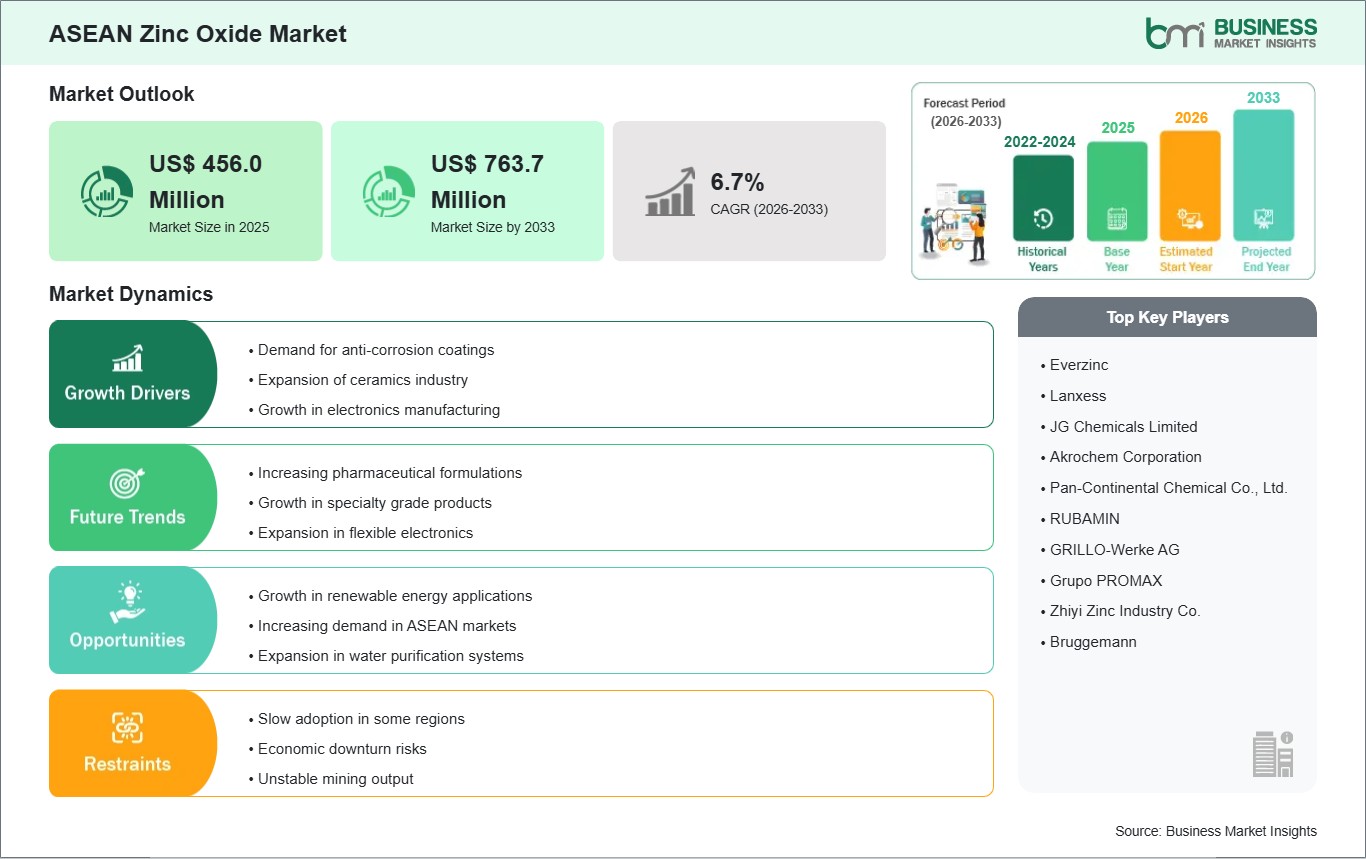
The ASEAN zinc oxide market size is expected to reach US$ 763.7 million by 2033 from US$ 456.0 million in 2025. The market is estimated to record a CAGR of 6.7% from 2026 to 2033.
The zinc oxide market in ASEAN region is progressing at a steady pace owing to increasing manufacturing activity in the regions in sectors such as rubber processing, ceramics, paints, pharmaceuticals, personal care, electronics, and animal feeds. The regions are increasingly developing their capacity as industrial zones, thereby leading to an increased demand for zinc oxide as a versatile additive and performance enhancer. The growth of the tire and auto components manufacturing industries in Indonesia, Thailand, and Vietnam have been key drivers of the zinc oxide market. In the ASEAN region, there is an increase in the demand for zinc oxide coatings, ceramics, and glass products owing to increased infrastructure development and urban construction. Vietnam and Thailand are seen to be key secondary growth markets because of their export-driven industrialization and electronics manufacturing industries. On the other hand, Malaysia continues to register consistent demand in the latex glove and specialty chemicals segments where zinc oxide is used as an additive. Nevertheless, the market in ASEAN is facing several challenges linked to unstable zinc metal prices and increasing environmental laws on emissions and hazardous waste management during production. The small-scale producers in ASEAN are under pressure from low-cost zinc oxide imports from East Asia. Also, the energy-intense nature of the production process leads to high production costs in countries with unstable industrial electricity rates. However, the future prospects of the zinc oxide market are likely to remain positive considering the future course of industrialization, automotive localization, and increased demand for specialty rubber compounds.

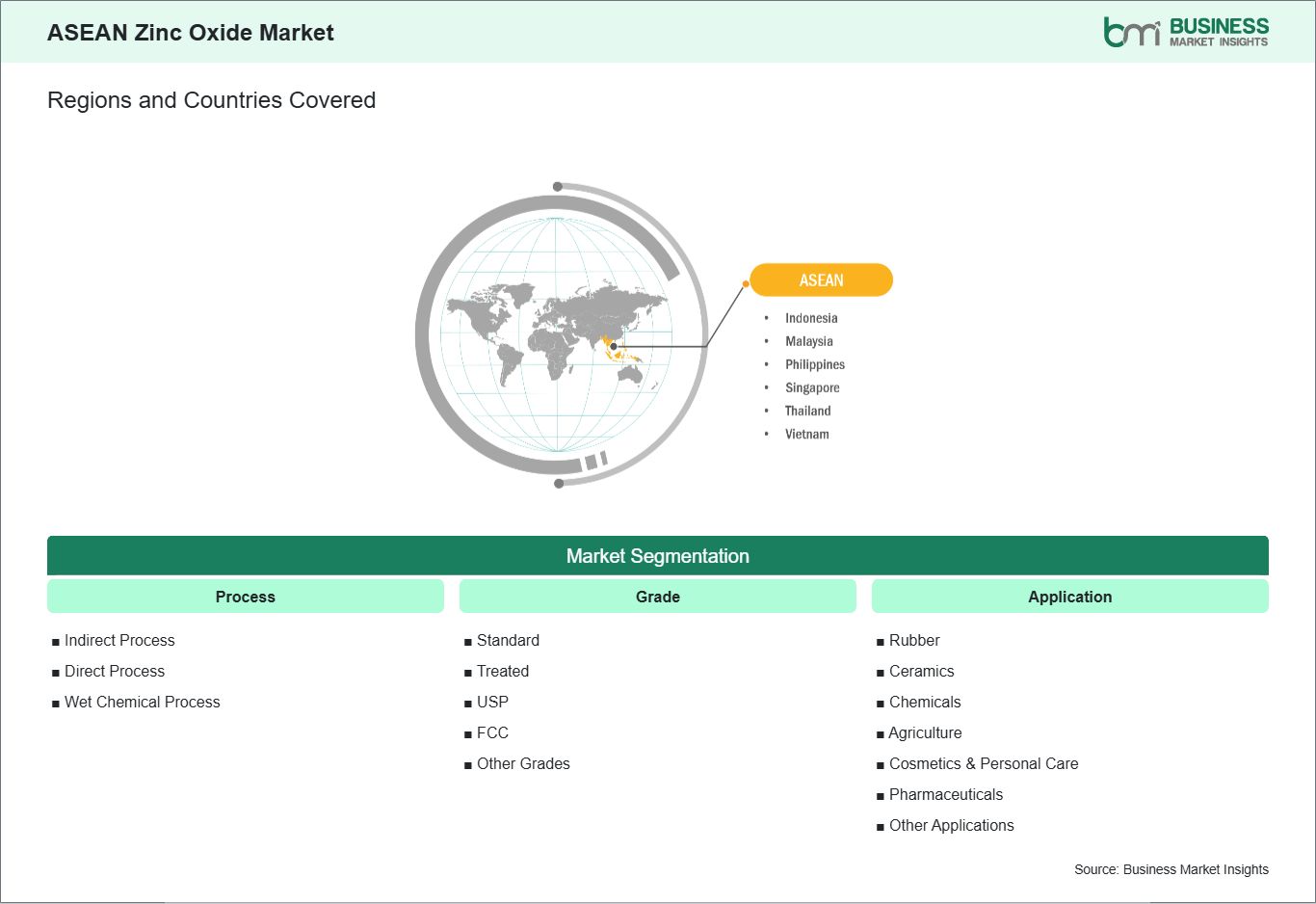
Key segments that contributed to the derivation of the ASEAN zinc oxide market analysis are process, grade, and applicaion.
The market for zinc oxide in ASEAN countries is experiencing steady growth due to the rising anti-corrosive coating industry in areas such as construction, maritime engineering, and industrial production. The Southeast Asian region experiences high humidity levels and heavy rainfall, as well as salt exposure in the coastal area, leading to rapid metal corrosion in infrastructure equipment. This means that there is an increasing demand for zinc oxide coatings to prevent corrosion in bridges, ports, industrial facilities, pipelines, and commercial structures. For instance, Indonesia is spending heavily on developing its transport system and ports, while Vietnam has been expanding its industrial zones along coastal areas.
The field of marine transport and offshore operations also plays a vital role in determining zinc oxide usage in ASEAN. The country of Singapore still ranks high among the busiest ports in the world, while Malaysia and Indonesia have continued to develop offshore oil depots and shipyard facilities. Zinc oxide is extensively employed in marine paints since it enhances protection from water, sun exposure, and corrosion. Modern coatings are preferred by manufacturers due to their cost-effectiveness in tropical weather. Increased shipping and port operations have been observed in the region because of growing trade among ASEAN countries.
The automotive industry and the metal fabricating sector continue to contribute towards market growth. Thailand and Indonesia together form a significant source of automobile manufacturing in Southeast Asia, leading to high demand for zinc oxide-coated steel products and anti-corrosive automotive parts. Zinc oxide is regularly incorporated into primers and coating materials utilized in automobiles, frames, fasteners, and galvanized steel sheets. On the other hand, ASEAN companies have been steadily adopting environmentally friendly water-based coatings, in which zinc oxide acts as an all-around additive. With industrial production constantly increasing throughout the region, it can be safely assumed that the use of zinc oxide in anti-corrosive applications will experience steady growth in the years ahead.
There are new openings for the zinc oxide market due to the rapid development of renewable energy projects in the ASEAN region, where zinc oxide can be applied in solar energy systems, energy storage technologies, and protective coatings. The Vietnamese, Thai, Malaysian, and Philippine governments are speeding up the implementation of renewable energy in order to decrease the importation of fossil fuels and increase energy security. Solar installations in the region have been rising in the last five years due to favorable policies and declining costs of photovoltaic manufacturing. Zinc oxide is applied in the production of solar panels, electronics, ceramics, and conductive layers.
Vietnam and Malaysia have become key producers for solar equipment and electronics manufacturing in Southeast Asia. Nanoparticles of zinc oxide have received much interest in photovoltaics and specialty electronics because of their unique optical properties as well as their electrical properties. Moreover, there are many Southeast Asian companies that have begun investing in highly efficient solar panels and components, thus increasing the demand for specialty zinc chemicals. Furthermore, there are many battery storage projects related to the integration of renewables that are occurring in ASEAN countries, especially on the remote islands in ASEAN nations.
The growth in renewable energy infrastructure also means that there will be greater demand for corrosion-proof coatings. The offshore wind turbines, floating solar panels, transmission towers, and energy storage centers need coatings that can endure the tropical climate and highly saline environment. Zinc oxide coatings are increasingly used since they improve the durability of structures and lower maintenance costs. Countries like Indonesia and the Philippines, which are made up of a number of islands, are implementing renewable microgrids and coastal energy infrastructure. As the ASEAN countries strive towards decarbonization and electrification, the applications of renewable energy will be one of the largest areas of consumption of zinc oxide in the region.

The ASEAN zinc oxide market is experiencing steady growth, with market size and share analysis reflecting evolving treatment preferences and competitive dynamics among key players. The report evaluates important subsegments categorized within process, grade, and application, highlighting their respective contributions to overall market performance.
By process, the indirect subsegment dominated the market in 2025, because it produces high-purity zinc oxide, which is essential for rubber, pharmaceuticals, and cosmetics. It ensures uniform particle size and better performance consistency, which industries require for quality-critical applications. Even though it is costlier than direct process, its product reliability and compliance with strict standards make it the preferred choice.
Based on grade, the standard subsegment dominated the market in 2025 due to its massive use in bulk manufacturing industries, especially rubber, ceramics, and paints. It offers a cost-effective balance between purity and performance, making it suitable for high-volume consumption. Industries prefer it because it is easily available and economically viable compared to high-purity grades.
On the basis of application, the rubber subsegment dominated the market in 2025, because zinc oxide is a key activator in vulcanization, which is essential for tire production. The global expansion of automotive and tire manufacturing directly drives demand. It improves strength, durability, and heat resistance of rubber products, making it irreplaceable. Continuous growth in mobility, logistics, and EV tires further strengthens its dominance.
| Report Attribute | Details |
|---|---|
| Market size in 2025 | US$ 456.0 Million |
| Market Size by 2033 | US$ 763.7 Million |
| CAGR (2026 - 2033) | 6.7% |
| Historical Data | 2022-2024 |
| Forecast period | 2026-2033 |
| Segments Covered | By Process
|
|
Regions and Countries Covered
| |
| ASEAN | Indonesia, Malaysia, Philippines, Singapore, Thailand, Vietnam |
| Market leaders and key company profiles |
|
The "ASEAN Zinc Oxide Market Size and Forecast (2022-2033)" report provides a detailed analysis of the market covering below areas:
The geographical scope of the ASEAN Zinc oxide market report is divided into: Indonesia, Malaysia, the Philippines, Singapore, Thailand, and Vietnam. Indonesia held the largest share in 2025.
Indonesia stands out as the most prominent country in the zinc oxide market among other countries in ASEAN, thanks to its well-developed rubber processing industry and increased automobile manufacturing capacity. The country's industrial composition creates an excellent atmosphere for high zinc oxide consumption in various industries such as tire manufacturing, footwear, conveyor belts, hoses, and industrial rubber products. Being one of the biggest natural rubber producers in the world increases the use of zinc oxide in the downstream rubber industry, where there is integration between the sourcing and processing activities. In the Indonesian country, the western parts of the country, especially Java, consume high amounts of zinc oxide because of the presence of automotive parts makers and industrial parks. There are numerous tire makers and rubber processing industries in the vicinity of Jakarta, West Java, and East Java which make high use of zinc oxide in their processes to enhance vulcanization efficiency, tensile strength, and thermal stability. Besides, the increasing two-wheelers and commercial vehicles sector is contributing immensely to local demand for zinc oxide. The zinc oxide market in Indonesia also receives support from government initiatives aimed at promoting manufacturing and reducing dependence on foreign imports of industrial intermediates. Despite this, manufacturers are still faced with difficulties that include fluctuations in the cost of raw materials, environmental compliance, and dependence on foreign technology to produce premium zinc oxide. Nonetheless, the wide industrial base and continued manufacturing growth in the country make Indonesia the largest market for zinc oxide in ASEAN.

The ASEAN zinc oxide market is evaluated by gathering qualitative and quantitative data post primary and secondary research, which includes important corporate publications, association data, and databases. A few of the key developments in the ASEAN zinc oxide market are:
The ASEAN Zinc Oxide Market is valued at US$ 456.0 Million in 2025, it is projected to reach US$ 763.7 Million by 2033.
As per our report ASEAN Zinc Oxide Market, the market size is valued at US$ 456.0 Million in 2025, projecting it to reach US$ 763.7 Million by 2033. This translates to a CAGR of approximately 6.7% during the forecast period.
The ASEAN Zinc Oxide Market report typically cover these key segments-
The historic period, base year, and forecast period can vary slightly depending on the specific market research report. However, for the ASEAN Zinc Oxide Market report:
The ASEAN Zinc Oxide Market is populated by several key players, each contributing to its growth and innovation. Some of the major players include:
The ASEAN Zinc Oxide Market report is valuable for diverse stakeholders, including:
Essentially, anyone involved in or considering involvement in the ASEAN Zinc Oxide Market value chain can benefit from the information contained in a comprehensive market report.
Please tell us your area of interest
(Market Segments/ Regions and Countries/ Companies)