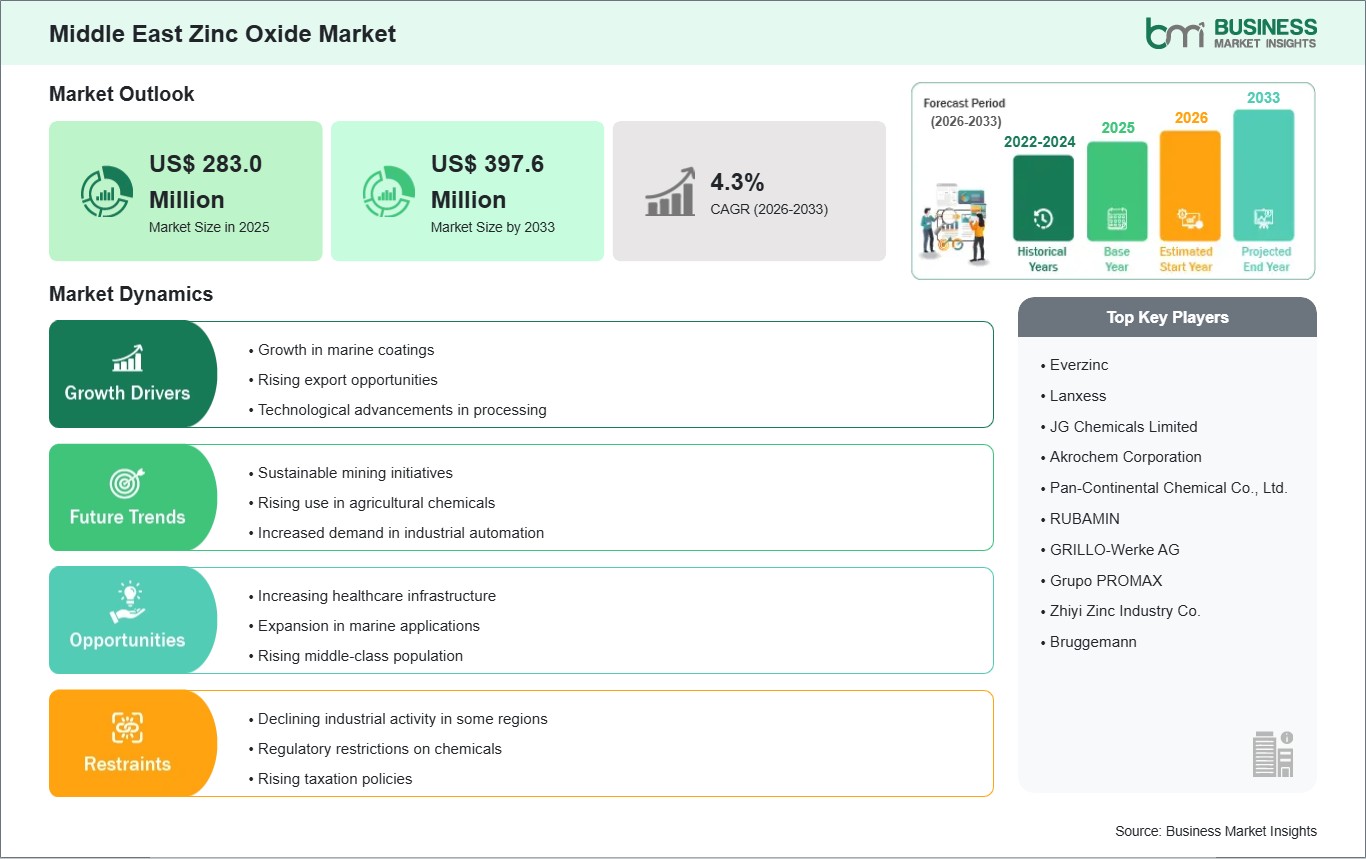
The Middle East zinc oxide market size is expected to reach US$ 397.6 million by 2033 from US$ 283.0 million in 2025. The market is estimated to record a CAGR of 4.3% from 2026 to 2033.
The Zinc Oxide in the Middle East market is affected mostly by rapid industrial diversification, construction growth, and manufacturing processes in various industries such as rubber processing, coating, ceramics, pharmaceuticals, and cosmetics. The usage of zinc oxide in the Middle East region is greatly dependent on large-scale projects, petrochemical industry growth, and local manufacture of chemicals since there is less dependency on imported finished goods. The usage of zinc oxide as a material for various applications such as anti-corrosive and UV protection makes the product very versatile in various industries. The Middle Eastern countries such as Iran, the United Arab Emirates, Saudi Arabia, and Egypt are some of the leading countries in generating demand in the Middle East region The UAE is significant in its role as a trading and re-export point for specialty chemicals, enabling the distribution of zinc oxide within the region. Diversification in the industries of Saudi Arabia and the chemical manufacturing industry of Iran act as key strengths behind regional demand. Egypt creates demand through its requirements of construction materials, ceramics, and agricultural needs. There are several weaknesses of the market including differences in industrialization levels among various nations, dependence on imports for the sourcing of raw materials in some areas, and price volatility in energy and feedstock markets. Environmental issues have gained significance lately as well.

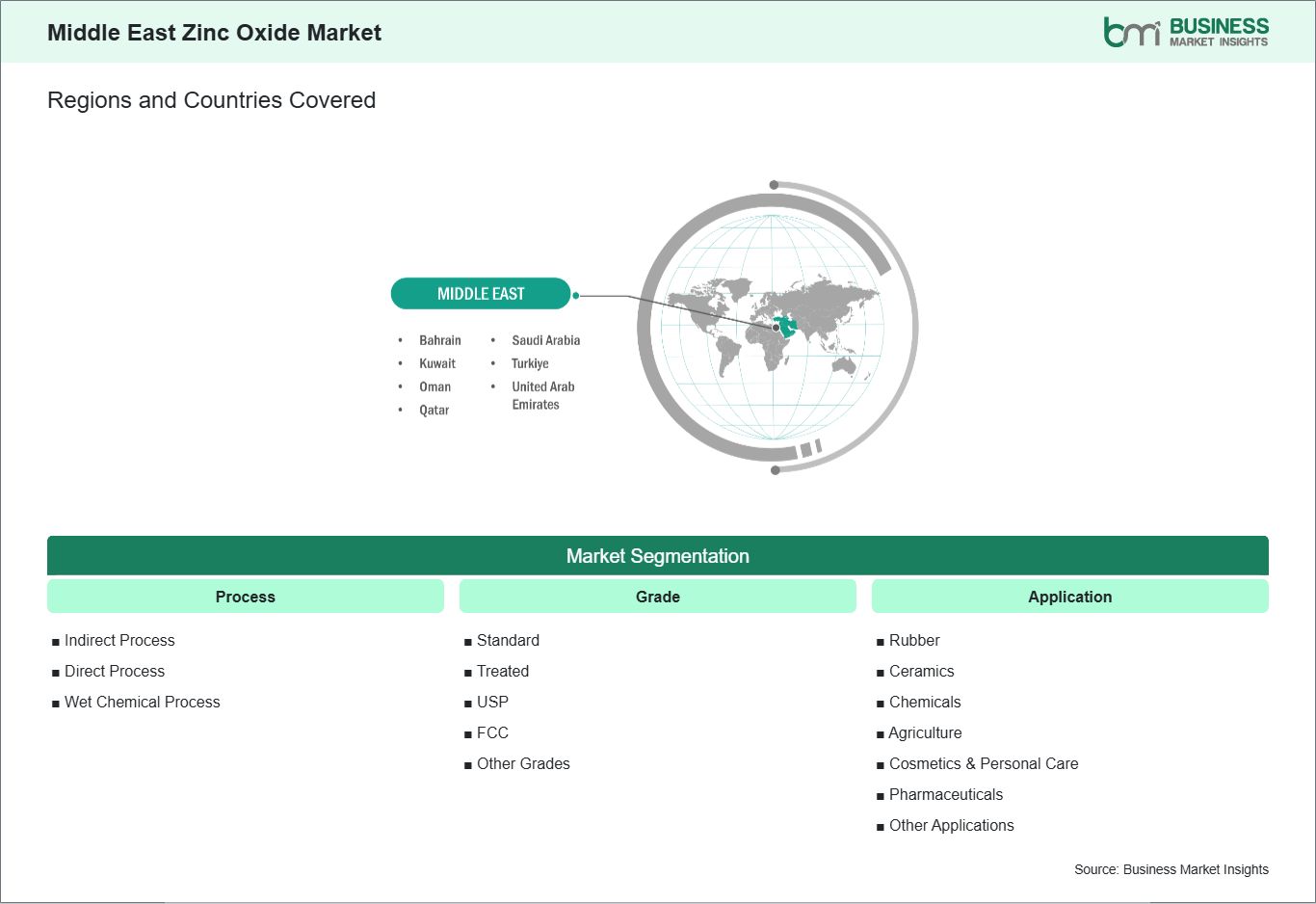
Key segments that contributed to the derivation of the Middle East zinc oxide market analysis are process, grade, and application.
The Middle East zinc oxide industry is witnessing sustained growth, owing to growing consumption of advanced marine coatings in coastal countries like UAE, Saudi Arabia, Oman, and Qatar. The proximity of the region to important shipping channels like the Strait of Hormuz and Red Sea Route ensures one of the busiest maritime business corridors in the world. Zinc oxide finds widespread application in marine coatings on account of its excellent corrosion resistance, ultraviolet light resistance, and fouling support characteristics. Such coatings help protect ships and offshore installations that are subjected to extremely saline and hot environments.
The UAE has been driving the demand for marine coatings, as witnessed by Jebel Ali port processing over 14 million TEUs per year, and continues to develop logistics capabilities. Marine coating systems incorporating zinc oxide have become increasingly popular among ship repair, offshore facilities, and oil terminal operators in Dubai and Abu Dhabi to increase their lifespan and maintenance cycle times. Similarly, investments in marine transportation in Saudi Arabia under Vision 2030, including the development of new ports in the Red Sea coast, has resulted in rising demand for corrosion-resistant coatings. The growing number of offshore oil platforms and desalination plants in Saudi Arabia will further drive the use of zinc oxide in marine applications.
In addition, market growth in the Gulf Cooperation Council (GCC) states of Oman and Qatar is fueled by port construction and LNG export facilities. The construction of the Duqm port in Oman and the expansion of the North Field natural gas facility in Qatar has resulted in increased demand for marine coatings to protect equipment and offshore facilities from deterioration. Given that harsh climatic conditions in the Middle East, such as heat, sand, and saltwater exposure, contribute to accelerated coating wear, zinc oxide has become steadly growing market in the region.
The Middle East zinc oxide market is also experiencing growth on account of growing investments made by governments of Gulf Cooperation Council (GCC) nations as well as other regional economies like Egypt, Jordan, and Iraq in developing healthcare infrastructures. Hospitals, specialty clinics, pharmaceutical production facilities, and medical tourism hubs have been set up in large numbers. Zinc oxide has several applications in the healthcare industry due to its antimicrobial, soothing, and protective nature. This material can be found in dermatological creams, wound healing products, antiseptic ointments, and medical coatings among others. Increased healthcare spending in the region is driving the demand for zinc oxide-based products.
Saudi Arabia is a major investor in the healthcare industry and is witnessing constant growth in its hospital network owing to the Vision 2030 plan. Healthcare mega projects being developed in Riyadh, Jeddah, and NEOM are driving demand for advanced medical products such as zinc oxide-based topical solutions and disinfectants. In the UAE, Dubai and Abu Dhabi are emerging as major medical tourism destinations and thus driving the demand for high-quality skincare and pharmaceutical-grade creams and medical products which contain zinc oxide.
Other nations such as Egypt, Jordan, and Kuwait are adopting a more modernized approach to their healthcare systems through public-private partnerships and new hospital projects. Egypt, which has a massive population base of more than 100 million people, is producing and importing more pharmaceutical ointments and hygiene products with zinc oxide. The pharmaceutical manufacturing industry in Jordan is growing its export business within the Middle East and Africa. With the increase in awareness about hygiene, protecting skin from infections, and infections in the Middle Eastern region, zinc oxide finds itself more commonly used in the field of medicine and healthcare.

The Middle East zinc oxide market is experiencing steady growth, with market size and share analysis reflecting evolving treatment preferences and competitive dynamics among key players. The report evaluates important subsegments categorized within process, grade, and application, highlighting their respective contributions to overall market performance.
By process, the indirect subsegment dominated the market in 2025, because it produces high-purity zinc oxide, which is essential for rubber, pharmaceuticals, and cosmetics. It ensures uniform particle size and better performance consistency, which industries require for quality-critical applications. Even though it is costlier than direct process, its product reliability and compliance with strict standards make it the preferred choice.
Based on grade, the standard subsegment dominated the market in 2025 due to its massive use in bulk manufacturing industries, especially rubber, ceramics, and paints. It offers a cost-effective balance between purity and performance, making it suitable for high-volume consumption. Industries prefer it because it is easily available and economically viable compared to high-purity grades.
On the basis of application, the rubber subsegment dominated the market in 2025, because zinc oxide is a key activator in vulcanization, which is essential for tire production. The global expansion of automotive and tire manufacturing directly drives demand. It improves strength, durability, and heat resistance of rubber products, making it irreplaceable. Continuous growth in mobility, logistics, and EV tires further strengthens its dominance.
| Report Attribute | Details |
|---|---|
| Market size in 2025 | US$ 283.0 Million |
| Market Size by 2033 | US$ 397.6 Million |
| CAGR (2026 - 2033) | 4.3% |
| Historical Data | 2022-2024 |
| Forecast period | 2026-2033 |
| Segments Covered | By Process
|
|
Regions and Countries Covered
| |
| Middle East | UAE, Saudi Arabia, Bahrain, Oman, Kuwait, Qatar, Turkiye |
| Market leaders and key company profiles |
|
The "Middle East Zinc Oxide Market Size and Forecast (2022-2033)" report provides a detailed analysis of the market covering below areas:
The geographical scope of the Middle East zinc oxide market report is divided into: the UAE, Saudi Arabia, Bahrain, Oman, Kuwait, Qatar, and Turkiye. Turkiye held the largest share in 2025.
Turkiye holds dominance in the Middle East zinc oxide market due to its diverse industrial structure, manufacturing capabilities, and favorable geographic location connecting Europe, Asia, and the Middle East. It features an advanced chemical and industrial processing system that allows for efficient production and utilization of zinc oxide in several applications such as rubber manufacturing, automotive parts, ceramics, coatings, and medicines. The automotive and tire manufacturing industry in Turkiye is one of the reasons behind high demand for zinc oxide in the region. Several factories manufacture tires and automotive parts not only for domestic consumption but also for export to other countries in Europe and the Middle East. The use of zinc oxide in tire vulcanization increases their flexibility and heat resistance. Furthermore, Turkiye’s construction and infrastructure sector is an important player in the consumption of zinc oxide. Fast-paced urbanization, growth of industrial zones, and massive residential housing projects lead to the use of zinc oxide in paints, ceramics, cement admixtures, and corrosion-resistant building materials. The ceramics industry of Turkiye, which operates prominently in provinces such as Kütahya and Bilecik, is another vital consumer of zinc oxide in specialty applications where the material increases glazing and product longevity. Moreover, there has been a significant rise in the number of pharmaceutical and cosmetics manufacturers in the country, resulting in increased consumption of zinc oxide for applications in creams, sunscreen lotions, and medical ointments. This factor can be attributed to Turkiye’s increasing export-oriented production of personal care products. Challenges faced by the market include reliance on imports of zinc raw materials, variations in energy prices, currency fluctuations, and strict environmental regulations in the chemical and metallurgical sectors.

The Middle East Zinc oxide market is evaluated by gathering qualitative and quantitative data post primary and secondary research, which includes important corporate publications, association data, and databases. A few of the key developments in the Middle East Zinc oxide market are:
The Middle East Zinc Oxide Market is valued at US$ 283.0 Million in 2025, it is projected to reach US$ 397.6 Million by 2033.
As per our report Middle East Zinc Oxide Market, the market size is valued at US$ 283.0 Million in 2025, projecting it to reach US$ 397.6 Million by 2033. This translates to a CAGR of approximately 4.3% during the forecast period.
The Middle East Zinc Oxide Market report typically cover these key segments-
The historic period, base year, and forecast period can vary slightly depending on the specific market research report. However, for the Middle East Zinc Oxide Market report:
The Middle East Zinc Oxide Market is populated by several key players, each contributing to its growth and innovation. Some of the major players include:
The Middle East Zinc Oxide Market report is valuable for diverse stakeholders, including:
Essentially, anyone involved in or considering involvement in the Middle East Zinc Oxide Market value chain can benefit from the information contained in a comprehensive market report.
Please tell us your area of interest
(Market Segments/ Regions and Countries/ Companies)