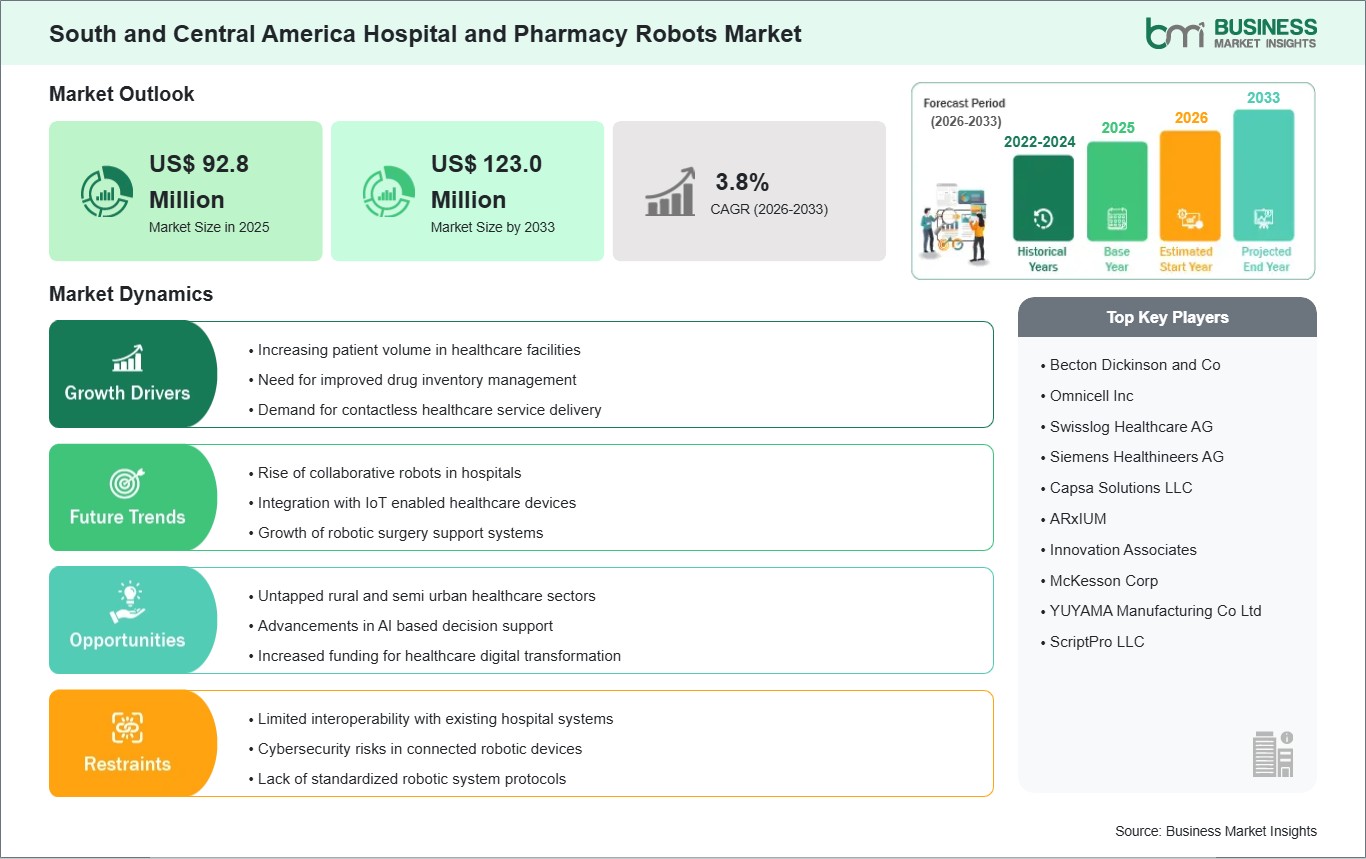
The South and Central America hospital and pharmacy robots market size is expected to reach US$ 123.0 million by 2033 from US$ 92.8 million in 2025. The market is estimated to record a CAGR of 3.8 % from 2026 to 2033.
The hospital and pharmacy robotics market in South and Central America is gradually transitioning from experimental adoption to broader operational integration. Hospitals and healthcare systems across the region are increasingly seeking ways to improve workflow efficiency, enhance patient safety, and optimize staff utilization. Robotics in this context covers a range of applications, including autonomous delivery robots for internal logistics, automated pharmacy dispensing systems, and support tools for medication management and inventory control. Early adopters are primarily large urban hospitals and private healthcare networks, which have the infrastructure and financial capacity to pilot robotic solutions. These systems help reduce manual handling of medications and supplies, which in turn minimizes human error and enhances regulatory compliance. Beyond logistical support, robotics is being explored as a tool to reduce repetitive administrative tasks, such as sorting, labeling, and tracking medications, thereby freeing pharmacists and nurses to focus on direct patient care. Integration with hospital information systems is becoming a key requirement, enabling real-time tracking of inventory and predictive replenishment. From an operational perspective, robotics provides measurable benefits, such as reduced waiting times for patients, more accurate medication distribution, and consistent adherence to protocols. However, adoption is still uneven across the region due to differences in healthcare infrastructure, staff readiness, and financial resources. Public hospitals often face challenges in allocating budget for high-cost technology and training personnel, whereas private facilities prioritize efficiency and differentiation in patient care as motivators for robotic implementation. In addition, institutions are increasingly aware of the importance of staff training and workflow redesign to ensure that robotics solutions complement rather than disrupt existing operations. Strategic partnerships with technology providers are becoming essential to provide ongoing maintenance, staff training, and technical support, which fosters confidence among hospital administrators. The executive analysis indicates that robotics adoption is steadily growing, driven by a combination of operational efficiency goals, patient safety imperatives, and evolving expectations for healthcare service quality. While the market remains in its early stages, these developments suggest a foundation for sustainable growth as technology becomes more accessible and integrated into routine healthcare operations.

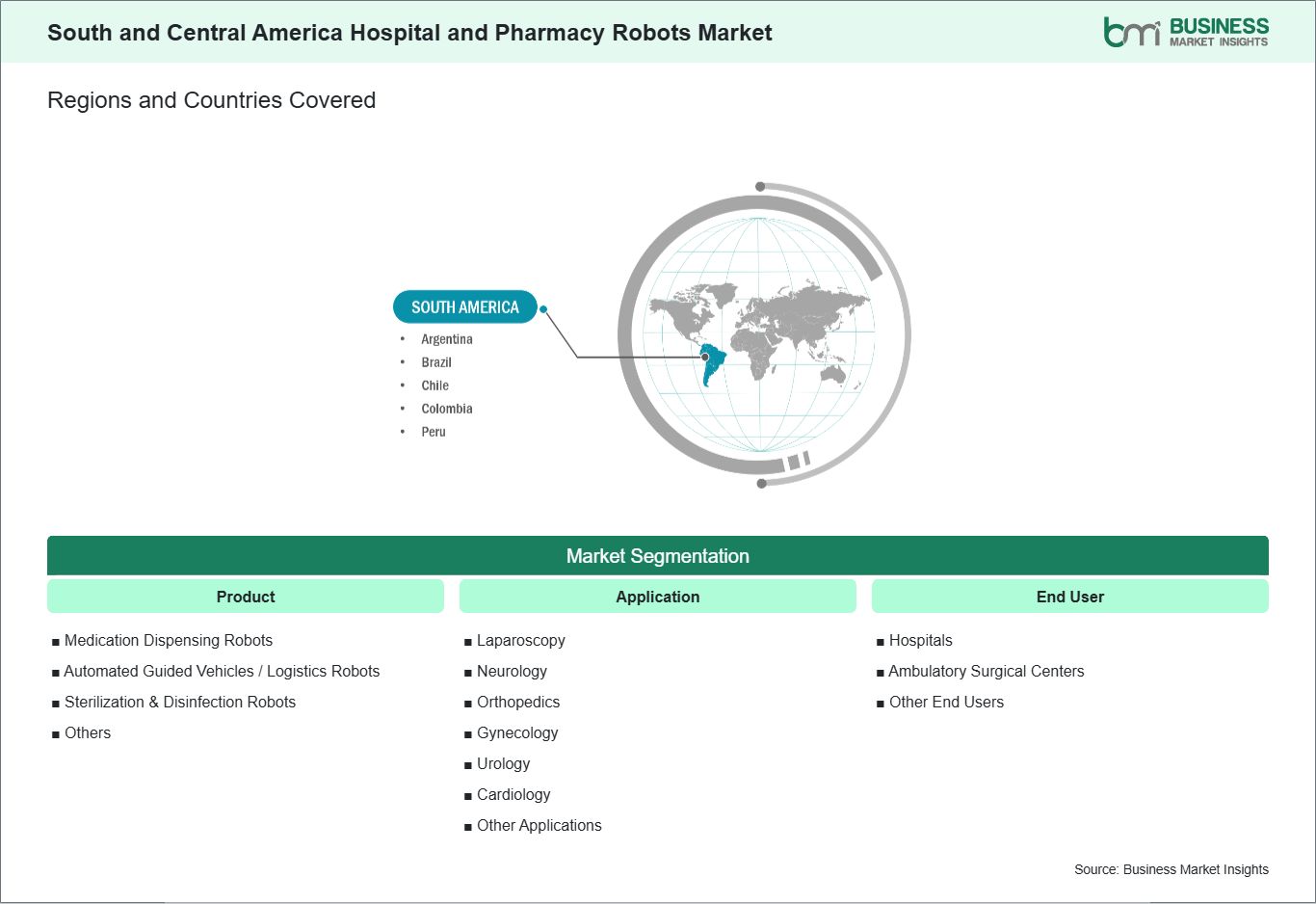
Key segments that contributed to the derivation of the South and Central America hospital and pharmacy robots market analysis are product, application, and end user.
The South and Central American healthcare landscape is witnessing a steady rise in the adoption of robotics due to rapid technological advancements. In Brazil, for example, hospitals in São Paulo are increasingly experimenting with autonomous delivery robots capable of navigating complex hospital layouts to transport medications, laboratory samples, and supplies. These robots are integrated with hospital information systems, allowing real-time tracking and route optimization. The expansion of AI-driven navigation, sensor technology, and predictive analytics has enhanced the ability of robots to operate reliably in dynamic hospital environments, reducing dependency on human staff for repetitive logistics tasks. This development is particularly valuable in large urban hospitals where high patient volumes require precise scheduling and timely delivery of critical materials. Additionally, robotics innovations in pharmacy operations, such as automated dispensing systems and inventory monitoring, have improved accuracy and minimized the risk of medication errors, aligning with global patient safety standards. In Mexico, robotics advancements are being directed toward optimizing pharmacy workflows and streamlining medication distribution. Autonomous robots are now capable of sorting, labeling, and preparing prescriptions for patients, significantly reducing waiting times and minimizing errors. Integration with electronic health records ensures that pharmacists can monitor medication stocks and patient compliance efficiently. Central American countries, such as Costa Rica and Panama, are beginning to adopt robotics for smaller-scale, targeted applications. In Costa Rica, autonomous robots are used in private hospitals to transport medications and laboratory samples across multiple floors, reducing delivery time and optimizing staff efficiency. Meanwhile, in Panama, pilot programs for robotic pharmacy assistants are being introduced in urban clinics to support inventory control and secure medication dispensing. These initiatives demonstrate how technological progress in robotics is gradually extending to mid-sized healthcare facilities, offering scalable solutions that balance cost and operational efficiency. Rapid advancements in robotics technologies are enabling hospitals and pharmacies across the region to enhance productivity, reduce human error, and create safer care environments.
Next-generation hospital robots are beginning to redefine operational workflows in South and Central American healthcare facilities. In Brazil, hospitals are piloting advanced robots equipped with artificial intelligence for predictive supply chain management. These robots can anticipate medication shortages, adjust delivery schedules, and communicate with pharmacy management systems to maintain optimal stock levels. The integration of autonomous mobile robots (AMRs) with real-time hospital data enables dynamic task prioritization, which is particularly beneficial in high-volume hospitals in Rio de Janeiro and Brasília. Such capabilities not only improve operational efficiency but also enhance patient safety by ensuring timely access to critical medications and supplies. The deployment of smart navigation systems allows these robots to adapt to crowded hospital corridors and avoid obstacles in real-time, improving reliability and reducing interruptions in hospital operations. Additionally, these robots are increasingly integrated with hospital information systems, providing administrators with actionable insights on task efficiency, operational bottlenecks, and staff performance metrics. In Central America, countries like Chile and Panama are exploring next-generation pharmacy robots with enhanced automation and safety features. In Santiago, Chile, private hospital networks are introducing robotic systems capable of secure medication compounding, precise dosage management, and controlled storage. These robots integrate with barcoding and RFID systems to ensure error-free dispensing and real-time inventory tracking. Similarly, in Panama City, advanced robotic pharmacy assistants are being tested for their ability to handle high patient loads, minimize human contact, and maintain rigorous hygiene standards. These next-generation systems are designed with scalability in mind, allowing smaller hospitals to gradually expand automation while maintaining patient safety and operational efficiency. Collectively, these developments signal a shift toward highly integrated, intelligent robotic solutions that transform traditional hospital and pharmacy operations across South and Central America.

The South and Central America hospital and pharmacy robots market demonstrates steady growth, with size and share analysis highlighting evolving trends and competitive dynamics among key players. The report examines subsegments categorized within product, application, and end user, offering insights into their contribution to overall market performance.
By product, the medication dispensing robots subsegment dominated the market in 2025, driven by the increasing demand for accurate, efficient, and error-free pharmacy operations in hospitals and clinics across South and Central America.
In terms of application, the laparoscopy subsegment dominated the market in 2025, driven by rising adoption of minimally invasive surgical procedures and the need for precision and reduced patient recovery times.
Based on end user, the hospitals subsegment dominated the market in 2025, driven by the growing focus on improving operational efficiency, patient safety, and automation of routine clinical and logistical tasks.
| Report Attribute | Details |
|---|---|
| Market size in 2025 | US$ 92.8 Million |
| Market Size by 2033 | US$ 123.0 Million |
| CAGR (2026 - 2033) | 3.8% |
| Historical Data | 2022-2024 |
| Forecast period | 2026-2033 |
| Segments Covered | By Product
|
|
Regions and Countries Covered
| |
| South and Central America | Brazil, Argentina, Peru, Chile, Colombia |
| Market leaders and key company profiles |
|
The "South and Central America Hospital and Pharmacy Robots Market Size and Forecast (2022–2033)" report provides a detailed analysis of the market covering below areas:
The geographical scope of the South and Central America Hospital and Pharmacy Robots Market report is divided into into Brazil, Argentina, Peru, Chile, and Colombia. Brazil held the largest share in 2025.
In the South and Central America hospital and pharmacy robots market, Brazil emerges as the dominant country with the largest share, driven by its well-established healthcare infrastructure, concentration of large urban hospitals, and early adoption of advanced automation technologies. Leading hospitals in São Paulo, Rio de Janeiro, and Brasília are increasingly implementing autonomous delivery systems, robotic pharmacy assistants, and surgical support robots to improve workflow efficiency, reduce medication errors, and enhance patient safety. Brazil’s market leadership is further supported by a growing network of private healthcare providers willing to invest in high-cost technology to optimize clinical operations and differentiate patient services. Argentina is gradually advancing in robotics adoption, with major urban hospitals in Buenos Aires and Córdoba integrating pharmacy automation solutions and robotic support in laboratory and logistics functions. Hospitals in Argentina are particularly focused on improving medication handling accuracy and streamlining internal transport systems, which helps address staff shortages and operational inefficiencies in both public and private sectors. In Peru, adoption is concentrated in larger metropolitan hospitals, particularly in Lima, where pilot programs for autonomous delivery and pharmacy dispensing robots are being tested to improve turnaround times and support clinical staff. The focus in Peru is on scalable solutions that can be gradually expanded across regional hospitals while maintaining cost-effectiveness. Chile is emerging as a key market for pharmacy automation and precision surgical robots, with private hospitals in Santiago and Valparaíso exploring systems capable of secure medication dispensing, inventory management, and minimally invasive surgical assistance. Chilean hospitals are prioritizing patient safety and operational efficiency, ensuring that robotics solutions are integrated with existing hospital management systems to maximize effectiveness. Colombia has witnessed increasing interest in hospital robotics, particularly in Bogotá and Medellín, where healthcare institutions are piloting robots for medication delivery, laboratory transport, and repetitive logistical tasks. Colombian hospitals emphasize solutions that improve workflow standardization and reduce manual errors while remaining adaptable to mid-sized healthcare facilities. The regional market reflects a diverse adoption landscape, with Brazil leading in scale and technological maturity, while Argentina, Peru, Chile, and Colombia are gradually investing in robotics to improve clinical efficiency, operational workflows, and patient safety. The market in these countries is poised for steady growth as hospitals continue to integrate robotics into daily operations and expand their focus on automation-driven healthcare solutions.

The South and Central America Hospital and Pharmacy Robots Market is evaluated by gathering qualitative and quantitative data post primary and secondary research, which includes important corporate publications, association data, and databases. A few of the key developments in the South and Central America hospital and pharmacy robots market are:
The South and Central America Hospital and Pharmacy Robots Market is valued at US$ 92.8 Million in 2025, it is projected to reach US$ 123.0 Million by 2033.
As per our report South and Central America Hospital and Pharmacy Robots Market, the market size is valued at US$ 92.8 Million in 2025, projecting it to reach US$ 123.0 Million by 2033. This translates to a CAGR of approximately 3.8% during the forecast period.
The South and Central America Hospital and Pharmacy Robots Market report typically cover these key segments-
The historic period, base year, and forecast period can vary slightly depending on the specific market research report. However, for the South and Central America Hospital and Pharmacy Robots Market report:
The South and Central America Hospital and Pharmacy Robots Market is populated by several key players, each contributing to its growth and innovation. Some of the major players include:
The South and Central America Hospital and Pharmacy Robots Market report is valuable for diverse stakeholders, including:
Essentially, anyone involved in or considering involvement in the South and Central America Hospital and Pharmacy Robots Market value chain can benefit from the information contained in a comprehensive market report.
Please tell us your area of interest
(Market Segments/ Regions and Countries/ Companies)