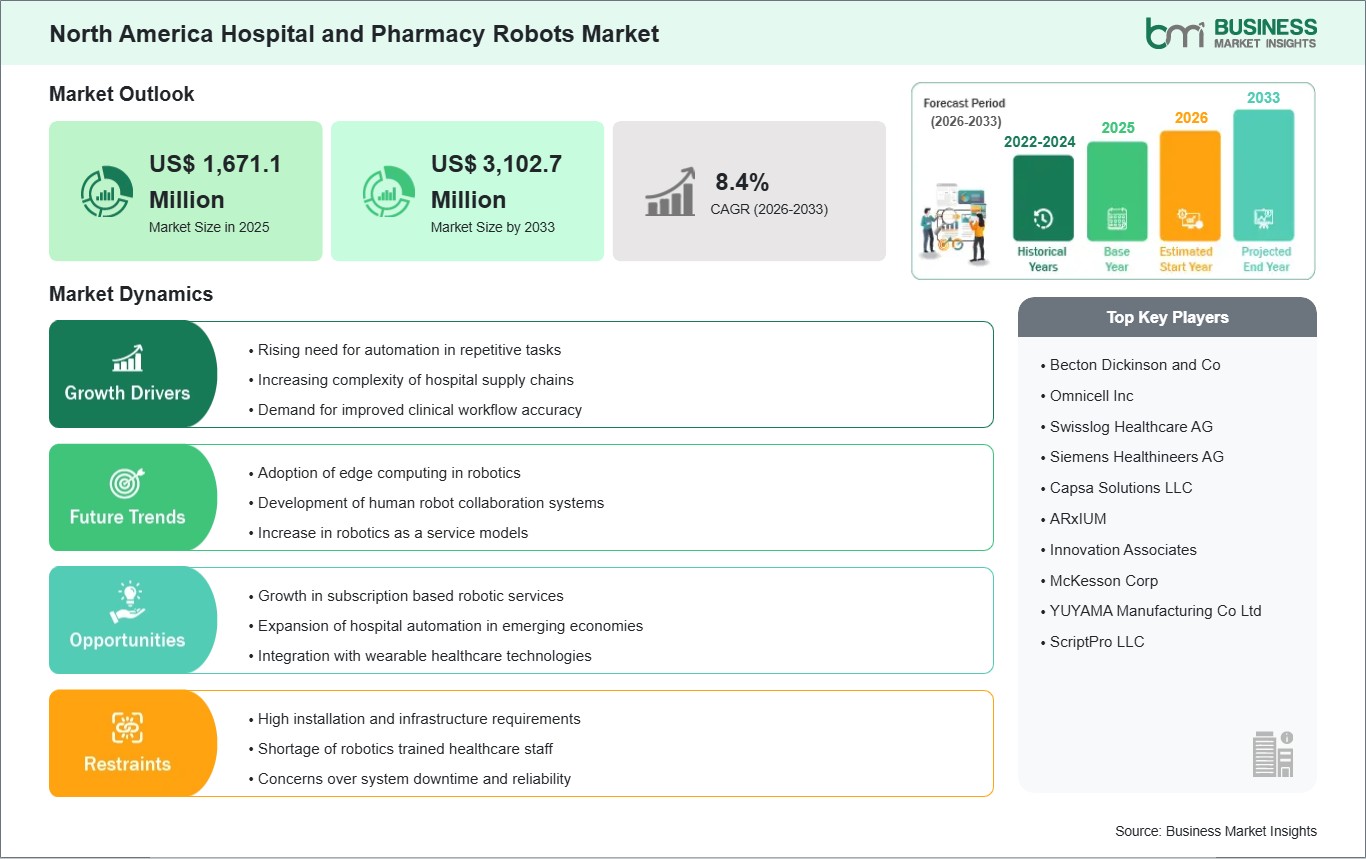
The North America hospital and pharmacy robots market size is expected to reach US$ 3,102.7 million by 2033 from US$ 1,671.1 million in 2025. The market is estimated to record a CAGR of 8.4 % from 2026 to 2033.
The North America hospital and pharmacy robots market is experiencing a transformative shift as healthcare facilities increasingly adopt robotic solutions to enhance efficiency, patient safety, and operational accuracy. The region is witnessing growing integration of automated systems in both hospital and pharmacy settings, driven by a need to reduce human error in medication dispensing and streamline repetitive tasks such as delivery of supplies and instruments. Hospitals are leveraging robotic solutions not only for logistics and pharmacy automation but also for diagnostic support, surgical assistance, and patient monitoring, creating a multifaceted value proposition. A significant factor influencing adoption is the increasing prevalence of chronic diseases and an aging population, which heightens demand for reliable, high-precision robotic operations. Operational efficiency remains a primary driver in hospitals deploying robotic solutions. Pharmacy robots, for instance, are used to manage inventory, track drug expiration dates, and ensure precise dosage preparation, minimizing the risk of adverse events caused by human error. In surgical environments, collaborative robots (cobots) are complementing clinicians’ capabilities, reducing procedure times, and improving recovery outcomes. Additionally, hospitals are exploring artificial intelligence (AI)-enabled robots that assist in patient interaction and remote monitoring, optimizing workflows in high-pressure environments. The increasing focus on reducing operational costs, improving staff productivity, and maintaining regulatory compliance in healthcare settings has made robotic solutions more appealing. Technological advancements in robotics, including machine learning, computer vision, and natural language processing, are enabling more intuitive and adaptable systems that integrate seamlessly with existing hospital information systems. Healthcare institutions are also investing in staff training programs to ensure effective utilization of robotic solutions, addressing initial resistance and operational challenges. Furthermore, collaborations between robotics manufacturers, hospital networks, and research institutions are fostering innovation in modular robotic designs and enhanced automation protocols. As the healthcare industry in North America continues to evolve toward a technology-driven model, the hospital and pharmacy robotics market is expected to play a central role in redefining operational standards, improving patient care quality, and shaping the future of healthcare service delivery.

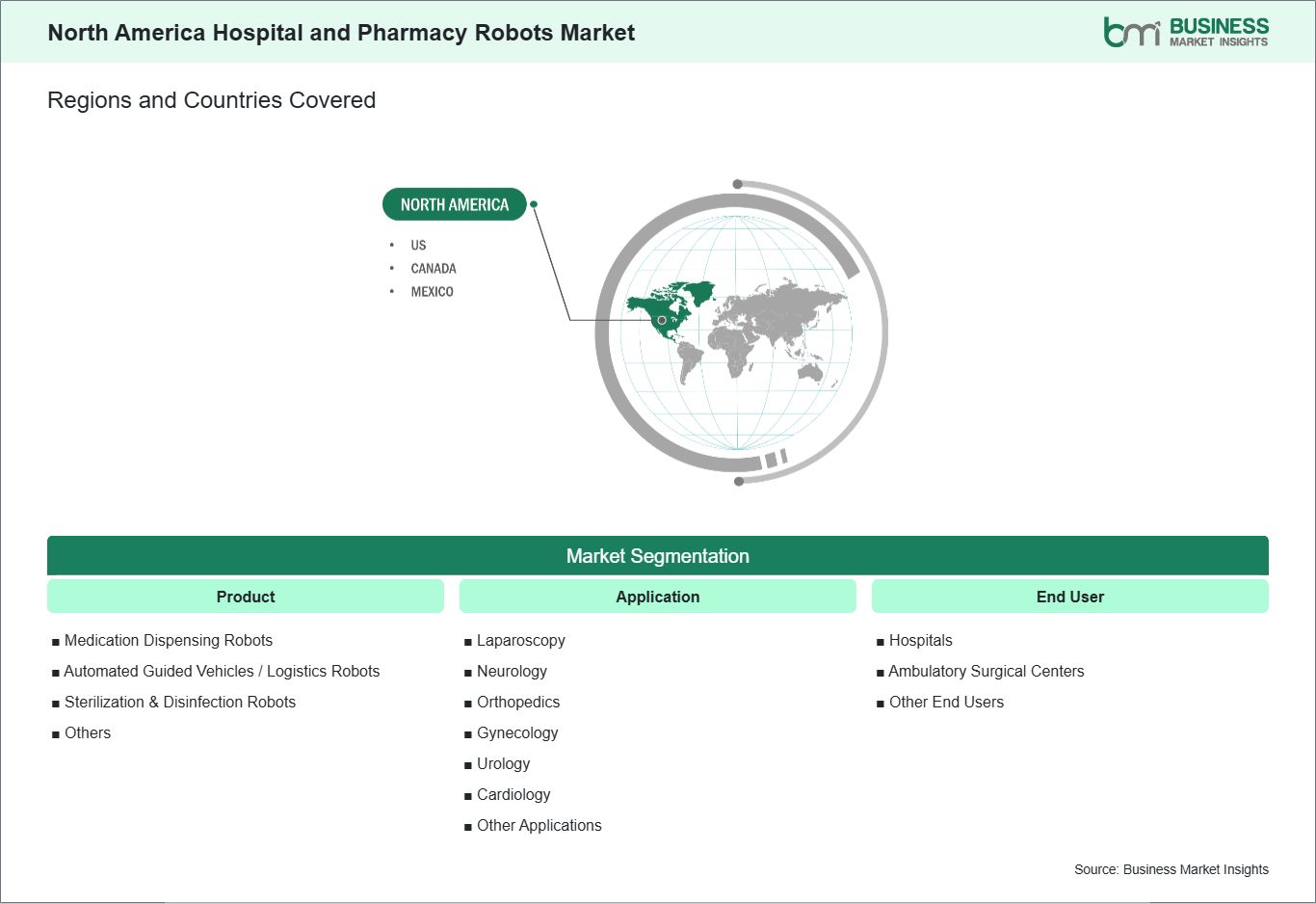
Key segments that contributed to the derivation of the North America hospital and pharmacy robots market analysis are product, application, and end user.
The North American hospital and pharmacy robots market is undergoing significant transformation driven by an accelerated demand for contactless healthcare operations. With the United States and Canada emphasizing stringent infection control protocols and operational resilience, healthcare providers are increasingly adopting robotic solutions to minimize direct human interaction across clinical and pharmacy functions. In high‑density hospital networks, such as those in metropolitan regions like New York, Los Angeles, Toronto, and Vancouver, automated systems for medication dispensing, sanitation, and internal logistics are being integrated to reduce touchpoints that could facilitate pathogen transmission. This shift is not only a response to episodic public health crises but a strategic move toward strengthening everyday clinical safety and workflow continuity. Region‑specific healthcare infrastructure dynamics further reinforce the adoption of contactless technologies. In the U.S., large integrated delivery networks and academic medical centers are prioritizing robotics investments to enhance operational capacity while addressing chronic workforce shortages in support roles. Hospitals are deploying AI‑enabled pharmacy robots that interface with electronic health records (EHRs) to reconcile prescriptions with inventory data without manual intervention. Meanwhile, in Canada, provincial health authorities are piloting contactless delivery bots within community hospitals to serve remote and rural populations, where minimizing unnecessary staff movement preserves both human capital and service quality. These localized examples illustrate how healthcare systems are tailoring robotics deployment to align with regional priorities, population health profiles, and resource constraints. Beyond infection prevention, contactless healthcare operations are also valued for bolstering accuracy and throughput. Automated dispensing and transport systems reduce human error in medication handling—a leading concern in both U.S. and Canadian patient safety initiatives. As North American providers pursue value‑based care models that incentivize quality and efficiency, contactless robotics are positioned as essential enablers of cost containment and enhanced clinical outcomes. This confluence of safety expectations, workforce optimization, and performance measurement frameworks is expected to sustain strong demand for contactless healthcare robotics throughout the region.
Autonomous robots performing intra‑hospital medicine deliveries are emerging as a core component of operational modernization strategies within North American healthcare systems. In major U.S. markets—such as Chicago, Houston, and Boston—large teaching hospitals and tertiary care centers have adopted autonomous mobile robots (AMRs) to relieve clinical staff of repetitive delivery tasks. By navigating complex hospital layouts, interfacing with lift systems, and coordinating with pharmacy workflow software, these robots improve the timeliness and reliability of medication distribution. The result is a more predictable supply chain within dynamic care environments where delays can compromise patient outcomes. The geography and scale of healthcare delivery in North America uniquely influence how autonomous delivery robots are deployed. In the American context, multi‑campus hospital systems leverage these robots to standardize delivery protocols across facilities, enabling centralized pharmacy operations to serve satellite clinics and wings. This is particularly evident in hospital groups operating in Texas and Florida, where high patient volumes and sprawling campuses make manual deliveries inefficient. Conversely, Canadian hospitals in provinces such as Ontario and Alberta are integrating autonomous medicine delivery robots with provincial e‑health frameworks, allowing real‑time tracking of medication fulfillment from pharmacy to point‑of‑care. These regional strategies underscore how autonomous robotics are adapted to different regulatory, technological, and logistical landscapes across North America. Operational performance improvements are among the most cited benefits of autonomous medicine delivery. North American providers report measurable reductions in turnaround time for medication orders, increased adherence to scheduled administration windows, and enhanced staff productivity. By reallocating pharmacists and nursing staff away from routine transport duties, hospitals can focus skilled personnel on direct patient care and clinical decision support. In an environment where healthcare systems face pressure to improve quality while managing rising costs, autonomous delivery robots are increasingly regarded as strategic assets that deliver both operational and economic value. The continued evolution of robotics navigation, fleet management, and integration with digital health systems will likely reinforce their role in North American hospital workflows.
The North America hospital and pharmacy robots market demonstrates steady growth, with size and share analysis highlighting evolving trends and competitive dynamics among key players. The report examines subsegments categorized within product, application, and end user, offering insights into their contribution to overall market performance.
By product, the medication dispensing robots subsegment dominated the market in 2025, driven by the growing need in North American healthcare facilities and retail pharmacies for automated systems that enhance dispensing accuracy, reduce medication errors, streamline workflow, and improve overall operational efficiency.
In terms of application, the laparoscopy subsegment dominated the market in 2025, driven by the increasing preference for minimally invasive surgical procedures in hospitals across North America, which reduce patient recovery time, lower complication risks, and support higher procedural precision through robotic assistance.
Based on end user, the hospitals subsegment dominated the market in 2025, driven by substantial investments in advanced robotic technologies aimed at improving patient outcomes, optimizing surgical and pharmacy operations, and addressing the rising demand for efficient, high-quality healthcare services across the region.
| Report Attribute | Details |
|---|---|
| Market size in 2025 | US$ 1,671.1 Million |
| Market Size by 2033 | US$ 3,102.7 Million |
| CAGR (2026 - 2033) | 8.4% |
| Historical Data | 2022-2024 |
| Forecast period | 2026-2033 |
| Segments Covered | By Product
|
|
Regions and Countries Covered
| |
| North America | US, Canada, Mexico |
| Market leaders and key company profiles |
|
The "North America Hospital and Pharmacy Robots Market Size and Forecast (2022–2033)" report provides a detailed analysis of the market covering below areas:
The geographical scope of the North America Hospital and Pharmacy Robots Market report is divided into US, Canada, and Mexico. US held the largest share in 2025.
The North America region, comprising the United States, Canada, and Mexico, represents a highly developed and economically integrated market with strong industrial capabilities, advanced infrastructure, and significant consumer demand across multiple sectors. Among these countries, the United States stands as the dominant country in the region, holding the largest share of economic activity, technological innovation, and market influence. The U.S. benefits from a highly diversified economy, strong purchasing power, extensive research and development capabilities, and the presence of major multinational corporations, which collectively drive innovation, production, and consumption across numerous industries. Its advanced logistics network, digital infrastructure, and strong financial ecosystem further support business expansion and cross-border trade throughout North America. Canada contributes a stable and well-regulated economic environment supported by strong natural resources, high standards of living, and well-developed trade relationships with the United States. The country’s economy benefits from sectors such as energy, mining, forestry, advanced manufacturing, and technology, while government policies emphasizing sustainability, innovation, and foreign investment continue to support long-term economic growth. Canada also maintains a highly skilled workforce and strong regulatory frameworks, making it an attractive location for both domestic and international businesses seeking stability and predictable operating conditions. Mexico plays a critical role within the North American region as a key manufacturing and export hub, benefiting from cost-competitive labor, expanding industrial infrastructure, and close trade integration with the United States and Canada through regional trade agreements. The country has developed strong capabilities in industries such as automotive manufacturing, electronics production, consumer goods, and industrial components. Mexico’s strategic geographic position allows it to serve as an efficient production base for companies targeting the broader North American market, while continued investments in industrial parks, logistics networks, and export-oriented manufacturing facilities strengthen its competitiveness. Additionally, ongoing nearshoring trends have increased the attractiveness of Mexico for companies seeking to relocate supply chains closer to the United States, which is expected to further enhance industrial growth and foreign investment in the country. Across the region, strong cross-border trade, integrated supply chains, and collaborative economic policies continue to support overall market expansion. The United States remains the primary driver of demand and innovation, while Canada and Mexico complement the regional ecosystem through resource strength, manufacturing capabilities, and strategic trade relationships. Together, these three economies form a balanced and interconnected regional market characterized by high consumption capacity, advanced production capabilities, and strong international trade influence.

The North America Hospital and Pharmacy Robots Market is evaluated by gathering qualitative and quantitative data post primary and secondary research, which includes important corporate publications, association data, and databases. A few of the key developments in the North America hospital and pharmacy robots market are:
The North America Hospital and Pharmacy Robots Market is valued at US$ 1,671.1 Million in 2025, it is projected to reach US$ 3,102.7 Million by 2033.
As per our report North America Hospital and Pharmacy Robots Market, the market size is valued at US$ 1,671.1 Million in 2025, projecting it to reach US$ 3,102.7 Million by 2033. This translates to a CAGR of approximately 8.4% during the forecast period.
The North America Hospital and Pharmacy Robots Market report typically cover these key segments-
The historic period, base year, and forecast period can vary slightly depending on the specific market research report. However, for the North America Hospital and Pharmacy Robots Market report:
The North America Hospital and Pharmacy Robots Market is populated by several key players, each contributing to its growth and innovation. Some of the major players include:
The North America Hospital and Pharmacy Robots Market report is valuable for diverse stakeholders, including:
Essentially, anyone involved in or considering involvement in the North America Hospital and Pharmacy Robots Market value chain can benefit from the information contained in a comprehensive market report.
Please tell us your area of interest
(Market Segments/ Regions and Countries/ Companies)