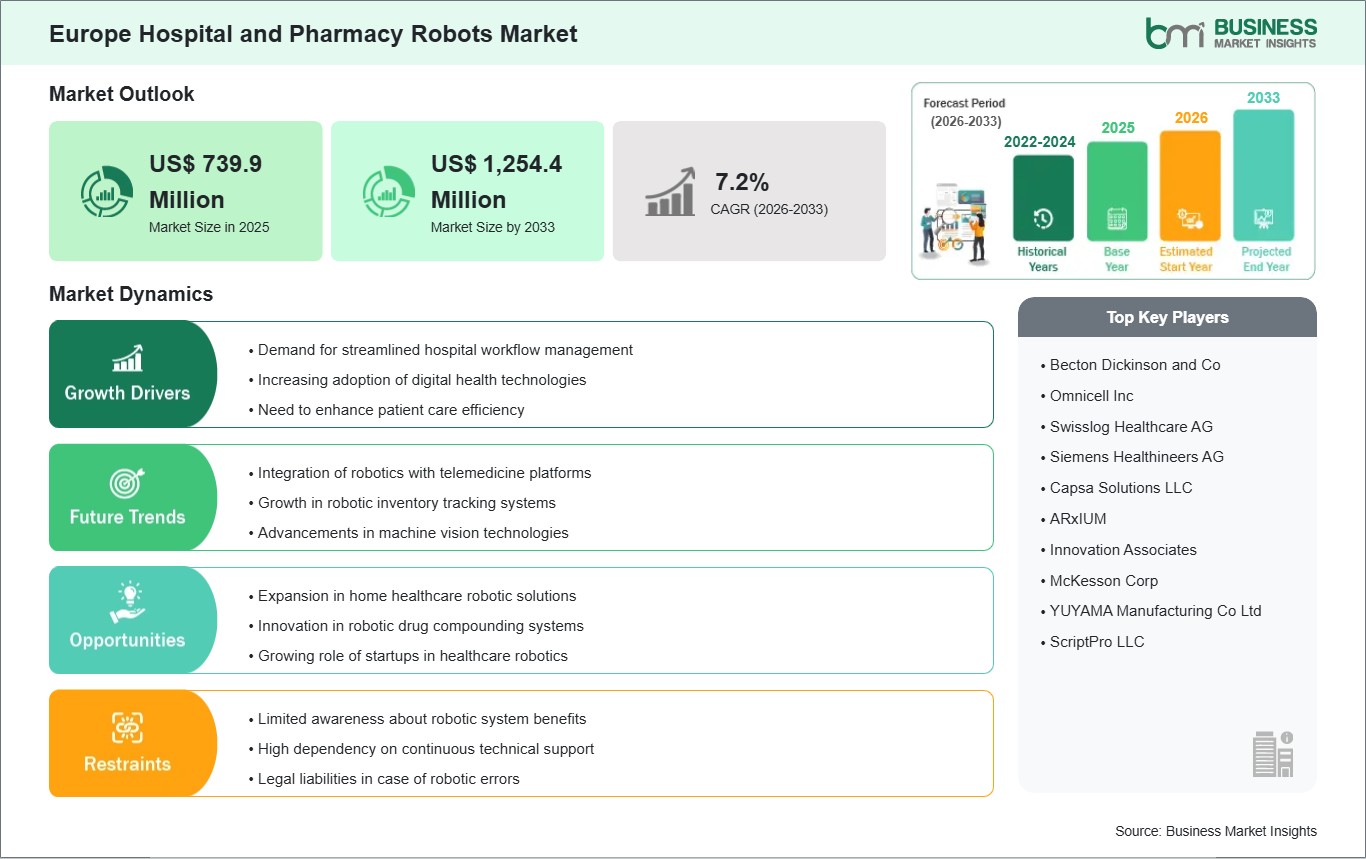
The Europe Hospital and Pharmacy Robots Market size is expected to reach US$1,254.4 million by 2033 from US$739.9 million in 2025. The market is estimated to record a CAGR of 7.2% from 2026 to 2033.
The European hospital and pharmacy robots market is witnessing accelerated adoption as healthcare providers across the continent embrace automation to enhance operational efficiency, reduce medication errors, and streamline pharmaceutical workflows. Hospitals and pharmacy networks are increasingly deploying robotic dispensing systems, automated compounding machines, and intelligent storage solutions to manage high prescription volumes while ensuring regulatory compliance. The region’s strong focus on patient safety and quality standards makes robotics a strategic investment, particularly in large academic hospitals, integrated hospital networks, and specialty clinics where prescription complexity and patient volumes are significant. Operational efficiency and error reduction are primary drivers for robotics adoption in Europe. Automated dispensing and compounding systems minimize manual handling of medications, reducing the risk of human error and ensuring consistent accuracy. Robotics also allows pharmacy staff to allocate more time toward clinical and patient-facing activities, improving overall healthcare delivery. Hospitals increasingly rely on integrated robotic systems to manage inventory, optimize stock levels, and support predictive restocking, ensuring uninterrupted access to medications for both inpatient and outpatient care. The market is further influenced by the integration of robotic technologies with hospital digital infrastructures. European hospitals are progressively connecting robotic dispensing systems with electronic health records, pharmacy management platforms, and clinical decision support tools. This interoperability enables real-time prescription verification, automated inventory tracking, and improved traceability, which are critical for meeting stringent regulatory requirements and maintaining high standards of patient safety. Innovation in robotic technologies, including autonomous mobile robots for internal logistics, intelligent medication dispensing, and AI-assisted compounding, is driving adoption across multiple hospital departments. These systems can reduce medication delivery times, optimize workflow coordination between pharmacy and clinical units, and enhance overall operational efficiency. The European hospital and pharmacy robots market is characterized by high technological readiness, stringent patient safety standards, and growing integration of robotics with digital hospital systems. These factors collectively position Europe as a leading region for the development and adoption of advanced hospital and pharmacy automation solutions.

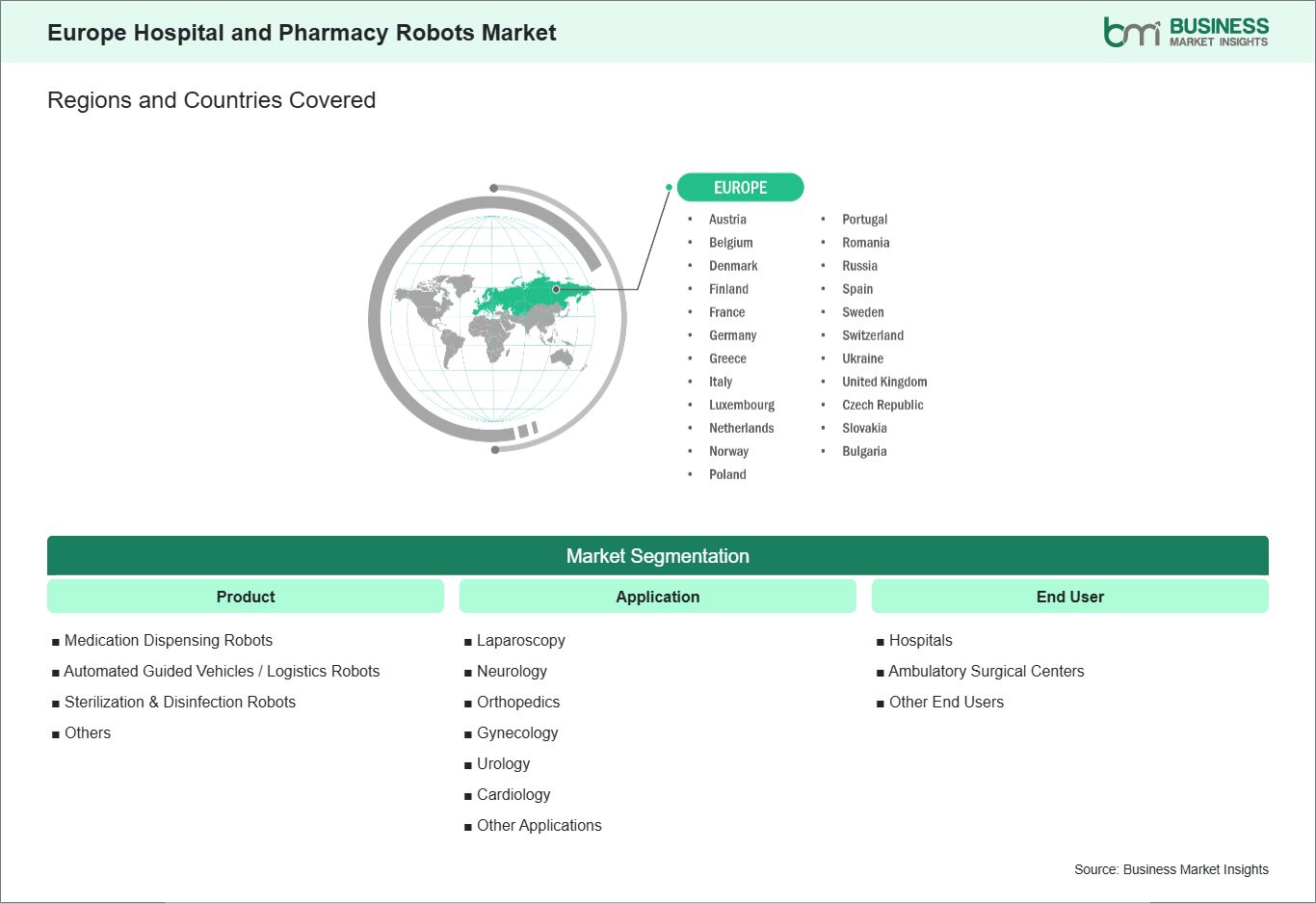
Key segments that contributed to the derivation of the Europe hospital and pharmacy robots market analysis are product, application, and end user.
Hospitals throughout Europe are facing sustained pressure to improve operational efficiency as healthcare demand increases, driven by aging populations, rising chronic disease prevalence, and the expansion of advanced clinical services. In countries such as Germany, France, and the United Kingdom, hospitals are navigating complex care environments where optimizing workflows has become essential to manage patient throughput and resource utilization. Traditional manual processes—especially those involved in pharmacy operations, medication distribution, and internal logistics—are often unable to meet the performance expectations of modern healthcare delivery. As a result, healthcare administrators are placing greater emphasis on solutions that can streamline operations, reduce operational bottlenecks, and support staff productivity. Operational efficiency has become a strategic priority integrated into broader national healthcare agendas across Europe. For example, healthcare systems in Scandinavian countries are implementing performance benchmarking and digital transformation programs that highlight efficiency as a core outcome measure. Hospitals in Spain and Italy are also seeking ways to shorten turnaround times for medication delivery and reduce workflow redundancies that can delay patient care. Within these initiatives, hospital and pharmacy robots are increasingly recognized for their potential to automate repetitive tasks, minimize process variability, and deliver consistent performance across departments. By handling routine logistics and repetitive pharmacy functions, robotic systems help free up medical and pharmacy professionals to focus on clinical decision‑making and direct patient care. European hospitals are also leveraging robotics to improve interdepartmental coordination and reduce administrative strain. In large tertiary care centers, pharmacy departments interface with multiple clinical units that require timely medication delivery, precise inventory control, and efficient communication channels. Manually coordinating these elements can be time‑intensive and prone to delays. Robotics solutions enable hospitals to standardize internal processes such as sorting, tracking, and transporting pharmaceuticals, thereby improving operational throughput and reducing the risk of internal errors. As healthcare providers continue to align operational performance with quality care outcomes, the adoption of robotic systems represents a strategic investment that supports efficiency objectives while enhancing overall service delivery in the hospital setting across Europe..
Automated robotic drug storage and retrieval systems are emerging as key components of modern pharmacy operations in European healthcare facilities. These solutions combine robotics with software‑driven inventory management to create highly organized medication storage environments that improve accuracy, speed, and traceability. In large hospital pharmacies across the Netherlands and Belgium, automated systems are increasingly deployed to streamline the handling of complex drug inventories. These systems can rapidly locate, retrieve, and prepare medications for dispensing, significantly reducing the time pharmacy staff spend on manual searches and handling. The result is a more reliable and efficient medication workflow that supports clinicians and enhances patient care. In countries such as Switzerland and Austria, hospital pharmacy directors are turning to high‑density automated storage solutions to manage broad assortments of medications, including high‑cost specialty drugs and temperature‑sensitive products. Robotic retrieval systems help maintain precise control over inventory conditions while minimizing storage footprint and reducing the risk of stock discrepancies. These systems also provide comprehensive audit trails that support regulatory compliance and internal quality assurance processes. By ensuring that medications are stored and retrieved consistently, hospitals can reduce waste, prevent stockouts, and make better use of limited pharmacy resources. Automated drug storage systems are particularly valuable in tertiary care hospitals with high prescription volumes and diverse therapeutic needs that require rapid access to a wide range of pharmaceuticals. Beyond inventory control, robotic storage and retrieval systems enhance overall pharmacy productivity by integrating with electronic pharmacy management platforms. In the United Kingdom and Iberian Peninsula, automated systems are often linked with electronic prescribing and dispensing software, enabling seamless data exchange and reducing manual data entry tasks. This integration improves coordination between clinical orders and pharmacy fulfillment, minimizing delays in medication delivery and enhancing patient safety. As European hospitals continue to modernize their pharmacy infrastructure, automated robotic storage and retrieval systems are expected to play an increasingly central role in organizing medication supply chains, reducing operational burden, and supporting scalable pharmacy services across diverse healthcare settings.
The Europe hospital and pharmacy robots market demonstrates steady growth, with size and share analysis highlighting evolving trends and competitive dynamics among key players. The report examines subsegments categorized within product, application, and end user, offering insights into their contribution to overall market performance.
By product, the medication dispensing robots subsegment dominated the market in 2025, driven by the need to reduce manual workload and enhance operational efficiency in pharmacies.
In terms of application, the laparoscopy subsegment dominated the market in 2025, driven by the increasing preference for surgeries that minimize complications and shorten hospital stays.
Based on end user, the hospitals subsegment dominated the market in 2025, driven by the demand for integrated robotic systems to support complex procedures and improve overall care delivery.
| Report Attribute | Details |
|---|---|
| Market size in 2025 | US$ 739.9 Million |
| Market Size by 2033 | US$ 1,254.4 Million |
| CAGR (2026 - 2033) | 7.2% |
| Historical Data | 2022-2024 |
| Forecast period | 2026-2033 |
| Segments Covered | By Product
|
|
Regions and Countries Covered
| |
| Europe | Belgium, Austria, Finland, Denmark, Greece, Poland, Romania, Russia, Ukraine, Czech Republic, Slovakia, Bulgaria, Italy, Luxembourg, Germany, Switzerland, France, Netherlands, Norway, Portugal, Spain, Sweden, United Kingdom |
| Market leaders and key company profiles |
|
The "Europe Hospital and Pharmacy Robots Market Size and Forecast (2022–2033)" report provides a detailed analysis of the market covering below areas:
The geographical scope of the Europe Hospital and Pharmacy Robots Market report is divided Belgium, Austria, Finland, Denmark, Greece, Poland, Romania, Russia, Ukraine, the Czech Republic, Slovakia, Bulgaria, Italy, Luxembourg, Germany, Switzerland, France, the Netherlands, Norway, Portugal, Spain, Sweden, and the UK. Germany held the largest share in 2025.
Country-level insights for the European hospital and pharmacy robots market show a heterogeneous landscape with significant variation in adoption, investment, and technological maturity. Germany holds the largest share in the market, driven by advanced hospital infrastructure, early adoption of healthcare automation, and integration of robotics with digital hospital systems. German hospitals widely deploy robotic dispensing units, automated compounding machines, and autonomous mobile robots for internal logistics, enabling efficient medication handling, inventory optimization, and reduced human error. Integration with electronic health records and clinical decision support tools further strengthens workflow efficiency, patient safety, and regulatory compliance, solidifying Germany’s dominant market position. France, the Netherlands, Switzerland, and the UK follow closely, with high adoption levels in tertiary hospitals and academic medical centers. These countries focus on robotic systems for automated dispensing, sterile compounding, and real-time inventory management, often as part of comprehensive hospital digitalization programs. Autonomous delivery robots are increasingly used for transporting medications and supplies within large hospitals, optimizing operational efficiency and reducing staff workload. Italy, Spain, Belgium, Austria, Finland, Denmark, Norway, and Luxembourg represent mature but slightly smaller markets, where adoption is concentrated in urban hospitals and specialized private healthcare facilities. Robotics is primarily applied to improve workflow efficiency, enhance medication safety, and reduce operational variability across multiple departments. Pilot projects and modular robotic platforms are increasingly deployed to scale automation based on hospital size and demand. Poland, Czech Republic, Slovakia, Romania, Bulgaria, Greece, Ukraine, and Russia show emerging adoption, with focus on modernizing pharmacy operations and internal logistics in tertiary care hospitals. Hospitals in these countries are exploring compact robotic dispensing and inventory management systems to improve medication traceability, reduce errors, and optimize workforce efficiency. In Russia, adoption is most pronounced among large urban hospitals, where government-supported modernization programs accelerate robotics deployment, positioning it as the strongest emerging market in the Eastern Europe subset. The European hospital and pharmacy robots market demonstrates a multi-tiered adoption landscape. Germany dominates due to technological readiness and widespread implementation, Western and Northern European countries show strong integration and operational scale, and Eastern and Southern European nations are gradually expanding robotics adoption through modernization initiatives and pilot programs. This diverse regional environment underscores Europe’s leadership in hospital and pharmacy robotics innovation, driven by patient safety, operational efficiency, and digital integration priorities.

The Europe Hospital and Pharmacy Robots Market is evaluated by gathering qualitative and quantitative data post primary and secondary research, which includes important corporate publications, association data, and databases. A few of the key developments in the Europe hospital and pharmacy robots market are:
The Europe Hospital and Pharmacy Robots Market is valued at US$ 739.9 Million in 2025, it is projected to reach US$ 1,254.4 Million by 2033.
As per our report Europe Hospital and Pharmacy Robots Market, the market size is valued at US$ 739.9 Million in 2025, projecting it to reach US$ 1,254.4 Million by 2033. This translates to a CAGR of approximately 7.2% during the forecast period.
The Europe Hospital and Pharmacy Robots Market report typically cover these key segments-
The historic period, base year, and forecast period can vary slightly depending on the specific market research report. However, for the Europe Hospital and Pharmacy Robots Market report:
The Europe Hospital and Pharmacy Robots Market is populated by several key players, each contributing to its growth and innovation. Some of the major players include:
The Europe Hospital and Pharmacy Robots Market report is valuable for diverse stakeholders, including:
Essentially, anyone involved in or considering involvement in the Europe Hospital and Pharmacy Robots Market value chain can benefit from the information contained in a comprehensive market report.
Please tell us your area of interest
(Market Segments/ Regions and Countries/ Companies)