Market Summary
Executive Summary and Global Market Analysis
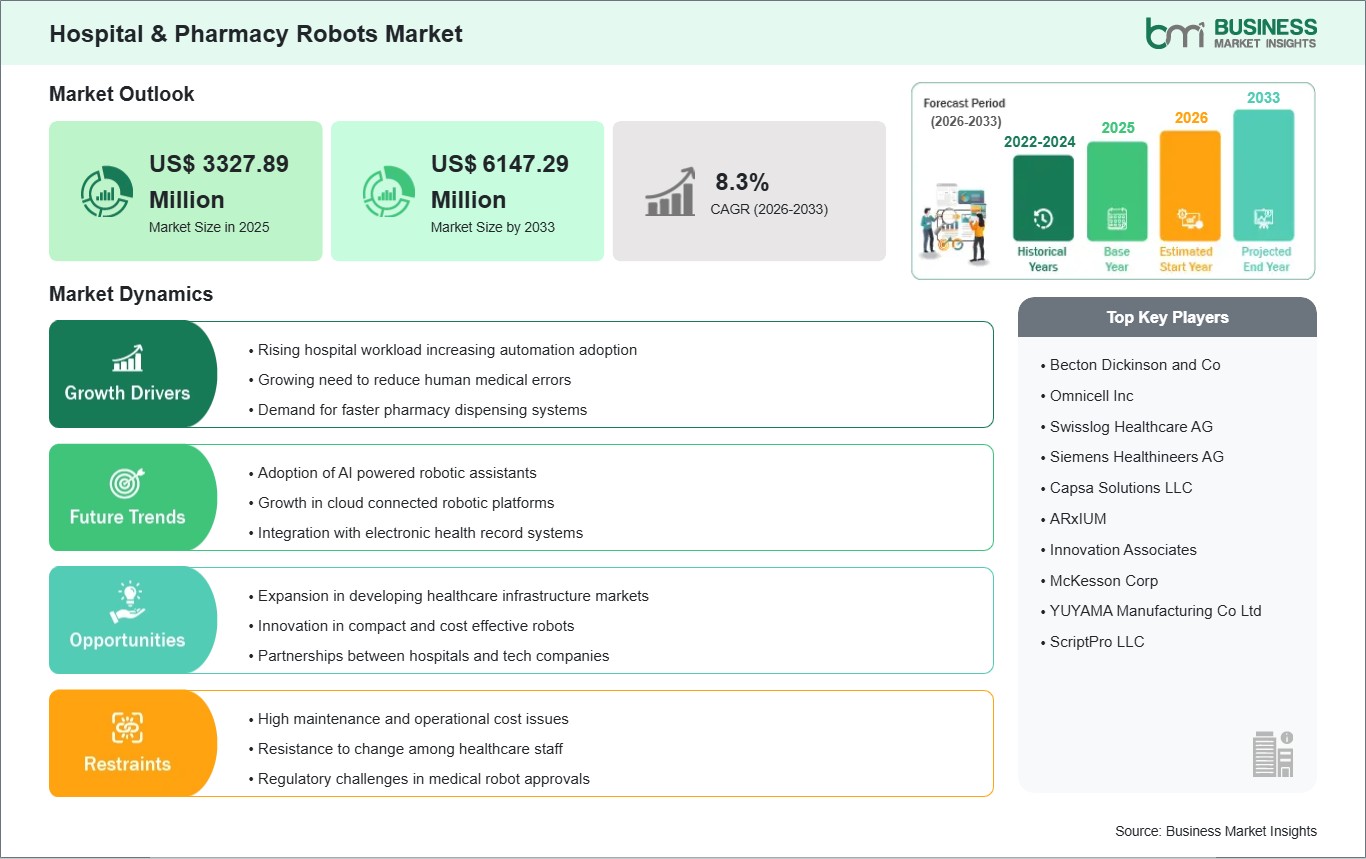
The global hospital and pharmacy robots market is witnessing increasing strategic importance as healthcare institutions aim to modernize medication management and improve operational efficiency. Hospitals and pharmacy chains are incorporating robotic technologies to automate repetitive and high-precision tasks such as medication dispensing, packaging, compounding, and internal drug transportation. Automation in these areas reduces operational inefficiencies and strengthens compliance with medication safety protocols. As healthcare systems become more complex and patient volumes continue to rise, robotic platforms are emerging as essential tools for maintaining accuracy, traceability, and workflow standardization within pharmaceutical services. From a market analysis perspective, healthcare providers are focusing on robotics to streamline pharmacy operations while minimizing dependency on manual labor. Medication dispensing errors remain a major operational concern for hospitals worldwide, and robotics solutions offer reliable accuracy through barcode verification, automated sorting, and real-time prescription validation. Hospital administrators are prioritizing robotics integration with electronic prescribing systems, automated storage units, and hospital information systems. This interoperability enables synchronized medication tracking from prescription entry to final dispensing, thereby improving transparency and regulatory compliance. Another key analytical factor shaping the market is the growing emphasis on cost optimization in healthcare delivery. While robotic systems require initial capital investment, they help reduce long-term operational costs by minimizing medication waste, improving inventory turnover, and reducing labor-intensive processes. Hospitals are evaluating robotics not only as a clinical support technology but also as an operational investment that improves pharmacy productivity and service consistency. Competitive dynamics in the market are characterized by continuous product innovation and technological differentiation. Robotics vendors are developing systems with enhanced precision sensors, automated quality checks, and modular configurations that allow hospitals to customize pharmacy automation according to prescription volumes and facility size. Partnerships between robotics manufacturers, healthcare technology providers, and hospital networks are also strengthening product deployment and integration capabilities. The market analysis indicates that robotics adoption in hospital and pharmacy settings is transitioning from a niche technology toward a standardized operational component of modern healthcare infrastructure.
Segment Analysis
Hospital & Pharmacy Robots Market Segmentation
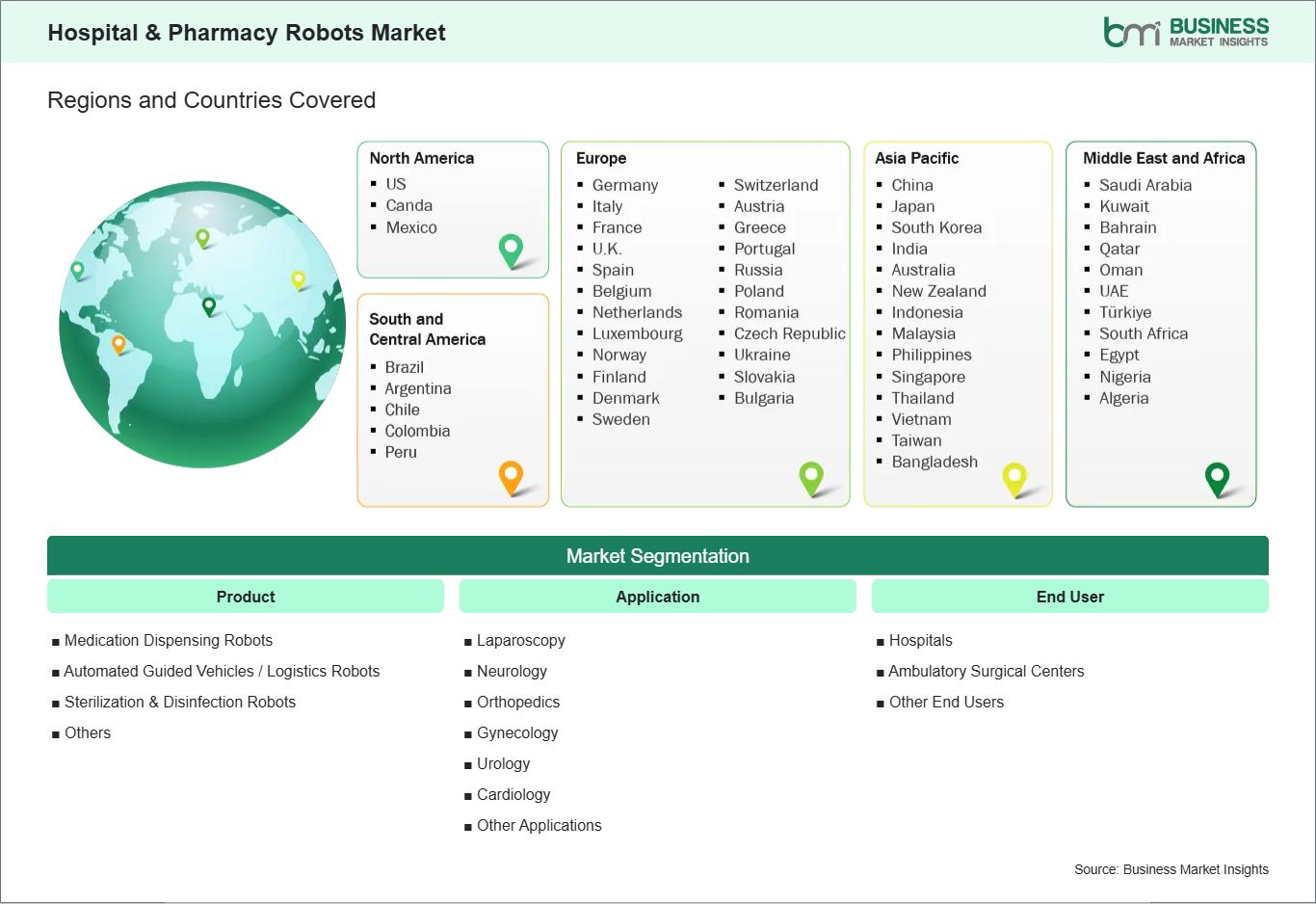
Key segments that contributed to the derivation of the Africa hospital and pharmacy robots market analysis are product, application, and end user.
- By product, the hospital and pharmacy robots market is segmented into medication dispensing robots, automated guided vehicles (AGVs) / logistics robots, sterilization & disinfection robots, and other products. The medication dispensing robots segment dominated the market in 2025.
- In terms of application, the hospital and pharmacy robots market is categorized into laparoscopy, neurology, orthopedics, gynecology, urology, cardiology, and other applications. The laparoscopy segment dominated the market in 2025.
- Based on end user, the market is classified into hospitals, ambulatory surgical centers, and other end users. The hospitals segment dominated the market in 2025.
Market Forces
Hospital & Pharmacy Robots Market Drivers and Opportunities
Rising Demand for Automation in Healthcare Operations
Healthcare organizations worldwide are turning to automation to improve operational efficiency and support high-quality patient care. Hospitals manage complex daily activities that include patient admissions, medical supply management, laboratory coordination, and internal transportation of equipment and medications. As patient expectations and service demands continue to rise, healthcare providers are exploring technologies that can streamline these processes without compromising safety or accuracy. Robotic systems are becoming an important part of hospital infrastructure as they can perform repetitive and time-consuming tasks with consistency and reliability. By handling routine logistical activities, robots allow healthcare professionals to dedicate more time to clinical responsibilities and patient interaction. Automation in healthcare operations is driven by the need to maintain organized and efficient hospital workflows. Many healthcare facilities operate across multiple departments that require constant coordination to deliver timely patient services. Robotic technologies help improve internal communication and resource management by automating tasks such as supply distribution, specimen transport, and equipment delivery. These systems can move materials throughout hospital environments while following predefined routes and operational protocols. This capability helps reduce delays and ensures that critical resources are delivered to the appropriate departments when needed. As a result, hospitals are able to maintain smoother operational processes and improve service quality. Another factor supporting the growing adoption of hospital robotics is the increasing focus on healthcare workforce optimization. Medical professionals often manage heavy workloads that include both clinical and administrative duties. Robotic solutions help reduce the burden of nonclinical tasks, allowing healthcare staff to concentrate on specialized medical responsibilities. Automation also contributes to more standardized processes across hospital departments, which improves accuracy and operational consistency. As healthcare facilities continue to adopt digital technologies and smart infrastructure, robotics are becoming an integral component of modern hospital operations, supporting efficiency, reliability, and improved patient service delivery.
Expansion of Robotic Solutions in Hospital Pharmacies
Hospital pharmacies are adopting robotic technologies to improve the efficiency and reliability of medication management processes. Pharmacy operations involve complex workflows that require careful organization, precise dispensing, and accurate inventory control. Robotic systems help automate these tasks by managing medication storage, retrieval, and preparation with high levels of consistency. By introducing automation into pharmacy environments, hospitals can streamline routine procedures while maintaining strict safety and quality standards. These technologies also support better organization of medications, which helps pharmacists manage large inventories more effectively. The expansion of robotic systems in hospital pharmacies is also closely linked to the growing emphasis on medication safety. Accurate dispensing and proper medication handling are essential to ensuring positive patient outcomes. Robotic technologies support these goals by following programmed protocols for drug selection, labeling, and distribution. Automated pharmacy systems can organize medications systematically and assist pharmacists in verifying prescriptions before they are delivered to patients or hospital departments. This structured approach helps reduce the likelihood of human error while improving the reliability of pharmacy operations. Pharmacists play a critical role in patient care by reviewing prescriptions, advising healthcare professionals, and ensuring proper medication use. When routine tasks such as sorting, packaging, and retrieving medications are automated, pharmacists can devote more time to these clinical responsibilities. Robotic systems also support better coordination between hospital departments by ensuring that medications are prepared and delivered in an organized and timely manner. As hospitals continue to modernize their pharmacy infrastructure, robotic technologies are expected to play an important role in creating efficient, safe, and well-managed medication distribution systems.
Size and Share Analysis
Hospital & Pharmacy Robots Market Size and Share Analysis
The hospital and pharmacy robots market demonstrates steady growth, with size and share analysis highlighting evolving trends and competitive dynamics among key players. The report examines subsegments categorized within product, application, and end user, offering insights into their contribution to overall market performance.
By product, the medication dispensing robots segment dominated the market in 2025, driven by the growing need to automate high-volume prescription handling while improving medication safety and reducing dispensing errors in hospital and retail pharmacies.
In terms of application, the laparoscopy segment dominated the market in 2025, driven by increasing demand for minimally invasive surgeries that offer higher precision, reduced complications, and faster patient recovery with robotic assistance.
Based on end user, the hospitals segment dominated the market in 2025, driven by the high volume of medication management, the need for improved patient safety, and the adoption of automation to streamline pharmacy workflows and reduce errors.
Report Coverage
Hospital & Pharmacy Robots Market Report Coverage and Deliverables
The "Hospital and Pharmacy Robots Market Size and Forecast (2022–2033)" report provides a detailed analysis of the market covering below areas:
- Hospital and Pharmacy Robots Market size and forecast at global, regional, and country levels for all the key market segments covered under the scope
- Hospital and Pharmacy Robots Market trends, as well as drivers, restraints, and opportunities
- Hospital and Pharmacy Robots Market analysis covering key trends, global and regional framework, major players, regulations, and recent developments
- Industry landscape and competition analysis covering market concentration, heat map analysis, prominent players, and recent developments for the Hospital and Pharmacy Robots Market
- Detailed company profiles, including SWOT analysis
Geographic Insights
Hospital & Pharmacy Robots Market Geographic Insights
The geographical scope of the hospital and pharmacy robots market report is divided into North America, Asia Pacific, Europe, Middle East & Africa, and South & Central America. North America held the largest share in 2025.
North America dominates the global hospital and pharmacy robots market, supported by advanced healthcare infrastructure, high technology adoption, and strong investment in digital health initiatives. Hospitals and large healthcare networks across the US and Canada are implementing robotic dispensing systems, autonomous medication delivery platforms, and AI-powered compounding solutions to improve operational efficiency and minimize prescription errors. Integration with electronic health records, pharmacy management software, and hospital information systems allows real-time tracking of medications, automated inventory management, and predictive restocking, making North America the most mature and technologically advanced market for hospital robotics. Europe represents a mature but growing market for hospital and pharmacy robotics. Countries such as Germany, France, and the UK are investing in automated pharmacy systems to support centralized hospital pharmacy models and improve medication safety. Robotics deployment in the region focuses on high-volume prescription handling, sterile compounding, and standardized drug dispensing across multiple departments. Strong regulatory frameworks for patient safety and government programs promoting digital healthcare adoption are driving the integration of robotics into existing hospital operations, supporting consistent and reliable pharmaceutical management. Asia Pacific is emerging as a high-growth market for hospital and pharmacy robots due to expanding healthcare infrastructure, increasing urbanization, and rising patient volumes. Hospitals in countries such as Japan, China, South Korea, and India are adopting robotic dispensing systems, automated medication storage solutions, and mobile logistics robots to optimize workflow efficiency and reduce staff workload. Early adoption in major metropolitan hospitals is gradually spreading to mid-sized healthcare facilities as awareness of the operational and clinical benefits of robotics increases. The Middle East and Africa is in the early stages of hospital robotics adoption, with implementation concentrated in technologically advanced hospitals in urban centers. Hospitals are deploying robotic systems for automated dispensing, medication transport, and inventory management to improve accuracy and operational efficiency. Government-backed healthcare modernization initiatives and investments in smart hospital infrastructure are expected to gradually drive wider adoption across the region, though growth remains limited compared to North America and Europe. South and Central America is a developing market for hospital and pharmacy robots, with adoption primarily in private hospitals and specialty healthcare facilities. Robotic solutions are being explored to manage high prescription volumes, optimize medication workflows, and reduce human errors in pharmacy operations. While large-scale deployment is limited, increasing investments in healthcare infrastructure, growing awareness of automation benefits, and digitalization initiatives are expected to expand robotics adoption across urban hospitals and hospital networks in the coming years.
Industry Activity
Recent Developments
The hospital and pharmacy robots market is evaluated by gathering qualitative and quantitative data post primary and secondary research, which includes important corporate publications, association data, and databases. A few of the key developments in the hospital and pharmacy robots market are:
- In July 2025, Swisslog Healthcare launched the PillPick Octave, an upgraded automated unit‑dose pharmacy system that advances medication safety with eco‑friendly packaging options and improved handling precision, aimed at supporting large hospital and outpatient pharmacy workflows.
- In April 2025, Parata unveiled the Parata Max 2 high‑speed robotic dispensing system, designed to automate vial filling, labeling, and sorting of high‑demand medications in clinical pharmacy settings, improving throughput and reducing manual workload for pharmacists.
Trust & Transparency
Research Methodology
The market analysis combines proprietary research with secondary data from government agencies, company disclosures, regulatory filings, industry databases and expert interviews. Market estimates are validated through data triangulation, cross-market benchmarking and analyst
review.
View Full Research Methodology
Key Sources Referred:
World Health Organization (WHO) Organisation for Economic Cooperation and Development (OECD) The World Bank Group Worldometer The Lancet International Bar Association International Trade Administration