Middle East Hospital and Pharmacy Robots Market Outlook (2022-2033)

Historic Data: 2022-2024   |   Base Year: 2025   |   Forecast Period: 2026-2033
Report Content: Market Scope, Market Segmentation, Market Dynamics, and Competitive Analysis

Report Coverage:
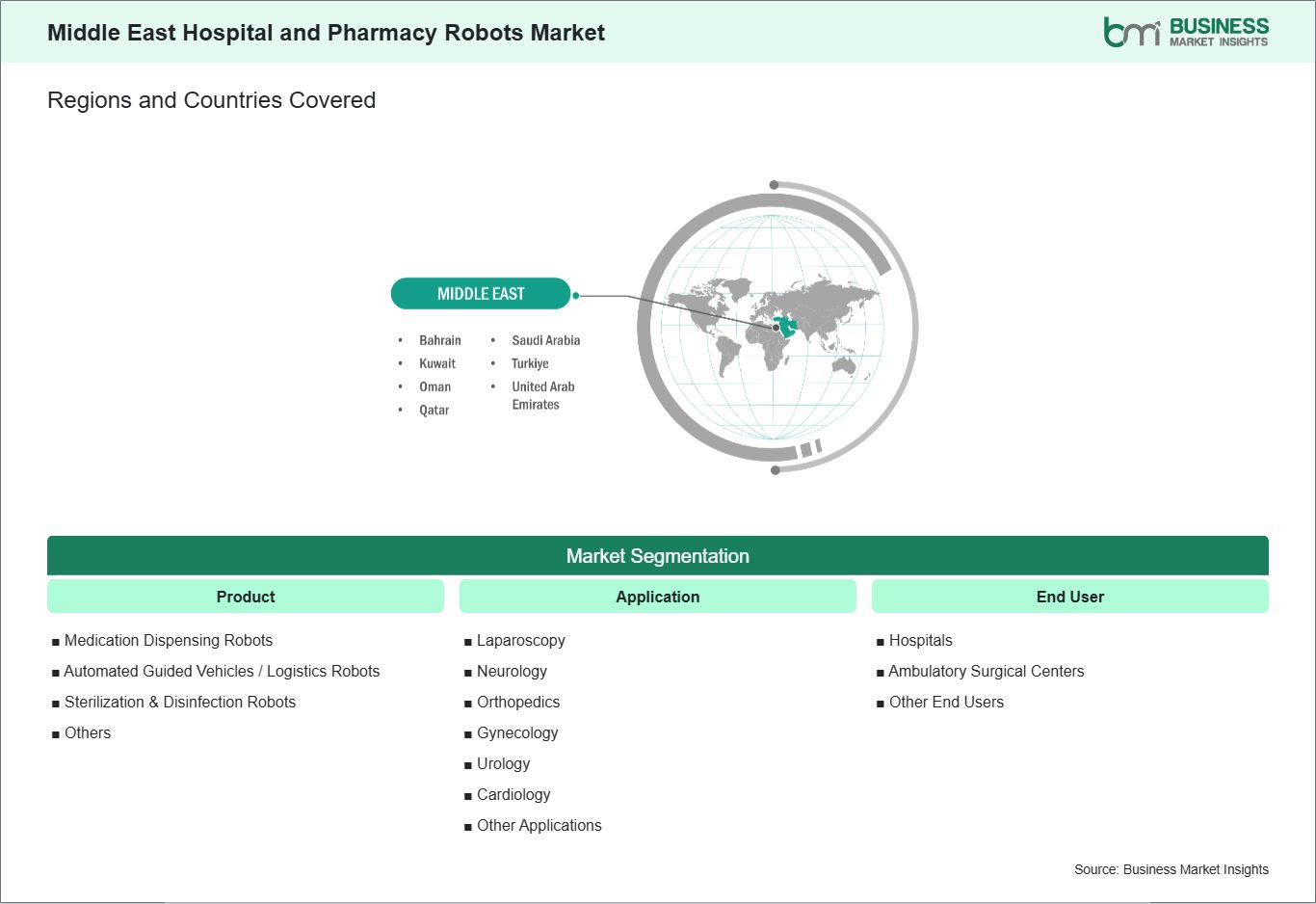
  • Product (Medication Dispensing Robots, Automated Guided Vehicles (AGVs) / Logistics Robots, Sterilization & Disinfection Robots, Others)
  • Application (Laparoscopy, Neurology, Orthopedics, Gynecology, Urology, Cardiology, Other Applications)
  • End User (Hospitals, Ambulatory Surgical Centers, Other End Users)

No. of Pages: 150
Report Code: BMIPUB00034960
Category: Life Sciences
Middle East Hospital and Pharmacy Robots Market

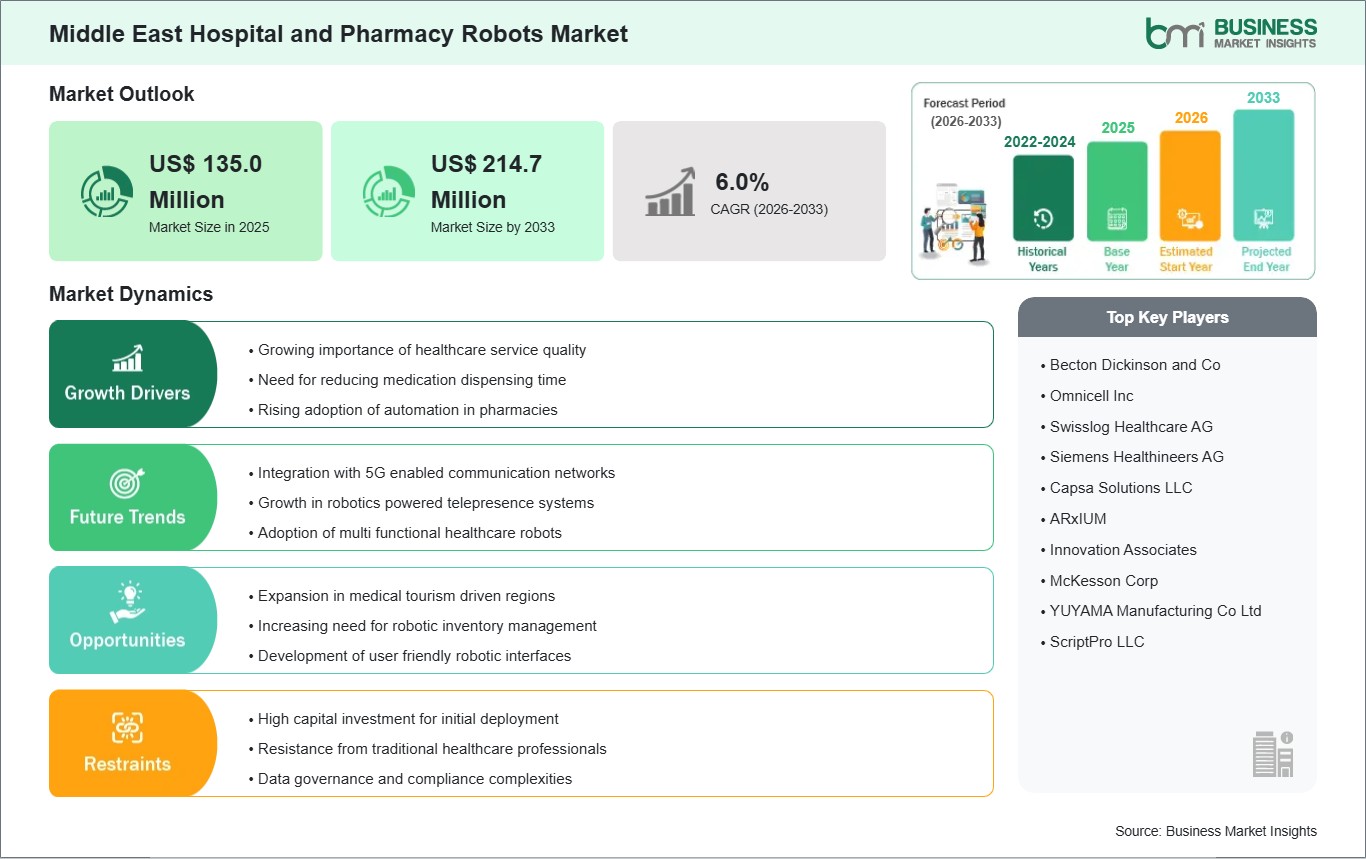
The Middle East hospital and pharmacy robots market size is expected to reach US$ 214.7 million by 2033 from US$ 135.0 million in 2025. The market is estimated to record a CAGR of 6.0 % from 2026 to 2033.

Executive Summary and Middle East Hospital and Pharmacy Robots Market Analysis:

The Middle East hospital and pharmacy robots market is entering a phase of structured adoption, reflecting the growing need for efficiency, accuracy, and safety in healthcare delivery. Hospitals across the region are actively integrating robotic systems into both clinical and operational workflows to manage rising patient volumes and evolving care demands. Hospital robots now perform tasks such as patient transport, surgical assistance, sanitation, and logistical support, while pharmacy robots automate medication dispensing, inventory management, and prescription verification processes. This adoption is fueled by increasing pressure on healthcare institutions to maintain high standards of care despite workforce shortages and rising operational costs. Stakeholders, including hospital administrators, technology vendors, and policy regulators, recognize the value of robotics in minimizing human error, reducing repetitive workload, and improving overall operational throughput. The market demonstrates a diverse competitive landscape, featuring multinational robotics companies alongside regional technology integrators who customize solutions for local healthcare infrastructures and regulatory environments. Interoperability with hospital information systems, electronic health records, and supply chain management platforms is emerging as a critical requirement for robotics solutions, driving vendors to offer modular and scalable systems. Pilot programs often act as a proving ground for new technology, allowing hospitals to evaluate performance, reliability, and staff adoption before wider deployment. Strategic collaborations and partnerships between robotics providers and healthcare institutions are increasingly common, emphasizing co-development of tailored solutions and shared training programs. In addition, government-led initiatives focusing on healthcare modernization and digital transformation are accelerating robotics adoption, reflecting a shift from experimental deployment to institutionalized practice. The analysis suggests that the market is moving toward integrated automation ecosystems, with robots becoming central to both administrative and clinical processes. As a result, hospital and pharmacy robotics are no longer viewed merely as technological enhancements but as essential tools for improving patient outcomes, optimizing resource utilization, and building resilient healthcare systems across the Middle East. With ongoing innovation, regulatory support, and growing stakeholder alignment, the market is well-positioned to mature rapidly over the next decade, offering opportunities for sustained adoption and operational transformation.

Middle East Hospital and Pharmacy Robots Market - Strategic Insights:

global-market-strategic-framework
Get more information on this report

Middle East Hospital and Pharmacy Robots Market Segmentation Analysis:

Key segments that contributed to the derivation of the Middle East hospital and pharmacy robots market analysis are product, application, and end user.

  • By product, the hospital and pharmacy robots market is segmented into medication dispensing robots, automated guided vehicles (agvs) / logistics robots, sterilization & disinfection robots and other products. The medication dispensing robots segment dominated the market in 2025.
  • In terms of application, the hospital and pharmacy robots market is categorized into laparoscopy, neurology, orthopedics, gynecology, urology, cardiology and other applications. The laparoscopy segment dominated the market in 2025.
  • Based on end user, the market is classified into hospitals, ambulatory surgical centers and other end users. The hospitals segment dominated the market in 2025.

Middle East Hospital and Pharmacy Robots Market Drivers and Opportunities:

Growth in electronic health records adoption

The adoption of Electronic Health Records (EHR) across the Middle East has expanded rapidly over the past decade, driven by national e‑health strategies in countries such as the United Arab Emirates, Saudi Arabia, and Qatar. Ministries of Health have increasingly mandated digital patient records as foundational infrastructure to improve interoperability, enhance patient safety, and reduce clinical errors. In Saudi Arabia, the rollout of the Seha integrated health information platform has accelerated digital transformation in both public and private hospitals, enabling seamless documentation and access to patient data. This foundation has created an environment in which robotics systems can be more effectively integrated, as accurate digital records are essential for automated workflows such as prescription fulfillment and clinical decision support. In the UAE, the Dubai Health Authority and Abu Dhabi’s Department of Health have prioritized EHR interoperability across multi‑facility healthcare networks. This strategic push ensures that patient history, diagnostics, and treatment plans are consistently captured in digital format, laying the groundwork for robotic systems to interface with these records. Pharmacy robots, for instance, rely on structured EHR data to verify prescriptions, manage medication histories, and reduce dispensing errors. When robots can access validated patient data directly from EHR systems, it minimizes reliance on manual inputs and enhances accuracy, especially in high‑throughput urban healthcare environments like Dubai’s academic medical centers. This has encouraged hospitals to pursue EHR standardization as a prerequisite to robotics deployment, reinforcing the symbiotic relationship between digital health platforms and automation technologies. In Qatar, the National Health Strategy includes explicit objectives to enhance data quality and connectivity across public and private sectors. As a result, healthcare providers in Doha and other regions have invested in unified digital health record systems that facilitate real‑time data sharing. This has enabled pilot projects where pharmacy robots pull live medication orders from EHRs to optimize dispensing workflows without redundant human mediation. The expansion of EHR adoption also supports longitudinal patient tracking and analytics, which further reinforces the strategic case for robotics. As digital health records become entrenched across Middle East healthcare ecosystems, they will continue to serve as a critical enabler for more sophisticated and scalable robotic applications in both hospital operations and pharmacy management.

Robots integrated with digital hospital systems

In the Middle East, hospitals are increasingly integrating robots with existing digital systems to improve operational throughput and coordinate complex clinical processes. Leading institutions in Riyadh, Jeddah, and Abu Dhabi are pioneering integrations between autonomous delivery robots and hospital information systems (HIS). These robots are wired into patient schedules, bed management platforms, and logistics modules to autonomously transport supplies, laboratory samples, and meals without manual intervention. By aligning robotics with digital workflows, healthcare facilities can reduce turnaround times, minimize contact‑based risks, and optimize staff utilization. For example, when an HIS schedule updates a test order, an automated transport robot can be queued to retrieve and deliver specimens to diagnostics labs, reducing delays and improving coordination. Pharmacy automation has also benefited from tight integration with the digital systems that underpin formulary management and inventory control in Middle East hospitals. In Kuwait and Bahrain, hospital pharmacy departments have adopted robotic dispensing systems that link directly with electronic medication administration records (eMAR) and procurement platforms. This integration allows robotics to reconcile prescribing information with inventory availability and dosing protocols, ensuring that medication dispensing aligns with up‑to‑date clinical guidelines. When changes occur—such as therapeutic substitutions or stock movement—updates propagate instantly through connected systems, enabling pharmacy robots to adjust actions without manual reprogramming. This level of integration enhances compliance, reduces wastage, and supports safer medication handling. Integration challenges remain, particularly in facilities where digital transformation is unevenly implemented, such as mixed public‑private health environments in Oman and Jordan. In these contexts, hospitals that have invested in digital middleware and API‑driven platforms are able to bridge legacy systems with robotic interfaces more effectively. Hospitals in Muscat, for instance, have begun using enterprise service buses to enable data exchange between scheduling systems, EHR platforms, and robotic control software. These integrated architectures allow robots to execute tasks based on real‑time clinical triggers, such as patient discharge orders or emergency reprioritizations. As Middle East healthcare systems continue advancing digital maturity, the convergence of robotics with core hospital systems will be a defining trend in improving operational efficiency and care quality across the region.

Middle East Hospital and Pharmacy Robots Market Size and Share Analysis:

The Middle East hospital and pharmacy robots market demonstrates steady growth, with size and share analysis highlighting evolving trends and competitive dynamics among key players. The report examines subsegments categorized within product, application, and end user, offering insights into their contribution to overall market performance.

By product, the medication dispensing robots subsegment dominated the market in 2025, driven by the growing need to improve accuracy, reduce dispensing errors, and enhance pharmacy workflow efficiency.

In terms of application, the laparoscopy subsegment dominated the market in 2025, driven by the increasing demand for minimally invasive surgeries and precision in surgical procedures.

Based on end user, the hospitals subsegment dominated the market in 2025, driven by expanding healthcare infrastructure and the need to streamline clinical and operational processes.

Middle East Hospital and Pharmacy Robots Market Report Highlights:

Report Attribute Details
Market size in 2025 US$ 135.0 Million
Market Size by 2033 US$ 214.7 Million
CAGR (2026 - 2033) 6.0%
Historical Data 2022-2024
Forecast period 2026-2033
Segments Covered By Product
  • Medication Dispensing Robots
  • Automated Guided Vehicles / Logistics Robots
  • Sterilization & Disinfection Robots
  • Others
By Application
  • Laparoscopy
  • Neurology
  • Orthopedics
  • Gynecology
  • Urology
  • Cardiology
  • Other Applications
By End User
  • Hospitals
  • Ambulatory Surgical Centers
  • Other End Users
Regions and Countries Covered
Middle East UAE, Saudi Arabia, Bahrain, Oman, Kuwait, Qatar, and Turkiye
Market leaders and key company profiles
  • Becton Dickinson and Co
  • Omnicell Inc
  • Swisslog Healthcare AG
  • Siemens Healthineers AG
  • Capsa Solutions LLC
  • ARxIUM
  • Innovation Associates
  • McKesson Corp
  • YUYAMA Manufacturing Co Ltd
  • ScriptPro LLC
Get more information on this report

Middle East Hospital and Pharmacy Robots Market Report Coverage and Deliverables:

The "Middle East Hospital and Pharmacy Robots Market Size and Forecast (2022–2033)" report provides a detailed analysis of the market covering below areas:

  • Middle East Hospital and Pharmacy Robots Market size and forecast at regional and country levels for all segments covered under the scope
  • Middle East Hospital and Pharmacy Robots Market trends, as well as drivers, restraints, and opportunities
  • Middle East Hospital and Pharmacy Robots Market analysis covering key trends, regional framework, major players, regulations, and recent developments
  • Industry landscape and competition analysis covering market concentration, heat map analysis, prominent players, and recent developments for the Middle East Hospital and Pharmacy Robots Market
  • Detailed company profiles, including SWOT analysis

Middle East Hospital and Pharmacy Robots Market Geographic Insights:

The geographical scope of the Middle East Hospital and Pharmacy Robots Market report is divided into UAE, Saudi Arabia, Bahrain, Oman, Kuwait, Qatar, and Turkiye. Saudi Arabia held the largest share in 2025.

The Middle East Hospital and Pharmacy Robots market shows significant variation in adoption and integration across individual countries, reflecting differences in healthcare infrastructure, digital maturity, and government priorities. Saudi Arabia is rapidly expanding robotics in both clinical and operational domains, with tertiary care centers and specialized surgical hospitals increasingly using robotic systems for complex procedures, while pilot projects in logistics and disinfection demonstrate a growing focus on workforce efficiency and patient safety. In the United Arab Emirates, hospitals in Abu Dhabi and Dubai are leading the region with widespread deployment of surgical and pharmacy robots, supported by national initiatives to develop smart healthcare facilities and digital hospital systems that ensure seamless integration of robotic platforms with electronic patient records. Bahrain has adopted a pragmatic approach, emphasizing the use of robotics for hospital support functions, pharmacy automation, and disinfection, which has been reinforced by government efforts to enhance healthcare quality and reduce human exposure to routine or hazardous tasks. Oman is in a nascent stage of adoption, prioritizing digital health infrastructure and telemedicine solutions as precursors for integrating robotics into hospital workflows, focusing initially on logistics, patient transport, and pharmacy support before expanding into surgical applications. Kuwait is making notable strides in combining advanced robotic surgery with digital hospital platforms, allowing automated systems to interact with electronic medication and patient management records, thereby increasing procedural accuracy and operational efficiency. In Qatar, significant investments in smart hospital infrastructure and specialized surgical centers are supporting the use of robots for multi-disciplinary procedures, while strong government-led digitalization strategies facilitate the integration of robotics across both clinical and pharmacy operations. Türkiye presents a unique scenario in the region, where modern hospitals and private healthcare networks are leveraging robotics for high-precision surgeries and gradually integrating pharmacy and logistics automation, supported by national efforts to expand electronic health record adoption and digital hospital management systems. Across these countries, the common drivers for adoption include improving clinical outcomes, enhancing workflow efficiency, reducing human error, and addressing growing patient volumes, while country-specific approaches reflect varying levels of infrastructure readiness, workforce training, and investment focus. The Middle East market demonstrates a heterogeneous but steadily converging pattern of robotics adoption, where the combination of supportive policies, advanced hospital systems, and digital health integration is shaping a sustainable environment for hospital and pharmacy automation.

global-market-geography
Get more information on this report

Middle East Hospital and Pharmacy Robots Market Research Report Guidance:

  • The report includes qualitative and quantitative data in the Middle East Hospital and Pharmacy Robots Market across product, application, end user and geography.
  • The report starts with the key takeaways (chapter 2), highlighting key trends and outlook of the Middle East Hospital and Pharmacy Robots Market.
  • Chapter 3 focuses on the research methodology of the study.
  • Chapter 4 includes ecosystem analysis.
  • Chapter 5 highlights the major industry dynamics in the Middle East Hospital and Pharmacy Robots Market, including factors that are driving the market, prevailing deterrents, potential opportunities, as well as future trends. Impact analysis of these drivers and restraints is also covered in this section.
  • Chapter 6 discusses the Middle East Hospital and Pharmacy Robots Market scenario, in terms of historical market revenues, and forecast till the year 2033.
  • Chapters 7 to 10 cover Middle East Hospital and Pharmacy Robots Market segments by product, application, end user, and geography across UAE, Saudi Arabia, Bahrain, Oman, Kuwait, Qatar, and Turkiye. They cover the market revenue, forecast, and factors driving the market.
  • Chapter 11 describes the competitive analysis along with the heat map analysis for the key players operating in the market.
  • Chapter 12 describes the industry landscape analysis. It provides detailed descriptions of business activities such as market initiatives, new developments, mergers, and joint ventures globally, along with a competitive landscape.
  • Chapter 13 provides detailed profiles of the major companies operating in the Middle East Hospital and Pharmacy Robots Market. Companies have been profiled on the basis of their key facts, business descriptions, products, financial overview, SWOT analysis, and key developments.
  • Chapter 14, i.e., the appendix, is inclusive of a brief overview of the company, a list of abbreviations, and a disclaimer.

Middle East Hospital and Pharmacy Robots Market News and Key Development:

The Middle East Hospital and Pharmacy Robots Market is evaluated by gathering qualitative and quantitative data post primary and secondary research, which includes important corporate publications, association data, and databases. A few of the key developments in the Middle East hospital and pharmacy robots market are:

  • In September 2025, Abu Dhabi’s Technology Innovation Institute (TII) and Nvidia launched the Middle East’s first AI & robotics research lab in the United Arab Emirates. This strategic collaboration aims to advance next‑generation AI models and robotics platforms, further strengthening robotics research and innovation across healthcare and other sectors.
  • In February 2026, California‑based Healthcare Triangle, Inc. expanded its regional presence by launching QuantumNexis operations in Dubai, offering AI‑powered Hospital Information Systems and digital health solutions across GCC markets including UAE, Saudi Arabia, Qatar, Oman, and Bahrain as part of broader healthcare modernization partnerships.

Key Sources Referred:

  • World Health Organization (WHO)
  • Organisation for Economic Cooperation and Development (OECD)
  • The World Bank Group
  • Worldometer
  • The Lancet
  • International Bar Association
  • International Trade Administration
The List of Companies - Middle East Hospital and Pharmacy Robots Market
  • Becton Dickinson and Co
  • Omnicell Inc
  • Swisslog Healthcare AG
  • Siemens Healthineers AG
  • Capsa Solutions LLC
  • ARxIUM
  • Innovation Associates
  • McKesson Corp
  • YUYAMA Manufacturing Co Ltd
  • ScriptPro LLC
Frequently Asked Questions
How big is the Middle East Hospital and Pharmacy Robots Market?

The Middle East Hospital and Pharmacy Robots Market is valued at US$ 135.0 Million in 2025, it is projected to reach US$ 214.7 Million by 2033.

What is the CAGR for Middle East Hospital and Pharmacy Robots Market by (2026 - 2033)?

As per our report Middle East Hospital and Pharmacy Robots Market, the market size is valued at US$ 135.0 Million in 2025, projecting it to reach US$ 214.7 Million by 2033. This translates to a CAGR of approximately  6.0% during the forecast period.

What segments are covered in this report?

The Middle East Hospital and Pharmacy Robots Market report typically cover these key segments-

  • Product (Medication Dispensing Robots, Automated Guided Vehicles (AGVs) / Logistics Robots, Sterilization & Disinfection Robots, Others)
  • Application (Laparoscopy, Neurology, Orthopedics, Gynecology, Urology, Cardiology, Other Applications)
  • End User (Hospitals, Ambulatory Surgical Centers, Other End Users)

What is the historic period, base year, and forecast period taken for Middle East Hospital and Pharmacy Robots Market?

The historic period, base year, and forecast period can vary slightly depending on the specific market research report. However, for the Middle East Hospital and Pharmacy Robots Market report:

  • Historic Period : 2022-2024
  • Base Year : 2025
  • Forecast Period : 2026-2033
  • Who are the major players in Middle East Hospital and Pharmacy Robots Market?

    The Middle East Hospital and Pharmacy Robots Market is populated by several key players, each contributing to its growth and innovation. Some of the major players include:

  • Becton Dickinson and Co
  • Omnicell Inc
  • Swisslog Healthcare AG
  • Siemens Healthineers AG
  • Capsa Solutions LLC
  • ARxIUM
  • Innovation Associates
  • McKesson Corp
  • YUYAMA Manufacturing Co Ltd
  • ScriptPro LLC
  • Who should buy this report?

    The Middle East Hospital and Pharmacy Robots Market report is valuable for diverse stakeholders, including:

    • Investors: Provides insights for investment decisions pertaining to market growth, companies, or industry insights. Helps assess market attractiveness and potential returns.
    • Industry Players: Offers competitive intelligence, market sizing, and trend analysis to inform strategic planning, product development, and sales strategies.
    • Suppliers and Manufacturers: Helps understand market demand for components, materials, and services related to concerned industry.
    • Researchers and Consultants: Provides data and analysis for academic research, consulting projects, and market studies.
    • Financial Institutions: Helps assess risks and opportunities associated with financing or investing in the concerned market.

    Essentially, anyone involved in or considering involvement in the Middle East Hospital and Pharmacy Robots Market value chain can benefit from the information contained in a comprehensive market report.

    Available Report Formats

    pdf-format excel-format pptx-format
    Buy Now
    Sales Assistance
    +1 646 791 7070 (US & UK)
    Customization Form

    Please tell us your area of interest
    (Market Segments/ Regions and Countries/ Companies)