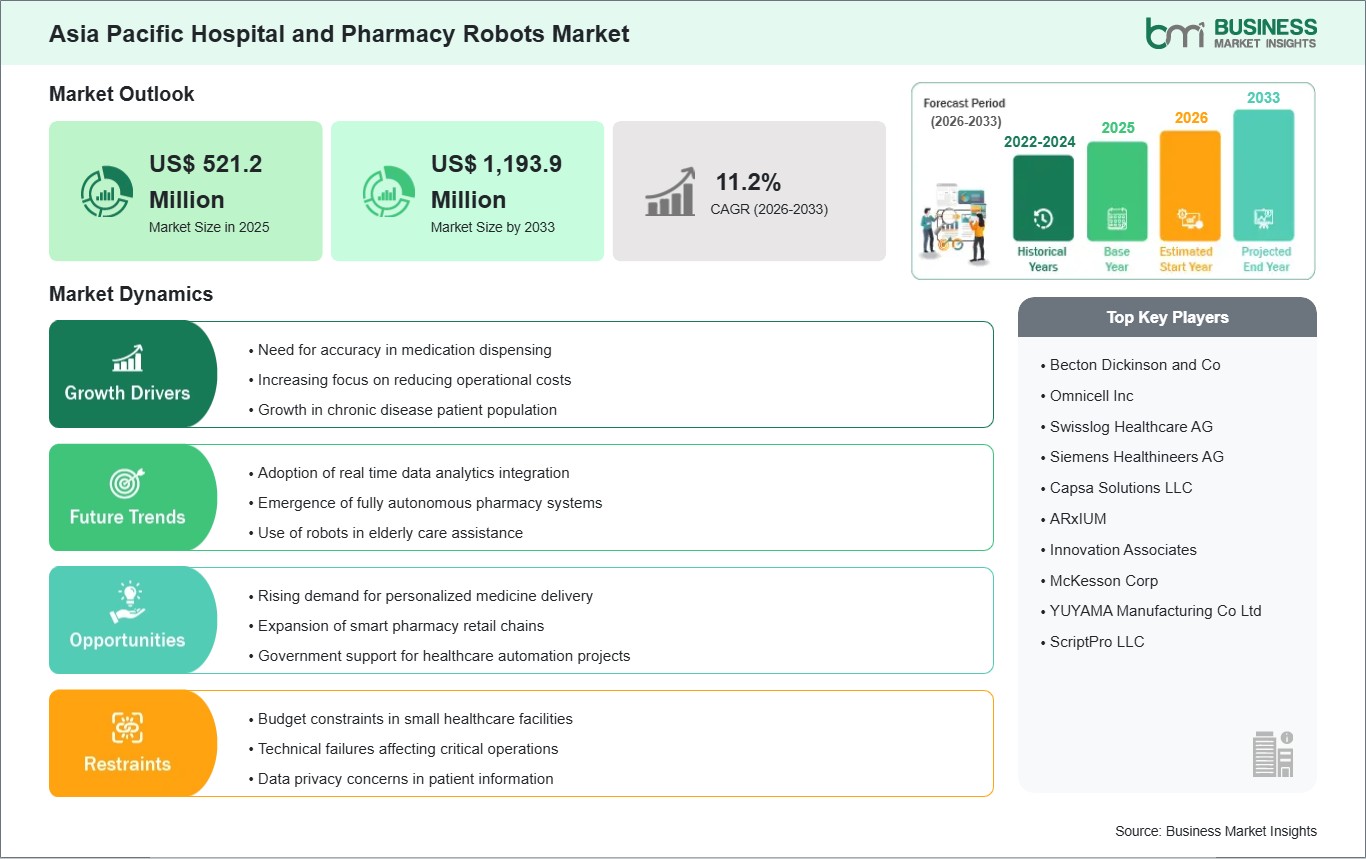
The Asia Pacific hospital and pharmacy robots market size is expected to reach US$ 1,193.9 million by 2033 from US$ 521.2 million in 2025. The market is estimated to record a CAGR of 11.2% from 2026 to 2033.
The Asia Pacific hospital and pharmacy robots market is experiencing accelerated adoption as healthcare institutions seek to address growing patient volumes, rising operational costs, and the demand for enhanced clinical precision. Robotics are being implemented across surgical procedures, hospital logistics, patient monitoring, and pharmacy operations. In pharmacy departments, robotic dispensing and compounding systems are enabling accurate preparation of medications, reducing human errors, and improving compliance with safety standards. Hospitals are also deploying autonomous systems for internal logistics, including the transport of laboratory samples, medications, and supplies, allowing staff to focus on patient care rather than repetitive tasks. From an analytical standpoint, adoption is uneven across the region. Developed markets such as Japan, South Korea, and Australia are deploying sophisticated surgical robotics, integrated pharmacy automation, and telepresence systems, while emerging economies like India, China, and Indonesia are gradually scaling pilot programs to improve workflow efficiency and medication accuracy. The integration of robotics with hospital information systems is a critical driver, enabling real-time inventory tracking, medication management, and coordination between departments. Additionally, robotics adoption is increasingly influenced by the need for infection control and patient safety. Autonomous disinfection robots and sanitation systems are being introduced in operating rooms, intensive care units, and high-traffic areas, reducing the risk of hospital-acquired infections. Hospitals are also exploring telepresence and patient-assistance robots to minimize direct exposure to contagious diseases and provide support in rehabilitation and mobility. Despite these benefits, challenges such as high initial investment, shortage of trained operators, and infrastructure constraints slow widespread adoption. However, the long-term trend points toward gradual integration of robotic solutions across clinical, pharmaceutical, and operational workflows, driven by hospitals’ focus on efficiency, safety, and the need to optimize human resources in increasingly complex healthcare environments. The Asia Pacific market is positioned for sustained growth as hospitals modernize and embrace automation technologies that complement medical staff rather than replace them.

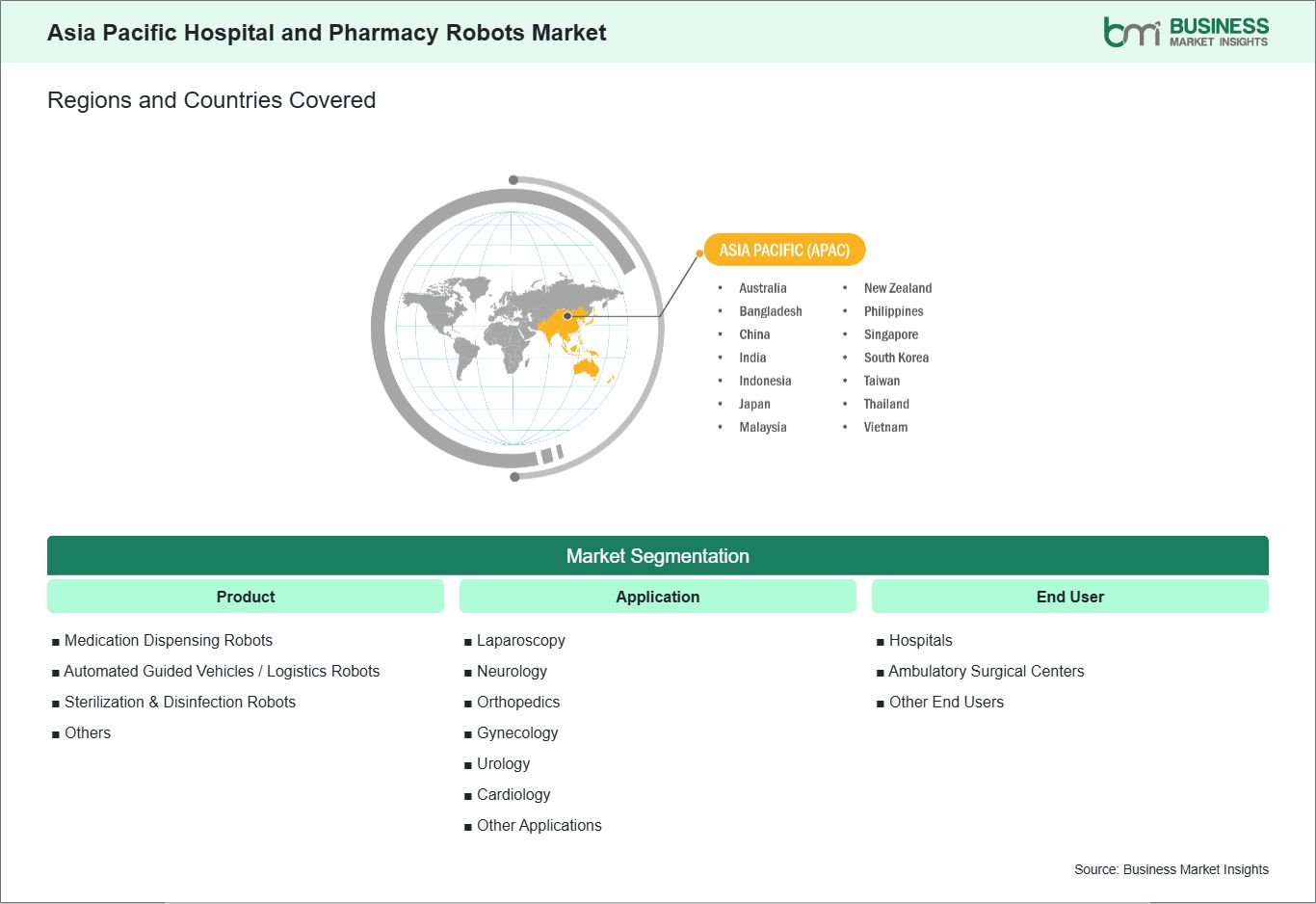
Key segments that contributed to the derivation of the Asia Pacific hospital and pharmacy robots market analysis are product, application, and end user.
Across the Asia Pacific region, hospitals and pharmacies are increasingly challenged by a shortage of trained pharmacists and support staff. Countries such as Japan and South Korea are facing demographic shifts with aging populations that are increasing demand for healthcare services while also shrinking the working‑age population. In emerging markets like India and Indonesia, growth in healthcare access has not been matched by a proportionate increase in pharmacy professionals, leading to overextended teams and longer dispensing times. These workforce pressures are forcing healthcare administrators to reassess traditional staffing models and explore alternative solutions that can maintain service quality without overburdening existing staff. The shortage of pharmacists is particularly acute in rural and semi‑urban areas where access to professional healthcare services has historically been limited. In nations such as Vietnam and the Philippines, smaller community hospitals and clinics often rely on a handful of pharmacy staff to manage large catchment populations. These conditions can lead to fatigue, reduced oversight, and increased risk of dispensing errors. Pharmaceutical education systems in many parts of the region are expanding, but the pipeline of qualified professionals is not growing quickly enough to meet the steep rise in demand for clinical and operational pharmacy services. As a result, healthcare leaders are under pressure to find ways to bolster capacity without compromising patient safety and care standards. At the policy level, several Asia Pacific health ministries have acknowledged the staffing shortfalls and are exploring workforce development initiatives that include foreign recruitment, expanded training programs, and incentives for professionals to serve in underserved regions. However, these strategies require time, regulatory coordination, and funding that may not be immediately available. In the meantime, hospitals and pharmacy groups are compelled to identify operational efficiencies and technological interventions that can supplement human efforts. The persistent imbalance between demand for pharmacy services and available human resources is becoming a defining factor in how healthcare systems in the region plan for sustainable growth and staff resilience over the coming decade.
In response to staffing challenges, healthcare providers across the Asia Pacific are accelerating the adoption of robotic systems to handle repetitive, routine tasks within hospital and pharmacy environments. Robotic solutions can take on functions such as medication sorting, counting, labeling, and inventory replenishment, freeing human pharmacists to focus on clinical care and patient counseling. In large metropolitan hospital systems in Australia and China, pilot implementations of pharmacy automation robots have demonstrated improvements in throughput and consistency, particularly during peak dispensing hours. These examples are encouraging other institutions to consider robotics as part of a broader operational redesign. Robotic systems are also being tailored to address specific bottlenecks in pharmacy workflows. For example, in high‑volume outpatient pharmacy settings in Singapore and Malaysia, automated shelving and retrieval systems handle bulk medication storage and retrieval, which reduces the amount of time staff spend walking back and forth to restock shelves. This not only improves speed and efficiency but also reduces the physical strain on pharmacy teams. Hospitals that serve large patient volumes have reported smoother transitions between prescription entry and medication preparation when robots assist with these routine functions. These technology‑driven workflows help standardize processes that would otherwise be vulnerable to human fatigue or inconsistency. Beyond dispensary functions, robots are increasingly integrated with digital pharmacy systems to support coordinated healthcare delivery. In integrated health networks in South Korea and Japan, robotic pharmacy solutions are linked with electronic prescribing and patient records, enabling seamless information flow and minimizing manual data entry. This level of integration enhances traceability and accountability while reducing the administrative burden on staff. As healthcare organizations across the Asia Pacific continue to invest in robotics, the focus is on striking a balance where technology complements human judgment and expertise. By automating repetitive tasks, pharmacies can achieve higher accuracy, better resource utilization, and an enhanced capacity to serve growing patient populations without proportionate increases in staffing costs.
The Asia Pacific hospital and pharmacy robots market demonstrates steady growth, with size and share analysis highlighting evolving trends and competitive dynamics among key players. The report examines subsegments categorized within product, application, and end user, offering insights into their contribution to overall market performance.
By product, the medication dispensing robots subsegment dominated the market in 2025, driven by the growing adoption of automation in pharmacies. It ensures accurate medication delivery and efficient workflow management.
In terms of application, the laparoscopy subsegment dominated the market in 2025, driven by increasing demand for minimally invasive surgical procedures. Robotic systems enhance precision, reduce recovery time, and improve patient outcomes.
Based on end user, the hospitals subsegment dominated the market in 2025, driven by high patient volumes and complex care requirements. Robotic solutions help streamline operations and support advanced clinical workflows.
| Report Attribute | Details |
|---|---|
| Market size in 2025 | US$ 521.2 Million |
| Market Size by 2033 | US$ 1,193.9 Million |
| CAGR (2026 - 2033) | 11.2% |
| Historical Data | 2022-2024 |
| Forecast period | 2026-2033 |
| Segments Covered | By Product
|
|
Regions and Countries Covered
| |
| Asia Pacific | China, India, Japan, Australia, Bangladesh, Indonesia, Malaysia, New Zealand, Philippines, Singapore, South Korea, Taiwan, Thailand, Vietnam |
| Market leaders and key company profiles |
|
The "Asia Pacific Hospital and Pharmacy Robots Market Size and Forecast (2022–2033)" report provides a detailed analysis of the market covering below areas:
The geographical scope of the Asia Pacific Hospital and Pharmacy Robots Market report is divided into China, India, Japan, Australia, Bangladesh, Indonesia, Malaysia, New Zealand, Philippines, Singapore, South Korea, Taiwan, Thailand, and Vietnam. China held the largest share in 2025.
The Asia Pacific hospital and pharmacy robots market exhibits significant variation across countries, with China as the dominant player due to its large population, extensive hospital network, and strong focus on healthcare modernization. Chinese hospitals are widely deploying robotic-assisted surgical systems, automated pharmacy dispensing solutions, and autonomous logistics robots to improve operational efficiency, reduce medication errors, and manage high patient volumes. Integration of robotics with electronic health records and AI-enabled management systems allows hospitals to streamline workflows, enhance patient safety, and optimize resource allocation. India is another high-growth market driven by expanding private hospitals, increasing surgical volumes, and growing interest in pharmacy automation. Hospitals in metropolitan areas are implementing robotic-assisted surgery platforms and automated medication dispensing systems to improve clinical precision and operational efficiency. Collaborations with international technology providers and workforce training programs are supporting adoption and scaling of these solutions. Japan and South Korea represent mature, technologically advanced markets. Japanese hospitals extensively utilize robotics in complex surgeries, pharmacy automation, and elderly care, while South Korea emphasizes AI-enabled surgical systems, telepresence robots, and autonomous hospital logistics. Both countries integrate robotic systems with digital health infrastructure to improve workflow efficiency and patient outcomes. Australia and New Zealand demonstrate steady adoption of hospital and pharmacy robots, focusing on surgical precision, pharmacy automation, and patient-assistance systems. These countries leverage robotics to optimize hospital workflows and enhance overall healthcare quality. Southeast Asian markets such as Singapore, Malaysia, Thailand, Vietnam, and the Philippines are gradually scaling adoption in tertiary hospitals and specialty care centers. Singapore leads in smart hospital initiatives, integrating robotics across surgery, pharmacy management, and patient transport. Malaysia and Thailand focus on robotic-assisted surgery and pharmacy automation, while Vietnam and the Philippines are piloting robotic solutions in hospital logistics and medication dispensing. Emerging markets including Indonesia, Bangladesh, and Taiwan are introducing robotics selectively in urban hospitals, particularly for pharmacy automation and surgical assistance. Pilot programs, infrastructure development, and workforce training are supporting gradual adoption. The Asia Pacific market is heterogeneous China holds the leading position, mature markets optimize technology integration, and emerging countries are steadily adopting robotics to modernize hospital and pharmacy operations, signaling strong regional growth potentia

The Asia Pacific Hospital and Pharmacy Robots Market is evaluated by gathering qualitative and quantitative data post primary and secondary research, which includes important corporate publications, association data, and databases. A few of the key developments in the Asia Pacific hospital and pharmacy robots market are:
The Asia Pacific Hospital and Pharmacy Robots Market is valued at US$ 521.2 Million in 2025, it is projected to reach US$ 1,193.9 Million by 2033.
As per our report Asia Pacific Hospital and Pharmacy Robots Market, the market size is valued at US$ 521.2 Million in 2025, projecting it to reach US$ 1,193.9 Million by 2033. This translates to a CAGR of approximately 11.2% during the forecast period.
The Asia Pacific Hospital and Pharmacy Robots Market report typically cover these key segments-
The historic period, base year, and forecast period can vary slightly depending on the specific market research report. However, for the Asia Pacific Hospital and Pharmacy Robots Market report:
The Asia Pacific Hospital and Pharmacy Robots Market is populated by several key players, each contributing to its growth and innovation. Some of the major players include:
The Asia Pacific Hospital and Pharmacy Robots Market report is valuable for diverse stakeholders, including:
Essentially, anyone involved in or considering involvement in the Asia Pacific Hospital and Pharmacy Robots Market value chain can benefit from the information contained in a comprehensive market report.
Please tell us your area of interest
(Market Segments/ Regions and Countries/ Companies)