Market Summary
Executive Summary and Market Analysis
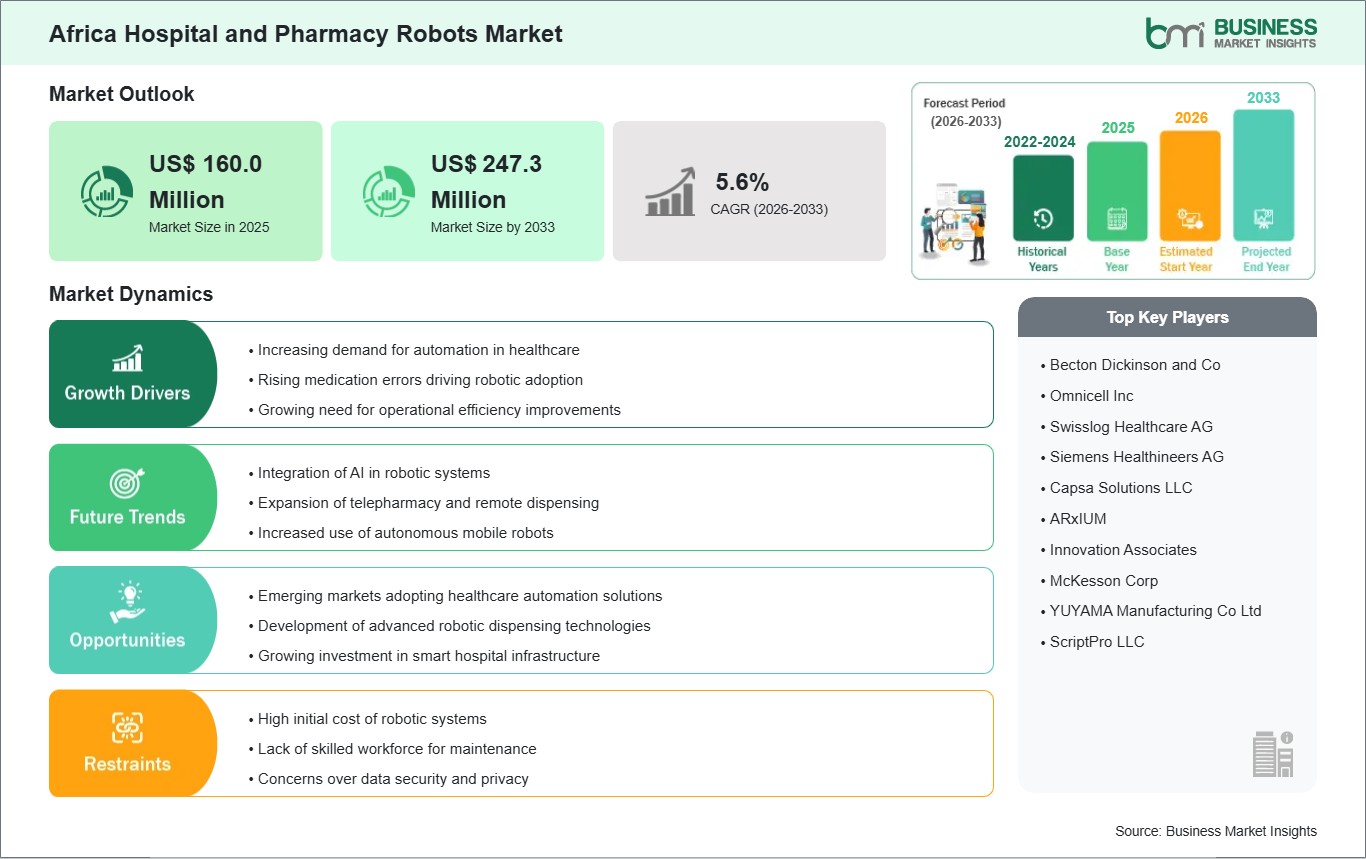
The Africa hospital and pharmacy robots market is emerging as healthcare institutions across the continent seek operational efficiency, improved patient safety, and advanced clinical support technologies. The market is characterized by the introduction of robotic systems across surgical assistance, pharmacy automation, hospital logistics, and rehabilitation functions. These technologies are adopted by tertiary hospitals, private healthcare networks, and technologically advanced medical centers that aim to enhance treatment accuracy and reduce manual workload for healthcare professionals. Automation tools in pharmacy departments, including robotic medication dispensing and compounding systems, are gaining traction as they help minimize human errors, optimize inventory management, and improve medication traceability. From an analytical perspective, demand for robotic solutions in African healthcare settings is closely linked to broader digital transformation initiatives within hospitals. Hospitals are integrating robotics with electronic medical records, imaging systems, and clinical decision-support platforms to streamline workflows and ensure consistent quality of care. Robotics also enables hospitals to automate repetitive tasks such as medication delivery, inventory management, and patient assistance, allowing healthcare professionals to focus more on clinical decision-making and patient interaction. The growing emphasis on infection control and operational resilience in healthcare facilities is shaping the market. Autonomous robots designed for disinfection and sanitation are adopted to reduce hospital-acquired infections and maintain sterile clinical environments. Similarly, telepresence robots and remote monitoring platforms are supporting healthcare delivery in remote or underserved areas by enabling physicians to conduct virtual consultations and supervise patient care without being physically present. However, the market remains in a developmental phase due to infrastructure and investment constraints. Many healthcare facilities across the continent operate with limited budgets and face shortages of skilled technicians capable of operating advanced robotic systems. Additionally, inconsistent electricity supply, regulatory fragmentation, and limited local manufacturing capacity present operational challenges for large-scale deployment. Despite these barriers, the Africa hospital and pharmacy robots market demonstrates strong strategic potential. Continuous healthcare modernization programs, expanding private hospital networks, and increasing collaborations between medical institutions and global technology vendors are expected to gradually strengthen the ecosystem for robotic healthcare solutions across the continent.
Segment Analysis
Africa Hospital and Pharmacy Robots Market Segmentation
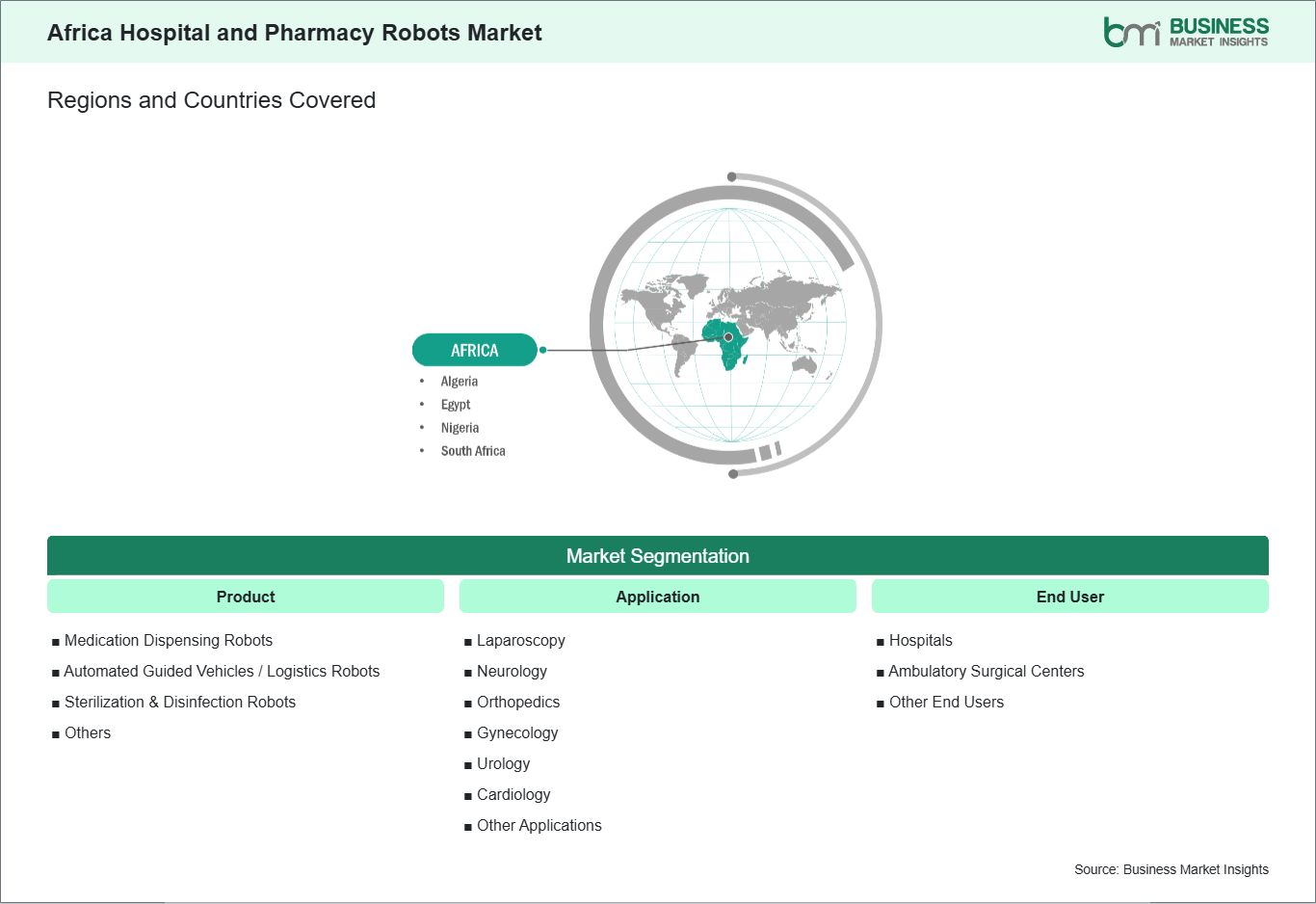
Key segments that contributed to the derivation of the Africa hospital and pharmacy robots market analysis are product, application, and end user.
- By product, the hospital and pharmacy robots market is segmented into medication dispensing robots, automated guided vehicles (agvs) / logistics robots, sterilization & disinfection robots, and other products. The medication dispensing robots segment dominated the market in 2025.
- In terms of application, the hospital and pharmacy robots market is categorized into laparoscopy, neurology, orthopedics, gynecology, urology, cardiology, and other applications. The laparoscopy segment dominated the market in 2025.
- Based on end user, the market is classified into hospitals, ambulatory surgical centers, and other end users. The hospitals segment dominated the market in 2025.
Market Forces
Africa Hospital and Pharmacy Robots Market Drivers and Opportunities
Rising demand for hospital automation
The demand for hospital automation is increasing across Africa as healthcare systems work to improve efficiency, address workforce shortages, and enhance patient care delivery. Several hospitals across the region rely on manual processes for routine tasks such as supply transport, patient record handling, and equipment movement. As patient volumes grow and healthcare facilities expand, these manual processes often create operational delays and place additional pressure on healthcare staff. Hospital automation technologies, including robotic systems, are explored as a practical solution to streamline workflows, reduce administrative burdens, and allow medical professionals to focus more on clinical responsibilities. Hospital robots are considered for a wide range of support functions within healthcare facilities. These systems can assist with tasks such as delivering medical supplies, transporting laboratory samples, managing internal logistics, and supporting cleaning and sanitation activities. By automating repetitive and time-consuming activities, hospitals can improve operational coordination and ensure that essential resources reach the right departments more efficiently. In environments where healthcare personnel are often limited and workloads are high, robotic automation helps optimize the use of available staff while improving service delivery within hospitals. Healthcare infrastructure development across several African countries is also encouraging interest in hospital automation solutions. Governments and private healthcare providers are investing in new medical facilities, modern equipment, and digital healthcare technologies to strengthen service quality and accessibility. As hospitals are designed or upgraded with more advanced technology environments, robotic systems are becoming a complementary component of modern healthcare operations. The integration of automation tools supports improved workflow management, enhances infection control practices, and contributes to more organized hospital environments. As awareness of these benefits grows, hospital automation is expected to play an important role in the transformation of healthcare operations across Africa.
AI-powered robotic medication dispensing systems
AI-powered robotic medication dispensing systems are gaining attention in Africa as healthcare providers seek safer and more efficient ways to manage pharmaceutical operations. Medication management in several hospitals and pharmacies involves several manual steps, including prescription verification, drug selection, labeling, and dispensing. These processes can be time-consuming and may increase the risk of human error when pharmacy staff are managing large numbers of prescriptions. Robotic dispensing systems supported by artificial intelligence can automate many of these functions, allowing pharmacies to organize, track, and distribute medications more accurately while maintaining consistent quality standards. These robotic systems are designed to store medications in automated cabinets or compartments and dispense them according to digital prescriptions entered by healthcare professionals. Artificial intelligence can assist by verifying prescription details, monitoring medication inventory levels, and identifying potential dispensing conflicts. This approach helps pharmacists maintain greater control over drug management while improving the speed of prescription processing. In busy hospital environments, automated dispensing solutions can reduce waiting times for medication preparation and allow pharmacy staff to focus on patient counseling and clinical support rather than manual dispensing tasks. The growing emphasis on digital healthcare transformation in Africa is also encouraging the introduction of advanced pharmacy automation technologies. Hospitals and pharmacy chains are adopting integrated healthcare management systems that connect patient records, prescription platforms, and pharmaceutical inventories. AI-enabled robotic dispensing systems can integrate with these digital platforms, creating a more coordinated medication management process across healthcare departments. As healthcare providers continue to prioritize patient safety, medication accuracy, and operational efficiency, AI-driven robotic dispensing technologies are expected to become an important component of modern pharmacy operations in Africa’s evolving healthcare landscape.
Size and Share Analysis
Africa Hospital and Pharmacy Robots Market Size and Share Analysis
The Africa hospital and pharmacy robots market demonstrates steady growth, with size and share analysis highlighting evolving trends and competitive dynamics among key players. The report examines subsegments categorized within product, application, and end user, offering insights into their contribution to overall market performance.
By product, the medication dispensing robots subsegment dominated the market in 2025, driven by the rising need for accurate, high-volume prescription handling and the reduction of medication errors through automated pharmacy workflows.
In terms of application, the laparoscopy subsegment dominated the market in 2025, driven by increasing demand for minimally invasive surgeries that improve surgical precision, reduce recovery time, and enhance patient outcomes.
Based on end user, the hospitals subsegment dominated the market in 2025, driven by the high volume of medication management and growing adoption of robotic automation to improve workflow efficiency and patient safety in hospital settings.
Report Coverage
Africa Hospital and Pharmacy Robots Market Report Coverage and Deliverables
The "Africa Hospital and Pharmacy Robots Market Size and Forecast (2022–2033)" report provides a detailed analysis of the market covering below areas:
- Africa Hospital and Pharmacy Robots Market size and forecast at regional and country levels for all segments covered under the scope
- Africa Hospital and Pharmacy Robots Market trends, as well as drivers, restraints, and opportunities
- Africa Hospital and Pharmacy Robots Market analysis covering key trends, regional framework, major players, regulations, and recent developments
- Industry landscape and competition analysis covering market concentration, heat map analysis, prominent players, and recent developments for the Africa Hospital and Pharmacy Robots Market
- Detailed company profiles, including SWOT analysis
Geographic Insights
Africa Hospital and Pharmacy Robots Market Geographic Insights
The geographical scope of the Africa Hospital and Pharmacy Robots Market report is divided into Egypt, South Africa, Nigeria, and Algeria. Nigeria held the largest share in 2025.
Country-level dynamics influence the development of the Africa hospital and pharmacy robots market, as adoption patterns vary based on healthcare investment, infrastructure readiness, and technology integration initiatives. Among the key countries analyzed, Nigeria has emerged as the dominant market due to its expanding healthcare infrastructure, rising demand for advanced treatment technologies, and strong government interest in modernizing hospital operations. The country’s large population and increasing burden on healthcare facilities have accelerated the need for automation solutions that improve efficiency in medication management, surgical procedures, and hospital logistics. Nigerian hospitals are introducing robotic-assisted surgical platforms and automated pharmacy dispensing systems to improve clinical precision and reduce medication errors. Additionally, partnerships between healthcare institutions and international medical technology providers are facilitating knowledge transfer and supporting the integration of robotics into hospital workflows. South Africa represents one of the most technologically mature healthcare markets in Africa and continues to play a key role in advancing medical robotics adoption. The presence of well-established private hospital networks, advanced research institutions, and skilled medical professionals has enabled the country to adopt sophisticated robotic systems across surgical and rehabilitation applications. Hospitals in South Africa are investing in robotic-assisted surgery platforms to enhance procedural accuracy and improve patient recovery outcomes. Furthermore, the country’s emphasis on digital healthcare infrastructure and clinical innovation supports the adoption of robotics in pharmacy automation, particularly in large tertiary hospitals where medication management processes require high levels of efficiency and precision. Egypt is witnessing growing interest in hospital robotics as part of broader healthcare modernization strategies. The government’s initiatives to upgrade hospital infrastructure and expand specialized treatment centers are creating opportunities for robotic technologies in surgical assistance and hospital service automation. Several leading hospitals in Egypt are evaluating robotic systems to enhance minimally invasive procedures and improve operational efficiency in pharmacy departments. The country’s expanding medical education sector is encouraging research and training programs that support the integration of robotics into clinical practice. Algeria is emerging as a developing market for hospital and pharmacy robots, supported by increased healthcare expenditure and modernization efforts within public hospitals. The government’s focus on strengthening healthcare services and improving hospital management systems is driving interest in automation technologies. Although adoption remains at an early stage, Algerian hospitals are exploring robotic systems for pharmacy inventory management, medication dispensing, and patient assistance services, indicating steady progress toward technologically advanced healthcare facilities.
Industry Activity
Recent Developments
The Africa hospital and pharmacy robots market is evaluated by gathering qualitative and quantitative data post primary and secondary research, which includes important corporate publications, association data, and databases. A few of the key developments in the Africa hospital and pharmacy robots market are:
- In December 2025, MicroPort MedBot, in partnership with RoboMed Global, launched the Toumai robotic surgical system in Nigeria after regulatory approval by the National Agency for Food and Drug Administration and Control. The system was deployed at NISA Premier Hospital, marking the first robotic surgery platform approved in West Africa. The launch enables minimally invasive robotic procedures with improved surgical precision and faster patient recovery. The companies also announced expansion plans to deploy robotic surgery programs across hospitals in West Africa.
- In January 2026, Morocco Ministry of Health and Social Protection launched a robotic surgery platform using the Revo-i surgical robot at Mohammed VI University Hospital. The system provides high-definition 3D visualization and precise robotic instrument control for complex surgeries. It aims to enhance surgical accuracy while reducing complications and recovery time. The initiative is part of Morocco’s broader strategy to modernize healthcare technology infrastructure.
Trust & Transparency
Research Methodology
The market analysis combines proprietary research with secondary data from government agencies, company disclosures, regulatory filings, industry databases and expert interviews. Market estimates are validated through data triangulation, cross-market benchmarking and analyst
review.
View Full Research Methodology
Key Sources Referred:
World Health Organization (WHO)Organisation for Economic Cooperation and Development (OECD)The World Bank GroupWorldometerThe LancetInternational Bar AssociationInternational Trade Administration