Market Summary
Executive Summary and Market Analysis
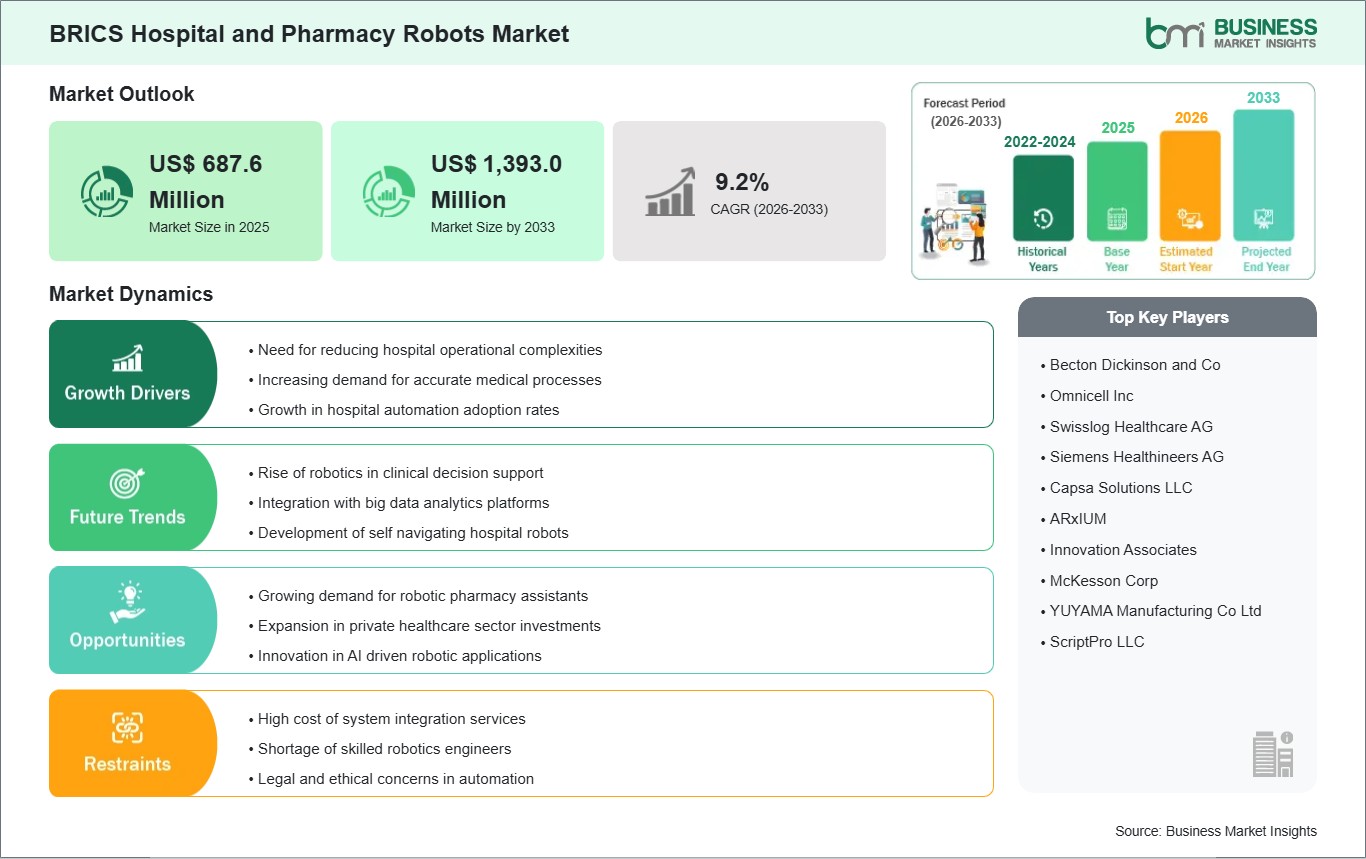
The BRICS hospital and pharmacy robots market is gaining momentum as healthcare systems in emerging economies increasingly adopt automation technologies to improve clinical efficiency, medication management, and hospital logistics. Hospitals across Brazil, Russia, India, China, and South Africa are experiencing growing patient volumes, which is prompting healthcare administrators to invest in robotic solutions that can streamline pharmacy operations and support hospital service workflows. Automation technologies are particularly valuable in large tertiary hospitals where medication dispensing accuracy, pharmaceutical inventory management, and sterile drug preparation require consistent precision. As a result, hospital and pharmacy robots are gradually becoming an integral component of modern healthcare infrastructure within the BRICS region. Healthcare institutions are primarily adopting robotic solutions to address operational inefficiencies and minimize medication-related risks. Pharmacy robots are capable of handling repetitive tasks such as drug sorting, packaging, labeling, and dispensing, which significantly reduces manual intervention and lowers the probability of medication errors. Hospitals are also leveraging automated systems to manage high-density pharmaceutical inventories, allowing pharmacists to track stock movement in real time and optimize medication storage. These capabilities help healthcare providers maintain better control over pharmaceutical supply chains and ensure uninterrupted medication availability. Another important aspect influencing market development is the modernization of hospital infrastructure across BRICS countries. Governments and private healthcare providers are investing in advanced hospital facilities that incorporate digital health technologies and automated medical equipment. In this environment, robotics is increasingly integrated into pharmacy management systems and hospital information platforms, enabling seamless coordination between prescription processing and medication dispensing. Such integration improves operational transparency and enhances the efficiency of clinical workflows. Additionally, rising awareness about healthcare quality and patient safety is encouraging hospitals to adopt technologies that support standardized medication handling practices. Robotic pharmacy systems allow healthcare providers to maintain consistent dispensing protocols and improve traceability in medication management processes. This is particularly important in large hospital networks where maintaining uniform pharmacy operations can be challenging. The BRICS hospital and pharmacy robots market is characterized by gradual but steady adoption driven by healthcare modernization, operational efficiency requirements, and growing emphasis on medication safety. As hospitals continue to expand automation capabilities, robotics is expected to play a strategic role in optimizing pharmacy operations and improving healthcare delivery across the region.
Segment Analysis
BRICS Hospital and Pharmacy Robots Market Segmentation
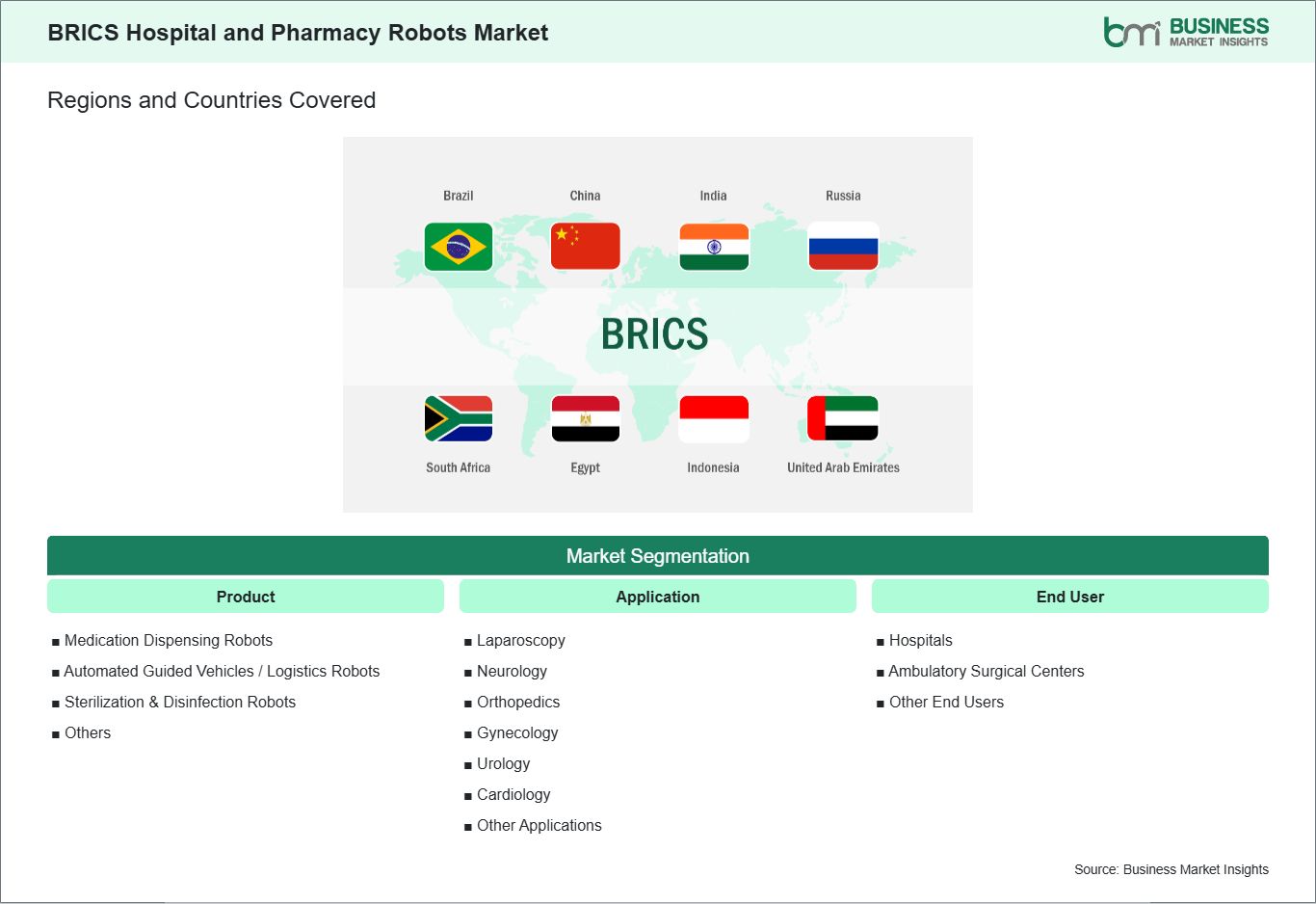
Key segments that contributed to the derivation of the BRICS hospital and pharmacy robots market analysis are product, application, and end user.
- By product, the hospital and pharmacy robots market is segmented into medication dispensing robots, automated guided vehicles (AGVs) / logistics robots, sterilization & disinfection robots and other products. The medication dispensing robots segment dominated the market in 2025.
- In terms of application, the hospital and pharmacy robots market is categorized into laparoscopy, neurology, orthopedics, gynecology, urology, cardiology and other applications. The laparoscopy segment dominated the market in 2025.
- Based on end user, the market is classified into hospitals, ambulatory surgical centers and other end users. The hospitals segment dominated the market in 2025.
Market Forces
BRICS Hospital and Pharmacy Robots Market Drivers and Opportunities
Rising healthcare investments in automation
Healthcare systems across the BRICS nations—Brazil, Russia, India, China, and South Africa—are undergoing rapid transformation as governments and private healthcare providers increase investments in modern medical technologies. Rising patient populations, urbanization, and the growing burden of chronic diseases are placing pressure on hospitals to deliver faster and more accurate healthcare services. To address these challenges, many healthcare institutions are allocating resources toward automation technologies that can improve operational efficiency and support medical staff. Hospital and pharmacy robots are increasingly viewed as strategic investments because they help streamline routine tasks, improve medication handling, and reduce administrative workloads in high-volume healthcare environments. In China, the expansion of large hospital networks and smart hospital initiatives has encouraged healthcare providers to incorporate robotic systems in pharmacy departments and hospital logistics operations. Similarly, India’s rapidly growing private hospital sector is investing in digital infrastructure and automation tools to improve patient service quality and operational management. Brazil’s healthcare sector is also witnessing gradual adoption of robotic technologies in advanced medical facilities and research-oriented hospitals. These developments reflect a broader regional shift toward integrating automation into healthcare operations, particularly in institutions that handle large patient volumes and complex clinical workflows. South Africa and Russia are also strengthening their healthcare infrastructure by introducing new technologies that enhance efficiency in medical facilities. Investments in digital healthcare platforms and automated medical equipment are creating opportunities for robotics to be integrated into pharmacy management and hospital support services. As healthcare budgets expand and modernization initiatives accelerate, hospital administrators across the BRICS region are prioritizing technologies that deliver long-term operational value. Robotics solutions that assist with medication dispensing, supply transport, and inventory management are therefore gaining attention as part of broader healthcare transformation strategies aimed at improving efficiency and patient safety.
Deployment of advanced robotic pharmacy infrastructure
The deployment of advanced robotic pharmacy infrastructure is emerging as a key trend across the BRICS healthcare market. Hospital pharmacies are increasingly adopting automated systems that can handle tasks such as medication storage, retrieval, packaging, and dispensing. These robotic solutions are designed to operate with integrated pharmacy management software, enabling hospitals to create highly organized medication workflows. In large metropolitan hospitals in countries such as China and Brazil, pharmacy automation is helping institutions manage extensive medication inventories while ensuring that prescriptions are processed accurately and efficiently. In India and China, healthcare providers are particularly focused on implementing robotic pharmacy systems in high-capacity hospital environments where prescription volumes are significantly higher than in smaller medical facilities. Automated dispensing units and robotic compounding systems help reduce manual handling of medications and support better control over pharmaceutical inventory. These systems also improve traceability by recording each stage of medication preparation and distribution, which strengthens patient safety protocols and regulatory compliance. As hospital networks expand in major urban centers, robotic infrastructure is becoming an important element of modern pharmacy management. South Africa and Russia are also exploring the benefits of robotic pharmacy technologies in both public and private healthcare facilities. Advanced robotic systems can support centralized pharmacy operations by organizing medication storage and enabling rapid dispensing to multiple hospital departments. This approach improves coordination between pharmacy units and clinical wards, ensuring that medications reach patients more quickly and with fewer operational delays. As healthcare providers across the BRICS countries continue to modernize their infrastructure, the deployment of robotic pharmacy solutions is expected to expand steadily, supporting efficient medication management and strengthening the overall performance of hospital pharmacy systems.
Size and Share Analysis
BRICS Hospital and Pharmacy Robots Market Size and Share Analysis
The BRICS ssssss demonstrates steady growth, with size and share analysis highlighting evolving trends and competitive dynamics among key players. The report examines subsegments categorized within product, application, and end user, offering insights into their contribution to overall market performance.
By product, the medication dispensing robots subsegment dominated the market in 2025, driven by the increasing need to automate pharmacy workflows to minimize medication errors and improve accuracy in high-volume drug dispensing.
In terms of application, the laparoscopy subsegment dominated the market in 2025, driven by the growing preference for robotic-assisted minimally invasive surgeries that enhance surgical precision and shorten patient recovery time.
Based on end user, the hospitals subsegment dominated the market in 2025, driven by the high volume of surgical procedures and stronger infrastructure that supports the adoption of advanced robotic technologies for clinical and operational efficiency.
Report Coverage
BRICS Hospital and Pharmacy Robots Market Report Coverage and Deliverables
The "BRICS Hospital and Pharmacy Robots Market Size and Forecast (2022–2033)" report provides a detailed analysis of the market covering below areas:
- BRICS Hospital and Pharmacy Robots Market size and forecast at regional and country levels for all segments covered under the scope
- BRICS Hospital and Pharmacy Robots Market trends, as well as drivers, restraints, and opportunities
- BRICS Hospital and Pharmacy Robots Market analysis covering key trends, regional framework, major players, regulations, and recent developments
- Industry landscape and competition analysis covering market concentration, heat map analysis, prominent players, and recent developments for the BRICS Hospital and Pharmacy Robots Market
- Detailed company profiles, including SWOT analysis
Geographic Insights
BRICS Hospital and Pharmacy Robots Market Geographic Insights
The geographical scope of the BRICS Hospital and Pharmacy Robots Market report is divided into Russia, Brazil, South Africa, India, the UAE, and China. China held the largest share in 2025.
Country-level dynamics in the BRICS hospital and pharmacy robots market exhibit significant variation, with China emerging as the dominant market due to its advanced healthcare infrastructure, government-led hospital modernization programs, and high adoption of automation technologies. Large urban hospitals in China are increasingly implementing robotic pharmacy systems for automated dispensing, compounding, and inventory management. In addition, autonomous mobile robots for internal hospital logistics are becoming common in tertiary hospitals, enabling faster delivery of medications, lab samples, and medical supplies while reducing manual handling. Integration of robotics with electronic health records and hospital management systems further strengthens operational efficiency and patient safety, reinforcing China’s leadership position in the region. India represents a rapidly growing market driven by the expansion of private healthcare providers and multispecialty hospitals. High prescription volumes and complex pharmaceutical regimens are motivating hospital administrators to adopt robotic dispensing solutions and automated medication storage systems. These technologies help reduce errors, optimize workflow, and allow pharmacists to focus on patient-centric activities. Emerging hospitals in tier-2 and tier-3 cities are also gradually integrating compact robotic systems to enhance pharmacy productivity despite limited infrastructure. Brazil is witnessing selective adoption of hospital robotics, primarily in major metropolitan centers where advanced healthcare facilities are located. Robotic pharmacy solutions in Brazil focus on improving medication traceability, inventory management, and compliance with regulatory standards. Hospitals are increasingly interested in automation to reduce operational inefficiencies in high-volume pharmacies and ensure reliable access to medications. Russia is gradually exploring automation as part of broader healthcare modernization initiatives. Government-supported programs encourage hospitals to integrate robotic systems for pharmacy operations, internal logistics, and sterile compounding. Adoption remains concentrated in urban and academic hospitals, where robotics can address workforce constraints and improve operational reliability. South Africa demonstrates moderate adoption of hospital and pharmacy robotics, largely driven by private hospitals in major cities. Robotics is viewed as a solution to optimize pharmacy workflow, improve medication dispensing accuracy, and enhance patient safety, particularly in high-capacity hospital settings. The UAE, though not a BRICS country, is included in this regional analysis due to its advanced healthcare infrastructure and strong investment in medical technology. Hospitals in the UAE are increasingly deploying robotics for automated dispensing, sterile compounding, and internal logistics, positioning the country as a high-potential market for intelligent pharmacy solutions. These countries show a diverse adoption landscape, with China clearly leading due to technological readiness and large-scale hospital deployments, while India, Brazil, Russia, South Africa, and the UAE represent emerging or niche markets with significant growth potential.
Industry Activity
Recent Developments
The BRICS Hospital and Pharmacy Robots Market is evaluated by gathering qualitative and quantitative data post primary and secondary research, which includes important corporate publications, association data, and databases. A few of the key developments in the BRICS hospital and pharmacy robots market are:
- In February 2026, Sri Ramachandra Medical Centre launched advanced robotic‑assisted surgical technology by installing an Intuitive da Vinci surgical system to support complex procedures. The system enhances precision and expands surgical capabilities in areas like urology and general surgery under robot‑assisted control. This launch marks another growth milestone in Indian hospital robotics adoption, offering high‑tech surgery options locally. Broader adoption of such robotic systems in BRICS healthcare settings reflects rising demand for minimally invasive and high‑precision surgical care.
- In May 2023, the Honghu Orthopedic Surgical Robot (marketed overseas as SkyWalker) developed by MicroPort MedBot was approved for market entry in Brazil, becoming one of the first advanced surgical robots certified for use there. Honghu assists surgeons in robot‑assisted joint replacement procedures with CT‑guided robotic arms, expanding access to precision orthopaedic surgery. This approval marked a significant expansion of Chinese surgical robotics into the Latin American healthcare market, supporting multiple clinical applications. The rollout in Brazilian hospitals helps accelerate adoption of advanced robotics across the BRICS region.
Trust & Transparency
Research Methodology
The market analysis combines proprietary research with secondary data from government agencies, company disclosures, regulatory filings, industry databases and expert interviews. Market estimates are validated through data triangulation, cross-market benchmarking and analyst
review.
View Full Research Methodology
Key Sources Referred:
World Health Organization (WHO)Organisation for Economic Cooperation and Development (OECD)The World Bank GroupWorldometerThe LancetInternational Bar AssociationInternational Trade Administration