Market Summary
Executive Summary and Market Analysis
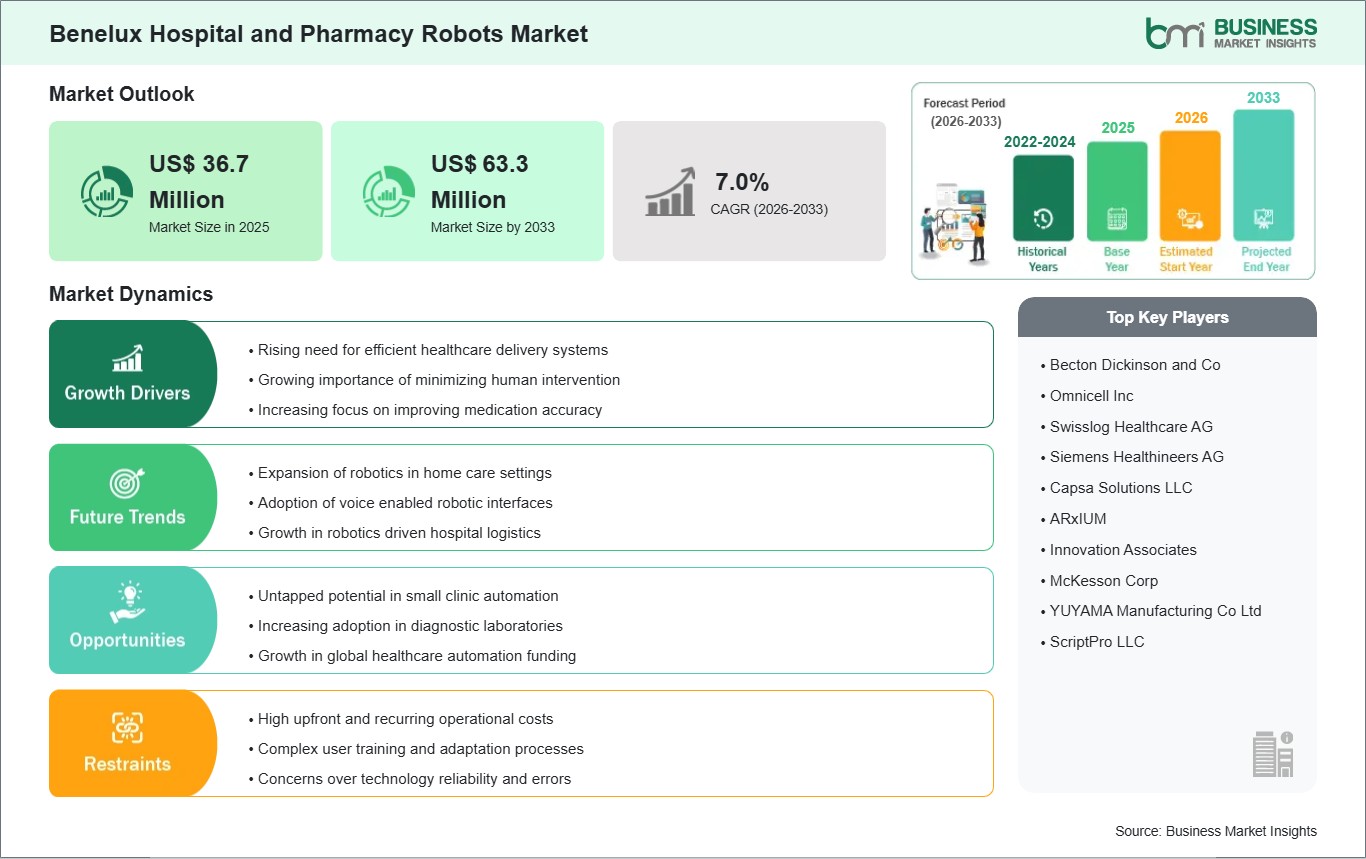
The Benelux hospital and pharmacy robots market is experiencing steady transformation as healthcare providers across Belgium, the Netherlands, and Luxembourg increasingly focus on improving operational precision, workflow standardization, and pharmaceutical supply chain control. Hospitals in the region are progressively adopting robotic technologies to automate medication dispensing, sterile compounding, packaging, and pharmacy inventory management. These solutions enable healthcare institutions to reduce dependency on manual processes while maintaining consistent medication handling standards. In a region known for high healthcare quality expectations, robotics plays a strategic role in ensuring traceability, accuracy, and process transparency in hospital pharmacy environments. Healthcare systems in Benelux are also influenced by rising prescription complexity due to the growing prevalence of chronic conditions and specialized therapies. As medication regimens become more complex, hospital pharmacies require systems that can support controlled dispensing, dosage verification, and real-time inventory monitoring. Robotic systems are increasingly used to organize high-density medication storage and automated retrieval, which significantly improves dispensing speed and reduces delays in medication delivery to clinical units. This operational efficiency contributes to better coordination between pharmacists, nurses, and physicians. Another critical factor shaping the market is the increasing demand for process standardization across hospital networks. Many healthcare groups in the region operate multiple facilities and seek centralized pharmacy management models to optimize procurement and medication distribution. Robotics allows hospital pharmacies to implement standardized workflows and maintain consistent quality control across multiple locations. Automated systems also generate digital audit trails, supporting regulatory compliance and facilitating pharmaceutical reporting requirements. Technological maturity within the Benelux healthcare sector further strengthens market development. Hospitals are gradually incorporating robotics into broader digital health ecosystems that include electronic prescription systems, automated medication cabinets, and integrated hospital management platforms. This interoperability enables seamless data exchange between clinical and pharmacy systems, improving medication tracking from prescription to patient administration. The Benelux hospital and pharmacy robots market is characterized by strong institutional readiness for automation, a focus on patient safety, and a healthcare environment that encourages operational innovation. These elements collectively support the expansion of robotic solutions across hospital pharmacies and medication management systems, positioning the region as an active adopter of healthcare automation technologies.
Segment Analysis
Benelux Hospital and Pharmacy Robots Market Segmentation
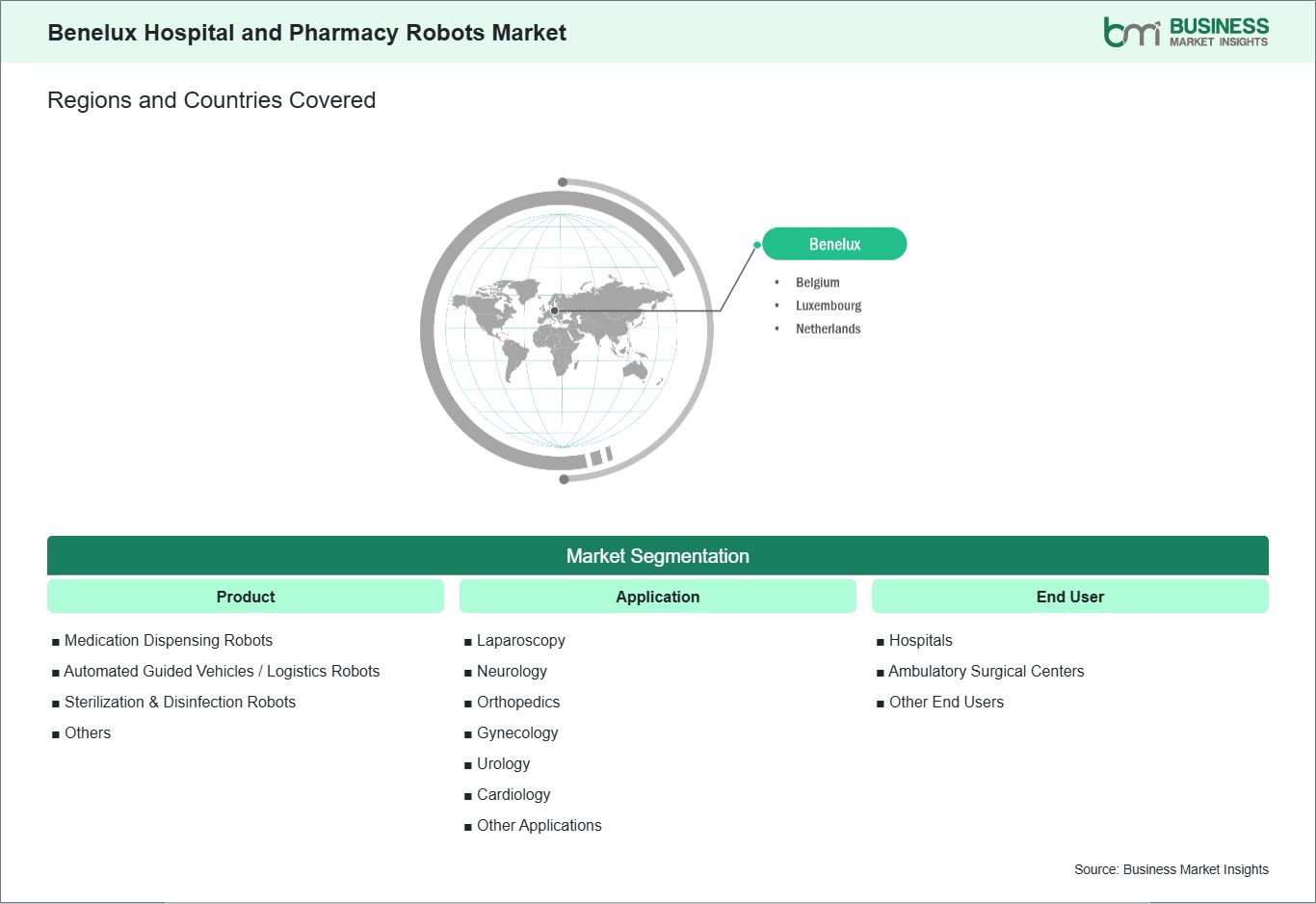
Key segments that contributed to the derivation of the Benelux hospital and pharmacy robots market analysis are product, application, and end user.
- By product, the hospital and pharmacy robots market is segmented into medication dispensing robots, automated guided vehicles (AGVs) / logistics robots, sterilization & disinfection robots and other products. The medication dispensing robots segment dominated the market in 2025.
- In terms of application, the hospital and pharmacy robots market is categorized into laparoscopy, neurology, orthopedics, gynecology, urology, cardiology and other applications. The laparoscopy segment dominated the market in 2025.
- Based on end user, the market is classified into hospitals, ambulatory surgical centers and other end users. The hospitals segment dominated the market in 2025.
Market Forces
Benelux Hospital and Pharmacy Robots Market Drivers and Opportunities
Growing hospital patient volumes worldwide
Hospitals in the Benelux region—comprising the Belgium, Netherlands, and Luxembourg—are experiencing steady growth in patient volumes due to aging populations, increasing prevalence of chronic diseases, and broader access to specialized medical services. Healthcare systems across these countries are known for their advanced infrastructure and strong public healthcare coverage, which attracts patients not only domestically but also from neighboring European regions seeking high-quality treatment. As patient admissions and outpatient consultations increase, hospitals are required to manage larger medication inventories and more complex pharmacy workflows. This rising service demand is placing pressure on hospital pharmacies to maintain accuracy and speed in medication dispensing while supporting multiple clinical departments simultaneously. In large teaching hospitals and regional medical centers across the Benelux area, pharmacy departments handle thousands of prescriptions daily for both inpatient and outpatient services. These facilities must coordinate medication preparation, storage, and distribution across various wards such as oncology, emergency care, and intensive care units. As hospital systems expand and patient flows increase, pharmacy teams often struggle to keep pace with growing operational demands using traditional manual processes. The complexity of medication management becomes even more pronounced in hospitals that treat patients with chronic conditions requiring multiple prescriptions and personalized dosage adjustments. This environment creates a strong need for advanced automation tools that can help hospitals handle large prescription volumes while maintaining high safety standards. Healthcare providers across the region are therefore prioritizing digital transformation initiatives that include pharmacy automation and robotics. Smart hospital strategies adopted in the Netherlands and Belgium encourage the integration of advanced technologies to streamline workflows and support patient safety initiatives. These developments align with broader European healthcare modernization efforts, where hospitals are increasingly adopting automated systems to reduce manual workload and improve operational efficiency. As hospital patient volumes continue to grow across the Benelux healthcare landscape, robotics is emerging as a strategic solution that enables hospitals to scale their pharmacy operations while ensuring reliable medication management and timely patient care.
High-capacity robotic prescription processing systems
High-capacity robotic prescription processing systems are becoming an important component of modern hospital pharmacy operations in the Benelux region. These advanced systems are designed to automate tasks such as medication storage, retrieval, packaging, labeling, and dispensing. By integrating robotics with pharmacy management software, hospitals can create streamlined workflows that reduce manual handling of medications and minimize the risk of dispensing errors. Robotic prescription processing is particularly valuable in large hospital networks where pharmacy departments must handle high volumes of medication orders from multiple clinical units throughout the day. Hospitals in Belgium and the Netherlands have already begun implementing centralized robotic pharmacy solutions as part of broader digital healthcare initiatives. For example, the Grand Hôpital de Charleroi introduced a modular pharmacy automation system designed to manage medication preparation and distribution for hundreds of hospital beds. The system automates packaging and therapy preparation processes within the hospital pharmacy, enabling consistent and efficient medication handling across departments. Such deployments illustrate how robotic technologies can transform pharmacy workflows by ensuring that prescriptions are processed quickly while maintaining strict safety and traceability standards. High-capacity robotic prescription systems also improve inventory management and medication traceability within hospital pharmacies. These systems rely on technologies such as barcode scanning and integrated software platforms to track medications from storage to patient delivery. Robots can automatically retrieve drugs from storage units, verify prescription details, and prepare them for dispensing with minimal human intervention. This automation improves operational transparency and helps hospitals maintain accurate inventory records while reducing the likelihood of medication shortages or misplaced stock. As healthcare facilities across the Benelux region continue to modernize their pharmacy operations, high-capacity robotic processing systems are expected to become a cornerstone of efficient, safe, and scalable medication management.
Size and Share Analysis
Benelux Hospital and Pharmacy Robots Market Size and Share Analysis
The Benelux hospital and pharmacy robots market demonstrates steady growth, with size and share analysis highlighting evolving trends and competitive dynamics among key players. The report examines subsegments categorized within product, application, and end user, offering insights into their contribution to overall market performance.
By product, the medication dispensing robots subsegment dominated the market in 2025, driven by the growing need for automated pharmacy systems that improve dispensing accuracy, reduce medication errors, and enhance prescription processing efficiency.
In terms of application, the laparoscopy subsegment dominated the market in 2025, driven by the increasing adoption of robotic-assisted minimally invasive procedures that provide greater surgical precision and faster patient recovery.
Based on end user, the hospitals subsegment dominated the market in 2025, driven by their high surgical volumes and greater capacity to invest in advanced robotic technologies and supporting infrastructure.
Report Coverage
Benelux Hospital and Pharmacy Robots Market Report Coverage and Deliverables
The "Benelux Hospital and Pharmacy Robots Market Size and Forecast (2022–2033)" report provides a detailed analysis of the market covering below areas:
- Benelux Hospital and Pharmacy Robots Market size and forecast at regional and country levels for all segments covered under the scope
- Benelux Hospital and Pharmacy Robots Market trends, as well as drivers, restraints, and opportunities
- Benelux Hospital and Pharmacy Robots Market analysis covering key trends, regional framework, major players, regulations, and recent developments
- Industry landscape and competition analysis covering market concentration, heat map analysis, prominent players, and recent developments for the Benelux Hospital and Pharmacy Robots Market
- Detailed company profiles, including SWOT analysis
Geographic Insights
Benelux Hospital and Pharmacy Robots Market Geographic Insights
The geographical scope of the Benelux Hospital and Pharmacy Robots Market report is divided into Belgium, the Netherlands, and Luxembourg. The Netherlands held the largest share in 2025.
The Benelux hospital and pharmacy robots market demonstrates distinct country-level dynamics across Belgium, the Netherlands, and Luxembourg, with each nation contributing to the regional automation landscape through different healthcare priorities, regulatory frameworks, and technological maturity. Among these countries, the Netherlands represents the dominant market, supported by its highly digitized healthcare infrastructure, strong hospital automation initiatives, and early adoption of advanced robotics technologies. Dutch healthcare institutions have been proactive in deploying robotic dispensing systems, automated medication storage units, and hospital logistics robots to improve operational accuracy and streamline pharmacy workflows. The country’s strong emphasis on healthcare innovation, combined with extensive integration of electronic health records and hospital information systems, has enabled seamless implementation of robotic platforms in both centralized hospital pharmacies and decentralized clinical units. Belgium also represents a significant contributor to the Benelux hospital and pharmacy robots market, particularly due to its established medical technology ecosystem and the presence of prominent research institutions specializing in healthcare engineering and robotics. Hospitals in Belgium are increasingly investing in automation solutions that support medication preparation, sterile compounding, and automated inventory control. These systems are helping healthcare facilities improve regulatory compliance, reduce medication dispensing errors, and optimize pharmaceutical supply chain processes. Furthermore, Belgian healthcare providers often engage in collaborative partnerships with robotics developers and digital health companies to test and implement next-generation automation platforms within hospital environments. This collaborative innovation culture continues to strengthen Belgium’s position as an important technology development hub within the regional healthcare robotics market. Luxembourg, while comparatively smaller in terms of hospital infrastructure and healthcare system scale, is gradually expanding its adoption of robotic technologies within hospital pharmacy operations. Healthcare facilities in the country are focusing on selective deployment of automation systems that enhance medication handling accuracy, streamline pharmacy inventory management, and support hospital logistics operations. Government initiatives aimed at modernizing healthcare infrastructure and promoting digital health technologies are contributing to gradual robotics integration in clinical environments. Additionally, Luxembourg’s healthcare institutions often collaborate with international technology providers to introduce advanced automation platforms tailored to smaller yet highly specialized hospital networks. The Netherlands leads the Benelux hospital and pharmacy robots market in terms of technological adoption and implementation scale, while Belgium maintains a strong innovation-driven ecosystem and Luxembourg continues to expand its presence through targeted modernization efforts and strategic technology partnerships.
Industry Activity
Recent Developments
The Benelux Hospital and Pharmacy Robots Market is evaluated by gathering qualitative and quantitative data post primary and secondary research, which includes important corporate publications, association data, and databases. A few of the key developments in the Benelux hospital and pharmacy robots market are:
- In November 2024, the university hospital UZ Leuven in Belgium invested in four new advanced surgical robots to expand robotic-assisted procedures across multiple specialties. The systems support areas such as urology, gynecology, thoracic surgery, ENT, and reconstructive surgery. The deployment aims to enhance surgical precision and enable minimally invasive operations with improved patient outcomes. This expansion reflects the growing adoption of robotic surgery platforms across Benelux hospitals.
- In June 2023, Omnicell collaborated with Alphatron Medical in the Netherlands to launch the AMiS-PRO Smart Medication Cart, a robotic-assisted medication management system. The platform helps automate medication distribution and tracking in hospital pharmacies and wards. It enables nurses to safely dispense and manage medicines using digital authentication and barcode verification. The solution improves medication safety and streamlines pharmacy workflows in healthcare facilities.
Trust & Transparency
Research Methodology
The market analysis combines proprietary research with secondary data from government agencies, company disclosures, regulatory filings, industry databases and expert interviews. Market estimates are validated through data triangulation, cross-market benchmarking and analyst
review.
View Full Research Methodology
Key Sources Referred:
World Health Organization (WHO)Organisation for Economic Cooperation and Development (OECD)The World Bank GroupWorldometerThe LancetInternational Bar AssociationInternational Trade Administration