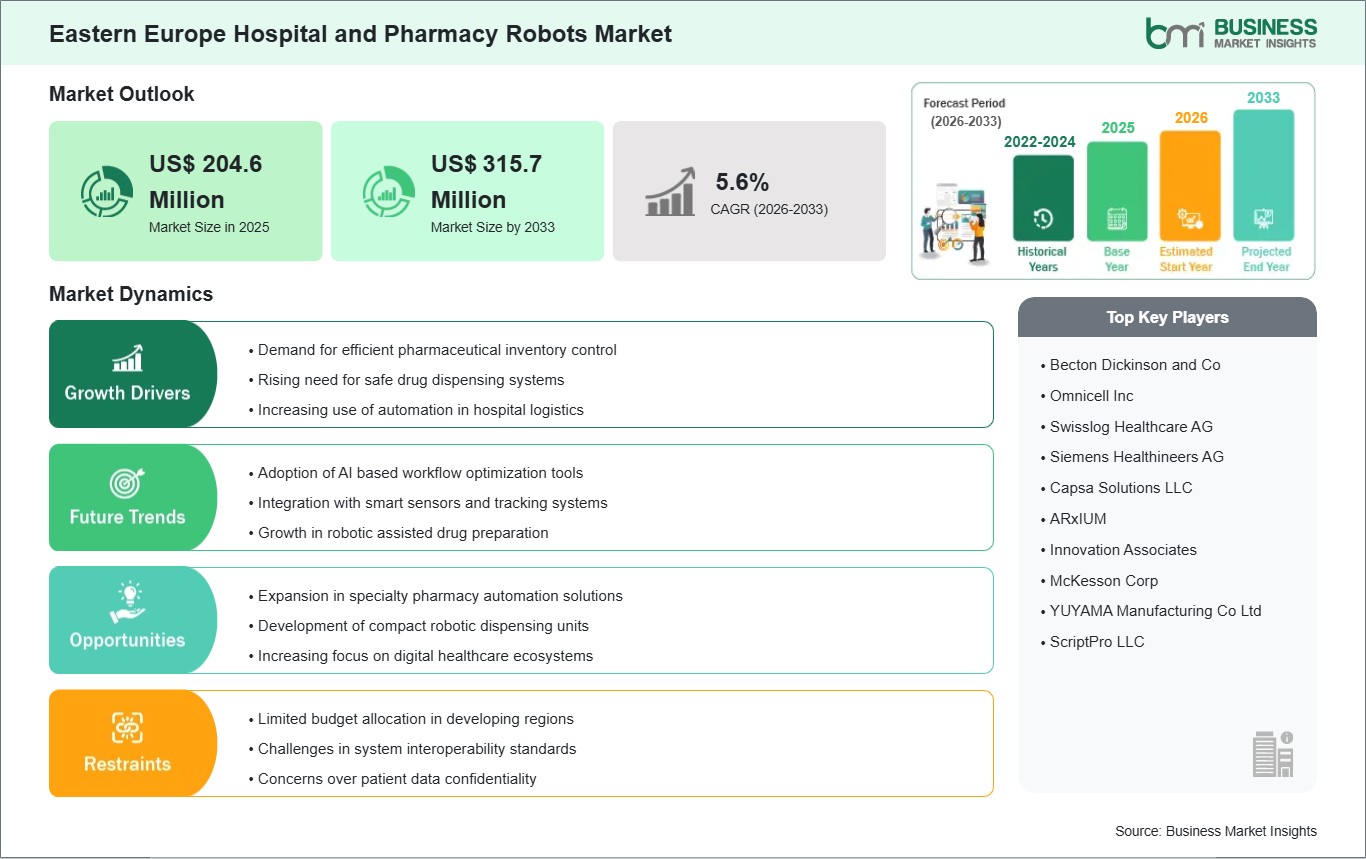
The Eastern Europe hospital and pharmacy robots market size is expected to reach US$315.7 million by 2033 from US$204.6 million in 2025. The market is estimated to record a CAGR of 5.6% from 2026 to 2033.
The Eastern Europe hospital and pharmacy robots market is witnessing gradual adoption as healthcare systems modernize and focus on improving operational efficiency, patient safety, and pharmaceutical management. Countries across this region, including Poland, Czechia, Hungary, and Romania, are investing in automation technologies to optimize hospital workflows, reduce human error in medication dispensing, and support staff shortages. Hospitals are increasingly integrating robotic solutions for repetitive pharmacy tasks, such as automated dispensing, compounding, labeling, and inventory management, which allows pharmacists to focus on patient care and clinical decision support. This strategic deployment of robotics is particularly relevant in tertiary care and academic hospitals, where prescription complexity and patient volumes are higher. Operational efficiency remains a primary driver for robotics adoption in Eastern Europe. Many hospitals in the region face increasing workloads combined with workforce constraints, making manual medication preparation and delivery time-consuming and prone to error. Pharmacy robots not only ensure consistent accuracy in dispensing but also support real-time inventory tracking, automated restocking, and error reduction. This is particularly critical in large hospital networks where decentralized pharmacies need standardized workflows to maintain compliance and minimize operational variability. Technological readiness in select Eastern European markets has accelerated adoption. Hospitals are increasingly integrating robotic pharmacy systems with digital health platforms, such as electronic prescription services and hospital information systems, enabling seamless communication between pharmacy and clinical departments. This interoperability enhances medication traceability, regulatory compliance, and workflow efficiency. Regulatory and patient safety considerations further support market growth. Pharmacy robots allow hospitals to implement standardized dispensing protocols, automated verification of prescriptions, and digital audit trails. This strengthens adherence to medication safety regulations and supports quality management initiatives. The Eastern Europe hospital and pharmacy robots market is characterized by emerging adoption driven by operational efficiency, digital integration, and safety-focused pharmacy management. While penetration remains limited compared to Western Europe, growing investment in automation and technology infrastructure is positioning the region for steady growth in robotics applications across hospitals and pharmacy operations.

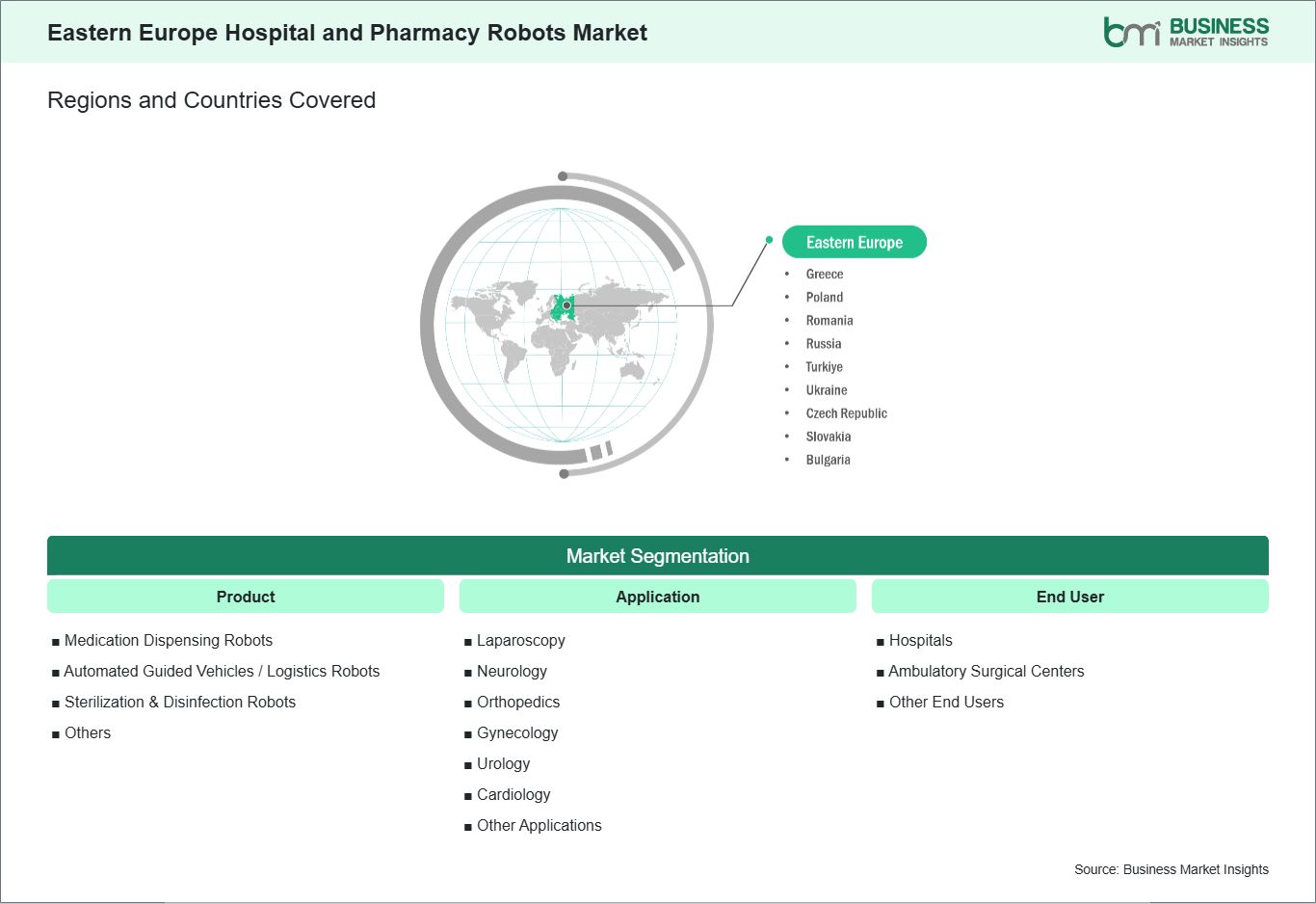
Key segments that contributed to the derivation of the Eastern Europe hospital and pharmacy robots market analysis are product, application, and end user.
Healthcare systems across Eastern Europe are increasingly focused on strengthening patient safety standards as governments and providers respond to rising demand for quality care. In countries such as Poland, Romania, and Hungary, hospital admissions have been growing steadily due to expanded access to healthcare services and an aging demographic requiring more frequent medical attention. With this rise in patient throughput, hospitals face mounting pressure to reduce preventable errors and ensure consistent care delivery. Traditional pharmacy practices and manual dispensing procedures have been identified as areas where inconsistencies can undermine patient safety, prompting healthcare leaders to explore ways to integrate more reliable systems into daily operations. Patient safety has become a central priority in national healthcare strategies throughout Eastern Europe. Ministries of Health and regional healthcare authorities are emphasizing frameworks that address clinical risk reduction, safe medication management, and workforce training. While efforts to upgrade clinical protocols and staff competencies continue, there is growing recognition that human error—particularly in busy hospital pharmacies—can compromise safety outcomes. In response, hospitals are examining how automation and robotics can help standardize safety‑critical processes, minimize variability in pharmacy tasks, and support clinicians in delivering more dependable care. The reputational and clinical impact of safety improvement initiatives has made investment in quality assurance technologies an important aspect of institutional planning. Eastern European healthcare facilities are also under scrutiny by patient advocacy groups and international quality accreditation organizations, which increasingly highlight the role of systematic process controls in improving safety performance. As part of quality improvement drives, hospitals in the region are evaluating how technology can mitigate risks associated with manual operations, especially in high‑pressure environments such as emergency departments, oncology units, and inpatient pharmacies. With safety standards gradually harmonizing with broader European Union benchmarks, healthcare providers in Eastern Europe are looking beyond incremental improvements toward solutions that can deliver measurable gains in reliability. In this context, robotics is emerging as an enabler of safer care pathways by reducing the likelihood of errors in medication handling and support services.
AI‑based medication verification robotic solutions are gaining attention in Eastern Europe as healthcare providers seek technologies that can improve accuracy and streamline pharmacy operations. These advanced robotic systems combine automation with artificial intelligence to perform checks that go beyond basic dispensing functions, including verifying drug identity, matching prescriptions against patient records, and ensuring correct dosage instructions. This level of intelligent verification is particularly valuable in high‑volume settings such as tertiary care hospitals and regional health networks in countries like Ukraine, Bulgaria, and Slovakia, where pharmacy workloads are increasing and expectations for safe medication delivery are rising. Unlike traditional automation that primarily focuses on mechanical tasks, AI‑enabled solutions can analyze data from electronic health records, pharmacy management systems, and robotic sensors to ensure that every step in the medication preparation process meets established safety parameters. This capability helps reduce the incidence of mismatches, omissions, and labeling errors that can occur when pharmacists must manually cross‑check numerous inputs under time pressure. By enhancing the accuracy of verification processes, robotics integrated with AI contribute to a safer medication supply chain and support pharmacy teams in maintaining higher standards of reliability. In environments where regulatory emphasis on quality and traceability is strengthening, such intelligent systems provide a complementary layer of assurance that elevates overall operational integrity. Adoption of AI‑based medication verification robotics is also influencing how hospitals in Eastern Europe manage pharmacy workflows and clinical coordination. These technologies can be embedded within centralized dispensing units or distributed across multiple hospital sites, enabling consistent verification practices regardless of organizational complexity. In larger health systems, robotics can help standardize processes across facilities that vary in size and specialization, creating a unified approach to medication accuracy. This harmonization not only improves patient safety outcomes but also supports compliance with internal audits and external quality evaluations. As Eastern European healthcare systems continue to modernize and strive for greater operational excellence, AI‑based medication verification robotics are positioned to play a meaningful role in achieving dependable, error‑resistant pharmacy services.
The Eastern Europe hospital and pharmacy robots market demonstrates steady growth, with size and share analysis highlighting evolving trends and competitive dynamics among key players. The report examines subsegments categorized within product, application, and end user, offering insights into their contribution to overall market performance.
By product, the medication dispensing robots subsegment dominated the market in 2025, driven by the growing adoption of automated systems to improve accuracy, reduce human errors, and streamline pharmacy operations.
In terms of application, the laparoscopy subsegment dominated the market in 2025, driven by the increasing use of robotic-assisted minimally invasive surgeries that enhance precision and reduce patient recovery time.
Based on end user, the hospitals subsegment dominated the market in 2025, driven by high patient volumes and the need to optimize clinical workflows with advanced robotic solutions.
| Report Attribute | Details |
|---|---|
| Market size in 2025 | US$ 204.6 Million |
| Market Size by 2033 | US$ 315.7 Million |
| CAGR (2026 - 2033) | 5.6% |
| Historical Data | 2022-2024 |
| Forecast period | 2026-2033 |
| Segments Covered | By Product
|
|
Regions and Countries Covered
| |
| Eastern Europe | Russia, Poland, Ukraine, Romania, the Czech Republic, Slovakia, Bulgaria, Greece |
| Market leaders and key company profiles |
|
The "Eastern Europe Hospital and Pharmacy Robots Market Size and Forecast (2022–2033)" report provides a detailed analysis of the market covering below areas:
The geographical scope of the Eastern Europe Hospital and Pharmacy Robots Market report is divided into Russia, Poland, Ukraine, Romania, the Czech Republic, Slovakia, Bulgaria, and Greece. Russia held the largest share in 2025.
Country-level dynamics within the Eastern Europe hospital and pharmacy robots market reveal a diverse adoption landscape, with Russia emerging as the dominant market due to its advanced healthcare infrastructure, government-backed hospital modernization programs, and early adoption of automation technologies. Large urban hospitals in Russia are increasingly integrating robotic pharmacy systems for automated dispensing, compounding, labeling, and inventory management. Additionally, autonomous mobile robots for internal hospital logistics are being deployed in tertiary care facilities to deliver medications, lab samples, and medical supplies efficiently, reducing manual handling and streamlining workflows. Integration with hospital information systems and electronic health records allows Russian hospitals to achieve higher operational efficiency, improved traceability, and enhanced patient safety, solidifying the country’s leadership position in the region. Poland is showing steady adoption of hospital and pharmacy robotics, particularly in major metropolitan hospitals. Polish healthcare providers are investing in robotic dispensing and inventory management systems to improve workflow efficiency and reduce medication errors. Automation is also being implemented to support internal logistics, enabling faster delivery of medications across hospital wards while allowing pharmacists to focus on clinical decision-making. Ukraine is emerging as a market with significant potential, driven by modernization initiatives in urban hospitals and growing demand for automation in pharmacy operations. Hospitals are piloting compact robotic systems for dispensing and inventory management, targeting improved accuracy, process standardization, and operational efficiency in both tertiary and regional healthcare facilities. Romania and the Czech Republic demonstrate gradual adoption of pharmacy robots, with focus on repetitive tasks such as prescription dispensing, compounding, and storage management. Automation in these countries is mostly concentrated in urban hospitals, supporting workforce optimization and medication safety. Integration with digital health systems remains a key driver for future adoption. Slovakia and Bulgaria are in early stages of robotics adoption, primarily in select private hospitals and academic medical centers. Pilot programs are testing robotic dispensing and internal logistics solutions to improve workflow efficiency and reduce operational bottlenecks. Greece is increasingly exploring robotics in hospital pharmacy environments to address workforce constraints and improve patient safety, particularly in large public hospitals. Robotic systems are being evaluated for automated dispensing, inventory management, and internal supply transport. While adoption varies across Eastern Europe, Russia clearly leads due to technological readiness, large-scale hospital deployments, and government support, while other countries such as Poland, Ukraine, Romania, the Czech Republic, Slovakia, Bulgaria, and Greece represent emerging or developing markets with considerable growth potential.

The Eastern Europe Hospital and Pharmacy Robots Market is evaluated by gathering qualitative and quantitative data post primary and secondary research, which includes important corporate publications, association data, and databases. A few of the key developments in the Eastern Europe hospital and pharmacy robots market are:
The Eastern Europe Hospital and Pharmacy Robots Market is valued at US$ 204.6 Million in 2025, it is projected to reach US$ 315.7 Million by 2033.
As per our report Eastern Europe Hospital and Pharmacy Robots Market, the market size is valued at US$ 204.6 Million in 2025, projecting it to reach US$ 315.7 Million by 2033. This translates to a CAGR of approximately 5.6% during the forecast period.
The Eastern Europe Hospital and Pharmacy Robots Market report typically cover these key segments-
The historic period, base year, and forecast period can vary slightly depending on the specific market research report. However, for the Eastern Europe Hospital and Pharmacy Robots Market report:
The Eastern Europe Hospital and Pharmacy Robots Market is populated by several key players, each contributing to its growth and innovation. Some of the major players include:
The Eastern Europe Hospital and Pharmacy Robots Market report is valuable for diverse stakeholders, including:
Essentially, anyone involved in or considering involvement in the Eastern Europe Hospital and Pharmacy Robots Market value chain can benefit from the information contained in a comprehensive market report.
Please tell us your area of interest
(Market Segments/ Regions and Countries/ Companies)