Nordic Hospital and Pharmacy Robots Market Outlook (2022-2033)

Historic Data: 2022-2024   |   Base Year: 2025   |   Forecast Period: 2026-2033
Report Content: Market Scope, Market Segmentation, Market Dynamics, and Competitive Analysis

Report Coverage:
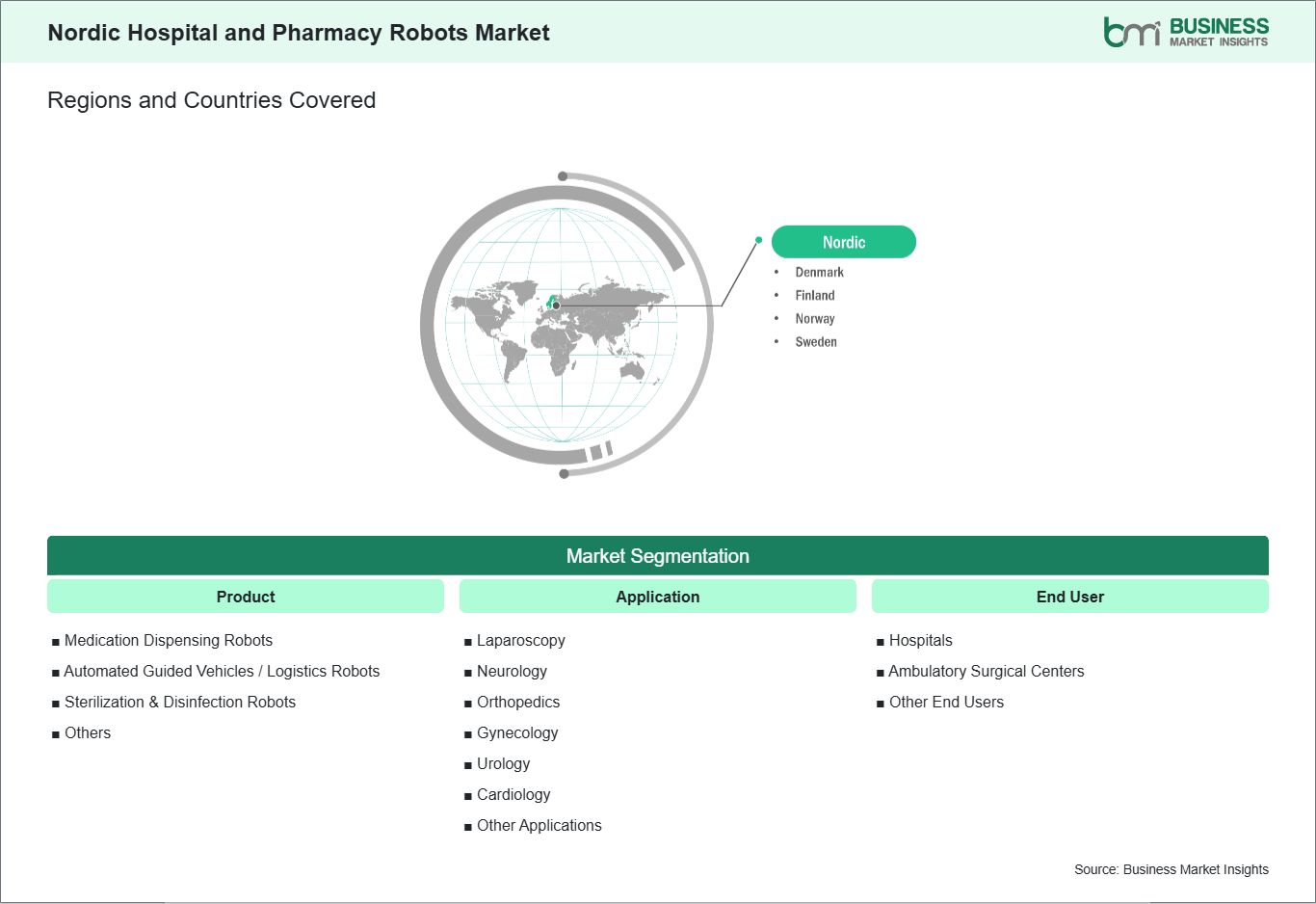
  • Product (Medication Dispensing Robots, Automated Guided Vehicles (AGVs) / Logistics Robots, Sterilization & Disinfection Robots, Others)
  • Application (Laparoscopy, Neurology, Orthopedics, Gynecology, Urology, Cardiology, Other Applications)
  • End User (Hospitals, Ambulatory Surgical Centers, Other End Users)

No. of Pages: 150
Report Code: BMIPUB00034961
Category: Life Sciences
Nordic Hospital and Pharmacy Robots Market

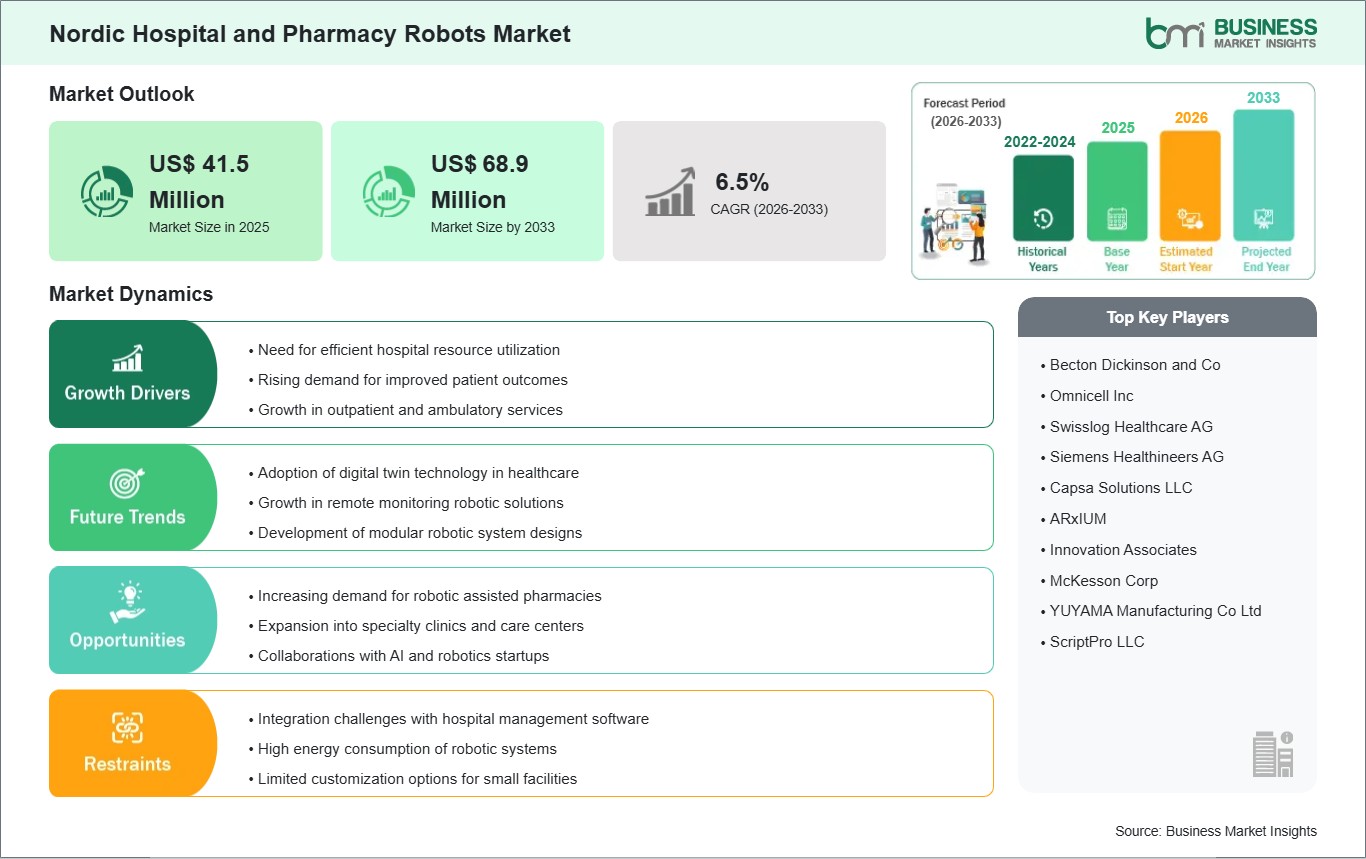
The Nordic hospital and pharmacy robots market size is expected to reach US$ 68.9 million by 2033 from US$ 41.5 million in 2025. The market is estimated to record a CAGR of 6.5 % from 2026 to 2033.

Executive Summary and Nordic Hospital and Pharmacy Robots Market Analysis:

The Nordic hospital and pharmacy robots market reflects the region’s strong commitment to modern healthcare infrastructure, operational efficiency, and technology-driven service delivery. Hospitals and pharmacies across Nordic countries are increasingly adopting robotic systems to manage routine processes that require high accuracy and consistent performance. These robots are commonly used for automated medication dispensing, internal transport of supplies, laboratory sample handling, and inventory management. By automating repetitive tasks, healthcare facilities can optimize operational workflows and allow clinical staff to dedicate more time to patient-focused responsibilities. The adoption of robotics also supports quality control by reducing manual errors and ensuring standardized procedures across hospital departments. Healthcare systems in the Nordic region are characterized by structured public healthcare frameworks, advanced digital infrastructure, and strong regulatory standards. These factors create a favorable environment for the integration of robotic technologies into hospital and pharmacy operations. Most hospitals already rely on digital patient records and centralized management systems, which makes it easier to integrate robotics platforms that depend on digital connectivity and real-time data exchange. As a result, robots can be programmed to interact with hospital information systems, pharmacy databases, and logistics management platforms to coordinate deliveries, monitor medication stock levels, and maintain accurate documentation of pharmaceutical handling. The growing complexity of hospital operations has also contributed to the demand for robotic support systems. Large healthcare facilities require efficient internal logistics to transport medical devices, sterile equipment, medications, and waste between departments. Robots designed for hospital environments can navigate corridors, elevators, and restricted areas while avoiding obstacles and maintaining strict hygiene standards. These capabilities make them particularly useful in large medical campuses where manual transportation can be time-consuming and resource-intensive. Pharmacy automation systems also contribute to improved operational reliability by organizing medication storage, tracking expiration dates, and ensuring accurate dispensing of prescriptions. Another key element shaping the market is the focus on patient safety and medication accuracy. Nordic healthcare providers maintain strict guidelines for pharmaceutical management, and robotic dispensing systems support compliance with these standards. Automated systems can verify prescriptions, measure precise medication quantities, and track every step of the dispensing process. This level of control improves traceability and reduces the risk of human error, which is particularly important in high-volume hospital pharmacies. The Nordic hospital and pharmacy robots market is driven by the region’s emphasis on efficient healthcare delivery, advanced digital capabilities, and strict quality standards. The combination of well-developed healthcare infrastructure and strong technology adoption creates a stable environment for the continued integration of robotics within hospitals and pharmacies. As healthcare organizations seek to enhance efficiency while maintaining high levels of safety and reliability, robotic solutions are expected to remain an important component of hospital operations across the Nordic region.

Nordic Hospital and Pharmacy Robots Market - Strategic Insights:

global-market-strategic-framework
Get more information on this report

Nordic Hospital and Pharmacy Robots Market Segmentation Analysis:

Key segments that contributed to the derivation of the Nordic hospital and pharmacy robots market analysis are product, application, and end user.

  • By product, the hospital and pharmacy robots market is segmented into medication dispensing robots, automated guided vehicles (agvs) / logistics robots, sterilization & disinfection robots and other products. The medication dispensing robots segment dominated the market in 2025.
  • In terms of application, the hospital and pharmacy robots market is categorized into laparoscopy, neurology, orthopedics, gynecology, urology, cardiology and other applications. The laparoscopy segment dominated the market in 2025.
  • Based on end user, the market is classified into hospitals, ambulatory surgical centers and other end users. The hospitals segment dominated the market in 2025.

Nordic Hospital and Pharmacy Robots Market Drivers and Opportunities:

Increasing prescription volumes in pharmacies

Pharmacies across the Nordic region are experiencing a steady increase in prescription volumes, largely driven by demographic changes and expanded access to healthcare services. Countries such as Sweden, Denmark, Norway, and Finland maintain universal healthcare systems that encourage regular physician consultations and structured treatment plans. As a result, a significant proportion of the population relies on prescription medicines for long-term disease management. Chronic conditions such as cardiovascular diseases, diabetes, respiratory disorders, and mental health conditions require continuous medication use, which increases the workload on community and hospital pharmacies. In Sweden, for example, national health statistics have shown that a majority of the population collects at least one prescribed medication each year, demonstrating the scale of pharmaceutical demand within the healthcare system. Population aging is another important factor contributing to prescription growth in Nordic countries. Older adults typically require multiple medications to manage chronic illnesses and maintain quality of life. Finland and Norway have seen gradual increases in the share of the population aged 65 years and above, which naturally raises demand for prescription medicines. Elderly patients frequently receive prescriptions for blood pressure treatments, cholesterol-lowering medications, and other long-term therapies. Pharmacies must therefore manage complex prescription profiles that often involve multiple medications per patient. This growing complexity increases the need for organized medication management systems capable of maintaining dispensing accuracy and proper documentation. In addition, expanding preventive healthcare services across the Nordic region have increased the number of individuals receiving medical treatment. Government health initiatives encourage early diagnosis and ongoing management of chronic diseases, which often requires pharmaceutical treatment. Pharmacies therefore serve a critical role as the final step in the healthcare delivery process. As prescription volumes continue to rise, pharmacies must adopt more efficient operational practices to ensure timely service, maintain patient safety, and manage growing medication inventories.

High-speed robotic prescription filling systems

High-speed robotic prescription filling systems are becoming an increasingly important component of pharmacy operations in the Nordic region. These systems automate several tasks traditionally performed by pharmacy staff, including medication storage, selection, packaging, and labeling. By automating these repetitive activities, pharmacies can significantly improve processing speed and reduce the risk of dispensing errors. Nordic healthcare providers place strong emphasis on medication safety and traceability, and robotic dispensing systems support these priorities by maintaining accurate digital records for every prescription handled within the pharmacy workflow. The adoption of robotic prescription filling technologies is particularly relevant in large urban pharmacies and hospital pharmacy departments that process high volumes of prescriptions each day. In cities such as Stockholm, Copenhagen, Oslo, and Helsinki, pharmacies often serve thousands of patients every week. High-speed robotic systems allow these facilities to store a wide range of pharmaceutical products within compact automated units. When a prescription is received, the system automatically retrieves the correct medication package and prepares it for pharmacist verification. This process reduces waiting times for patients and allows pharmacy professionals to focus on clinical consultations rather than manual dispensing tasks. Robotic filling systems also support improved inventory management in Nordic pharmacies. Automated storage units continuously track medication quantities and monitor product expiration dates. This capability allows pharmacies to maintain optimal stock levels and reduce the risk of medication shortages. In hospital pharmacies, where hundreds of different medications may be used across multiple departments, automated inventory tracking ensures that essential medicines remain available for patient treatment. The ability to monitor inventory digitally also improves supply chain coordination between pharmaceutical distributors and healthcare facilities. As pharmacy workloads increase and healthcare providers continue to focus on efficiency and patient safety, high-speed robotic prescription filling systems are expected to play a growing role in modern pharmacy operations throughout the Nordic region.

Nordic Hospital and Pharmacy Robots Market Size and Share Analysis:

The Nordic hospital and pharmacy robots market demonstrates steady growth, with size and share analysis highlighting evolving trends and competitive dynamics among key players. The report examines subsegments categorized within product, application, and end user, offering insights into their contribution to overall market performance.

By product, the medication dispensing robots subsegment dominated the market in 2025, driven by the growing need for accurate, efficient, and automated medication management in hospital and retail pharmacy operations.

In terms of application, the laparoscopy subsegment dominated the market in 2025, the increasing preference for minimally invasive surgical procedures that require high precision and robotic assistance in hospitals.

Based on end user, the hospitals subsegment dominated the market in 2025, driven by the high volume of medication handling, surgical procedures, and clinical logistics that require automated robotic systems to improve operational efficiency.

Nordic Hospital and Pharmacy Robots Market Report Highlights:

Report Attribute Details
Market size in 2025 US$ 41.5 Million
Market Size by 2033 US$ 68.9 Million
CAGR (2026 - 2033) 6.5%
Historical Data 2022-2024
Forecast period 2026-2033
Segments Covered By Product
  • Medication Dispensing Robots
  • Automated Guided Vehicles / Logistics Robots
  • Sterilization & Disinfection Robots
  • Others
By Application
  • Laparoscopy
  • Neurology
  • Orthopedics
  • Gynecology
  • Urology
  • Cardiology
  • Other Applications
By End User
  • Hospitals
  • Ambulatory Surgical Centers
  • Other End Users
Regions and Countries Covered
Nordic Sweden, Denmark, Norway, Finland
Market leaders and key company profiles
  • Becton Dickinson and Co
  • Omnicell Inc
  • Swisslog Healthcare AG
  • Siemens Healthineers AG
  • Capsa Solutions LLC
  • ARxIUM
  • Innovation Associates
  • McKesson Corp
  • YUYAMA Manufacturing Co Ltd
  • ScriptPro LLC
Get more information on this report

Nordic Hospital and Pharmacy Robots Market Report Coverage and Deliverables:

The "Nordic Hospital and Pharmacy Robots Market Size and Forecast (2022–2033)" report provides a detailed analysis of the market covering below areas:

  • Nordic Hospital and Pharmacy Robots Market size and forecast at regional and country levels for all segments covered under the scope
  • Nordic Hospital and Pharmacy Robots Market trends, as well as drivers, restraints, and opportunities
  • Nordic Hospital and Pharmacy Robots Market analysis covering key trends, regional framework, major players, regulations, and recent developments
  • Industry landscape and competition analysis covering market concentration, heat map analysis, prominent players, and recent developments for the Nordic Hospital and Pharmacy Robots Market
  • Detailed company profiles, including SWOT analysis

Nordic Hospital and Pharmacy Robots Market Geographic Insights:

The geographical scope of the Nordic Hospital and Pharmacy Robots Market report is divided into Sweden, Denmark, Norway, and Finland. Sweden held the largest share in 2025.

The Nordic region, comprising Sweden, Denmark, Norway, and Finland, represents a dynamic and prosperous area in Northern Europe with a high standard of living, advanced infrastructure, and a strong emphasis on innovation and sustainability. Sweden stands out as the dominant country in this region, holding the largest economic and demographic share, with its well-diversified economy spanning technology, manufacturing, and services, and a population concentrated around metropolitan hubs like Stockholm, Gothenburg, and Malmö. Its global companies in automotive, telecommunications, and clean energy sectors contribute significantly to regional economic strength and export potential. Norway, while smaller in population than Sweden, has a highly developed economy driven by natural resources, particularly oil and gas, as well as fisheries and maritime industries, making it an important player in energy exports and sustainable management of resources. Denmark is notable for its stable business environment, advanced logistics infrastructure, and strong agricultural and pharmaceutical sectors, while its capital, Copenhagen, serves as a major hub for trade, innovation, and international finance within the region. Finland complements the Nordic economic landscape with its emphasis on technology, education, and industrial production, particularly in areas such as information technology, machinery, and clean technology solutions, reflecting the country’s high human capital and innovation capabilities. Across these countries, there is a shared commitment to environmental sustainability, digitalization, and efficient governance, creating an attractive environment for foreign investment and cross-border collaborations. The Nordic labor markets are characterized by high levels of workforce skill, strong social welfare systems, and effective labor regulations, which together contribute to stable consumer markets and predictable business conditions. While Sweden’s larger population and economic output give it a leading role in setting regional trends, each of the other countries maintains specialized strengths that enhance the overall diversity and resilience of the Nordic region. Combined, the four countries offer a well-integrated regional economy with strong international trade links, sophisticated financial systems, and robust innovation ecosystems, making the Nordic region a model for economic stability, technological advancement, and sustainable development. The region’s focus on research and development, coupled with widespread adoption of digital solutions and green technologies, positions it for continued growth and leadership in emerging global markets, while its cultural emphasis on collaboration, transparency, and efficiency supports both domestic and international business operations. Sweden’s dominant position ensures that policy and market developments there often influence broader regional trends, but Norway, Denmark, and Finland provide complementary capabilities that strengthen the overall competitiveness of the Nordic region.

global-market-geography
Get more information on this report

Nordic Hospital and Pharmacy Robots Market Research Report Guidance:

  • The report includes qualitative and quantitative data in the Nordic Hospital and Pharmacy Robots Market across product, application, end user and geography.
  • The report starts with the key takeaways (chapter 2), highlighting key trends and outlook of the Nordic Hospital and Pharmacy Robots Market.
  • Chapter 3 focuses on the research methodology of the study.
  • Chapter 4 includes ecosystem analysis.
  • Chapter 5 highlights the major industry dynamics in the Nordic Hospital and Pharmacy Robots Market, including factors that are driving the market, prevailing deterrents, potential opportunities, as well as future trends. Impact analysis of these drivers and restraints is also covered in this section.
  • Chapter 6 discusses the Nordic Hospital and Pharmacy Robots Market scenario, in terms of historical market revenues, and forecast till the year 2033.
  • Chapters 7 to 10 cover Nordic Hospital and Pharmacy Robots Market segments by product, application, end user, and geography across Sweden, Denmark, Norway, and Finland. They cover the market revenue, forecast, and factors driving the market.
  • Chapter 11 describes the competitive analysis along with the heat map analysis for the key players operating in the market.
  • Chapter 12 describes the industry landscape analysis. It provides detailed descriptions of business activities such as market initiatives, new developments, mergers, and joint ventures globally, along with a competitive landscape.
  • Chapter 13 provides detailed profiles of the major companies operating in the Nordic Hospital and Pharmacy Robots Market. Companies have been profiled on the basis of their key facts, business descriptions, products, financial overview, SWOT analysis, and key developments.
  • Chapter 14, i.e., the appendix, is inclusive of a brief overview of the company, a list of abbreviations, and a disclaimer.

Nordic Hospital and Pharmacy Robots Market News and Key Development:

The Nordic Hospital and Pharmacy Robots Market is evaluated by gathering qualitative and quantitative data post primary and secondary research, which includes important corporate publications, association data, and databases. A few of the key developments in the Nordic hospital and pharmacy robots market are:

  • In September 2025, Universal Robots announced that its long‑time Danish partner Technicon was elevated to a global Certified Solution Provider specifically for the pharmaceutical industry, strengthening its position in Nordic healthcare automation by enabling deeper collaboration on robotic solutions that improve pharmaceutical manufacturing and lab workflows across the region, particularly in Denmark and broader Nordic life science markets.
  • In September 2024, ForwardX Robotics entered into a strategic partnership with Optiscan Group to distribute its autonomous mobile robots (AMRs) throughout the Nordic countries — including Finland, Denmark, Norway, and Sweden — marking a significant market expansion move for robotics solutions capable of serving healthcare, logistics, and intralogistics operations that can support the deployment of hospital and pharmacy robots for tasks like delivery, material handling, and internal logistics.

Key Sources Referred:

  • World Health Organization (WHO)
  • Organisation for Economic Cooperation and Development (OECD)
  • The World Bank Group
  • Worldometer
  • The Lancet
  • International Bar Association
  • International Trade Administration
The List of Companies - Nordic Hospital and Pharmacy Robots Market
  • Becton Dickinson and Co
  • Omnicell Inc
  • Swisslog Healthcare AG
  • Siemens Healthineers AG
  • Capsa Solutions LLC
  • ARxIUM
  • Innovation Associates
  • McKesson Corp
  • YUYAMA Manufacturing Co Ltd
  • ScriptPro LLC
Frequently Asked Questions
How big is the Nordic Hospital and Pharmacy Robots Market?

The Nordic Hospital and Pharmacy Robots Market is valued at US$ 41.5 Million in 2025, it is projected to reach US$ 68.9 Million by 2033.

What is the CAGR for Nordic Hospital and Pharmacy Robots Market by (2026 - 2033)?

As per our report Nordic Hospital and Pharmacy Robots Market, the market size is valued at US$ 41.5 Million in 2025, projecting it to reach US$ 68.9 Million by 2033. This translates to a CAGR of approximately  6.5% during the forecast period.

What segments are covered in this report?

The Nordic Hospital and Pharmacy Robots Market report typically cover these key segments-

  • Product (Medication Dispensing Robots, Automated Guided Vehicles (AGVs) / Logistics Robots, Sterilization & Disinfection Robots, Others)
  • Application (Laparoscopy, Neurology, Orthopedics, Gynecology, Urology, Cardiology, Other Applications)
  • End User (Hospitals, Ambulatory Surgical Centers, Other End Users)

What is the historic period, base year, and forecast period taken for Nordic Hospital and Pharmacy Robots Market?

The historic period, base year, and forecast period can vary slightly depending on the specific market research report. However, for the Nordic Hospital and Pharmacy Robots Market report:

  • Historic Period : 2022-2024
  • Base Year : 2025
  • Forecast Period : 2026-2033
  • Who are the major players in Nordic Hospital and Pharmacy Robots Market?

    The Nordic Hospital and Pharmacy Robots Market is populated by several key players, each contributing to its growth and innovation. Some of the major players include:

  • Becton Dickinson and Co
  • Omnicell Inc
  • Swisslog Healthcare AG
  • Siemens Healthineers AG
  • Capsa Solutions LLC
  • ARxIUM
  • Innovation Associates
  • McKesson Corp
  • YUYAMA Manufacturing Co Ltd
  • ScriptPro LLC
  • Who should buy this report?

    The Nordic Hospital and Pharmacy Robots Market report is valuable for diverse stakeholders, including:

    • Investors: Provides insights for investment decisions pertaining to market growth, companies, or industry insights. Helps assess market attractiveness and potential returns.
    • Industry Players: Offers competitive intelligence, market sizing, and trend analysis to inform strategic planning, product development, and sales strategies.
    • Suppliers and Manufacturers: Helps understand market demand for components, materials, and services related to concerned industry.
    • Researchers and Consultants: Provides data and analysis for academic research, consulting projects, and market studies.
    • Financial Institutions: Helps assess risks and opportunities associated with financing or investing in the concerned market.

    Essentially, anyone involved in or considering involvement in the Nordic Hospital and Pharmacy Robots Market value chain can benefit from the information contained in a comprehensive market report.

    Available Report Formats

    pdf-format excel-format pptx-format
    Buy Now
    Sales Assistance
    +1 646 791 7070 (US & UK)
    Customization Form

    Please tell us your area of interest
    (Market Segments/ Regions and Countries/ Companies)