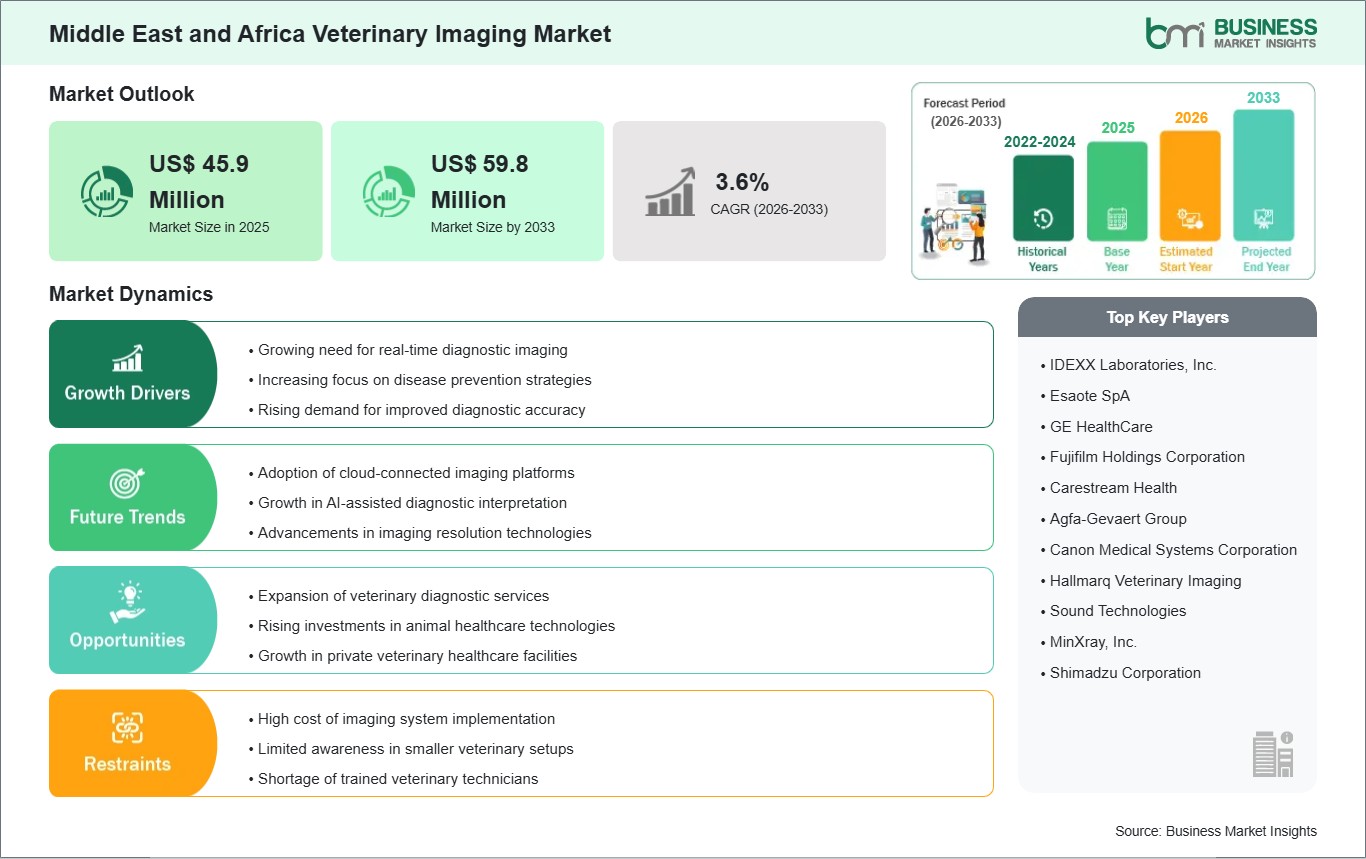
The Middle East and Africa veterinary imaging market size is expected to reach US$59.8 million by 2033 from US$45.9 million in 2025. The market is estimated to record a CAGR of 3.6% from 2026 to 2033.
The MEA veterinary imaging industry consists of the veterinary imaging markets of Saudi Arabia, the United Arab Emirates (UAE), Egypt, South Africa, Nigeria, Kenya, Morocco, and Qatar. The MEA veterinary imaging market is growing relatively steadily due to the growth of pet ownership, modernization of livestock management, and an increase in awareness of preventative veterinary care. Urbanization within the MEA region is creating more technologically advanced diagnostic modalities for use with pets (i.e., digital radiography, high-resolution ultrasound, and computed tomography) and creating a demand for portable, durable, and inexpensive imaging solutions in rural and agricultural areas to be used with livestock, poultry, and equine production operations. Thus, both urban clinics that have sophisticated technologies as well as rural areas that utilize field-based solutions designed to provide efficient operations and manage disease coexist in the MEA veterinary imaging marketplace. Technological innovation is a primary driver of the MEA veterinary imaging marketplace. Veterinary imaging vendors are offering compact, energy-efficient imaging systems that incorporate diagnostic support with artificial intelligence (AI), telemedicine, and cloud-based data storage to allow remote veterinary consultations, real-time patient monitoring, and improved overall workflow efficiency for veterinarians. The MEA veterinary imaging marketplace emphasizes affordability, ease of use, and durability to accommodate the differing economic conditions and infrastructure of the MEA region. Professional training, technology transfer, and reliable after-sale services provided through collaborative efforts between veterinary imaging equipment manufacturers, veterinary associations, and academic institutions create an environment that further encourages adoption of technology in the MEA veterinary imaging marketplace. The primary focus of government initiatives in the MEA region is on livestock production.

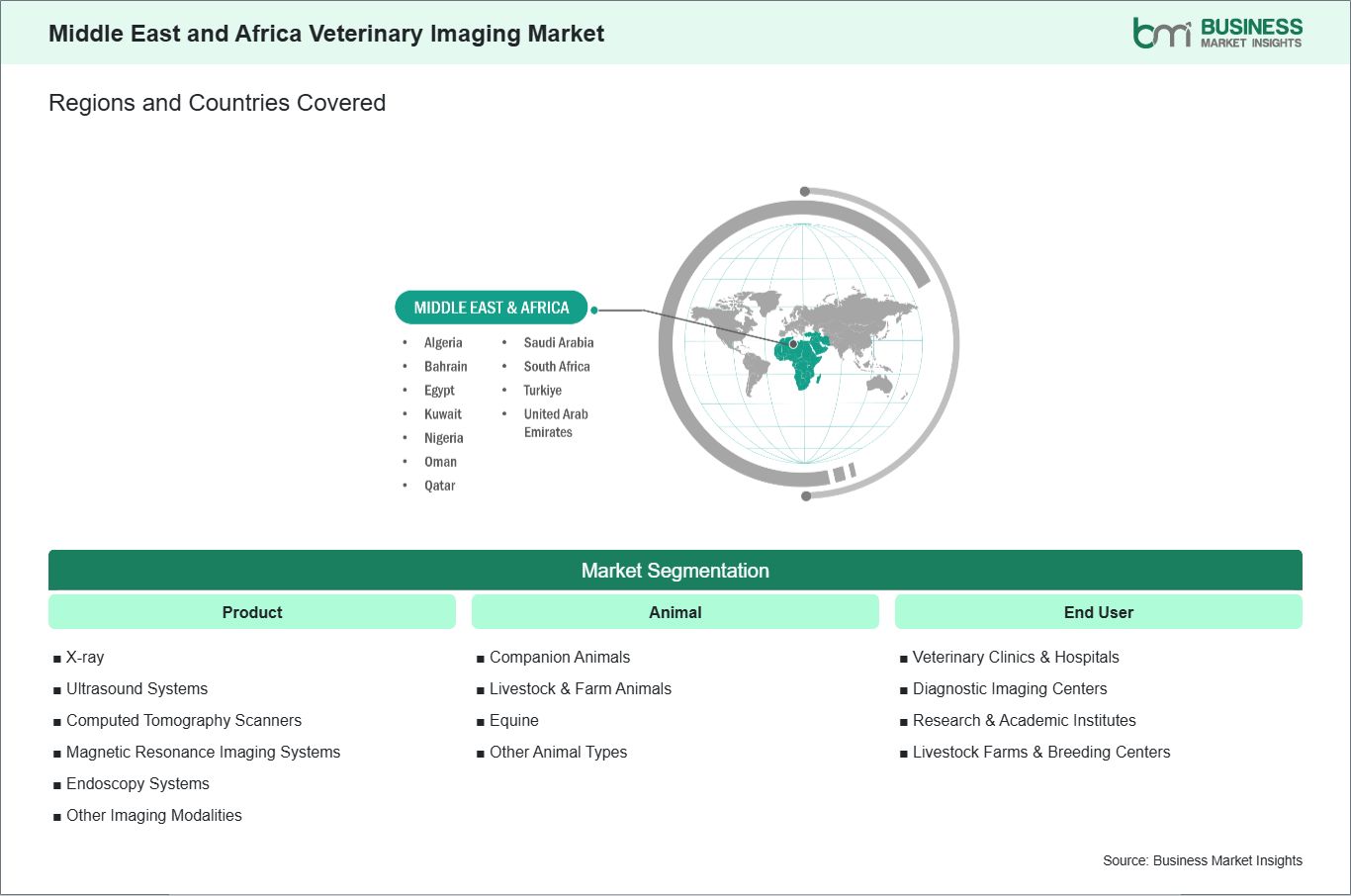
Key segments that contributed to the derivation of the Middle East and Africa veterinary imaging market analysis are product type, animal type, and end user.
The growing concern for animal welfare and well-being has been one of the most important drivers for the veterinary imaging market throughout the Middle East and Africa. With more people responsible for companion animals and livestock investing in preventive health care, the journey to improving and maintaining the health of these animals begins with proper and timely diagnosis of health diseases through diagnostic imaging.
Many veterinary clinics/hospitals across the Middle East and Africa are acquiring diagnostic imaging technologies, such as X-ray, ultrasound, and CT scans, to support the proper diagnosis of animal diseases, the development of effective treatment plans, and the long-term monitoring of animal health. Diagnostic imaging technologies have become a critical part of monitoring overall health and chronic illness, resulting in improved treatment outcomes.
As more people focus on improving the welfare of animals, veterinarians are investing in state-of-the-art diagnostic imaging equipment, training of staff, and facility upgrades to meet client expectations. The services provided by diagnostic imaging allow veterinarians to detect health problems before they become critical, customize treatment plans for each animal, and efficiently monitor each animal's recovery after treatment. This proactive approach to animal care and treatment improves the quality of care provided to animals and creates a stronger, more trustworthy relationship between veterinarians and animal owners.
The increasing complexity of animal health issues, particularly chronic and internal health issues, is spurring the growth of demand for advanced diagnostics. Clinics that utilize diagnostic imaging in their routine treatment of patients are more likely than others to provide consistent, high-quality care to their patients. The ongoing emphasis on improving the health and well-being of animals throughout the Middle East and Africa will continue to stimulate the growth of the overall veterinary imaging market and position veterinary diagnostic imaging as a key component of the modern veterinarian's practice.
The use of advanced imaging technologies is revolutionizing the provision of veterinary services throughout the Middle East and Africa. Digital radiography, ultrasound and CT scanners are now being used by veterinary clinics to provide higher accuracy in diagnosis, to make less invasive treatment possible and to improve overall treatment delivery. By using these technologies, veterinarians can detect disease at an earlier stage, track the progress of treatment and effectively manage more complicated cases.
The availability of mobile and flexible imaging devices is growing, enabling diagnostic procedures to be performed in clinic environments, on farms and in remote locations. This flexibility in use increases operational efficiency, expands the range of services that can be offered and enables veterinarians to provide timely health care services to clients regardless of their situation or location. This trend reflects the much broader movement underway to modernize the delivery of veterinary service and the central role that technology plays in daily veterinary practise.
Digital-based innovations such as software for analysing images, artificial intelligence-assisted interpretation of images, and teleconsultation platforms are providing enhanced capabilities for veterinarians to diagnose their patients. These resources will help to decrease the incidence of errors, improve the efficiency of the veterinarian's workflow and assist with making well-informed treatment decisions. By integrating advanced imaging technologies with digital-based solutions, veterinarians in the Middle East and Africa will be able to continue to provide high-quality veterinary care to their clients while simultaneously improving the efficiency of their operations. These same factors will also contribute to continued growth in the veterinary imaging industry and the provision of modern, technologically advanced animal health care services throughout the Middle East and Africa.

The Middle East and Africa veterinary imaging market demonstrates steady growth, with size and share analysis highlighting evolving trends and competitive dynamics among key players. The report examines subsegments categorized within product type, animal type, and end user, offering insights into their contribution to overall market performance.
By product type, the x-ray segment dominated the market in 2025, driven by its affordability, widespread clinical use, rapid diagnostic capabilities, and strong adoption in routine veterinary care across clinics and field settings.
Based on animal type, the companion animals segment dominated the market in 2025, driven by increasing pet ownership and higher expenditure on preventive and advanced animal healthcare, especially diagnostics for dogs and cats.
On the Basis of end user, the veterinary clinics & hospitals segment dominated the market in 2025, driven by the proliferation of veterinary care facilities equipped with advanced imaging systems to meet rising demand for comprehensive diagnostics and treatment services.
| Report Attribute | Details |
|---|---|
| Market size in 2025 | US$ 45.9 Million |
| Market Size by 2033 | US$ 59.8 Million |
| CAGR (2026 - 2033) | 3.6% |
| Historical Data | 2022-2024 |
| Forecast period | 2026-2033 |
| Segments Covered | By Product
|
|
Regions and Countries Covered
| |
| Middle East and Africa | Turkiye, the UAE, Saudi Arabia, Bahrain, Oman, Egypt, South Africa, Algeria, Nigeria, Kuwait, Qatar |
| Market leaders and key company profiles |
|
The "Middle East and Africa Veterinary Imaging Market Size and Forecast (2022–2033)" report provides a detailed analysis of the market covering below areas:
The geographical scope of the Middle East and Africa Veterinary Imaging Market report is divided into Turkiye, the UAE, Saudi Arabia, Bahrain, Oman, Egypt, South Africa, Algeria, Nigeria, Kuwait, and Qatar. Turkiye held the largest share in 2025.
The MEA veterinary imaging market shows heterogeneous adoption, with Turkiye as the dominant country due to its advanced veterinary infrastructure, large companion animal population, and significant livestock and equine sectors. Urban clinics and specialty hospitals in major cities such as Istanbul and Ankara are widely adopting high-end imaging systems including CT, digital radiography, and ultrasound for preventive care, surgical planning, and herd management. Government initiatives and professional veterinary associations further reinforce Turkiye’s leading position in technology adoption and operational scale. United Arab Emirates (UAE) has a growing market driven by urban pet ownership and a thriving equine industry, with clinics adopting advanced imaging modalities integrated with telemedicine and cloud-based diagnostics. Saudi Arabia and Qatar focus on large-scale livestock operations and companion animal diagnostics, emphasizing high-resolution imaging for herd health and preventive care. Bahrain and Oman are emerging markets, prioritizing portable and durable imaging systems for livestock and equine management, while urban clinics gradually integrate higher-end technologies. Egypt, South Africa, Algeria, and Nigeria show developing adoption patterns, with urban veterinary centers integrating digital radiography and ultrasound, while rural and agricultural regions rely on cost-effective, portable solutions. The MEA veterinary imaging market demonstrates a dual dynamic: high-tech urban adoption for companion animals and practical, field-oriented solutions for livestock and equine care. Turkiye leads in scale, technological sophistication, and professional expertise, while other countries are progressively expanding veterinary imaging capabilities, driving sustained regional growth.

The Middle East and Africa Veterinary Imaging Market is evaluated by gathering qualitative and quantitative data post primary and secondary research, which includes important corporate publications, association data, and databases. A few of the key developments in the Middle East and Africa veterinary imaging market are:
The Middle East and Africa Veterinary Imaging Market is valued at US$ 45.9 Million in 2025, it is projected to reach US$ 59.8 Million by 2033.
As per our report Middle East and Africa Veterinary Imaging Market, the market size is valued at US$ 45.9 Million in 2025, projecting it to reach US$ 59.8 Million by 2033. This translates to a CAGR of approximately 3.6% during the forecast period.
The Middle East and Africa Veterinary Imaging Market report typically cover these key segments-
The historic period, base year, and forecast period can vary slightly depending on the specific market research report. However, for the Middle East and Africa Veterinary Imaging Market report:
The Middle East and Africa Veterinary Imaging Market is populated by several key players, each contributing to its growth and innovation. Some of the major players include:
The Middle East and Africa Veterinary Imaging Market report is valuable for diverse stakeholders, including:
Essentially, anyone involved in or considering involvement in the Middle East and Africa Veterinary Imaging Market value chain can benefit from the information contained in a comprehensive market report.
Please tell us your area of interest
(Market Segments/ Regions and Countries/ Companies)