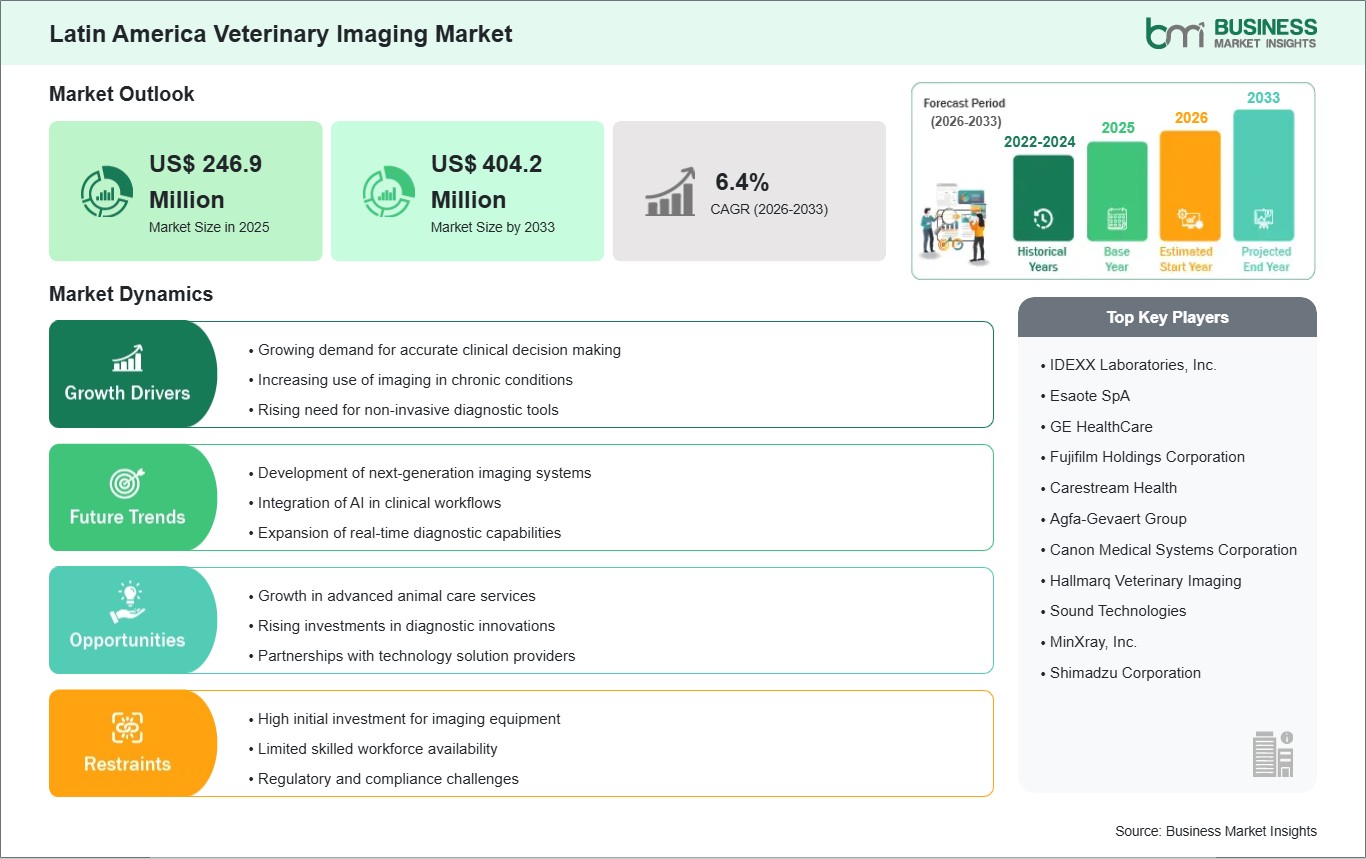
The Latin America veterinary imaging market size is expected to reach US$404.2 million by 2033 from US$246.9 million in 2025. The market is estimated to record a CAGR of 6.4% from 2026 to 2033.
The Latin America veterinary imaging market, encompassing countries such as Brazil, Mexico, Argentina, Chile, Colombia, Peru, Venezuela, Ecuador, Uruguay, Paraguay, and Bolivia, is experiencing steady growth fueled by rising pet ownership, increasing awareness of preventive veterinary care, and modernization of livestock and poultry industries. Urban centers are driving the adoption of high-end imaging solutions such as digital radiography, computed tomography (CT), and ultrasound for companion animals, while rural and agricultural regions rely on portable and cost-effective systems for herd management, disease detection, and productivity enhancement. The market reflects a dual dynamic, balancing advanced diagnostics in urban veterinary clinics with practical, field-oriented solutions for livestock and poultry operations. Technological advancement is a key driver in Latin America. Vendors are introducing compact, energy-efficient imaging systems with cloud-based storage, telemedicine capabilities, and AI-assisted diagnostic tools, enabling remote consultations, second-opinion diagnostics, and real-time monitoring. Manufacturers also emphasize affordability, ease of use, and durability to address the region’s diverse economic conditions and varying infrastructure levels. Strategic collaborations between equipment providers, veterinary associations, and academic institutions support workforce training, technology transfer, and reliable after-sales service, reinforcing adoption and market penetration. Government initiatives targeting livestock productivity, animal welfare, and preventive care further stimulate demand for veterinary imaging solutions. Regulatory frameworks are gradually evolving across the region, facilitating the approval of advanced devices and encouraging private sector participation. Overall, the Latin America veterinary imaging market is evolving into a technology-driven and professionalized ecosystem where preventive care, operational efficiency, and innovation intersect, creating a high-potential environment for continued adoption of modern veterinary imaging technologies.

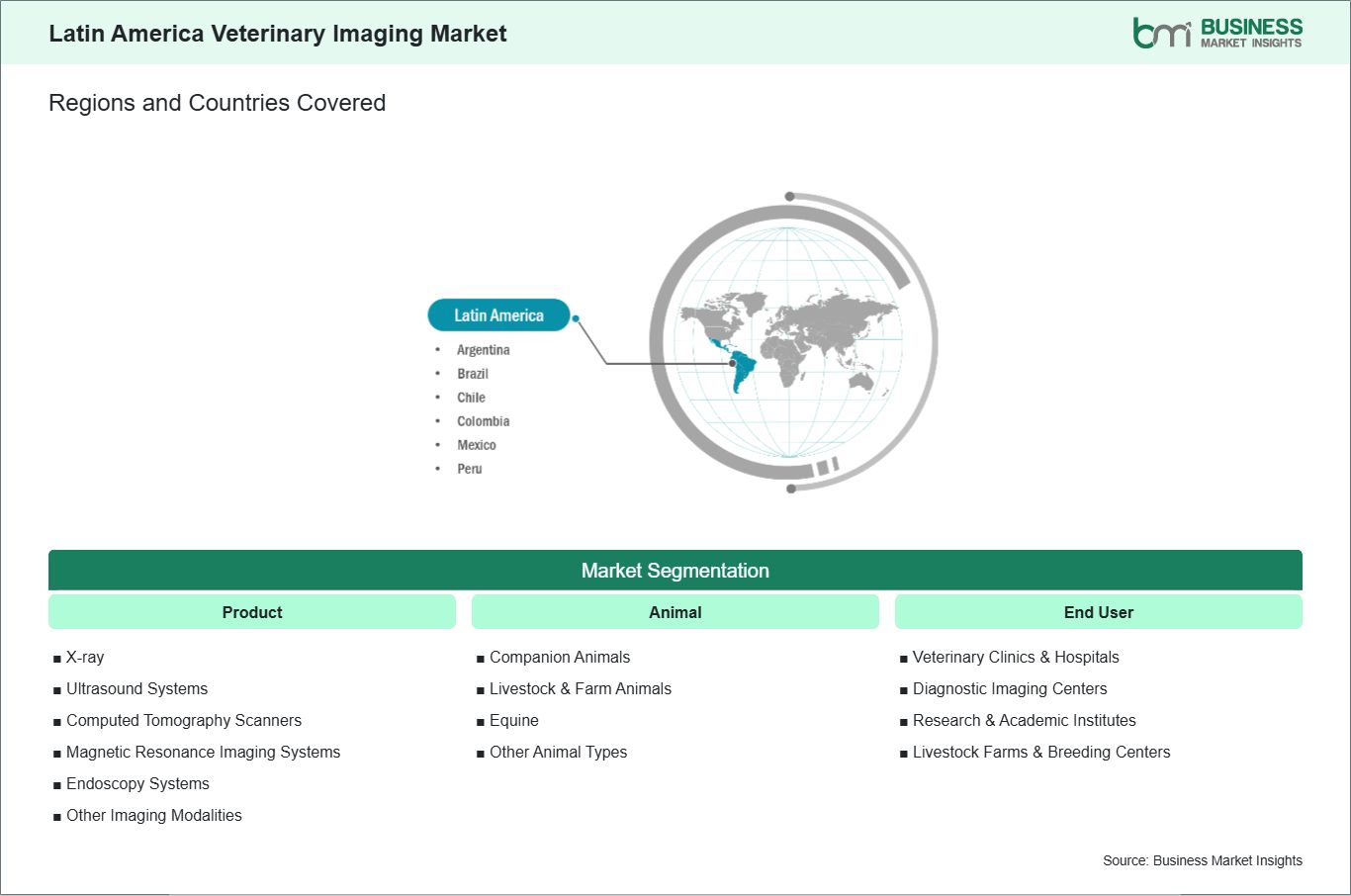
Key segments that contributed to the derivation of the Latin America veterinary imaging market analysis are product type, animal type, and end user.
A key factor driving growth in the veterinary imaging market throughout Latin America has been the increasing focus on companion animal health care. Pet owners are placing increased emphasis on preventive care and regular check ups, as well as the early detection of health problems, to assure the overall health of their pet. As a response, veterinary clinics have begun providing more advanced imaging services (i.e., X-rays, ultrasound, and computed tomography) to facilitate accurate diagnosis as well as suitable treatment planning. The use of imaging technologies has become an important part of providing integrated medical care for animals while providing ongoing monitoring of their health.
Furthermore, because pet owners are seeking increased-quality and more personalized veterinary care, veterinary practices are investing in modern equipment, staff training, and improving their infrastructure. The use of imaging services enables vets to detect health issues early, customize the treatment of their patients, and effectively monitor recovery of those patients. In turn, this strengthens clients’ trust in their veterinarian, increases client satisfaction, and reinforces the importance of imaging as an essential part of veterinary practice.
Additionally, the growing incidence of chronic and/or complicated conditions in companion animals has increased demand for diagnostic technology. Veterinary clinics that provide advanced imaging on a daily basis in the course of caring for patients will be able to address these issues much more efficiently and effectively while upholding high standards. The increased emphasis on the health care of companion animals in Latin America will continue to drive stable growth within the veterinary imaging industry, and will solidify imaging technologies as indispensable tools for modern veterinary practices.
A major shift is happening in the treatment of animals as more veterinary clinics across Latin America adopt the latest imaging technologies, including digital radiography, ultrasound, and all-in-one CT imaging systems. These advanced technologies have contributed to increased diagnostic accuracy, less invasive procedures for patients, and improved treatment outcomes. Increased use of imaging enables veterinarians to detect conditions at an early stage, monitor the progress of treatment, and effectively manage multiple clinical conditions.
The emergence of portable and adaptable imaging systems has led to more veterinarians performing diagnostics at the clinic, on farms, and in remote locations (e.g., On-the-Go Vet). The greater flexibility afforded by portable imaging systems allows veterinary professionals to deliver timely service, expand their practice area, and improve workflow efficiency. Together with other technological advancements, the trend towards increased use of portable imaging systems is indicative of a modernized practice of veterinary medicine.
Digital imaging technology (such as image analysis software, teleconsultation platforms, and AI-assisted interpretation) continues to improve the ability of veterinarians to provide high-quality medical care to their patients by improving diagnostic accuracy, improving operational efficiency, and enhancing the quality of the services provided. Veterinary practices in Latin America are positioned for continued growth by adopting modern and efficient imaging technologies in conjunction with digital technologies resulting in a more advanced and technology-based healthcare delivery for all animals (companion & farm).

The Latin America veterinary imaging market demonstrates steady growth, with size and share analysis highlighting evolving trends and competitive dynamics among key players. The report examines subsegments categorized within product type, animal type, and end user, offering insights into their contribution to overall market performance.
By product type, the x-ray segment dominated the market in 2025, driven by its affordability, widespread clinical use, rapid diagnostic capabilities, and strong adoption in routine veterinary care across clinics and field settings.
Based on animal type, the companion animals segment dominated the market in 2025, driven by increasing pet ownership and higher expenditure on preventive and advanced animal healthcare, especially diagnostics for dogs and cats.
On the Basis of end user, the veterinary clinics & hospitals segment dominated the market in 2025, driven by the proliferation of veterinary care facilities equipped with advanced imaging systems to meet rising demand for comprehensive diagnostics and treatment services.
| Report Attribute | Details |
|---|---|
| Market size in 2025 | US$ 246.9 Million |
| Market Size by 2033 | US$ 404.2 Million |
| CAGR (2026 - 2033) | 6.4% |
| Historical Data | 2022-2024 |
| Forecast period | 2026-2033 |
| Segments Covered | By Product
|
|
Regions and Countries Covered
| |
| Latin America | Mexico, Brazil, Argentina, Peru, Chile, Colombia |
| Market leaders and key company profiles |
|
The "Latin America Veterinary Imaging Market Size and Forecast (2022–2033)" report provides a detailed analysis of the market covering below areas:
The geographical scope of the Latin America Veterinary Imaging Market report is divided into Mexico, Brazil, Argentina, Peru, Chile, and Colombia. Mexico held the largest share in 2025.
The veterinary imaging markets across key countries in Latin America differ massively in scope between the largest (Mexico) and the others. Mexico has an exceptional veterinary infrastructure system; it houses a large family pet population and has a large livestock industry, so this country is a leader in the region. Urban pet clinics and specialty veterinary hospitals in the main urban centres of Mexico (e.g., Mexico City and Guadalajara) use high-end digital imaging systems like radiography, ultrasound, and CT for disease prevention, diagnosis, surgical planning, and management opportunities related to livestock (herds) through diagnostic imaging. The Mexican government's commitment to national programs that promote livestock productivity, preventive healthcare and general care for animals as well as the continued expansion of private-sector investments into technology-driven diagnostic services are two primary factors of Mexico's leadership in Latin America. Brazil is ranked by country as the second-largest veterinary imaging market in Latin America due to high adoption of imaging technology, both in urban pet clinics and in commercial livestock operations across municipalities and regions. Particularly within metropolitan areas, high-resolution imaging systems tend to be utilized extensively in veterinary hospitals; while portable/mid-range imaging systems tend to be utilized primarily in rural farms or remote areas, particularly regarding the management of both cattle and horses. Brazil is also supported by a strong organized veterinary community that provides ongoing education, support for technology maintenance and assistance with technology adoption to veterinarians and veterinary technicians (associates). Argentina has also shown growth in veterinary imaging market size as a result of continued increases in pet ownership within urban settings and further modernizing their farming practices for cattle and horses. Most urban pet clinics have begun integrating high-end digital imaging modalities into their practice, while the large-scale livestock producers continue.

The Latin America Veterinary Imaging Market is evaluated by gathering qualitative and quantitative data post primary and secondary research, which includes important corporate publications, association data, and databases. A few of the key developments in the Latin America veterinary imaging market are:
The Latin America Veterinary Imaging Market is valued at US$ 246.9 Million in 2025, it is projected to reach US$ 404.2 Million by 2033.
As per our report Latin America Veterinary Imaging Market, the market size is valued at US$ 246.9 Million in 2025, projecting it to reach US$ 404.2 Million by 2033. This translates to a CAGR of approximately 6.4% during the forecast period.
The Latin America Veterinary Imaging Market report typically cover these key segments-
The historic period, base year, and forecast period can vary slightly depending on the specific market research report. However, for the Latin America Veterinary Imaging Market report:
The Latin America Veterinary Imaging Market is populated by several key players, each contributing to its growth and innovation. Some of the major players include:
The Latin America Veterinary Imaging Market report is valuable for diverse stakeholders, including:
Essentially, anyone involved in or considering involvement in the Latin America Veterinary Imaging Market value chain can benefit from the information contained in a comprehensive market report.
Please tell us your area of interest
(Market Segments/ Regions and Countries/ Companies)