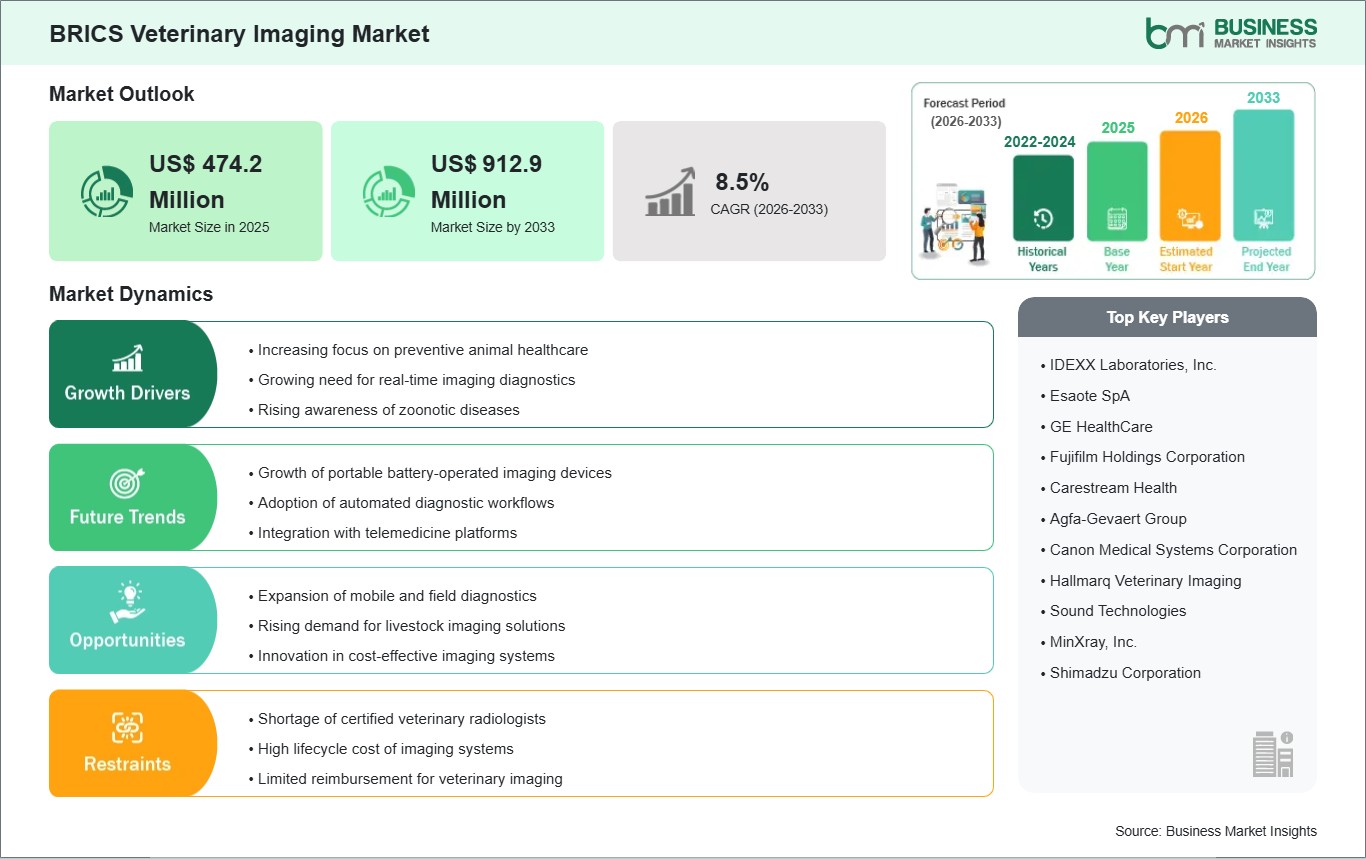
The BRICS veterinary imaging market size is expected to reach US$912.9 million by 2033 from US$474.2 million in 2025. The market is estimated to record a CAGR of 8.5% from 2026 to 2033.
The BRICS veterinary imaging market, encompassing Brazil, Russia, India, China, and South Africa, is characterized by rapid growth driven by expanding livestock industries, increasing companion animal ownership, and rising investments in veterinary healthcare infrastructure. The market is transitioning from traditional diagnostic approaches to imaging-led precision veterinary care, incorporating digital radiography, ultrasound, and advanced modalities such as computed tomography (CT) in both urban and rural settings. The rising awareness of preventive healthcare and herd health management is driving frequent adoption of imaging systems, particularly in countries with large agricultural bases, where disease monitoring and productivity optimization are critical. Technological innovation is a key market driver in BRICS nations. Companies are offering portable, high-resolution imaging devices tailored for diverse operating conditions, from modern urban clinics to field-based livestock operations. Software integration, including AI-assisted diagnostics, cloud storage, and telemedicine-enabled imaging, is becoming increasingly prevalent, enabling remote consultations and improved diagnostic accuracy. Manufacturers are also focusing on cost-effectiveness and energy efficiency, addressing price sensitivity in emerging economies while ensuring operational reliability. Market expansion is reinforced by strategic collaborations between veterinary associations, equipment distributors, and educational institutions, facilitating training, after-sales support, and technology transfer. Regulatory frameworks vary widely across the BRICS countries, influencing market entry strategies, device approval timelines, and regional adoption rates. Government initiatives targeting animal health, disease prevention, and livestock productivity are further accelerating the use of imaging solutions. Overall, the BRICS veterinary imaging market reflects a high-growth, technology-driven landscape where innovation, preventive care, and professional skill development converge to enhance diagnostic efficiency and healthcare quality.

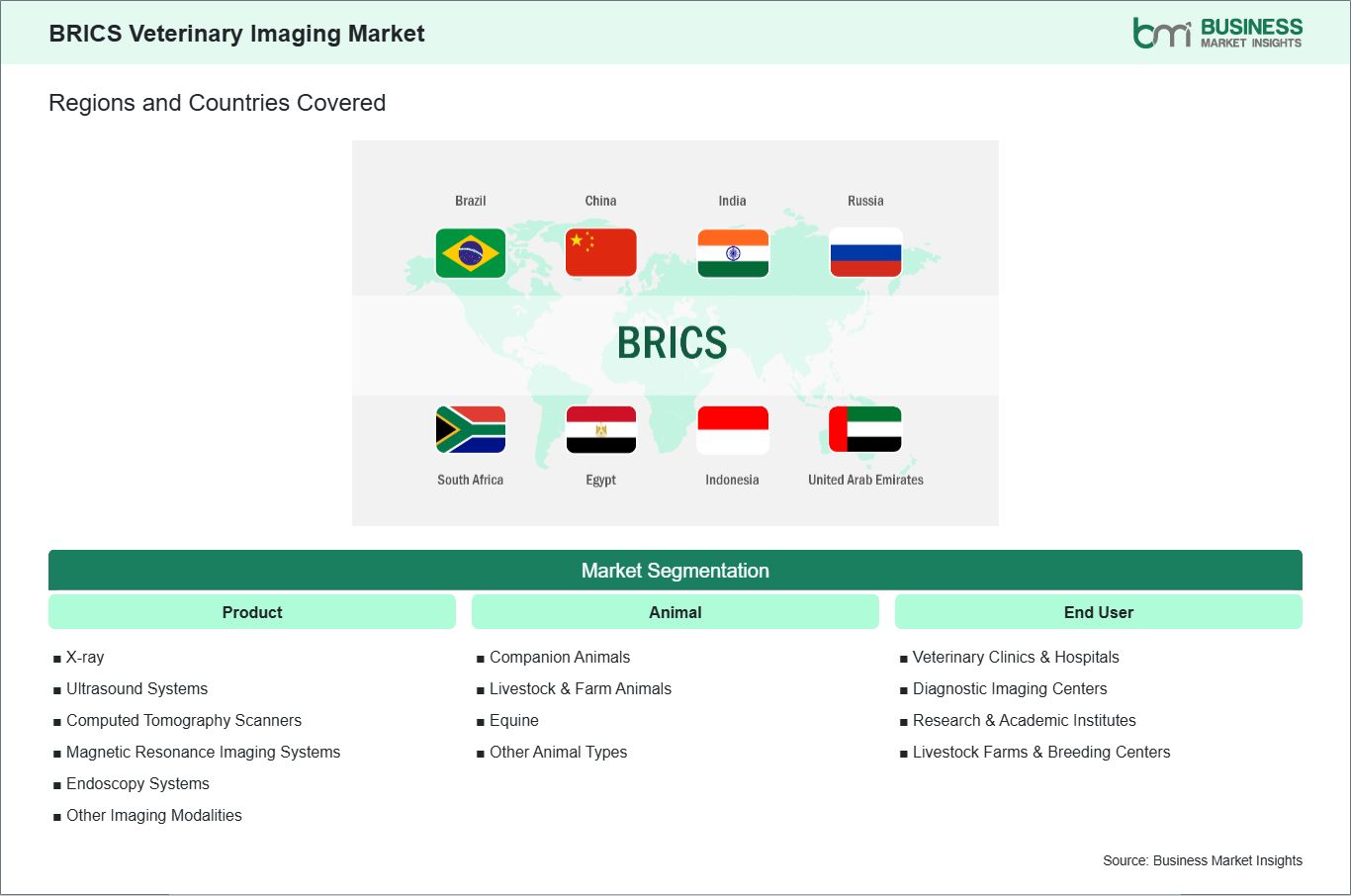
Key segments that contributed to the derivation of the BRICS veterinary imaging market analysis are product type, animal type, and end user.
One major factor driving the veterinary imaging market in the BRICS countries is the growth in companion animal health expenditure. There is a significant increase in the focus on both the health and welfare of pets by their owners, who continue to invest more money into helping their pets live longer, healthier lives. Because of this, there is a growing demand for preventative healthcare (preventative medicine), early identification of disease, and regular diagnostic services from their veterinarians. Veterinary clinics are responding to this demand by expanding their services to provide advanced imaging services that allow for accurate diagnostics and provide a foundation for effective treatment planning. Newer imaging technologies, such as radiographs (X-Rays), ultrasounds (US), and CT scans, are becoming invaluable resources for the veterinarian to regularly monitor companion animal health and support better decision-making when determining a clinically appropriate course of action.
As more pet owners understand that animals have rights and are expecting to provide them with higher levels of care, many veterinary clinics are actively investing in equipment, training their personnel, and improving their facilities to meet the expectations of their clients. Imaging services allow veterinary clinicians to better assess the pet and identify potential issues earlier, customize their treatment plan, and efficiently track the patient’s recovery. All of these improvements help to build trust and loyalty towards the veterinary clinic and increase the overall value of diagnostic imaging as part of their routine veterinary practice.
Additionally, as more chronic diseases develop in our companion animals, especially with respect to orthopedic and internal organ issues, the use of diagnostic imaging technologies will continue to grow. By incorporating advanced diagnostics into everyday veterinary practice, veterinarians will be better positioned to meet the challenges associated with chronic diseases while providing their patients with the highest possible quality of care. An increase in the level of investment in companion animal healthcare will produce improved healthcare outcomes and provide veterinarians with an economic incentive to continue to provide care to our companion animals.
Advanced imaging technologies have transformed the veterinary industry in BRICS countries. Veterinary clinics now use digital radiography, ultrasound, and CT scanners to enhance their diagnostic capabilities, reduce the need for invasive procedures, and provide better outcomes for their patients. With these technologies, veterinarians are able to detect complex health issues earlier and can manage both companion animals and farm animals with more accuracy.
Portable and flexible imaging systems are also becoming more popular as veterinarians are able to access diagnostic tools from their own clinics, on farms, or in other rural areas. These types of tools help improve the efficiency of a clinic's operations, broaden the practice's service area, and enable them to respond quickly to different types of healthcare challenges. This shift towards advanced imaging means that the practice of veterinary medicine is modernizing, with technology being an essential part of day-to-day operations.
Digital innovations, such as image analysis software and teleconsultation platforms, are continuing to improve the level of service delivered to patients by veterinarians in the BRICS nations. AI-assisted interpretation helps reduce the number of mistakes made in the interpretation of diagnostic images, streamline workflow, and enhance decision-making capabilities. The combination of advanced imaging and digital innovations has allowed veterinary practices to increase their operational efficiencies and provide higher-quality service to their clients. With the continued adoption of innovative diagnostic tools, there is substantial potential for expansion in the veterinary marketplace, giving clinics an opportunity to provide cutting-edge, technology-driven veterinary care throughout all of BRICS.

The BRICS veterinary imaging market demonstrates steady growth, with size and share analysis highlighting evolving trends and competitive dynamics among key players. The report examines subsegments categorized within product type, animal type, and end user, offering insights into their contribution to overall market performance.
By product type, the x-ray segment dominated the market in 2025, driven by its affordability, widespread clinical use, rapid diagnostic capabilities, and strong adoption in routine veterinary care across clinics and field settings.
Based on animal type, the companion animals segment dominated the market in 2025, driven by increasing pet ownership and higher expenditure on preventive and advanced animal healthcare, especially diagnostics for dogs and cats.
On the Basis end user, the veterinary clinics & hospitals segment dominated the market in 2025, driven by the proliferation of veterinary care facilities equipped with advanced imaging systems to meet rising demand for comprehensive diagnostics and treatment services.
| Report Attribute | Details |
|---|---|
| Market size in 2025 | US$ 474.2 Million |
| Market Size by 2033 | US$ 912.9 Million |
| CAGR (2026 - 2033) | 8.5% |
| Historical Data | 2022-2024 |
| Forecast period | 2026-2033 |
| Segments Covered | By Product
|
|
Regions and Countries Covered
| |
| BRICS | Russia, Brazil, South Africa, India, the UAE, China |
| Market leaders and key company profiles |
|
The "BRICS Veterinary Imaging Market Size and Forecast (2022–2033)" report provides a detailed analysis of the market covering below areas:
The geographical scope of the BRICS Veterinary Imaging Market report is divided into Russia, Brazil, South Africa, India, the UAE, China. China held the largest share in 2025.
The BRICS market for veterinary imaging varies significantly from one country to another. China is the market leader. This is largely due to its large population of livestock; a rapidly growing number of companion animals; and a huge investment in veterinary infrastructure. The rapid adoption of digital X-ray, computerised tomography (CT) and high-resolution ultrasound by both large farms and Chinese veterinary practices is greatly improving disease prevention, herd health management and accuracy of diagnosis. Supported by a sophisticated supply chain, skilled employees and government programs to improve livestock productivity and health, China will continue to be the principal market in the BRICS region. India is a fast-growing market for veterinary imaging driven largely by new veterinary practices in the semi-urban and rural sectors and the need for improved management of livestock. The need for affordable and portable imaging devices (i.e. digital X-rays or portable ultrasound) will improve the monitoring of herd health and preventive health in both livestock and companion animals. Growing government financed animal health programs and increasing awareness among companion animal owners will help gradually incorporate veterinary imaging technology into routine diagnostic practices. Brazil has a strong emerging market in both companion and livestock veterinary imaging. Structured, private veterinary services, the growing number of urban dwellers and the increasing demand for preventive veterinary care will continue to support the development of this market. Digital x-ray and high resolution ultrasound are examples of the types of veterinary imaging technology that Brazil's health care system currently uses to support the implementation of preventive health care.

The BRICS Veterinary Imaging Market is evaluated by gathering qualitative and quantitative data post primary and secondary research, which includes important corporate publications, association data, and databases. A few of the key developments in the BRICS veterinary imaging market are:
The BRICS Veterinary Imaging Market is valued at US$ 474.2 Million in 2025, it is projected to reach US$ 912.9 Million by 2033.
As per our report BRICS Veterinary Imaging Market, the market size is valued at US$ 474.2 Million in 2025, projecting it to reach US$ 912.9 Million by 2033. This translates to a CAGR of approximately 8.5% during the forecast period.
The BRICS Veterinary Imaging Market report typically cover these key segments-
The historic period, base year, and forecast period can vary slightly depending on the specific market research report. However, for the BRICS Veterinary Imaging Market report:
The BRICS Veterinary Imaging Market is populated by several key players, each contributing to its growth and innovation. Some of the major players include:
The BRICS Veterinary Imaging Market report is valuable for diverse stakeholders, including:
Essentially, anyone involved in or considering involvement in the BRICS Veterinary Imaging Market value chain can benefit from the information contained in a comprehensive market report.
Please tell us your area of interest
(Market Segments/ Regions and Countries/ Companies)