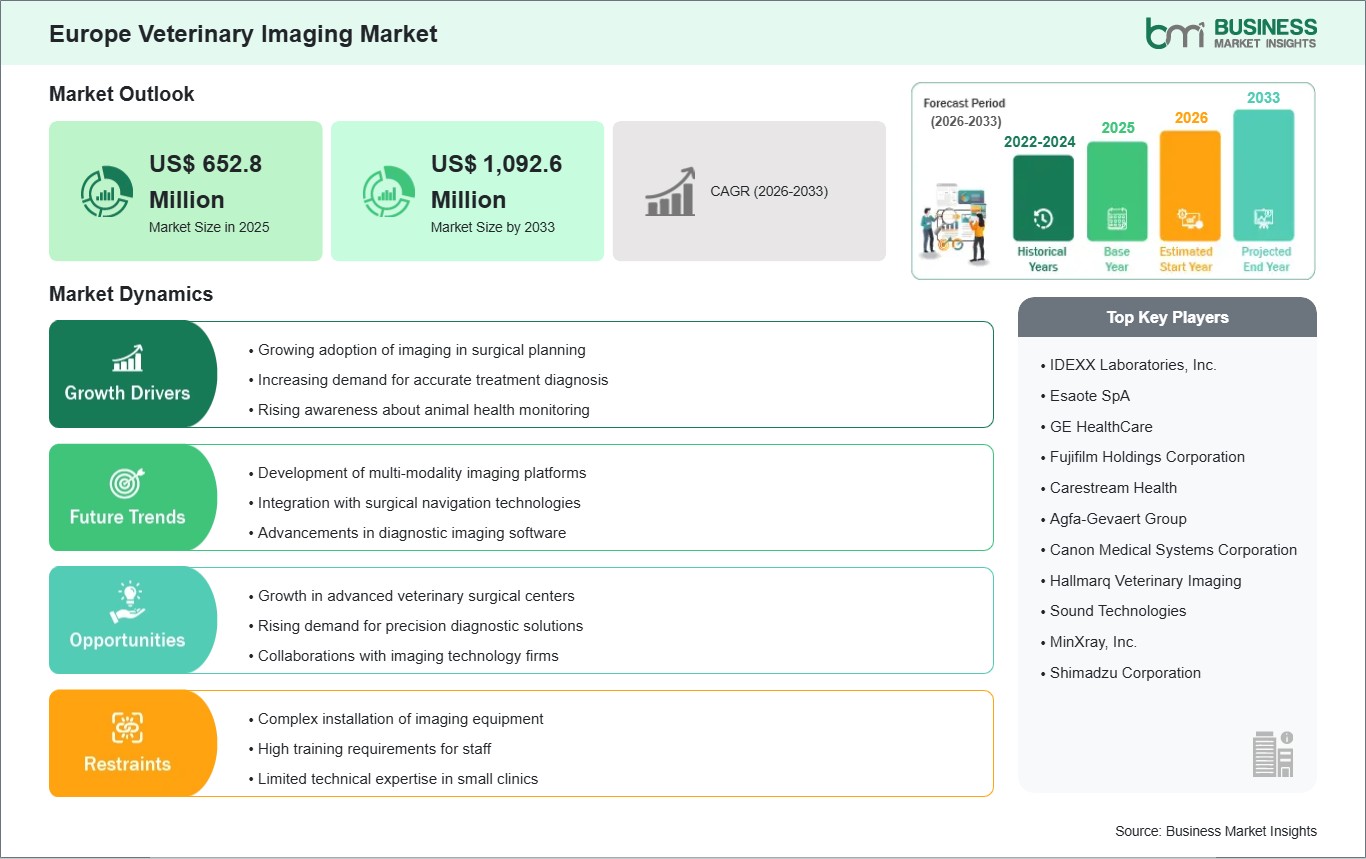
The Europe veterinary imaging market size is expected to reach US$1,092.6 million by 2033 from US$652.8 million in 2025. The market is estimated to record a CAGR of 7.0% from 2026 to 2033.
The Europe veterinary imaging market is a mature and highly diversified landscape, encompassing Western, Central, and Eastern European countries, driven by increasing pet ownership, rising awareness of preventive animal healthcare, and advanced livestock management practices. The market is witnessing a shift from conventional diagnostics to imaging-led veterinary care, including digital radiography, computed tomography (CT), magnetic resonance imaging (MRI), and high-resolution ultrasound. Urban veterinary clinics are increasingly integrating advanced imaging systems for companion animals, while rural and agricultural areas are adopting portable, durable, and cost-efficient solutions for herd health management and early disease detection. The convergence of technological innovation, professional expertise, and preventive care trends is shaping the European veterinary imaging sector into a more efficient and patient-focused ecosystem. Technological advancement is a primary growth driver, with vendors introducing compact, energy-efficient imaging systems capable of software integration, telemedicine support, cloud-based image storage, and AI-assisted diagnostic capabilities. These innovations allow veterinary professionals to perform remote consultations, second-opinion diagnostics, and real-time monitoring, enhancing operational efficiency across diverse clinical and field settings. Additionally, manufacturers focus on user-friendly designs, durability, and cost-effectiveness to meet the needs of both mature and emerging markets within Europe. Market growth is supported by collaborations between equipment suppliers, veterinary associations, and academic institutions, facilitating workforce training, technology transfer, and reliable after-sales support. Regulatory frameworks across Europe are generally well-established, enabling standardized device approvals and promoting high-quality veterinary care. Government initiatives and industry programs focused on livestock productivity, preventive animal healthcare, and animal welfare further strengthen the adoption of imaging solutions. The European veterinary imaging market demonstrates a stable and technologically advanced growth trajectory. The sector is characterized by a balance between high-end urban adoption and practical field-based solutions, emphasizing innovation, preventive care, and operational efficiency. The market’s mature infrastructure, coupled with a strong focus on quality and professional development, positions Europe as one of the most advanced and opportunity-rich regions globally for veterinary diagnostic imaging technologies.

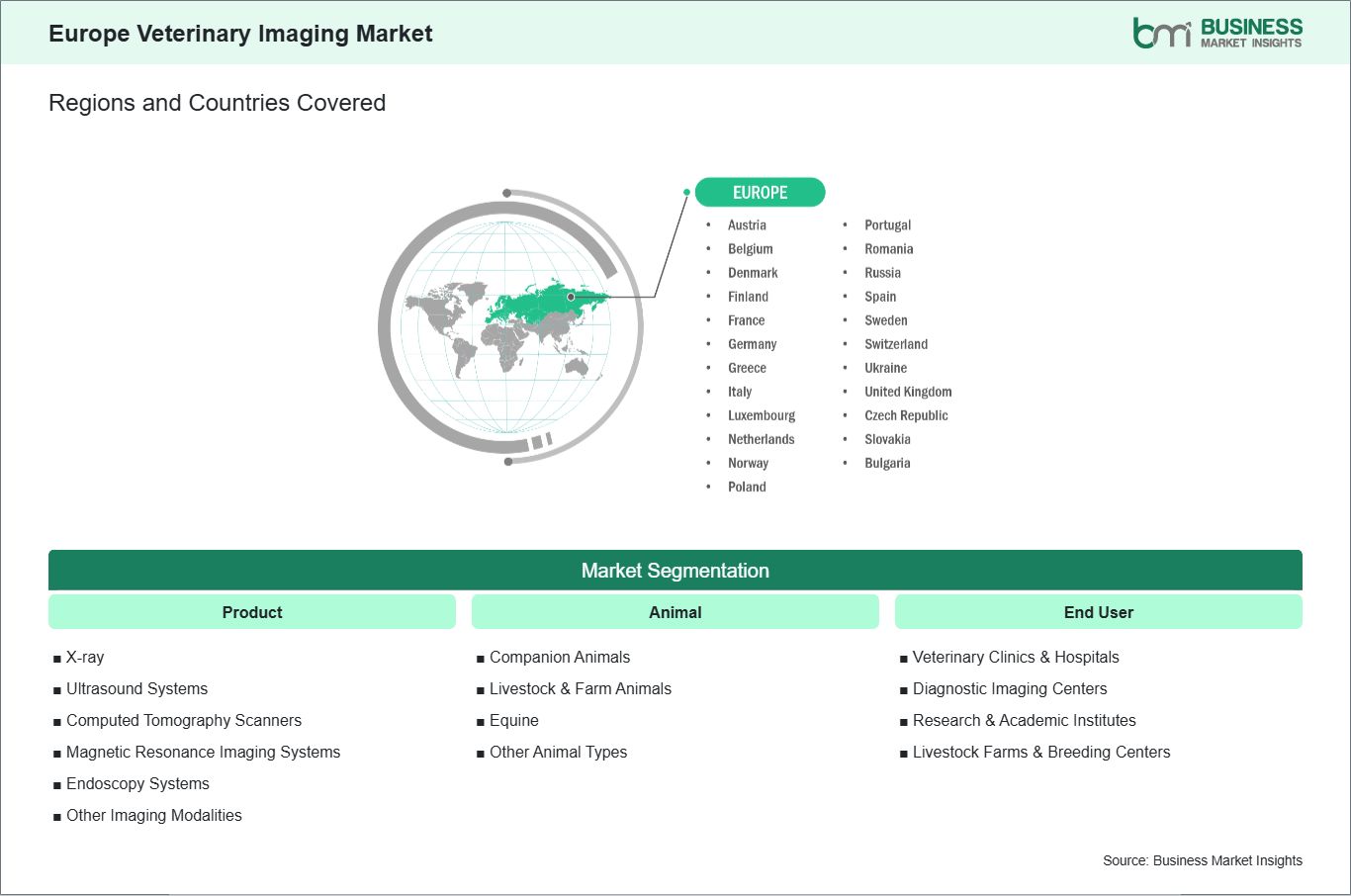
Key segments that contributed to the derivation of the Europe veterinary imaging market analysis are product type, animal type, and end user.
The growing emphasis on companion animal wellness is a key driver of the veterinary imaging market across Europe. Pet owners are placing more importance on preventive care, early diagnosis, and routine health monitoring for their animals. Veterinary practices are responding by integrating diagnostic imaging into standard care, using technologies such as X-ray, ultrasound, and CT scans to ensure accurate assessments and informed treatment planning. The focus on wellness and early intervention underscores the role of imaging in modern veterinary services.
Pet owners increasingly expect personalized and high-quality care. Clinics are investing in advanced equipment, staff training, and enhanced facilities to meet these expectations. Imaging services allow veterinarians to detect health issues at early stages, monitor treatments effectively, and adjust care strategies as needed. This proactive approach not only improves outcomes for animals but also strengthens client trust and engagement.
In addition, the rise of chronic and complex health conditions in pets contributes to higher demand for imaging technologies. Veterinary clinics that offer comprehensive diagnostic services are better positioned to manage these challenges and maintain high standards of care. The emphasis on companion animal wellness across Europe supports steady market growth and establishes veterinary imaging as a critical component of effective healthcare delivery.
Advances in diagnostic imaging technology have changed animal healthcare, as veterinarians in Europe now employ methods such as digital X-ray, ultrasound, computed tomography (CT or CAT scans), magnetic resonance imaging (MRI), etc., to enhance their ability to accurately diagnose conditions. In addition, these new imaging technologies are used to reduce the need for invasive procedures and deliver higher quality outcomes to patients. Early detection of certain conditions, monitoring progress through diagnostic imaging over time, and being able to efficiently manage multiple cases visit are all contributing factors towards providing increased levels of quality veterinary care by utilizing advanced imaging solutions.
The widespread availability of portable imaging solutions, which can be used anywhere – including veterinary clinics, farms, and remote sites – have also contributed to the rising number of veterinarians using diagnostic imaging. Portable/versatile diagnostic imaging tools enable veterinarians greater flexibility in terms of when and where they provide their services, ultimately allowing them to provide these services in a timely manner and extending their geographical range as well as improving their operational efficiency. Consequently, this is indicative of the general trend in veterinary practices becoming more modernized due to advancements in technology becoming an integral part of the everyday practice.
Furthermore, digital innovations, including but not limited to image analysis software, teleconsultation, and AI-driven digital interpretation, are supplementing the diagnostic capabilities of veterinary practices. As these technologies allow veterinarians to reduce mistakes, optimize their workflows, and improve clinical decision making, the combination of advanced imaging technology (digital) solutions enables veterinary clinics throughout Europe to provide excellence in veterinary medicine while at the same time maintaining high operational efficiencies. The continued adoption of advanced technologies in veterinary imaging guarantees the sustained growth of the veterinary imaging market, thus allowing for future advances in animal health care.

The Europe veterinary imaging market demonstrates steady growth, with size and share analysis highlighting evolving trends and competitive dynamics among key players. The report examines subsegments categorized within product type, animal type, and end user, offering insights into their contribution to overall market performance.
By product type, the x-ray segment dominated the market in 2025, driven by its affordability, widespread clinical use, rapid diagnostic capabilities, and strong adoption in routine veterinary care across clinics and field settings.
Based on animal type, the companion animals segment dominated the market in 2025, driven by increasing pet ownership and higher expenditure on preventive and advanced animal healthcare, especially diagnostics for dogs and cats.
On the Basis of end user, the veterinary clinics & hospitals segment dominated the market in 2025, driven by the proliferation of veterinary care facilities equipped with advanced imaging systems to meet rising demand for comprehensive diagnostics and treatment services.
| Report Attribute | Details |
|---|---|
| Market size in 2025 | US$ 652.8 Million |
| Market Size by 2033 | US$ 1,092.6 Million |
| CAGR () | |
| Historical Data | 2022-2024 |
| Forecast period | 2026-2033 |
| Segments Covered | By Product
|
|
Regions and Countries Covered
| |
| Europe | Belgium, Austria, Finland, Denmark, Greece, Poland, Romania, Russia, Ukraine, Czech Republic, Slovakia, Bulgaria, Italy, Luxembourg, Germany, Switzerland, France, Netherlands, Norway, Portugal, Spain, Sweden, United Kingdom |
| Market leaders and key company profiles |
|
The "Europe Veterinary Imaging Market Size and Forecast (2022–2033)" report provides a detailed analysis of the market covering below areas:
The geographical scope of the Europe Veterinary Imaging Market report is divided into Belgium, Austria, Finland, Denmark, Greece, Poland, Romania, Russia, Ukraine, Czech Republic, Slovakia, Bulgaria, Italy, Luxembourg, Germany, Switzerland, France, Netherlands, Norway, Portugal, Spain, Sweden, United Kingdom. Germany held the largest share in 2025.
The veterinary imaging market in Europe has a wide variety of products. Germany is the largest country; it has developed, advanced veterinary systems and is home to a large number of pets and farm animals. There is also a high penetration of CT/MRI, digital x-ray and advanced ultrasound in used in large urban veterinary facilities, specialty veterinarian hospitals, and large commercial farms. Imaging is used by these facilities to provide preventive care, detect disease early, plan for surgery, and many other uses. Imaging in the European veterinary market has been developed supported by strong regulatory oversight, high levels of professional association involvement, and many different government initiatives that support animal health. The veterinary imaging market in other western European countries (France and the UK), has been very much developed, with many high-powered animal imaging systems in urban veterinary centre and rural live stock operations relying on more portable mid-cost systems; the same is true for the market in Italy, Spain and the Netherlands where there is a growing interest in the use of portable imaging systems for livestock management and advanced diagnostics by urban veterinary clinics. Eastern Europe (Poland, Romania, Czech Republic, Slovakia, Bulgaria, Russia, Ukraine) shows a wide range of imaging usage. In urban centres, advanced veterinary imaging technologies have been adopted, while rural areas have primarily focused on less-costly portable systems that can be used in livestock operations. Belgium, Austria, Switzerland, Luxembourg, and Nordic countries (Sweden, Norway, Finland and Denmark) have focused on developing imaging materials that support precision diagnostics, preventive care, and high-quality urban veterinary care. Greece and Portugal are developing markets with the use of imaging being largely limited to urban environments.

The Europe Veterinary Imaging Market is evaluated by gathering qualitative and quantitative data post primary and secondary research, which includes important corporate publications, association data, and databases. A few of the key developments in the Europe veterinary imaging market are:
The Europe Veterinary Imaging Market is valued at US$ 652.8 Million in 2025, it is projected to reach US$ 1,092.6 Million by 2033.
As per our report Europe Veterinary Imaging Market, the market size is valued at US$ 652.8 Million in 2025, projecting it to reach US$ 1,092.6 Million by 2033. This translates to a CAGR of approximately during the forecast period.
The Europe Veterinary Imaging Market report typically cover these key segments-
The historic period, base year, and forecast period can vary slightly depending on the specific market research report. However, for the Europe Veterinary Imaging Market report:
The Europe Veterinary Imaging Market is populated by several key players, each contributing to its growth and innovation. Some of the major players include:
The Europe Veterinary Imaging Market report is valuable for diverse stakeholders, including:
Essentially, anyone involved in or considering involvement in the Europe Veterinary Imaging Market value chain can benefit from the information contained in a comprehensive market report.
Please tell us your area of interest
(Market Segments/ Regions and Countries/ Companies)