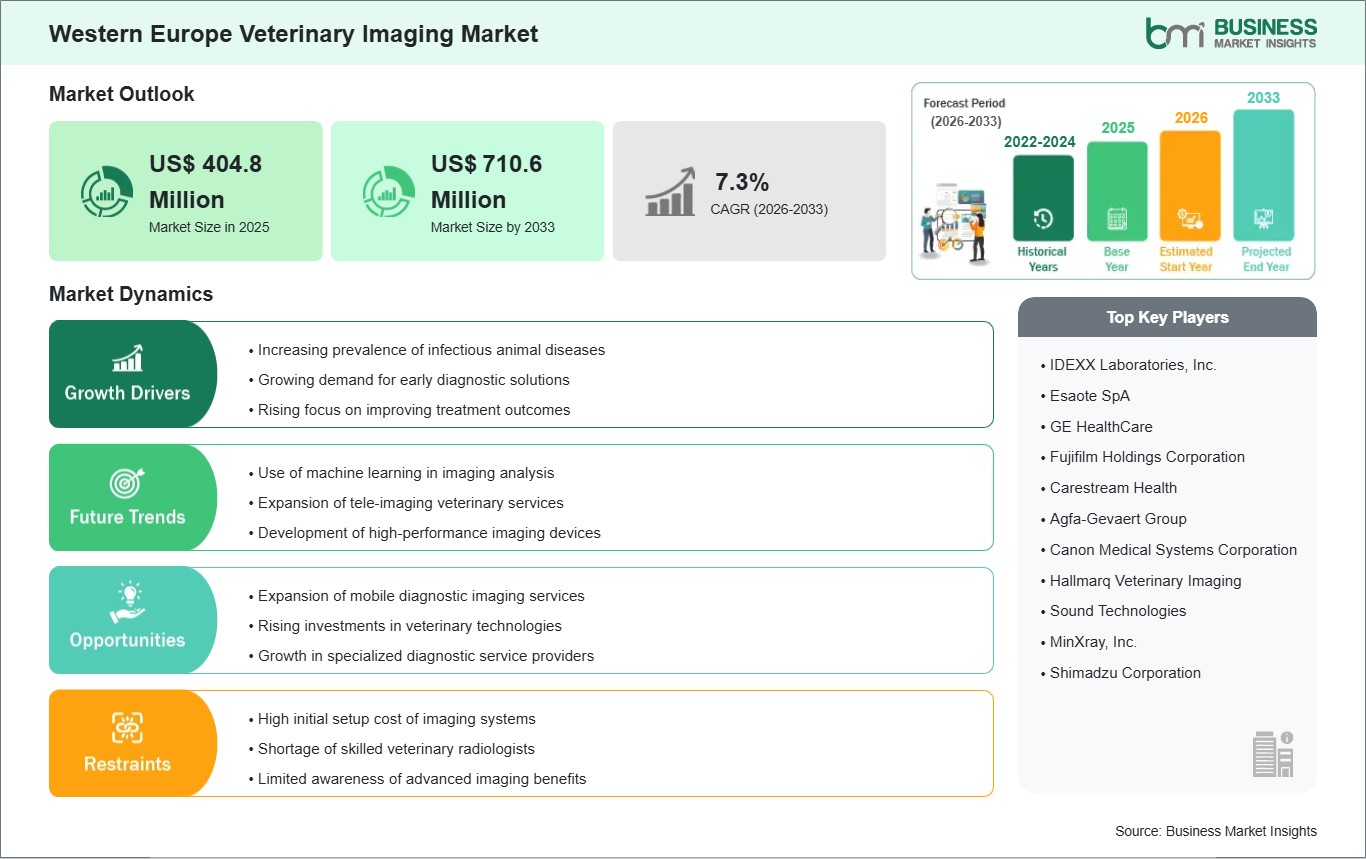
The Western Europe veterinary imaging market size is expected to reach US$710.6 million by 2033 from US$404.8 million in 2025. The market is estimated to record a CAGR of 7.3% from 2026 to 2033.
Urban animal clinics adopt advanced diagnostic technologies through the installation of equipment such as digital radiography, CT scan, ultra-modern ultrasounds, and MRI imaging machines. This move aims at improving diagnostic capacity, planning surgical procedures, and promoting preventive healthcare in pets. Rural and agricultural areas have adopted imaging solutions that are portable and durable to ensure surveillance of herds, manage the productivity of livestock, and prevent diseases in them. Urban areas are focusing on advanced and innovative technologies, while rural areas are using imaging systems designed to withstand field work. Manufacturers are developing energy-efficient and compact imaging technologies that incorporate artificial intelligence diagnostic solutions, telemedicine functions, and cloud-based storage systems. This development enables veterinarians to conduct consultations remotely, monitor animals' health conditions, and optimize workflow in their hospitals and farms. Government policies and regulatory frameworks emphasize animal welfare, preventive care, and livestock productivity, providing additional incentives for veterinary imaging adoption. Strong professional veterinary networks support standardized care and best practices. The region is evolving into a professionalized, technology-driven ecosystem where innovation, operational efficiency, and preventive healthcare converge, offering opportunities for modern veterinary imaging solutions.

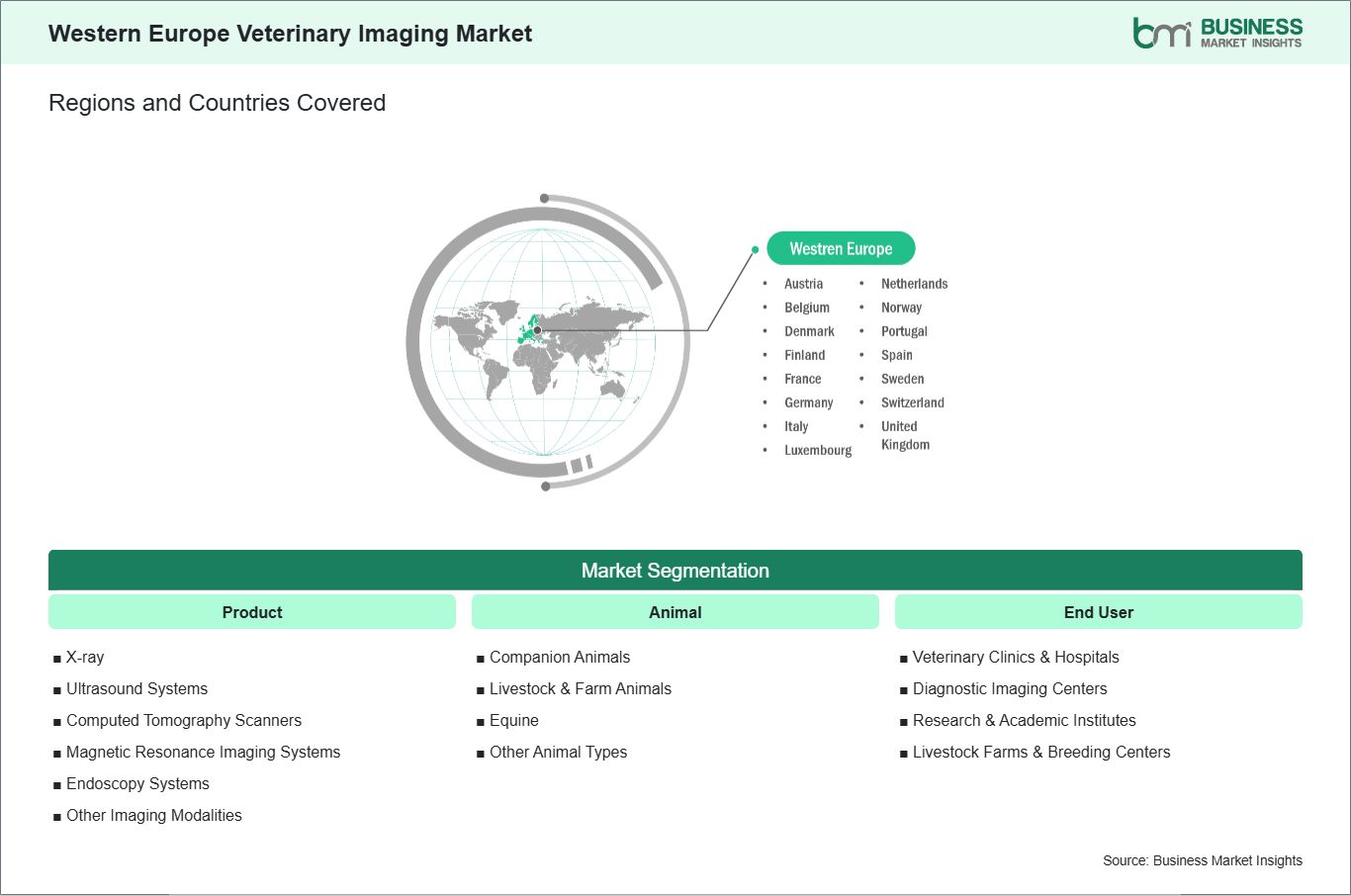
Key segments that contributed to the derivation of the Western Europe veterinary imaging market analysis are product type, animal type, and end user.
Pet owners place much emphasis on prevention and diagnostics to maintain proper health conditions of their pets. Modern veterinary clinics implement a wide range of techniques, including diagnostics by using X-rays, ultrasounds, and CT scans, among other types of technologies, to ensure proper assessment of the condition of the patient.
High customer satisfaction is achieved by applying appropriate medical equipment and providing quality imaging services to customers. Veterinary clinics implementing imaging services provide quality veterinary services, which leads to an increase in market penetration rate since clients have higher confidence in their clinics due to the advanced services provided to patients.
Advanced medical conditions among companion animals increase the demand for diagnostic services offered in veterinary clinics. Advanced technologies help veterinarians to diagnose, treat, and monitor patients to achieve better results in their work. Companion animal health care is developed in Western Europe, and the market penetration will continue growing due to the increasing number of chronic conditions.
The use of digital radiographs, ultrasounds, and CT scans is becoming popular among clinics that employ them to increase accuracy, reduce the invasiveness of procedures, and ensure better treatment. These imaging technologies help clinicians diagnose patients on time, track progress, and control difficult cases.
Portable and multifunctional imaging systems are becoming common, helping clinics work efficiently under various conditions. The trend is part of the process of modernizing veterinary services, where technology plays an essential role.
Digital means, such as AI-powered image recognition programs, teleconsulting solutions, and software applications designed for interpreting images, can be used for improving the quality of diagnoses provided by veterinarians. Advanced imaging technologies combined with digital instruments will help clinics offer high-quality services in Western Europe.

The Western Europe veterinary imaging market demonstrates steady growth, with size and share analysis highlighting evolving trends and competitive dynamics among key players. The report examines subsegments categorized within product type, animal type, and end user, offering insights into their contribution to overall market performance.
By product type, the x-ray segment dominated the market in 2025, driven by its affordability, widespread clinical use, rapid diagnostic capabilities, and strong adoption in routine veterinary care across clinics and field settings.
Based on animal type, the companion animals segment dominated the market in 2025, driven by increasing pet ownership and higher expenditure on preventive and advanced animal healthcare, especially diagnostics for dogs and cats.
On the basis of end user, the veterinary clinics & hospitals segment dominated the market in 2025, driven by the proliferation of veterinary care facilities equipped with advanced imaging systems to meet rising demand for comprehensive diagnostics and treatment services.
| Report Attribute | Details |
|---|---|
| Market size in 2025 | US$ 404.8 Million |
| Market Size by 2033 | US$ 710.6 Million |
| CAGR (2026 - 2033) | 7.3% |
| Historical Data | 2022-2024 |
| Forecast period | 2026-2033 |
| Segments Covered | By Product
|
|
Regions and Countries Covered
| |
| Western Europe | Belgium, the Netherlands, Luxembourg, Germany, France, Italy, Spain, Switzerland, Sweden, Austria, the United Kingdom, Denmark, Portugal, Norway, Finland |
| Market leaders and key company profiles |
|
The "Western Europe Veterinary Imaging Market Size and Forecast (2022–2033)" report provides a detailed analysis of the market covering below areas:
The geographical scope of the Western Europe Veterinary Imaging Market report is divided into Belgium, the Netherlands, Luxembourg, Germany, France, Italy, Spain, Switzerland, Sweden, Austria, the United Kingdom, Denmark, Portugal, Norway, and Finland. Germany held the largest share in 2025.
Germany is the dominant country due to its developed veterinary infrastructure, extensive companion animal population, and large-scale livestock and equine industries. Urban clinics and specialty hospitals in cities such as Berlin, Munich, and Frankfurt utilize high-end imaging modalities, including CT, digital radiography, ultrasound, and MRI, for preventive care, surgical planning, and herd health monitoring. Government-backed initiatives, veterinary associations, and professional training programs reinforce Germany's leadership in technological integration. France demonstrates strong adoption in urban companion animal clinics and livestock farms, emphasizing preventive diagnostics using digital radiography and ultrasound, with some integration of advanced imaging modalities in metropolitan hospitals. The UK is a mature market with widespread use of high-resolution imaging systems in companion animal hospitals. Rural livestock operations rely on portable devices for herd health and equine management. Italy and the Netherlands show steady growth, with urban veterinary clinics investing in high-end imaging technologies and agricultural operations adopting portable, durable systems. Spain and Switzerland are emerging as focused markets for companion animal imaging, with growing adoption of digital radiography and ultrasound, particularly in urban centers. Western Europe balances sophisticated urban adoption for companion animals with practical field-oriented solutions for livestock and equine operations. Germany leads the region in technological integration, infrastructure, and professional expertise, while other countries continue expanding capabilities.

The Western Europe Veterinary Imaging Market is evaluated by gathering qualitative and quantitative data post primary and secondary research, which includes important corporate publications, association data, and databases. A few of the key developments in the Western Europe veterinary imaging market are:
The Western Europe Veterinary Imaging Market is valued at US$ 404.8 Million in 2025, it is projected to reach US$ 710.6 Million by 2033.
As per our report Western Europe Veterinary Imaging Market, the market size is valued at US$ 404.8 Million in 2025, projecting it to reach US$ 710.6 Million by 2033. This translates to a CAGR of approximately 7.3% during the forecast period.
The Western Europe Veterinary Imaging Market report typically cover these key segments-
The historic period, base year, and forecast period can vary slightly depending on the specific market research report. However, for the Western Europe Veterinary Imaging Market report:
The Western Europe Veterinary Imaging Market is populated by several key players, each contributing to its growth and innovation. Some of the major players include:
The Western Europe Veterinary Imaging Market report is valuable for diverse stakeholders, including:
Essentially, anyone involved in or considering involvement in the Western Europe Veterinary Imaging Market value chain can benefit from the information contained in a comprehensive market report.
Please tell us your area of interest
(Market Segments/ Regions and Countries/ Companies)