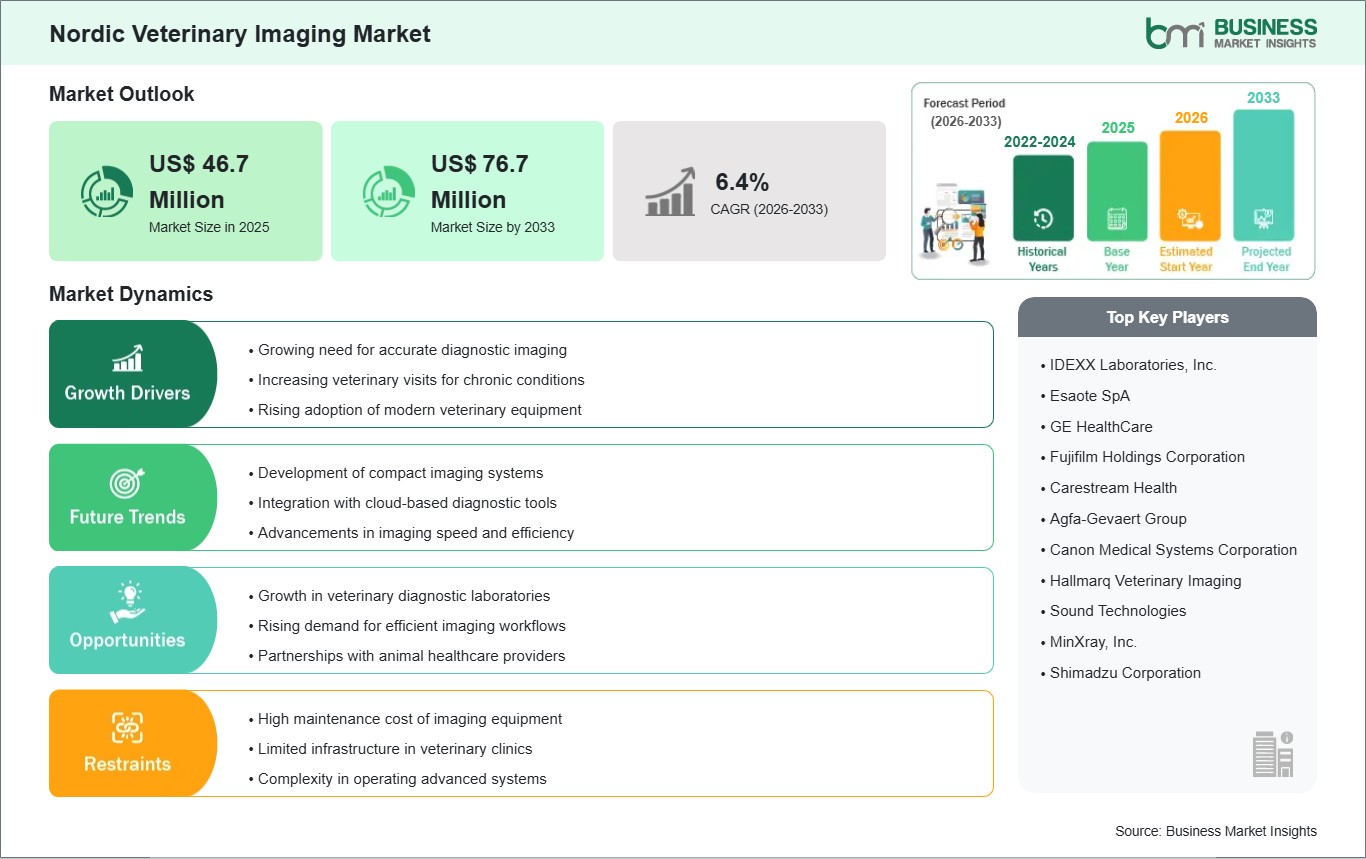
The Nordic veterinary imaging market size is expected to reach US$76.7 million by 2033 from US$46.7 million in 2025. The market is estimated to record a CAGR of 6.4% from 2026 to 2033.
The Nordic veterinary imaging market is experiencing steady growth, driven by rising pet ownership, increasing awareness of preventive animal healthcare, and modernization of livestock management practices. The region is characterized by high technology adoption, with veterinary clinics increasingly integrating advanced imaging modalities such as digital radiography, high-resolution ultrasound, computed tomography (CT), and magnetic resonance imaging (MRI) to enhance diagnostic accuracy and operational efficiency. Both companion animal clinics and large-scale agricultural operations are investing in imaging solutions to support early disease detection, surgical planning, and herd health monitoring, reflecting a dual focus on urban sophistication and practical field applications. Technological innovation plays a central role in market development. Vendors are offering compact, energy-efficient imaging systems with AI-assisted diagnostics, telemedicine integration, and cloud-based image storage, enabling remote consultations, second-opinion diagnostics, and real-time monitoring. Emphasis on durability, user-friendly design, and cost-effectiveness ensures that systems meet the varying infrastructure and operational needs across Nordic countries. Strategic collaborations between equipment suppliers, veterinary associations, and academic institutions further support workforce training, technology transfer, and reliable after-sales services, driving adoption across both urban and rural settings. Government initiatives and regulatory frameworks in the Nordic region support animal welfare, preventive care, and livestock productivity, providing additional incentives for the adoption of veterinary imaging technologies. Overall, the Nordic veterinary imaging market is evolving into a highly professionalized, technology-driven ecosystem where innovation, preventive care, and operational efficiency intersect, creating a favorable environment for continued adoption of modern veterinary imaging solutions.

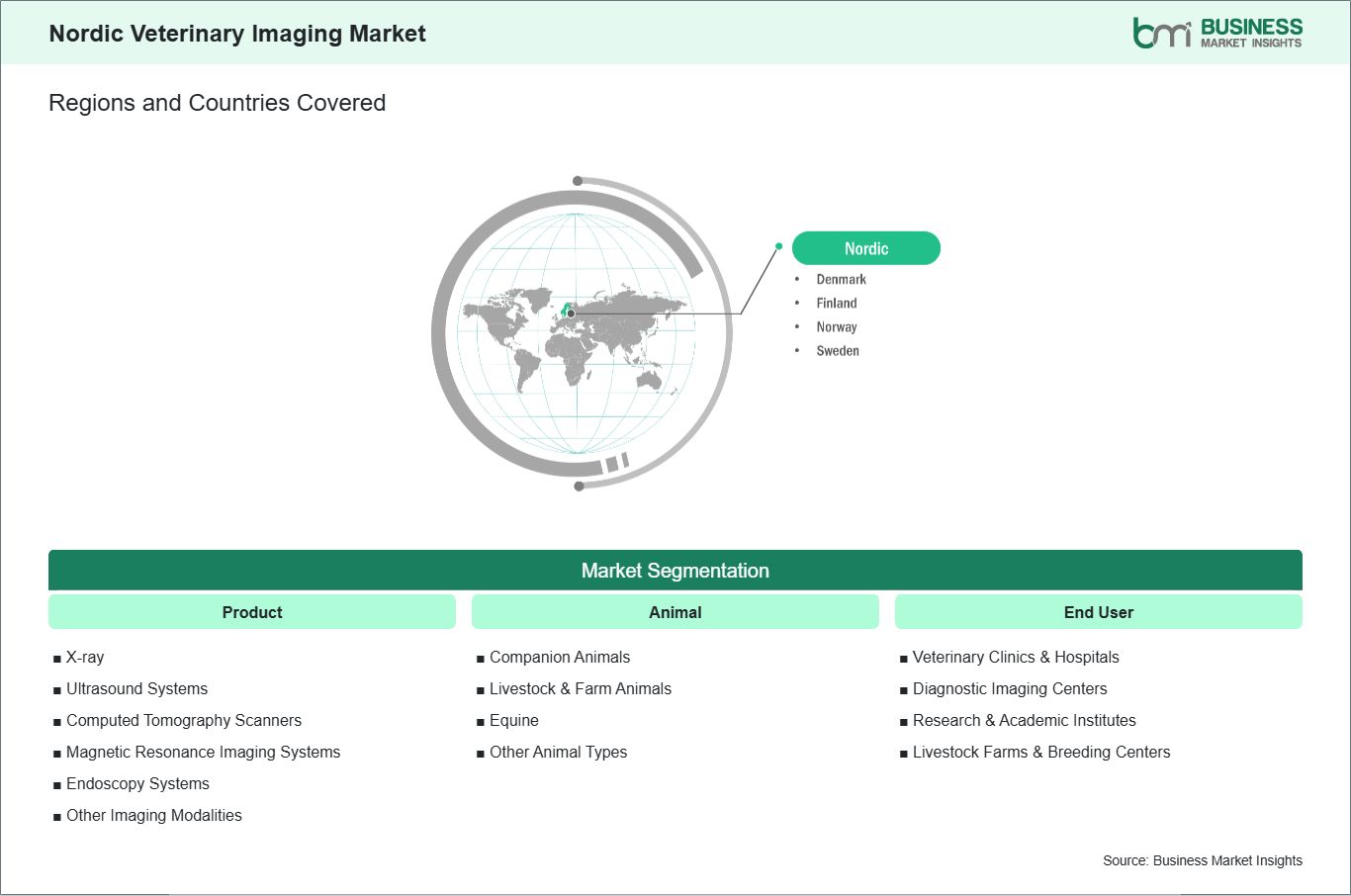
Key segments that contributed to the derivation of the Nordic veterinary imaging market analysis are product type, animal type, and end user.
The veterinary imaging market throughout the Nordic region is being driven by a surge of interest from pet owners in the welfare and health of their companion animals. There has been a shift in the way that most pet owners care for their pets, and they are emphasizing preventive care, early identification of conditions, and long-term health monitoring for their pets more than ever.
As a result, veterinary clinics have begun to utilize diagnostic imaging tools, including X-ray, ultrasound, and CT scans, as part of their standard practice; thus allowing for proper evaluations, the development of effective treatment strategies, and increased accuracy when monitoring chronic conditions in pet patients.
In response to the increase within veterinary practices for high-quality care, veterinary clinics are investing in new equipment, staff training, and building renovations. The routine use of imaging services results in early identification of disease, development of effective treatment strategies, and reduced time between the beginning of care and the recovery of the patient.
As the focus of veterinarians continues to be on the health and welfare of companion animals within the Nordic region, there will be continued demand and growth within the veterinary imaging market.
The growth in demand for diagnostic imaging will also continue due to the increase in animals suffering from both chronic and complex illnesses. Veterinary clinics that utilize advanced imaging technologies will have a substantial advantage over those who do not and will be able to provide high standards of care while managing a variety of patients. The commitment of veterinarians in the Nordic region to providing the best possible care for companion animals, will result in increased growth in the veterinary imaging market, as well as demonstrate the critical role that imaging technologies play within modern veterinary care.
Diagnostics using advanced diagnostic imaging technologies are changing how veterinary practices operate and conduct imaging procedures across the Nordic Region. The ability to diagnose animals accurately has improved due to the use of digital radiography, ultrasound, and CT imaging in practice. The number of available methods for diagnosing and treating patients has been expanded, while the overall quality of care provided to animals has improved through the use of modern technology and the ability to detect diseases at an earlier stage, track disease progression, and use more comprehensive approaches to providing care for complex cases.
With the ability to perform diagnostic imaging anywhere, regardless of location, the demand for portable imaging systems has increased. This flexibility has allowed practitioners to provide timely veterinary care, whether within the confines of their practice or at farms and remote locations, and has greatly increased the ability of practitioners to deliver comprehensive services to clients who may not typically have access to veterinary services. As a result, veterinary clinics and hospitals throughout the Nordic Region are being modernized to embrace technology and integrate it into daily operations.
Multiple advances have also been made with digital tools including the use of AI-assisted image interpretation, teleconsultation platforms, and software to analyze patient data and images, all of which enhance the overall quality of diagnostics and imaging services offered by veterinarians. Integration of these advanced diagnostic imaging technologies with various digital solutions has allowed veterinarians throughout the Nordic Region to provide quality veterinary care in a more efficient and technological manner. The ongoing implementation and expansion of these technologies and solutions continue to contribute to the growth of the overall veterinary imaging marketplace throughout the Nordic region.

The Nordic veterinary imaging market demonstrates steady growth, with size and share analysis highlighting evolving trends and competitive dynamics among key players. The report examines subsegments categorized within product type, animal type, and end user, offering insights into their contribution to overall market performance.
By product type, the x-ray segment dominated the market in 2025, driven by its affordability, widespread clinical use, rapid diagnostic capabilities, and strong adoption in routine veterinary care across clinics and field settings.
Based on animal type, the companion animals segment dominated the market in 2025, driven by increasing pet ownership and higher expenditure on preventive and advanced animal healthcare, especially diagnostics for dogs and cats.
On the Basis of end user, the veterinary clinics & hospitals segment dominated the market in 2025, driven by the proliferation of veterinary care facilities equipped with advanced imaging systems to meet rising demand for comprehensive diagnostics and treatment services.
| Report Attribute | Details |
|---|---|
| Market size in 2025 | US$ 46.7 Million |
| Market Size by 2033 | US$ 76.7 Million |
| CAGR (2026 - 2033) | 6.4% |
| Historical Data | 2022-2024 |
| Forecast period | 2026-2033 |
| Segments Covered | By Product
|
|
Regions and Countries Covered
| |
| Nordic | Sweden, Denmark, Norway, Finland |
| Market leaders and key company profiles |
|
The "Nordic Veterinary Imaging Market Size and Forecast (2022–2033)" report provides a detailed analysis of the market covering below areas:
The geographical scope of the Nordic Veterinary Imaging Market report is divided into Sweden, Denmark, Norway, and Finland. Sweden held the largest share in 2025.
The Nordic veterinary imaging sector has a highly developed and well-established infrastructure in which Sweden holds the largest market share. This is due in part to Sweden's advanced veterinary infrastructure; large numbers of companion animals, livestock and horses; and a highly developed livestock and horse sector. Large numbers of urban veterinary clinics offering high-quality imaging modalities such as digital x-rays, CT scans, and high-quality ultrasound for the purposes of preventative care/surgery planning and monitoring the health of herds are located in urban areas like Stockholm or Gothenburg (continual use of these technologies has also helped to increase the number of veterinary specialists involved in small animal practice). Initiatives led by the Swedish government to promote animal welfare, improve livestock productivity, and encourage the use of preventative veterinary care have also contributed to Sweden's position as the leader of the Nordic veterinary imaging market. Professional veterinary societies in Sweden are well-established and assist with the training, transfer of technology, and acceptance of advanced diagnostic tools. Denmark is a key player in the Nordic market, with significant penetration of digital radiography and ultrasound. Urban companion animal clinics and commercial livestock producers in Denmark have a high level of acceptance of both ultrasound and digital x-ray. Many veterinary facilities are looking to implement portable, durable imaging systems for field applications (as many farms raise dairy or swine), whereas urban clinics are increasingly using higher-end imaging modalities for specialty diagnostics. Norway has a mature veterinary imaging market, with urban companion animal clinics using high-resolution ultrasound and CT technologies, while portable imaging systems are increasingly used in rural areas for the management of livestock and horses. Adoption rates are driven by preventive care programs and government-sponsored livestock health initiatives. Although Finland has a comparatively smaller veterinary imaging market than its Scandinavian neighbors, it is experiencing rapid growth (particularly for those modalities used in equine practice) because of high levels of demand for veterinary imaging services by clients of veterinarians in Finland.

The Nordic Veterinary Imaging Market is evaluated by gathering qualitative and quantitative data post primary and secondary research, which includes important corporate publications, association data, and databases. A few of the key developments in the Nordic veterinary imaging market are:
The Nordic Veterinary Imaging Market is valued at US$ 46.7 Million in 2025, it is projected to reach US$ 76.7 Million by 2033.
As per our report Nordic Veterinary Imaging Market, the market size is valued at US$ 46.7 Million in 2025, projecting it to reach US$ 76.7 Million by 2033. This translates to a CAGR of approximately 6.4% during the forecast period.
The Nordic Veterinary Imaging Market report typically cover these key segments-
The historic period, base year, and forecast period can vary slightly depending on the specific market research report. However, for the Nordic Veterinary Imaging Market report:
The Nordic Veterinary Imaging Market is populated by several key players, each contributing to its growth and innovation. Some of the major players include:
The Nordic Veterinary Imaging Market report is valuable for diverse stakeholders, including:
Essentially, anyone involved in or considering involvement in the Nordic Veterinary Imaging Market value chain can benefit from the information contained in a comprehensive market report.
Please tell us your area of interest
(Market Segments/ Regions and Countries/ Companies)