Market Summary
Executive Summary and Market Analysis
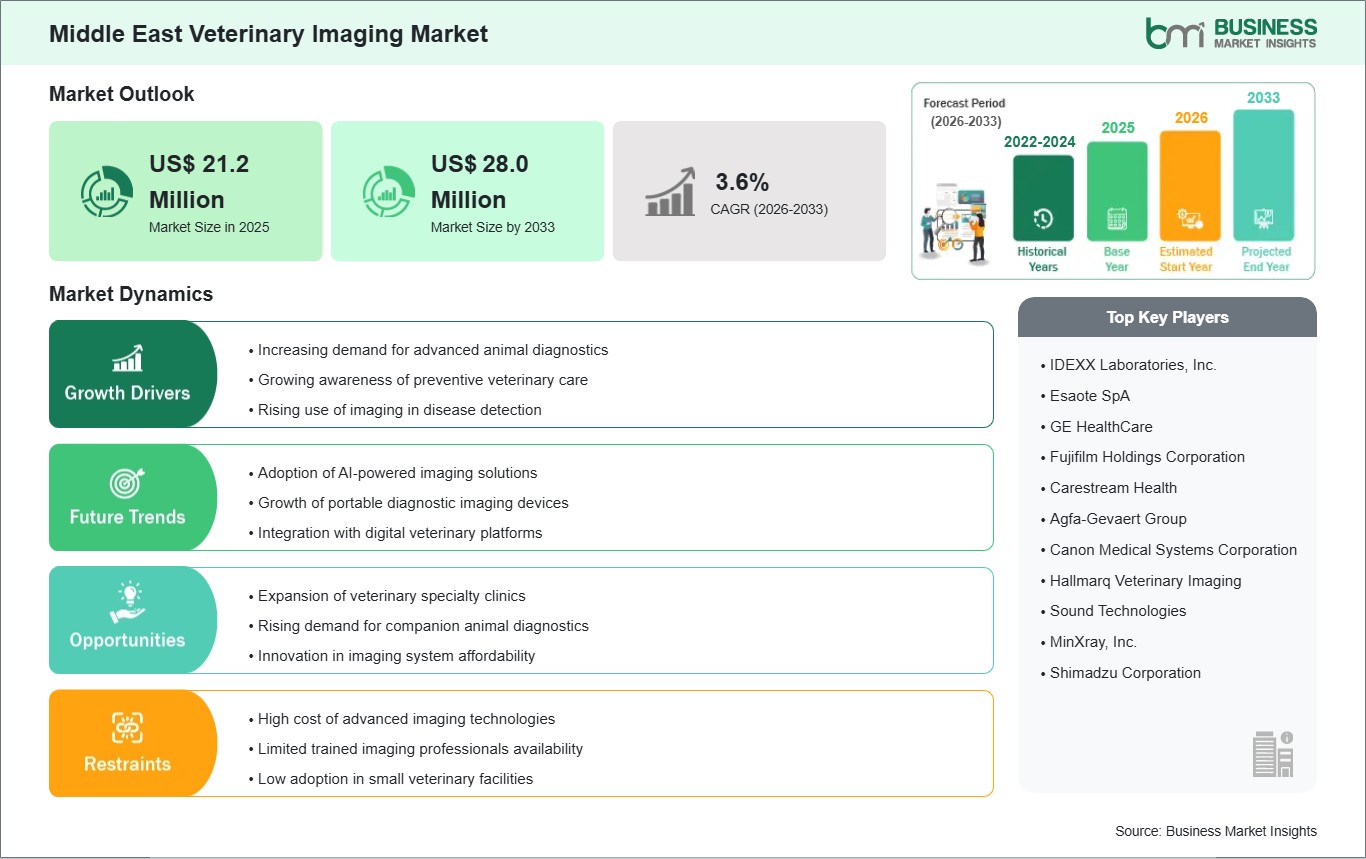
The Middle East veterinary imaging market is experiencing steady growth driven by increasing pet ownership, modernization of veterinary services, and expanding livestock and equine industries. The market is characterized by a dual adoption pattern, with urban veterinary clinics investing in high-end imaging modalities such as digital radiography, computed tomography (CT), and high-resolution ultrasound for companion animals, while rural and agricultural regions rely on portable, cost-efficient, and durable imaging systems for herd health management, disease prevention, and productivity optimization. This approach balances sophisticated diagnostic capabilities in urban centers with practical, field-oriented solutions that enhance operational efficiency across diverse veterinary settings. Technological innovation is a major driver of market expansion. Vendors are introducing compact, energy-efficient imaging systems equipped with AI-assisted diagnostics, telemedicine capabilities, and cloud-based storage, facilitating remote consultations, real-time monitoring, and improved workflow efficiency. Affordability, durability, and ease of use are prioritized to address the region’s economic and infrastructural variability. Strategic partnerships between equipment manufacturers, veterinary associations, and educational institutions support professional training, technology transfer, and reliable after-sales services, strengthening adoption rates. Government initiatives focusing on preventive care, livestock productivity, and animal welfare further stimulate demand for veterinary imaging solutions. Evolving regulatory frameworks are improving device approvals and encouraging private sector participation. Overall, the Middle East veterinary imaging market is evolving into a professionalized, technology-driven ecosystem, effectively combining high-end urban diagnostics with practical field solutions, and offering significant growth opportunities for advanced veterinary imaging technologies.
Segment Analysis
Middle East Veterinary Imaging Market Segmentation
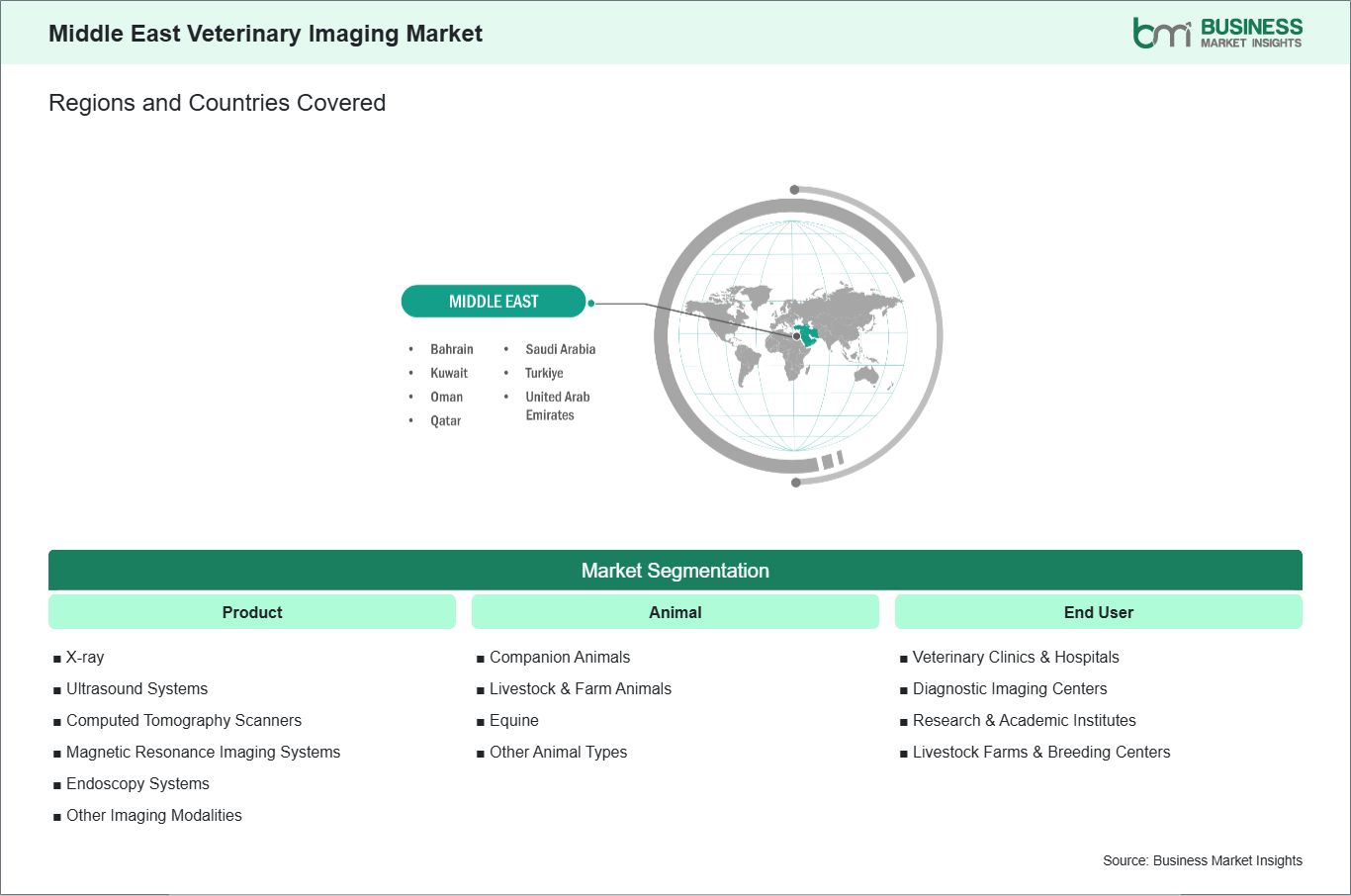
Key segments that contributed to the derivation of the Middle East veterinary imaging market analysis are product type, animal type, and end user.
- By product type, the veterinary imaging market is segmented into X-ray, Ultrasound Systems, Computed Tomography (CT) Scanners, Magnetic Resonance Imaging (MRI) Systems, Endoscopy Systems, Other Imaging Modalities. The x-ray segment dominated the market in 2025.
- Based on animal type, the veterinary imaging market is categorized into companion animals, livestock & farm animals, equine, and other animal types. The companion animals segment dominated the market in 2025.
- On the Basis of end user, the veterinary imaging market is classified into veterinary clinics & hospitals, diagnostic imaging centers, research & academic institutes, and livestock farms & breeding centers. The veterinary clinics & hospitals segment dominated the market in 2025.
Market Forces
Middle East Veterinary Imaging Market Drivers and Opportunities
Rising focus on companion and livestock health
The need to improve animal health through preventative care, early diagnosis and ongoing monitoring is driving the veterinary imaging market growth in Middle Eastern countries. The increasing number of veterinary clinics and hospitals is offering diagnostic imaging through X-ray, ultrasound and CT imaging; these technologies provide vet clinics with the ability to obtain accurate assessments of an animal's health status. Imaging is often an integral part of the veterinary practice when diagnosing health problems, treating chronic conditions and improving overall outcomes for the animal. Veterinarians are increasingly taking advantage of modern equipment, training and infrastructure to provide a higher level of care as animal welfare awareness grows. Imaging services allow veterinarians to detect conditions early, plan a specific treatment plan and manage the recovery process more efficiently; this is a proactive approach to improving client trust and reinforcing the importance of imaging within the overall veterinary service. The need for advanced imaging solutions is increasing in response to the growing complexity of health care challenges posed by both companion animals and livestock. Veterinary clinics that are implementing diagnostic imaging at the core of their practice will have the systems in place to handle a diverse case load with a high level of service. The emphasis on animal health in the Middle East is projected to support the continued growth of the veterinary imaging market and further demonstrate the critical importance of veterinary imaging.
Expanding adoption of advanced imaging technologies
The adoption of advanced imaging technologies is reshaping veterinary practice in the Middle East. Clinics are increasingly using digital radiography, ultrasound, and CT scanning to improve diagnostic accuracy, reduce invasive procedures, and deliver better treatment outcomes. These technologies enable early detection of complex conditions and allow veterinarians to manage both companion and farm animals more effectively.
Portable and flexible imaging solutions are gaining traction, providing the ability to perform diagnostics in clinics, farms, and remote locations. This adaptability improves service efficiency, extends coverage, and supports timely care delivery across diverse environments. The trend reflects broader modernization of veterinary services, with technology playing a central role in daily practice.
Digital tools such as image analysis software, AI-assisted interpretation, and teleconsultation platforms further enhance diagnostic capabilities. These innovations reduce errors, streamline workflows, and support informed clinical decision-making. By combining advanced imaging technologies with digital solutions, veterinary clinics in the Middle East can improve care quality, operational efficiency, and client satisfaction. Continued adoption of these technologies positions the regional market for sustained growth while fostering modern, technology-driven animal healthcare.
Size and Share Analysis
Middle East Veterinary Imaging Market Size and Share Analysis
The Middle East veterinary imaging market demonstrates steady growth, with size and share analysis highlighting evolving trends and competitive dynamics among key players. The report examines subsegments categorized within product type, animal type, and end user, offering insights into their contribution to overall market performance.
By product type, the x-ray segment dominated the market in 2025, driven by its affordability, widespread clinical use, rapid diagnostic capabilities, and strong adoption in routine veterinary care across clinics and field settings.
Based on animal type, the companion animals segment dominated the market in 2025, driven by increasing pet ownership and higher expenditure on preventive and advanced animal healthcare, especially diagnostics for dogs and cats.
On the Basis of end user, the veterinary clinics & hospitals segment dominated the market in 2025, driven by the proliferation of veterinary care facilities equipped with advanced imaging systems to meet rising demand for comprehensive diagnostics and treatment services.
Report Coverage
Middle East Veterinary Imaging Market Report Coverage and Deliverables
The "Middle East Veterinary Imaging Market Size and Forecast (2022–2033)" report provides a detailed analysis of the market covering below areas:
- Middle East Veterinary Imaging Market size and forecast at regional and country levels for all segments covered under the scope
- Middle East Veterinary Imaging Market trends, as well as drivers, restraints, and opportunities
- Middle East Veterinary Imaging Market analysis covering key trends, regional framework, major players, regulations, and recent developments
- Industry landscape and competition analysis covering market concentration, heat map analysis, prominent players, and recent developments for the Middle East Veterinary Imaging Market
- Detailed company profiles, including SWOT analysis
Geographic Insights
Middle East Veterinary Imaging Market Geographic Insights
The geographical scope of the Middle East Veterinary Imaging Market report is divided into UAE, Saudi Arabia, Bahrain, Oman, Kuwait, Qatar, and Turkiye. Turkiye held the largest share in 2025.
The use of advanced imaging technologies is revolutionizing the provision of veterinary services throughout the Middle East and Africa. Digital radiography, ultrasound and CT scanners are now being used by veterinary clinics to provide higher accuracy in diagnosis, to make less invasive treatment possible and to improve overall treatment delivery. By using these technologies, veterinarians can detect disease at an earlier stage, track the progress of treatment and effectively manage more complicated cases.
The availability of mobile and flexible imaging devices is growing, enabling diagnostic procedures to be performed in clinic environments, on farms and in remote locations. This flexibility in use increases operational efficiency, expands the range of services that can be offered and enables veterinarians to provide timely health care services to clients regardless of their situation or location. This trend reflects the much broader movement underway to modernize the delivery of veterinary service and the central role that technology plays in daily veterinary practise.
Digital-based innovations such as software for analysing images, artificial intelligence-assisted interpretation of images, and teleconsultation platforms are providing enhanced capabilities for veterinarians to diagnose their patients. These resources will help to decrease the incidence of errors, improve the efficiency of the veterinarian's workflow and assist with making well-informed treatment decisions. By integrating advanced imaging technologies with digital-based solutions, veterinarians in the Middle East and Africa will be able to continue to provide high-quality veterinary care to their clients while simultaneously improving the efficiency of their operations. These same factors will also contribute to continued growth in the veterinary imaging industry and the provision of modern, technologically advanced animal health care services throughout the Middle East and Africa.
Industry Activity
Recent Developments
The Middle East Veterinary Imaging Market is evaluated by gathering qualitative and quantitative data post primary and secondary research, which includes important corporate publications, association data, and databases. A few of the key developments in the Middle East veterinary imaging market are:
- In March 2023, IDEXX Laboratories, Inc. announced the launch of a new portable ultrasound system designed specifically for veterinary practices in the Middle East, aiming to enhance diagnostic imaging capability and workflow efficiency in regional clinics.
- In January 2024, Zoetis also expanded its diagnostic imaging portfolio through its Vetscan Imagyst platform, adding AI‑assisted analysis capabilities (e.g., AI Urine Sediment analysis) that support faster in‑clinic diagnostics — tools increasingly adopted by clinics in advanced Middle East markets like the UAE and Saudi Arabia.
Trust & Transparency
Research Methodology
The market analysis combines proprietary research with secondary data from government agencies, company disclosures, regulatory filings, industry databases and expert interviews. Market estimates are validated through data triangulation, cross-market benchmarking and analyst
review.
View Full Research Methodology
Key Sources Referred:
International Veterinary Radiology Association (IVRA)American College of Veterinary Radiology (ACVR)European Association of Veterinary Diagnostic Imaging (EAVDI)US Food and Drug Administration (FDA)US Department of Agriculture (USDA)World Organisation for Animal Health (WOAH)American Veterinary Medical Association (AVMA)American Animal Hospital Association (AAHA)