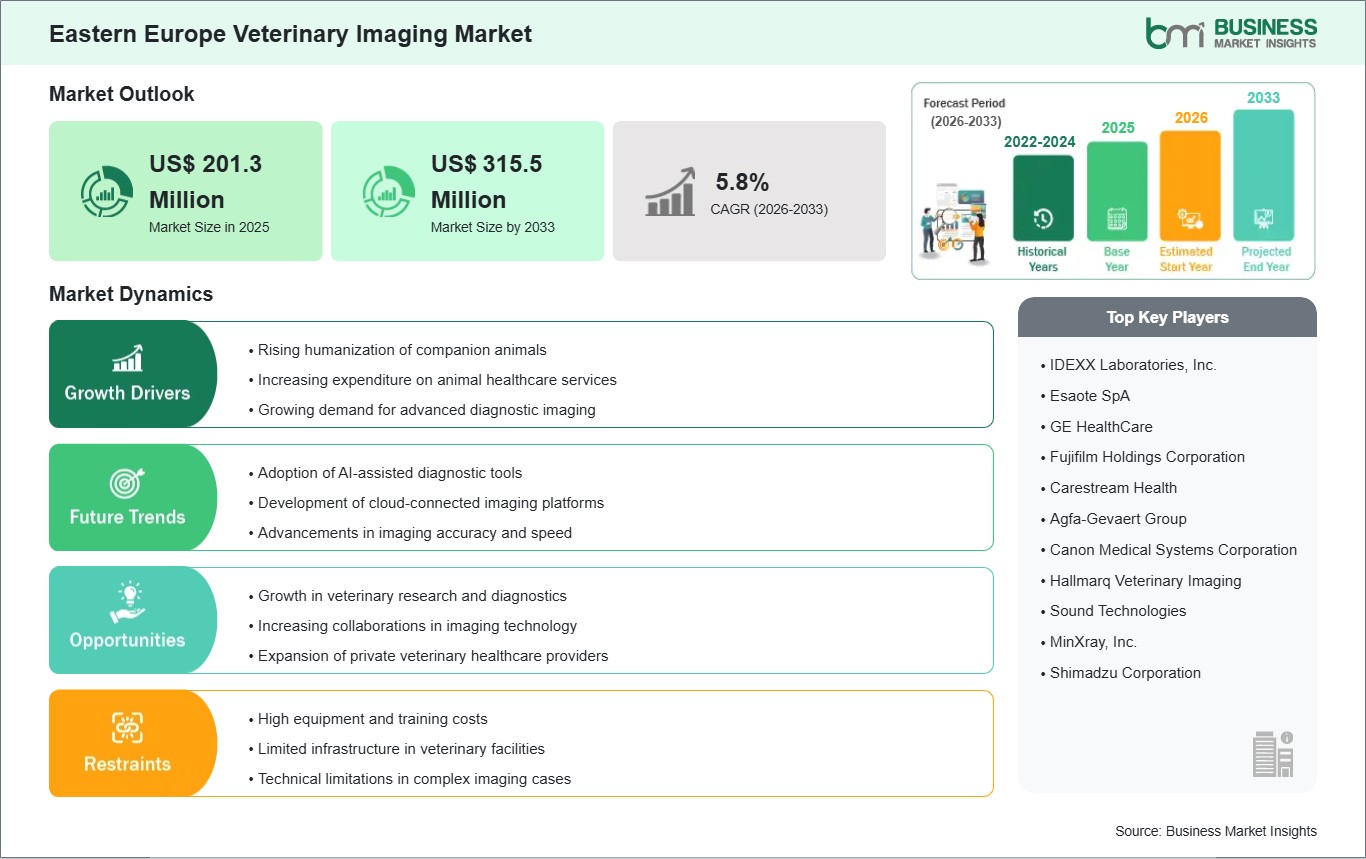
The Eastern Europe veterinary imaging market size is expected to reach US$315.5 million by 2033 from US$201.3 million in 2025. The market is estimated to record a CAGR of 5.8% from 2026 to 2033.
The Eastern Europe veterinary imaging market is characterized by gradual modernization and increasing adoption of advanced diagnostic technologies across countries such as Poland, Romania, Hungary, Czech Republic, Slovakia, and Bulgaria. The market is primarily driven by rising awareness of preventive healthcare in companion animals, a growing number of veterinary clinics, and the gradual mechanization of livestock farming. Veterinary service providers are increasingly adopting digital radiography, ultrasound, and portable imaging systems to improve disease detection, surgical planning, and herd management. Urban centers are the primary hubs for high-end imaging solutions, while rural areas tend to rely on cost-effective and portable systems, creating a dual-speed market landscape. Technological innovation is central to the market’s growth. Compact, energy-efficient, and durable imaging systems are gaining traction, enabling both urban clinics and field-based livestock operations to implement effective diagnostics. Software integration, including image analysis, telemedicine capabilities, and cloud-based storage, is gradually expanding across the region, facilitating remote consultation and improved operational efficiency. Vendors are increasingly focusing on affordability and ease of use to accommodate varying economic conditions and infrastructure disparities. Market expansion is further supported by collaborations between equipment suppliers, veterinary associations, and educational institutions, which provide training, maintenance, and technology transfer programs. Regulatory frameworks across Eastern Europe are evolving, enabling smoother approvals for advanced imaging devices and encouraging private sector participation. Government initiatives to improve animal welfare, livestock productivity, and disease control are also stimulating demand for veterinary imaging solutions. The Eastern Europe veterinary imaging market is in a phase of steady transformation, with increasing technological adoption and professionalization of veterinary services. Preventive care, operational efficiency, and innovation are shaping the market, positioning it as an emerging but promising region for veterinary diagnostic imaging solutions.

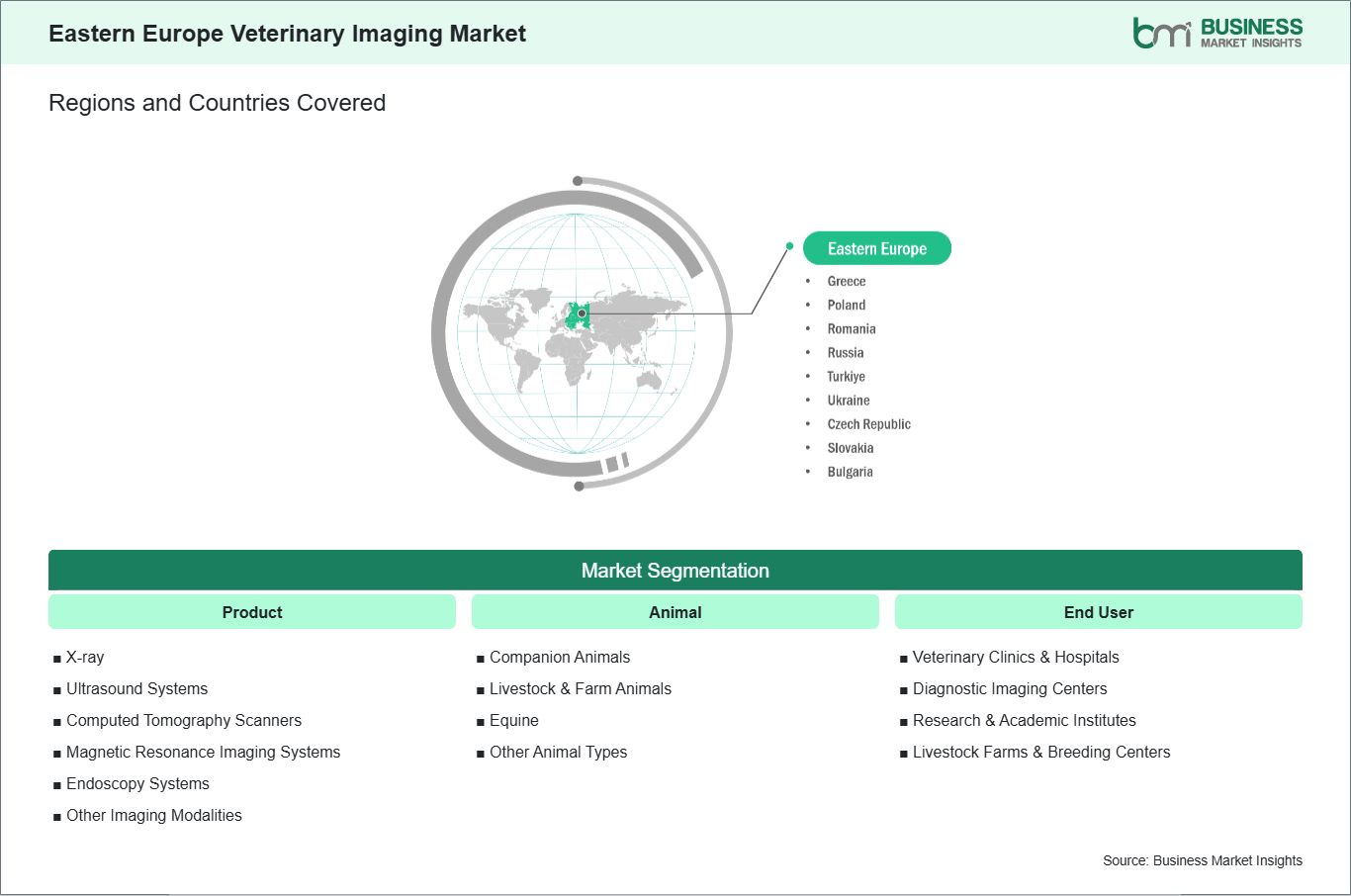
Key segments that contributed to the derivation of the Eastern Europe veterinary imaging market analysis are product type, animal type, and end user.
Increasing attention to companion animal health is a primary factor driving growth in the Eastern Europe veterinary imaging market. Pet owners are placing higher importance on preventive care, early diagnosis, and regular monitoring of animal health. Veterinary clinics are responding by incorporating diagnostic imaging into their services, using tools such as X-ray, ultrasound, and CT scans to support accurate assessments and effective treatment plans. The focus on early detection and ongoing health monitoring reinforces the value of imaging technologies in everyday veterinary practice.
As pet owners seek higher-quality care, veterinary providers are investing in infrastructure, equipment, and staff training to meet these expectations. Imaging services allow veterinarians to identify health issues early, create precise treatment strategies, and track recovery efficiently. This emphasis on comprehensive care strengthens client trust and encourages continued investment in advanced diagnostic solutions.
The growing prevalence of chronic and complex conditions among companion animals also supports the demand for imaging services. Clinics that integrate advanced diagnostic technologies into routine care are better equipped to manage these challenges while maintaining high standards. The rising focus on companion animal health in Eastern Europe not only enhances care outcomes but also drives sustained market expansion, positioning imaging technologies as essential tools in modern veterinary practice across the region.
Veterinary practice is evolving through the introduction of sophisticated imaging technologies into clinics throughout Eastern Europe. Digital X-rays, ultrasound and CT scans are being applied within veterinary clinics to improve diagnostic accuracy, decrease the need for invasive procedures and improve patient treatment outcomes by enabling clinicians to identify diseases at an earlier stage and manage complex cases more efficiently.
Portable, user-friendly imaging technologies will play an increasingly important role in veterinary medicine by enabling diagnostics to occur within clinics, on farms and in rural and remote areas of the world. This greater flexibility enhances efficiency and allows veterinarians to offer uninterrupted service for a greater distance while providing rapid responses to the evolving needs of clients. These trends are part of the larger effort to modernize veterinary medicine as technology has become a primary focus in daily veterinary practice.
Digital technologies, such as teleconsultation, and image analysis software, are enhancing diagnostic capabilities and enabling veterinarians to perform quantitative measurements of their patients through the use of AI-assisted interpretation methods that allow for greater diagnostic accuracy, reduce the chances of human error, and shorten the workflow necessary to complete a diagnostic task, all of which will help to provide higher quality care for their patients more efficiently than previously possible. By utilizing advanced imaging technologies in conjunction with existing digital technologies, veterinary practices in Eastern Europe are positioning themselves to provide the best possible care for their clients while also expanding their operational capacity. Ongoing adoption of new technologies will help to ensure that the veterinary imaging market in Eastern Europe remains dynamic, modern, and poised for continued growth.

The Eastern Europe veterinary imaging market demonstrates steady growth, with size and share analysis highlighting evolving trends and competitive dynamics among key players. The report examines subsegments categorized within product type, animal type, and end user, offering insights into their contribution to overall market performance.
By product type, the x-ray segment dominated the market in 2025, driven by its affordability, widespread clinical use, rapid diagnostic capabilities, and strong adoption in routine veterinary care across clinics and field settings.
Based on animal type, the companion animals segment dominated the market in 2025, driven by increasing pet ownership and higher expenditure on preventive and advanced animal healthcare, especially diagnostics for dogs and cats.
On the Basis of end user, the veterinary clinics & hospitals segment dominated the market in 2025, driven by the proliferation of veterinary care facilities equipped with advanced imaging systems to meet rising demand for comprehensive diagnostics and treatment services.
| Report Attribute | Details |
|---|---|
| Market size in 2025 | US$ 201.3 Million |
| Market Size by 2033 | US$ 315.5 Million |
| CAGR (2026 - 2033) | 5.8% |
| Historical Data | 2022-2024 |
| Forecast period | 2026-2033 |
| Segments Covered | By Product
|
|
Regions and Countries Covered
| |
| Eastern Europe | Russia, Poland, Ukraine, Romania, the Czech Republic, Slovakia, Bulgaria, Greece |
| Market leaders and key company profiles |
|
The "Eastern Europe Veterinary Imaging Market Size and Forecast (2022–2033)" report provides a detailed analysis of the market covering below areas:
The geographical scope of the Eastern Europe Veterinary Imaging Market report is divided into Russia, Poland, Ukraine, Romania, the Czech Republic, Slovakia, Bulgaria, Greece. Russia held the largest share in 2025.
Adoption trends across countries within the Eastern Europe veterinary imaging market show substantial differences. Russia is the leading country due to the size of its livestock industry, the rapidly growing population of companion animals, and large investments into developing the veterinary infrastructure. Digital radiology, ultrasound, and computed tomography (CT) are examples of advanced imaging systems that are prevalent in urban clinics and larger farms across the country, allowing for the prevention of disease, herd management, and high precision diagnostics. In addition to the advanced imaging modalities, strong government regulations, veterinary associations, and animal health initiatives supported by the government further support Russia's position as the largest veterinary imaging market in the region. Poland also has significant adoption rates of veterinary imaging systems across both veterinary clinics that treat companion animals and livestock. Additionally, urban clinics prefer to utilize higher quality imaging modalities, while rural farms typically use lower-cost portable imaging systems. A recent increase in the use of imaging modalities for preventive care has resulted in gradual growth of veterinary imaging in Ukraine; especially in urban and commercial farms. Romania’s veterinary clinics are being modernized slowly; with veterinarians using digital radiology and ultrasound; but the rural livestock producers typically continue to use portable imaging systems. The Czech Republic utilizes veterinary imaging regularly through both its veterinary clinics and research facilities treating companion animals; and the trend of increasing the use of advanced imaging for early diagnosis and more accurate results continues to grow. Slovakia’s small-scale livestock producers’ primary concern is using cost-effective imaging approaches; and higher quality modalities are primarily used by urban clinics in the country. Both Bulgaria and Greece are emerging as veterinary imaging markets; however the overwhelming majority of investments in each of those countries are occurring in urban veterinary clinics.

The Eastern Europe Veterinary Imaging Market is evaluated by gathering qualitative and quantitative data post primary and secondary research, which includes important corporate publications, association data, and databases. A few of the key developments in the Eastern Europe veterinary imaging market are:
The Eastern Europe Veterinary Imaging Market is valued at US$ 201.3 Million in 2025, it is projected to reach US$ 315.5 Million by 2033.
As per our report Eastern Europe Veterinary Imaging Market, the market size is valued at US$ 201.3 Million in 2025, projecting it to reach US$ 315.5 Million by 2033. This translates to a CAGR of approximately 5.8% during the forecast period.
The Eastern Europe Veterinary Imaging Market report typically cover these key segments-
The historic period, base year, and forecast period can vary slightly depending on the specific market research report. However, for the Eastern Europe Veterinary Imaging Market report:
The Eastern Europe Veterinary Imaging Market is populated by several key players, each contributing to its growth and innovation. Some of the major players include:
The Eastern Europe Veterinary Imaging Market report is valuable for diverse stakeholders, including:
Essentially, anyone involved in or considering involvement in the Eastern Europe Veterinary Imaging Market value chain can benefit from the information contained in a comprehensive market report.
Please tell us your area of interest
(Market Segments/ Regions and Countries/ Companies)