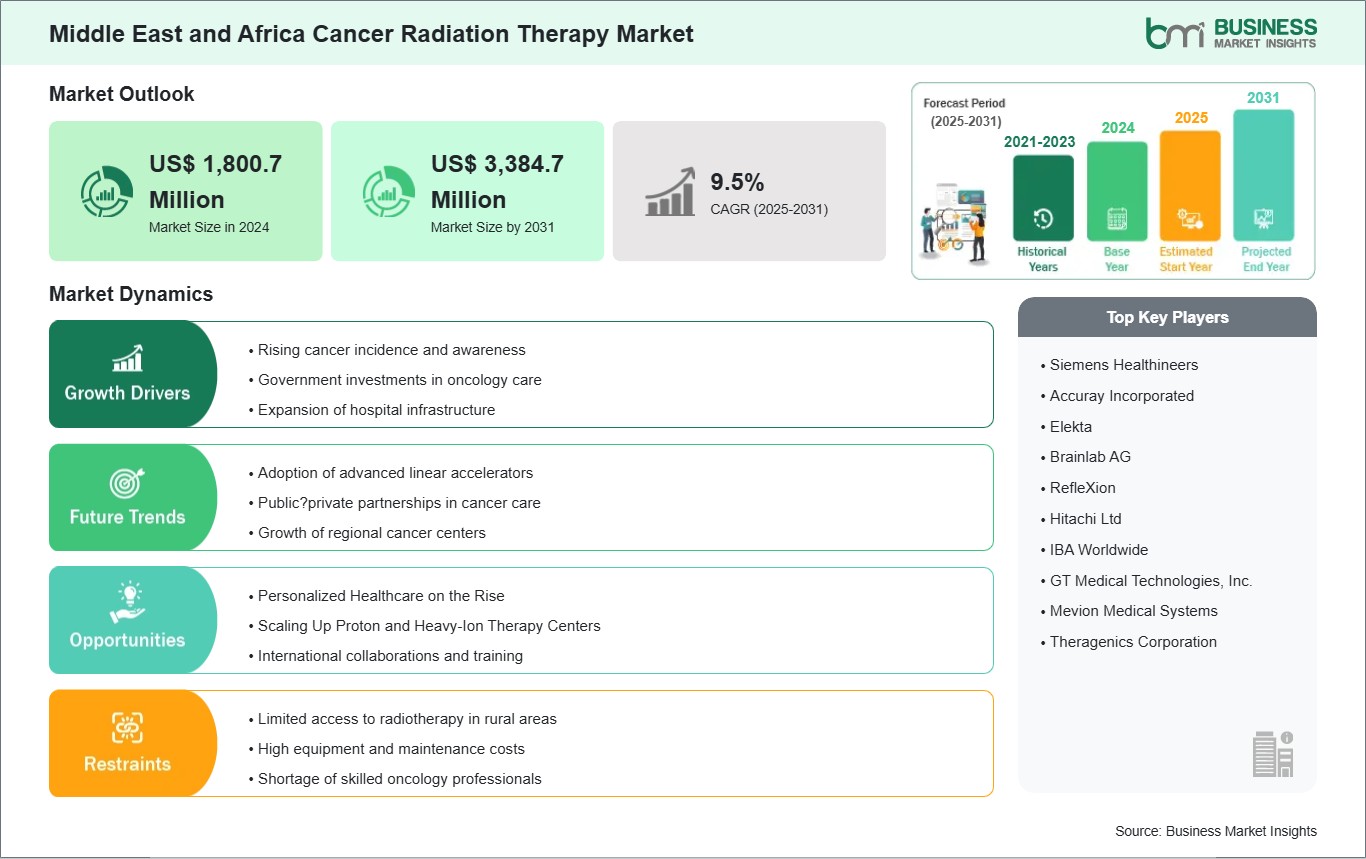
The Middle East and Africa cancer radiation therapy market size is expected to reach US$ 3,384.7 million by 2031 from US$ 1,800.7 million in 2024. The market is estimated to record a CAGR of 9.5% from 2025 to 2031.
The Middle East & Africa (MEA) cancer radiation therapy market is expanding as governments and private healthcare providers respond to rising cancer incidence, particularly breast, prostate, and cervical cancers. The region shows a diverse landscape, with advanced oncology centers in South Africa, Saudi Arabia, and the UAE coexisting with areas that have limited access to radiotherapy services. Urban hospitals are adopting high-precision external beam radiotherapy, image-guided systems, and brachytherapy, while cross-border collaborations help transfer clinical expertise and technology to developing markets. Regional initiatives promoting early diagnosis and integration of radiation therapy into national cancer care programs are contributing to a steady increase in patient access in metropolitan centers.
Despite this growth, the MEA market faces several constraints that affect uniform adoption. Rural and lower-income regions struggle with limited infrastructure, workforce shortages, and high capital costs for advanced equipment. Procurement delays and inconsistent regulatory frameworks in certain countries slow technology deployment, while the lack of trained radiation oncologists and physicists restricts the reach of complex treatment modalities. Opportunities exist in leveraging digital oncology solutions, such as telemedicine-based treatment planning, cloud-enabled workflow management, and AI-assisted dose planning, which can enhance efficiency, extend care to underserved areas, and support the long-term modernization of radiation therapy services across the region.

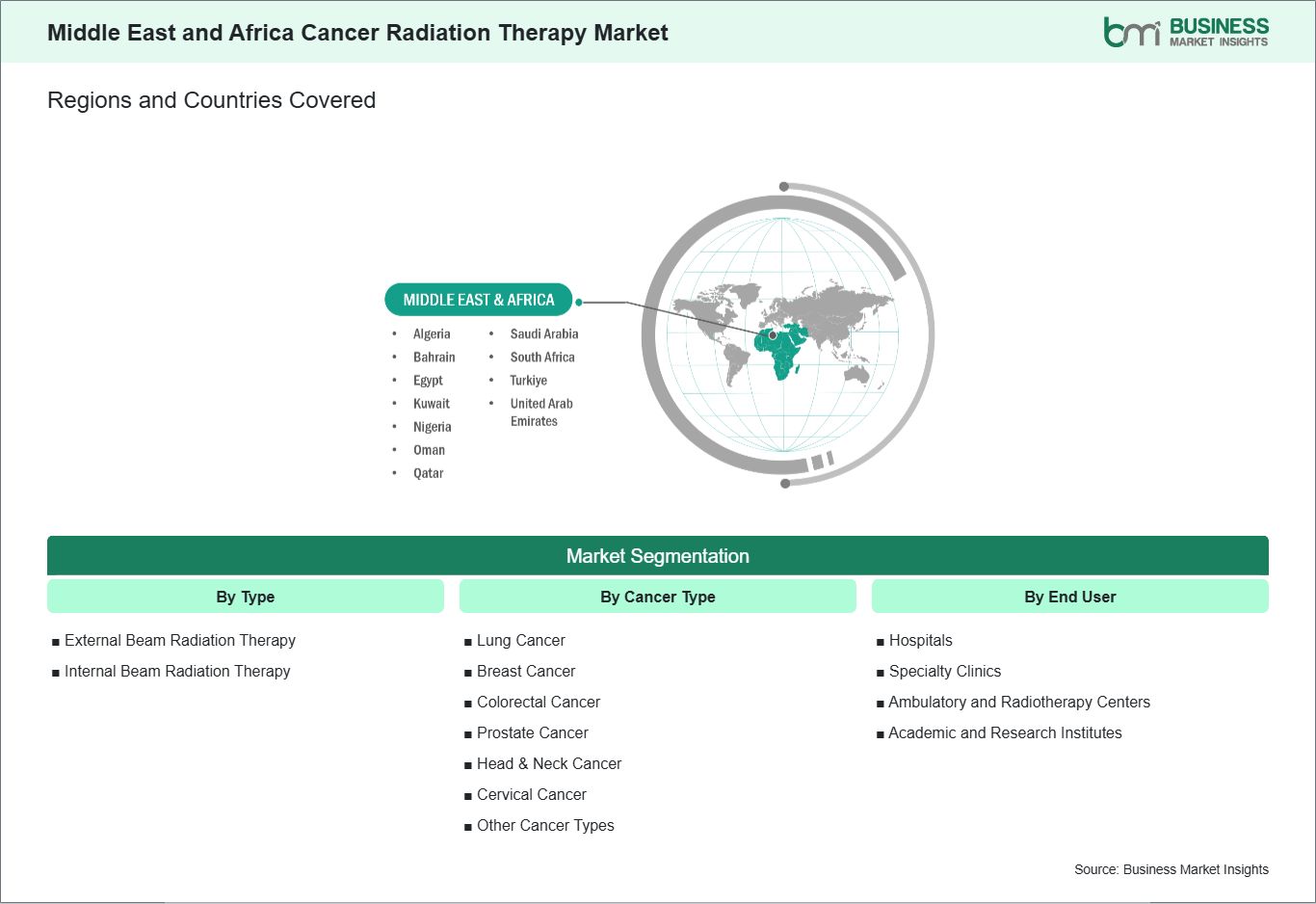
Key segments that contributed to the derivation of the Middle East and Africa cancer radiation therapy market analysis are type, cancer type, and end user.
Cancer prevalence is accelerating across the Middle East and Africa due to aging populations, rapid urbanization, and persistent exposure to risk factors such as tobacco, air pollution, and infectious agents. Gulf countries such as Saudi Arabia and the UAE are experiencing more breast and thyroid cancers alongside lifestyle-related colorectal cases, while North African nations report high burdens of liver cancer linked to hepatitis and schistosomiasis. In Sub‑Saharan Africa, head‑and‑neck and cervical cancers remain prominent, with late-stage presentations common in Nigeria, Ethiopia, and Tanzania.
Screening and diagnostic expansion are uneven, creating distinct demand profiles for radiation therapy across the region. Tertiary centers in Riyadh, Abu Dhabi, and Cairo are scaling external beam platforms for complex cases, while emerging hubs in Nairobi and Accra prioritize foundational linear accelerator capacity to address backlog and geographic access gaps. Brachytherapy is being revitalized for cervical cancer in East and Southern Africa, and for prostate cancer in South Africa and Morocco, reflecting disease patterns and cost-effectiveness in resource-limited settings.
Government strategies and philanthropic initiatives are catalyzing oncology infrastructure growth, but workforce and maintenance constraints persist. National cancer plans in the Gulf emphasize technology upgrades and quality assurance, whereas African programs focus on decentralizing services and strengthening referral networks. As awareness campaigns and vaccination efforts (HPV, hepatitis B) expand, more patients enter formal care pathways—sustaining a multi‑year surge in radiation therapy demand and positioning cancer prevalence as a durable driver of the Middle East and Africa market.
Personalized oncology is gaining momentum across the Middle East and Africa as precision imaging, molecular testing, and adaptive planning become more accessible. Leading centers in the Gulf integrate genomic profiling and PET/CT into radiotherapy decision‑making, enabling dose adaptation for radiosensitive subtypes and complex head‑and‑neck cases. In South Africa and Egypt, multidisciplinary boards are standardizing contouring and leveraging MRI for gynecologic and brain tumors, while pilot radiomics projects explore image‑based biomarkers to refine treatment intensity.
Technology adoption is widening the personalization toolkit beyond conventional EBRT. IMRT, IGRT, and SBRT are routine in Gulf and North African tertiary hospitals, supporting hypofractionated schedules for breast and prostate cancers and stereotactic approaches for oligometastatic disease. Proton therapy referrals from the Middle East to regional centers are growing for pediatric and skull‑base indications, and African programs are upgrading brachytherapy with 3D image guidance to tailor dose for cervical cancer—reducing toxicity while improving local control.
Policy shifts and training collaborations are aligning incentives with individualized care. Reimbursement frameworks in the Gulf are expanding coverage for advanced techniques and adaptive workflows, while African public‑private partnerships fund planning software, QA programs, and workforce development. Patients are seeking shorter courses with fewer side effects, and cross‑border care pathways—such as referrals to high‑complexity centers—support access to precision platforms. These dynamics create a clear opportunity for vendors and providers to deliver integrated, patient‑specific radiation therapy solutions tailored to the diverse clinical and resource realities of the Middle East and Africa.

The Middle East and Africa cancer radiation therapy market demonstrates steady growth, with size and share analysis highlighting evolving trends and competitive dynamics among key players. The report further examines subsegments categorized within type, cancer type, and end user, offering insights into their contribution to overall market performance.
By type, the external beam radiation therapy subsegment dominated the market in 2024. Due to its widespread availability, precision targeting, noninvasive nature, and effectiveness in treating diverse cancers, it is the preferred choice across global oncology practices.
Based on cancer type, the lung cancer subsegment dominated the market in 2024. Due to its high incidence, strong link with smoking and pollution, late‑stage diagnoses, and reliance on advanced radiation techniques, it is the most treated cancer type globally.
In terms of end user, the hospitals subsegment dominated the market in 2024. Hospitals dominated the market since they provide comprehensive cancer care, advanced radiation infrastructure, skilled oncologists, and integrated treatment pathways, making them the primary setting for delivering radiation therapy services.
| Report Attribute | Details |
|---|---|
| Market size in 2024 | US$ 1,800.7 Million |
| Market Size by 2031 | US$ 3,384.7 Million |
| CAGR (2025 - 2031) | 9.5% |
| Historical Data | 2021-2023 |
| Forecast period | 2025-2031 |
| Segments Covered | By Type
|
| Regions and Countries Covered | Middle East and Africa
|
| Market leaders and key company profiles |
|
The "Middle East and Africa Cancer Radiation Therapy Market Size and Forecast (2021 - 2031)" report provides a detailed analysis of the market covering below areas:
The geographical scope of the Middle East and Africa Cancer Radiation Therapy market report is divided into: Saudi Arabia, the UAE, Kuwait, Bahrain, Qatar, Oman, Turkiye, South Africa, Egypt, Nigeria, Algeria, and the Rest of MEA. South Africa held the largest share in 2024.
South Africa leads the MEA radiation therapy market due to its well-developed oncology infrastructure, concentration of high-technology cancer centers, and a robust pool of trained professionals. Major cities such as Johannesburg, Cape Town, and Pretoria host most of the country's advanced facilities, including linear accelerators, stereotactic and image-guided systems, and brachytherapy units. South Africa's dual public-private healthcare model allows for the early adoption of advanced techniques in private hospitals while maintaining broader patient access in public centers. The country's investment in workforce training programs ensures a steady supply of radiation oncologists, medical physicists, and technologists capable of managing complex treatment protocols.
Challenges persist, particularly in extending these services to rural provinces where infrastructure and specialist availability are limited. To address these gaps, South Africa is focusing on digital oncology integration, telemedicine platforms, and coordinated public sector expansion to improve access and treatment efficiency. Additionally, as a regional referral hub, South Africa attracts patients from neighboring countries seeking high-quality radiotherapy, reinforcing its leadership position. Sustained investment in equipment modernization, clinical training, and technology adoption ensures the country continues to shape the evolution of the MEA cancer radiation therapy market.

The Middle East and Africa Cancer Radiation Therapy market is evaluated by gathering qualitative and quantitative data post primary and secondary research, which includes important corporate publications, association data, and databases. A few of the key developments in the Middle East and Africa cancer radiation therapy market are:
The Middle East and Africa Cancer Radiation Therapy Market is valued at US$ 1,800.7 Million in 2024, it is projected to reach US$ 3,384.7 Million by 2031.
As per our report Middle East and Africa Cancer Radiation Therapy Market, the market size is valued at US$ 1,800.7 Million in 2024, projecting it to reach US$ 3,384.7 Million by 2031. This translates to a CAGR of approximately 9.5% during the forecast period.
The Middle East and Africa Cancer Radiation Therapy Market report typically cover these key segments-
The historic period, base year, and forecast period can vary slightly depending on the specific market research report. However, for the Middle East and Africa Cancer Radiation Therapy Market report:
The Middle East and Africa Cancer Radiation Therapy Market is populated by several key players, each contributing to its growth and innovation. Some of the major players include:
The Middle East and Africa Cancer Radiation Therapy Market report is valuable for diverse stakeholders, including:
Essentially, anyone involved in or considering involvement in the Middle East and Africa Cancer Radiation Therapy Market value chain can benefit from the information contained in a comprehensive market report.
Please tell us your area of interest
(Market Segments/ Regions and Countries/ Companies)