Market Summary
Executive Summary and Market Analysis
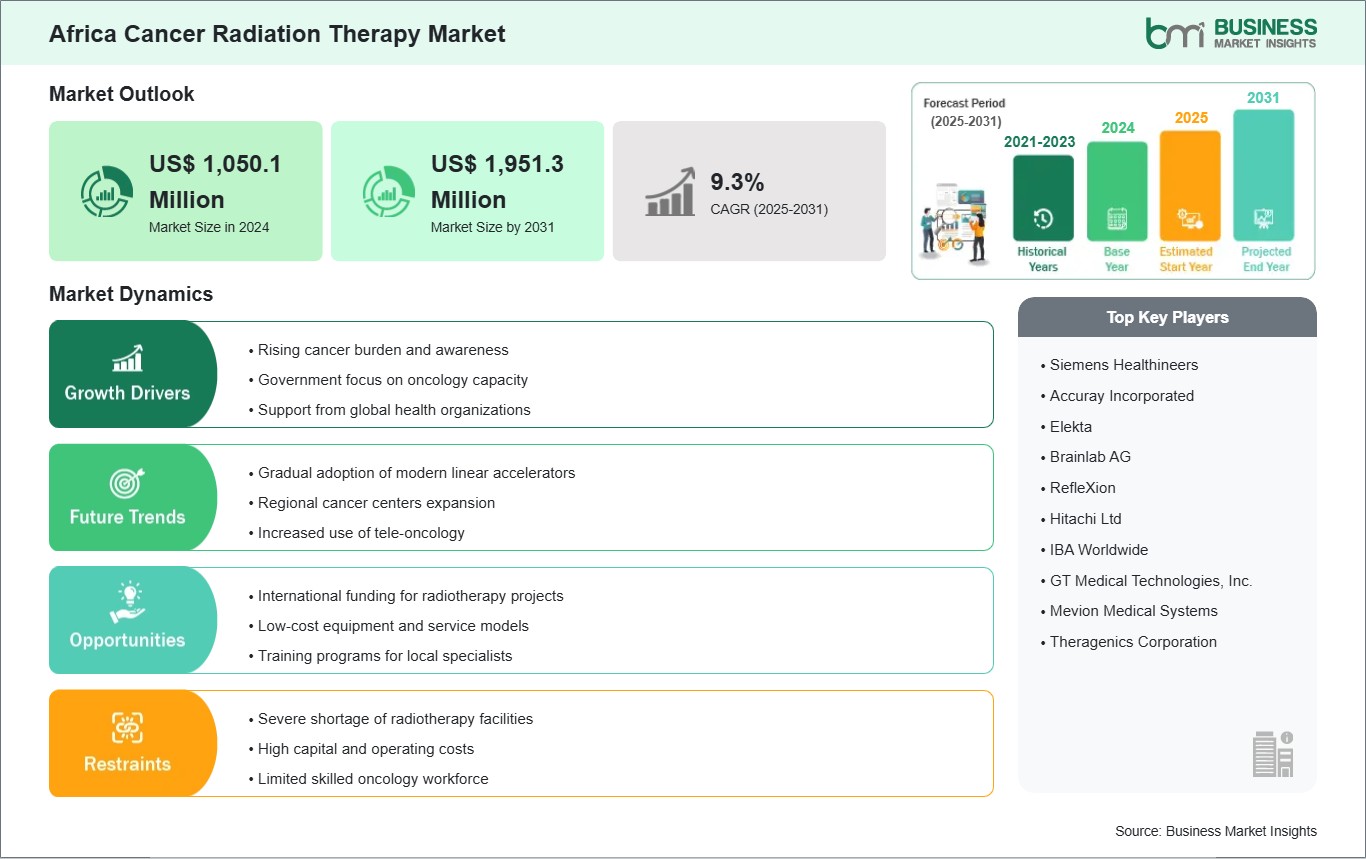
The cancer radiation therapy market in Africa is steadily evolving as healthcare systems across the region work to expand oncology services and reduce the long‑standing treatment gap. Growth is supported by increasing investments in modern radiotherapy equipment, rising awareness of early cancer diagnosis, and the gradual establishment of specialized cancer centers in several countries. Governments and private players are recognizing the growing cancer burden and are prioritizing radiotherapy infrastructure as part of broader national health strategies. Multilateral organizations are also contributing to capacity‑building through technology partnerships and training programs aimed at increasing the number of skilled radiation oncologists and medical physicists in the region.
Limited access to advance linear accelerators, inconsistent electricity supply in some regions, and shortages of trained personnel remain key restraints that slow technology adoption. Additionally, patients in rural and remote areas still encounter barriers in reaching centralized treatment facilities. Despite these challenges, the region presents a significant opportunity for sustainable expansion, particularly through public - private partnerships and the introduction of compact, cost‑efficient radiation therapy solutions tailored for low‑resource environments. As African nations continue modernizing healthcare infrastructure, the demand for accessible and reliable radiation therapy is expected to strengthen across the continent.
Segment Analysis
Africa Cancer Radiation Therapy Market Segmentation
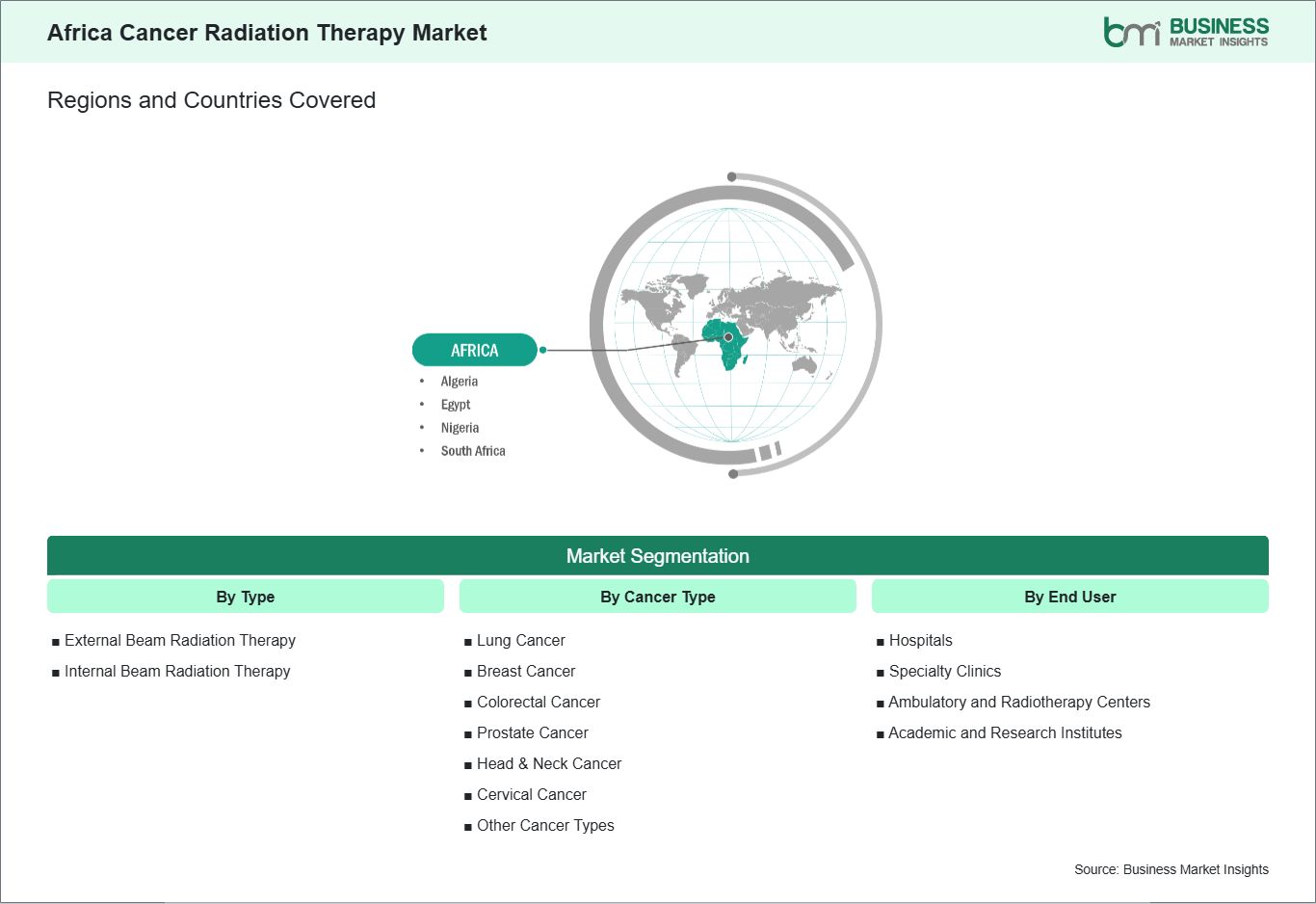
Key segments that contributed to the derivation of the Africa cancer radiation therapy market analysis are type, cancer type, and end user.
- By type, the cancer radiation therapy market is segmented into external beam radiation therapy and internal beam radiation therapy. The external beam radiation therapy segment dominated the market in 2024.
- Based on cancer type, the cancer radiation therapy market is segmented into lung cancer, breast cancer, colorectal cancer, prostate cancer, head & neck cancer, cervical cancer, and others. The lung cancer segment dominated the market in 2024.
- In terms of end user, the cancer radiation therapy market is segmented into hospitals, specialty clinics, ambulatory and radiotherapy centers, and academic and research institutes. The hospitals segment dominated the market in 2024.
Market Forces
Africa Cancer Radiation Therapy Market Drivers and Opportunities
Increasing Prevalence of Cancer
Cancer cases are rising across Africa due to changes in lifestyle, growing urban populations, and longer life expectancy. Diseases such as breast, cervical, prostate, and lung cancer are diagnosed more frequently across both urban and semi-urban areas. This growing disease burden is increasing the need for effective treatment options, including radiation therapy. As surgery and drug therapy are often not sufficient, radiation therapy is becoming a critical part of cancer care across many African countries.
Healthcare systems in Africa are improving cancer diagnosis and referral pathways. More patients are being identified at stages where radiation therapy is required either as a primary treatment or in combination with surgery and chemotherapy. External beam radiation therapy is used due to its flexibility in treating different tumor types, while internal beam radiation therapy is adopted for cancers such as cervical and prostate cancer. This growing patient flow is placing pressure on hospitals to expand radiation therapy capacity.
As awareness of cancer symptoms improves and screening programs slowly expand, the demand for radiation therapy services continues to rise. Governments and healthcare providers are recognizing the need to strengthen oncology infrastructure to manage this growing burden. As a result, increasing cancer prevalence is acting as a strong and sustained driver for the Africa cancer radiation therapy market.
Rising Demand for Personalized Medicine
There is growing awareness across Africa that cancer treatment outcomes improve when therapy is tailored to individual patients. Personalized medicine focuses on selecting the right treatment approach based on tumor type, location, and patient condition. This shift is creating strong opportunities for advanced radiation therapy techniques that allow precise targeting of tumors while limiting damage to healthy tissues.
Modern external beam radiation therapy systems support personalized treatment planning through image-guided and intensity-controlled approaches. These technologies help clinicians adjust radiation doses based on tumor behavior and patient response. In internal beam radiation therapy, personalized dose delivery is becoming important for treating cancers common in Africa, such as cervical and prostate cancer. This trend is encouraging hospitals to upgrade existing systems and adopt more advanced planning software.
As oncology training improves and partnerships with international healthcare organizations increase, African cancer centers are gaining the capability to deliver more customized radiation therapy. Patients are also becoming more informed and are seeking better quality treatment with fewer side effects. This rising demand for personalized care creates a strong opportunity for equipment manufacturers, service providers, and healthcare systems to invest in advanced radiation therapy solutions tailored to the African market.
Size and Share Analysis
Africa Cancer Radiation Therapy Market Size and Share Analysis
The Africa cancer radiation therapy market demonstrates steady growth, with size and share analysis highlighting evolving trends and competitive dynamics among key players. The report further examines subsegments categorized within type, cancer type, and end user, offering insights into their contribution to overall market performance.
By type, the external beam radiation therapy subsegment dominated the market in 2024. Due to its widespread availability, precision targeting, noninvasive nature, and effectiveness in treating diverse cancers, it is the preferred choice across global oncology practices.
Based on cancer type, the lung cancer subsegment dominated the market in 2024. Due to its high incidence, strong link with smoking and pollution, late‑stage diagnoses, and reliance on advanced radiation techniques, it is the most treated cancer type globally.
In terms of end user, the hospitals subsegment dominated the market in 2024. Hospitals dominated the market since they provide comprehensive cancer care, advanced radiation infrastructure, skilled oncologists, and integrated treatment pathways, making them the primary setting for delivering radiation therapy services.
Report Coverage
Africa Cancer Radiation Therapy Market Report Coverage and Deliverables
The "Africa Cancer Radiation Therapy Market Size and Forecast (2021 - 2031)" report provides a detailed analysis of the market covering below areas:
- Africa Cancer Radiation Therapy market size and forecast at regional and country levels for key market segments covered under the scope
- Africa Cancer Radiation Therapy market trends, as well as market dynamics such as drivers, restraints, and key opportunities
- Africa Cancer Radiation Therapy market analysis covering key market trends, regional framework, major players, regulations, and recent market developments
- Industry landscape and competition analysis covering market concentration, heat map analysis, prominent players, and recent developments for the Africa Cancer Radiation Therapy market
- Detailed company profiles, including SWOT analysis
Geographic Insights
Africa Cancer Radiation Therapy Market Geographic Insights
The geographical scope of the Africa Cancer Radiation Therapy market report is divided into: Nigeria, Egypt, South Africa, and Algeria. South Africa held the largest share in 2024.
South Africa represents the most developed and influential market for cancer radiation therapy in Africa, supported by its relatively advanced healthcare infrastructure and stronger adoption of modern oncology technologies. The country benefits from a well‑established network of public and private cancer centers, many of which have integrated advanced radiotherapy modalities and imaging‑guided treatment approaches. South Africa also hosts a larger pool of trained radiation oncologists and medical physicists compared to other African nations, enabling more consistent delivery of high‑quality care. Its regulatory environment is comparatively structured, encouraging the introduction of radiotherapy systems and supporting long‑term equipment maintenance programs. Despite its strengths, South Africa experiences disparities between metropolitan and rural regions, where access to radiotherapy remains uneven. Public hospitals face equipment maintenance delays and occasional capacity constraints, which can lead to treatment backlogs. Nonetheless, the country continues to explore modernization initiatives, including accelerated facility upgrades and collaborations with international technology providers. A growing emphasis on digital oncology solutions, such as treatment‑planning platforms and tele‑mentoring programs, enhances its ability to expand specialized care. South Africa’s continued leadership in training, technology adoption, and clinical expertise positions it as the central hub for radiotherapy development and innovation within the African continent.
Industry Activity
Recent Developments
The Africa Cancer Radiation Therapy market is evaluated by gathering qualitative and quantitative data post primary and secondary research, which includes important corporate publications, association data, and databases. A few of the key developments in the Africa cancer radiation therapy market are:
- In April 2025, MedAccess and Elekta announced the launch of an innovative pay-per-use financing model to expand access to cancer radiotherapy equipment and services in African countries, particularly targeting improved affordability and sustainability of radiotherapy treatment infrastructure in Kenya and Tanzania.
- In November 2024, Icon Oncology announced that the Arcadia Oncology Centre in Pretoria had installed a Varian VitalBeam linear accelerator, enhancing high-precision radiation therapy treatments for cancer patients with improved targeting accuracy and shorter treatment sessions.
Trust & Transparency
Research Methodology
The market analysis combines proprietary research with secondary data from government agencies, company disclosures, regulatory filings, industry databases and expert interviews. Market estimates are validated through data triangulation, cross-market benchmarking and analyst
review.
View Full Research Methodology
Key Sources Referred:
The World BankWorld Health Organization (WHO)Center for Disease Control and Prevention (CDC)Union for International Cancer Control (UICC)International Agency for Research on Cancer (IARC)American Society for Radiation Oncology (ASTRO)European Society for Radiotherapy & Oncology (ESTRO)Asia-Oceania Federation of Organizations for Radiological Technology (AOFRT)Company WebsitesCompany Annual ReportsCompany Investor Presentations