Asia Pacific Cancer Radiation Therapy Market Outlook (2021–2031)

Historic Data: 2021-2023   |   Base Year: 2024   |   Forecast Period: 2025-2031
Report Content: Market Scope, Market Segmentation, Market Dynamics, and Competitive Analysis

Report Coverage:
  • Type (External Beam Radiation Therapy, Internal Beam Radiation Therapy)
  • Cancer Type (Lung Cancer, Breast Cancer, Colorectal Cancer, Prostate Cancer, Head & Neck Cancer, Cervical Cancer, Other Cancer Types)
  • End User (Hospitals, Specialty Clinics, Ambulatory and Radiotherapy Centers, Academic and Research Institutes)

No. of Pages: 100
Report Code: BMIPUB00033462
Category: Life Sciences
Asia Pacific Cancer Radiation Therapy Market
Buy Now

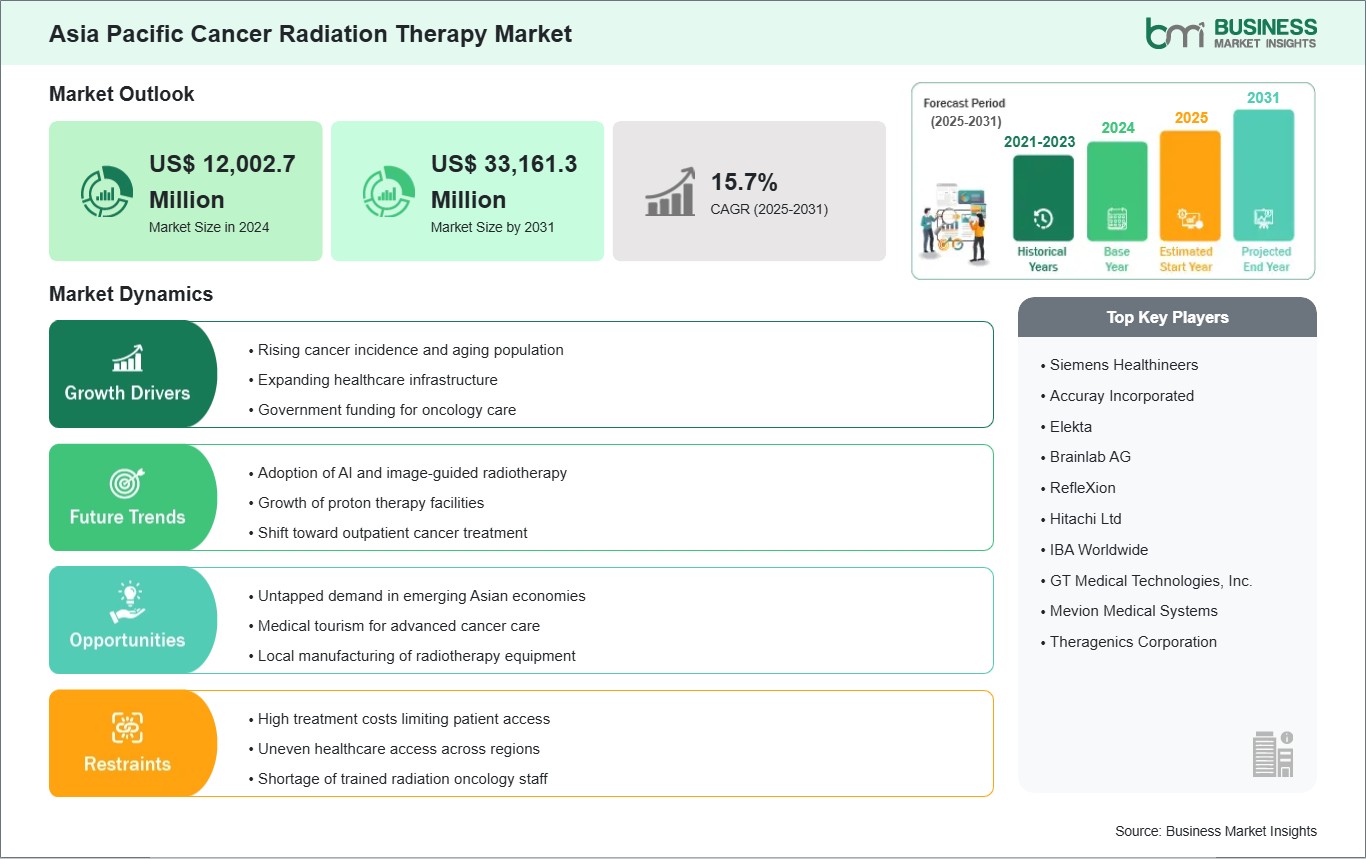
The Asia Pacific cancer radiation therapy market size is expected to reach US$ 33,161.3 million by 2031 from US$ 12,002.7 million in 2024. The market is estimated to record a CAGR of 15.7% from 2025 to 2031.

Executive Summary and Asia Pacific Cancer Radiation Therapy Market Analysis:

The cancer radiation therapy market in Asia Pacific is advancing rapidly as healthcare systems modernize and governments prioritize oncology capacity-building across both developed and emerging economies. Growth is driven by expanding cancer incidence, rising investment in clinical infrastructure, and increasing adoption of advanced treatment modalities across large markets such as China, Japan, India, Australia, and South Korea. Several countries are upgrading radiotherapy departments with image-guided systems, motion-management capabilities, and data-driven planning tools to support more precise and efficient treatments. Expanding medical tourism corridors, especially in East and Southeast Asia, also contribute to procedural demand as cross-border patients seek comprehensive, technology-intensive cancer care.

Despite this momentum, the region faces structural constraints. Uneven distribution of radiotherapy centers, particularly between urban hubs and remote areas, continues to limit access for large segments of the population. Workforce shortages—especially of medical physicists and dosimetrists—challenge uniform adoption of advanced techniques. In some markets, procurement complexity and lengthy reimbursement processes can delay technology refresh cycles. However, a compelling opportunity lies in the region's accelerating shift toward digital oncology. AI-based contouring, cloud-enabled planning, adaptive workflows, and remote QA solutions can help scale high-quality treatments even in resource-limited settings. As Asia Pacific continues investing in integrated, multidisciplinary cancer care, radiotherapy is positioned to play a central role in treatment expansion and technological innovation.

Asia Pacific Cancer Radiation Therapy Market - Strategic Insights:

global-market-strategic-framework
Get more information on this report

Asia Pacific Cancer Radiation Therapy Market Segmentation Analysis:

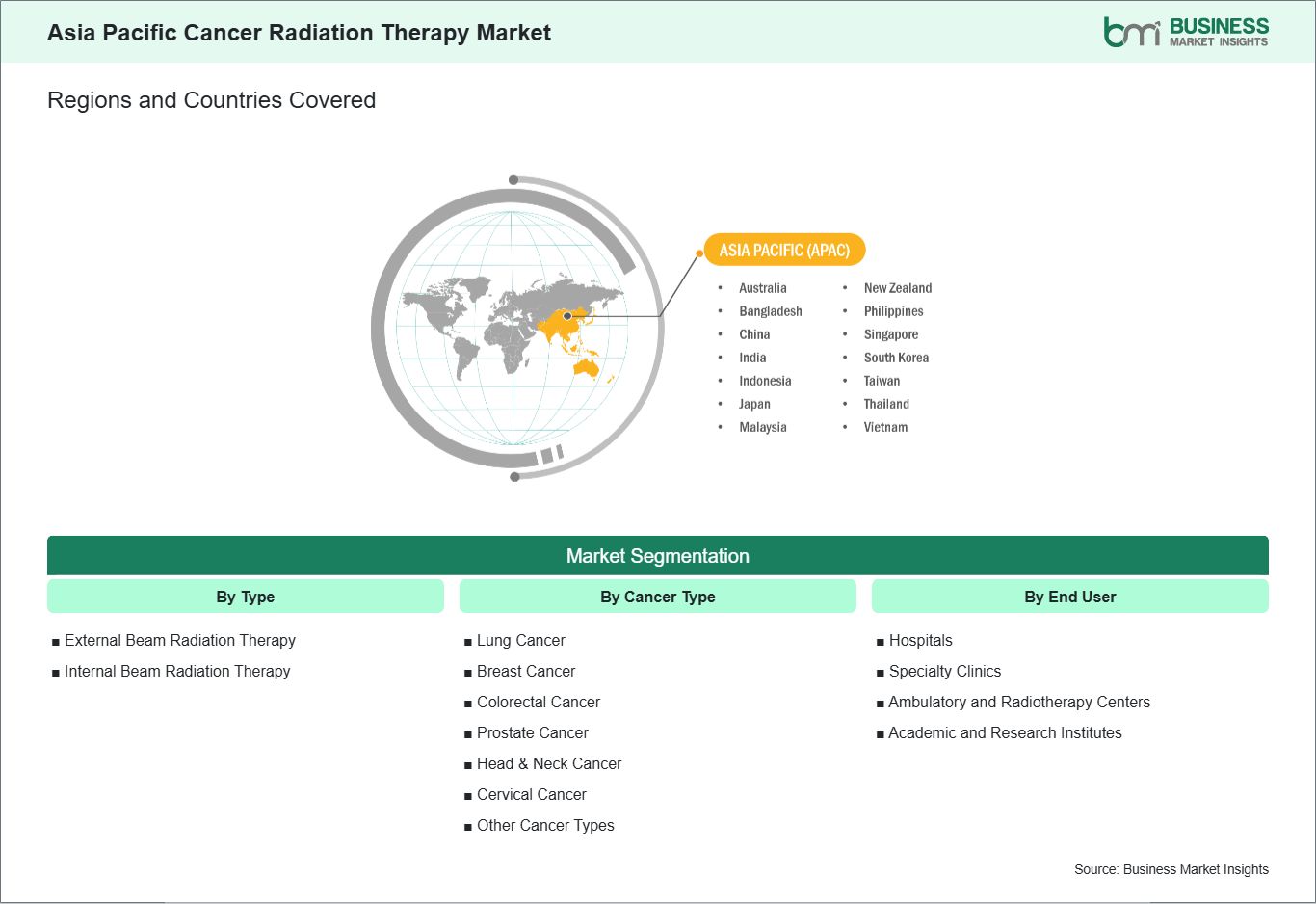
Key segments that contributed to the derivation of the Asia Pacific cancer radiation therapy market analysis are type, cancer type, and end user.

  • By type, the cancer radiation therapy market is segmented into external beam radiation therapy and internal beam radiation therapy. The external beam radiation therapy segment dominated the market in 2024.
  • Based on cancer type, the cancer radiation therapy market is segmented into lung cancer, breast cancer, colorectal cancer, prostate cancer, head & neck cancer, cervical cancer, and others. The lung cancer segment dominated the market in 2024.
  • In terms of end user, the cancer radiation therapy market is segmented into hospitals, specialty clinics, ambulatory and radiotherapy centers, and academic and research institutes. The hospitals segment dominated the market in 2024.

Asia Pacific Cancer Radiation Therapy Market Drivers and Opportunities:

Growing Incidence of Cancer Cases

Cancer incidence is climbing across Asia Pacific as aging populations, environmental exposures, and shifting diets reshape disease patterns. Japan and South Korea face high burdens of colorectal and gastric cancers linked to aging and screening uptake, while China and India report rising lung and head‑and‑neck cancers associated with air pollution and tobacco use. Australia and New Zealand continue to experience elevated melanoma rates due to UV exposure, adding distinct radiotherapy needs alongside breast and prostate cancers prevalent in urban centers.

Expanding screening programs and improved imaging are increasing detection at stages where radiation therapy is integral to multimodal care. Australia's organized breast and colorectal screening, Japan's gastric cancer surveillance, and China's pilot lung cancer CT initiatives are channeling more patients into radiotherapy pathways. External beam radiation therapy remains the backbone across tertiary hubs in Sydney, Tokyo, and Shanghai, while brachytherapy is prioritized for gynecologic and prostate indications in India and China, reflecting local disease profiles and resource configurations.

Infrastructure growth is uneven, creating capacity pressures and access gaps between metropolitan and regional areas. High‑end linear accelerators and stereotactic platforms are concentrated in advanced economies, whereas populous countries such as Indonesia and India are scaling basic radiotherapy capacity to meet surging demand. Public investments, private hospital expansion, and cross‑border care—such as patients traveling to Singapore for complex cases—underscore how rising prevalence is a durable driver of the Asia Pacific cancer radiation therapy market.

Increasing Popularity of Personalized Healthcare

Personalized oncology is accelerating across Asia Pacific, propelled by genomics, precision imaging, and data‑driven planning. Japan and South Korea integrate molecular profiling into treatment decisions, enabling radiotherapy to be tailored to tumor biology and radio-sensitivity. Australia's multidisciplinary tumor boards routinely combine PET/CT and MRI for adaptive planning, while India's leading centers are adopting contouring standardization and dose‑painting strategies to align with diverse tumor presentations.

Advanced technologies are widening the personalization toolkit. Intensity‑modulated and image‑guided radiotherapy are now standard in major urban hospitals, with stereotactic body radiotherapy used for oligometastatic disease in Australia and Korea. Proton therapy—available in Japan, China, and Australia—offers organ‑sparing options for pediatric, head‑and‑neck, and thoracic tumors, and AI‑assisted planning is emerging in Singapore and Japan to refine dose distributions and reduce variability across clinicians.

Policy and reimbursement shifts are reinforcing the move toward individualized care. Australia's public funding for advanced radiotherapy techniques, Japan's coverage for select proton indications, and China's tiered reimbursement pilots are encouraging the adoption of precision platforms. Patients are increasingly seeking shorter, hypofractionated courses with fewer side effects, and regional training collaborations are building expertise in adaptive workflows. These trends create a strong opportunity for vendors and providers to deliver integrated, patient‑specific radiation therapy solutions tailored to the heterogeneity of Asia Pacific market.

Asia Pacific Cancer Radiation Therapy Market Size and Share Analysis:

The Asia Paific cancer radiation therapy market demonstrates steady growth, with size and share analysis highlighting evolving trends and competitive dynamics among key players. The report further examines subsegments categorized within type, cancer type, and end user, offering insights into their contribution to overall market performance.

By type, the external beam radiation therapy subsegment dominated the market in 2024. Due to its widespread availability, precision targeting, noninvasive nature, and effectiveness in treating diverse cancers, it is the preferred choice across global oncology practices.

Based on cancer type, the lung cancer subsegment dominated the market in 2024. Due to its high incidence, strong link with smoking and pollution, late‑stage diagnoses, and reliance on advanced radiation techniques, it is the most treated cancer type globally.

In terms of end user, the hospitals subsegment dominated the market in 2024. Hospitals dominated the market since they provide comprehensive cancer care, advanced radiation infrastructure, skilled oncologists, and integrated treatment pathways, making them the primary setting for delivering radiation therapy services.

Asia Pacific Cancer Radiation Therapy Market Report Highlights:

Report Attribute Details
Market size in 2024 US$ 12,002.7 Million
Market Size by 2031 US$ 33,161.3 Million
CAGR (2025 - 2031)15.7%
Historical Data 2021-2023
Forecast period 2025-2031
Segments Covered By Type
  • External Beam Radiation Therapy
  • Internal Beam Radiation Therapy
By Cancer Type
  • Lung Cancer
  • Breast Cancer
  • Colorectal Cancer
  • Prostate Cancer
  • Head & Neck Cancer
  • Cervical Cancer
  • Other Cancer Types
By End User
  • Hospitals
  • Specialty Clinics
  • Ambulatory and Radiotherapy Centers
  • Academic and Research Institutes
Regions and Countries Covered Asia Pacific
  • China
  • Japan
  • South Korea
  • India
  • Australia
  • New Zealand
  • Indonesia
  • Malaysia
  • Philippines
  • Singapore
  • Thailand
  • Vietnam
  • Taiwan
  • Bangladesh
Market leaders and key company profiles
  • Siemens Healthineers
  • Accuray Incorporated
  • Elekta
  • Brainlab AG
  • RefleXion
  • Hitachi Ltd
  • IBA Worldwide
  • GT Medical Technologies, Inc.
  • Mevion Medical Systems
  • Theragenics Corporation
Get more information on this report

Asia Pacific Cancer Radiation Therapy Market Report Coverage and Deliverables:

The "Asia Pacific Cancer Radiation Therapy Market Size and Forecast (2021 - 2031)" report provides a detailed analysis of the market covering below areas:

  • Asia Pacific Cancer Radiation Therapy market size and forecast at regional and country levels for key market segments covered under the scope
  • Asia Pacific Cancer Radiation Therapy market trends, as well as market dynamics such as drivers, restraints, and key opportunities
  • Asia Pacific Cancer Radiation Therapy market analysis covering key market trends, regional framework, major players, regulations, and recent market developments
  • Industry landscape and competition analysis covering market concentration, heat map analysis, prominent players, and recent developments for the Asia Pacific Cancer Radiation Therapy market
  • Detailed company profiles, including SWOT analysis

Asia Pacific Cancer Radiation Therapy Market Geographic Insights:

The geographical scope of the Asia Pacific Cancer Radiation Therapy market report is divided into: China, Japan, South Korea, India, Australia, New Zealand, Indonesia, Malaysia, the Philippines, Singapore, Thailand, Vietnam, Taiwan, Bangladesh, and the Rest of Asia. China held the largest share in 2024.

China dominates the Asia Pacific cancer radiation therapy market due to its expansive oncology network, strong domestic manufacturing ecosystem, and significant government focus on strengthening cancer treatment capacity. The country has rapidly expanded radiotherapy infrastructure across major metropolitan areas, integrating advanced linear accelerators, precision imaging, and treatment‑planning platforms into large tertiary hospitals. China's academic medical centers serve as hubs for clinical innovation, supporting research on adaptive radiotherapy, AI‑driven planning, and integrated imaging workflows. These institutions also play a critical role in training a large pool of radiation oncologists, physicists, and technologists, enabling the country to scale modern treatment techniques across a wide geography.

China's strong industrial capabilities give it a unique advantage in the region. Domestic manufacturers contribute to the radiotherapy supply chain, enhancing equipment availability, lowering time-to-installation, and supporting more predictable service cycles. The country also emphasizes digital transformation within healthcare, promoting data interoperability, imaging standardization, and cloud‑based oncology platforms. This allows smoother implementation of advanced workflows and consistent quality assurance practices. Additionally, China's extensive patient volume drives continuous skill enhancement across disease sites, reinforcing its status as a regional leader. Its combination of research intensity, large-scale infrastructure, clinical expertise, and manufacturing strength positions China as the primary driver shaping the future of radiotherapy in Asia Pacific.

global-market-geography
Get more information on this report

Asia Pacific Cancer Radiation Therapy Market Research Report Guidance:

  • The report includes qualitative and quantitative data in the Asia Pacific cancer radiation therapy market across type, cancer type, end user, and geography.
  • The report starts with the key takeaways (chapter 2), highlighting the key trends and outlook of the Asia Pacific Cancer Radiation Therapy market.
  • Chapter 3 includes the research methodology of the study.
  • Chapter 4 further includes ecosystem analysis.
  • Chapter 5 highlights the major industry dynamics in the Asia Pacific Cancer Radiation Therapy market, including factors that are driving the market, prevailing deterrents, potential opportunities, as well as future trends. Impact analysis of these drivers and restraints is also covered in this section.
  • Chapter 6 discusses the Asia Pacific Cancer Radiation Therapy market scenario, in terms of historical market revenues, and forecast till the year 2031.
  • Chapters 7 to 10 cover Asia Pacific Cancer Radiation Therapy market segments by type, cancer type, end user, and geography across China, Japan, South Korea, India, Australia, New Zealand, Indonesia, Malaysia, the Philippines, Singapore, Thailand, Vietnam, Taiwan, Bangladesh, and the Rest of Asia Pacific. They cover the market revenue, forecast, and factors driving the market.
  • Chapter 11 describes the competitive analysis along with the heat map analysis for the key players operating in the market.
  • Chapter 12 describes the industry landscape analysis. It provides detailed descriptions of business activities such as market initiatives, new developments, mergers, and joint ventures globally, along with a competitive landscape.
  • Chapter 13 provides detailed profiles of the major companies operating in the Asia Pacific Cancer Radiation Therapy market. Companies have been profiled on the basis of their key facts, business descriptions, products, financial overview, SWOT analysis, and key developments.
  • Chapter 14, i.e., the appendix, is inclusive of a brief overview of the company, list of abbreviations, and disclaimer.

Asia Pacific Cancer Radiation Therapy Market News and Key Development:

The Asia Pacific Cancer Radiation Therapy market is evaluated by gathering qualitative and quantitative data post primary and secondary research, which includes important corporate publications, association data, and databases. A few of the key developments in the Asia Pacific cancer radiation therapy market are:

  • In December 2025, Telix Pharmaceuticals Limited announced a strategic clinical collaboration with Varian to explore combined theranostic and external beam radiation therapy (EBRT) applications, leveraging Telix's radiopharmaceutical products together with Varian's radiation oncology systems to potentially enhance targeted cancer treatment across the Asia Pacific region.
  • In August 2024, Varian (a Siemens Healthineers company) announced that it had launched the HyperSight imaging solution for its TrueBeam and Edge radiotherapy systems across Asia Pacific, aimed at enhancing radiotherapy accuracy and workflow efficiency to support personalized cancer radiation treatments.

Key Sources Referred:

  • The World Bank
  • World Health Organization (WHO)
  • Center for Disease Control and Prevention (CDC)
  • Union for International Cancer Control (UICC)
  • International Agency for Research on Cancer (IARC)
  • American Society for Radiation Oncology (ASTRO)
  • European Society for Radiotherapy & Oncology (ESTRO)
  • Asia-Oceania Federation of Organizations for Radiological Technology (AOFRT)
  • Company Websites
  • Company Annual Reports
  • Company Investor Presentations

The List of Companies - Asia Pacific Cancer Radiation Therapy Market

  • Siemens Healthineers
  • Accuray Incorporated
  • Elekta
  • Brainlab AG
  • RefleXion
  • Hitachi Ltd
  • IBA Worldwide
  • GT Medical Technologies, Inc.
  • Mevion Medical Systems
  • Theragenics Corporation
Frequently Asked Questions
How big is the Asia Pacific Cancer Radiation Therapy Market?

The Asia Pacific Cancer Radiation Therapy Market is valued at US$ 12,002.7 Million in 2024, it is projected to reach US$ 33,161.3 Million by 2031.

What is the CAGR for Asia Pacific Cancer Radiation Therapy Market by (2025 - 2031)?

As per our report Asia Pacific Cancer Radiation Therapy Market, the market size is valued at US$ 12,002.7 Million in 2024, projecting it to reach US$ 33,161.3 Million by 2031. This translates to a CAGR of approximately 15.7% during the forecast period.

What segments are covered in this report?

The Asia Pacific Cancer Radiation Therapy Market report typically cover these key segments-

  • Type (External Beam Radiation Therapy, Internal Beam Radiation Therapy)
  • Cancer Type (Lung Cancer, Breast Cancer, Colorectal Cancer, Prostate Cancer, Head & Neck Cancer, Cervical Cancer, Other Cancer Types)
  • End User (Hospitals, Specialty Clinics, Ambulatory and Radiotherapy Centers, Academic and Research Institutes)

What is the historic period, base year, and forecast period taken for Asia Pacific Cancer Radiation Therapy Market?

The historic period, base year, and forecast period can vary slightly depending on the specific market research report. However, for the Asia Pacific Cancer Radiation Therapy Market report:

  • Historic Period : 2021-2023
  • Base Year : 2024
  • Forecast Period : 2025-2031
  • Who are the major players in Asia Pacific Cancer Radiation Therapy Market?

    The Asia Pacific Cancer Radiation Therapy Market is populated by several key players, each contributing to its growth and innovation. Some of the major players include:

  • Siemens Healthineers
  • Accuray Incorporated
  • Elekta
  • Brainlab AG
  • RefleXion
  • Hitachi Ltd
  • IBA Worldwide
  • GT Medical Technologies, Inc.
  • Mevion Medical Systems
  • Theragenics Corporation
  • Who should buy this report?

    The Asia Pacific Cancer Radiation Therapy Market report is valuable for diverse stakeholders, including:

    • Investors: Provides insights for investment decisions pertaining to market growth, companies, or industry insights. Helps assess market attractiveness and potential returns.
    • Industry Players: Offers competitive intelligence, market sizing, and trend analysis to inform strategic planning, product development, and sales strategies.
    • Suppliers and Manufacturers: Helps understand market demand for components, materials, and services related to concerned industry.
    • Researchers and Consultants: Provides data and analysis for academic research, consulting projects, and market studies.
    • Financial Institutions: Helps assess risks and opportunities associated with financing or investing in the concerned market.

    Essentially, anyone involved in or considering involvement in the Asia Pacific Cancer Radiation Therapy Market value chain can benefit from the information contained in a comprehensive market report.

    Available Report Formats

    pdf-format excel-format pptx-format
    Buy Now

    Customization Form

    Please tell us your area of interest
    (Market Segments/ Regions and Countries/ Companies)