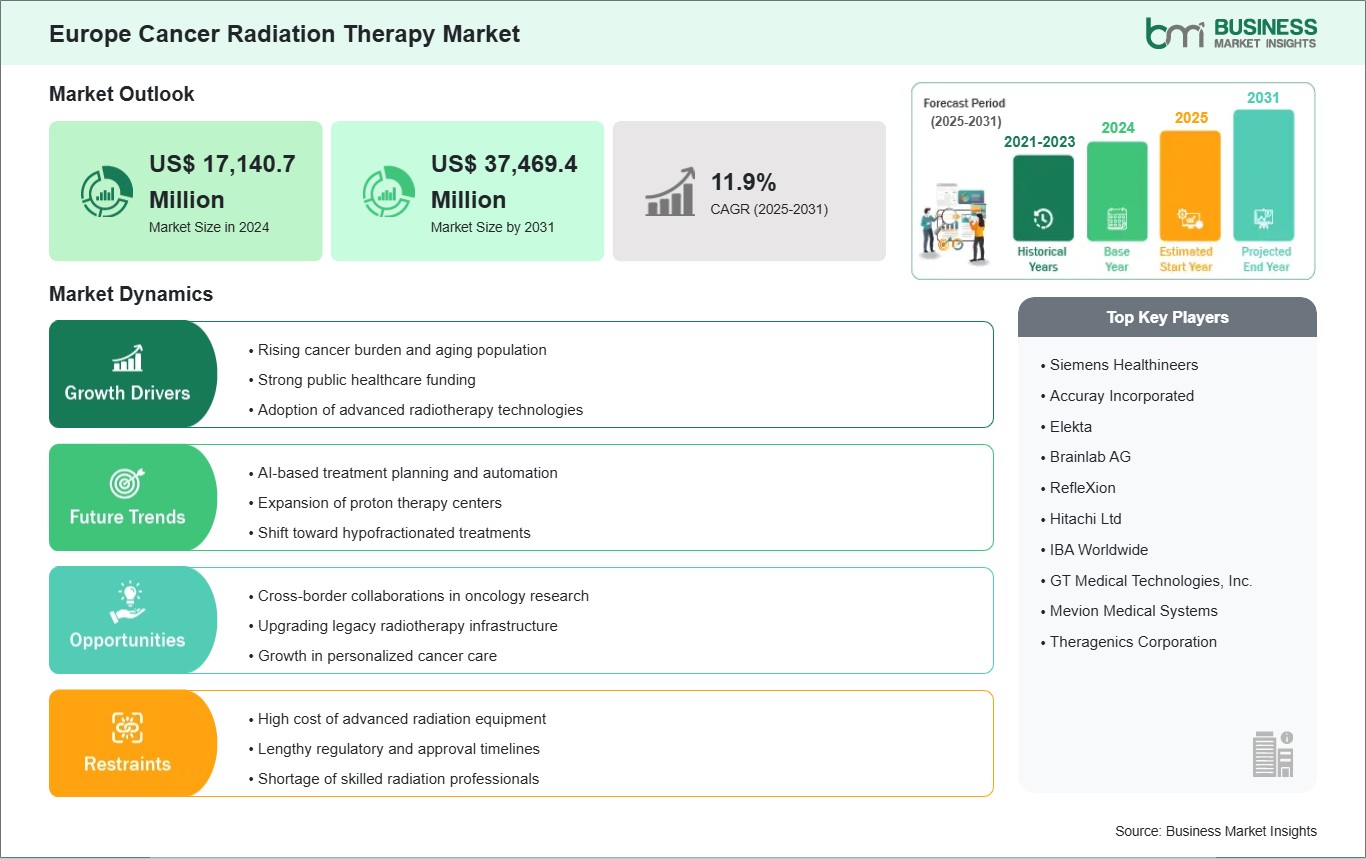
The Europe cancer radiation therapy market size is expected to reach US$ 37,469.4 million by 2031 from US$ 17,140.7 million in 2024. The market is estimated to record a CAGR of 11.9% from 2025 to 2031.
The cancer radiation therapy market in Europe is characterized by its strong clinical standards, deep research culture, and highly coordinated national cancer control programs across Western, Central, and Southern Europe. The region benefits from mature oncology infrastructures, advanced imaging integration, sophisticated physics governance, and widespread adoption of precision radiotherapy techniques. Hospitals in major European countries continually upgrade treatment capabilities with adaptive workflows, real‑time imaging, and automated planning tools, enabling streamlined operations and improved consistency of care. Europe's regulatory clarity and well‑structured accreditation frameworks support technology adoption by emphasizing safety, quality assurance, and outcome-based protocols.
Despite these strengths, the region faces notable constraints. Treatment capacity pressures in high‑volume academic centers, slow equipment replacement cycles in certain countries, and ongoing workforce shortages—particularly medical physicists and radiotherapy technologists—create operational bottlenecks. Variability in reimbursement structures across European healthcare systems can also influence the pace of technology modernization. Nonetheless, a significant opportunity lies in Europe's accelerated transition toward digital oncology ecosystems. AI‑enabled contouring, cloud‑based planning collaboration, real‑time QA automation, and data‑linked clinical pathways are rapidly evolving, offering a pathway to bridge capacity gaps and elevate care standardization. As Europe continues advancing integrated cancer strategies, radiotherapy remains a central pillar in the region's move toward precision, sustainability, and technology-enhanced oncology care.

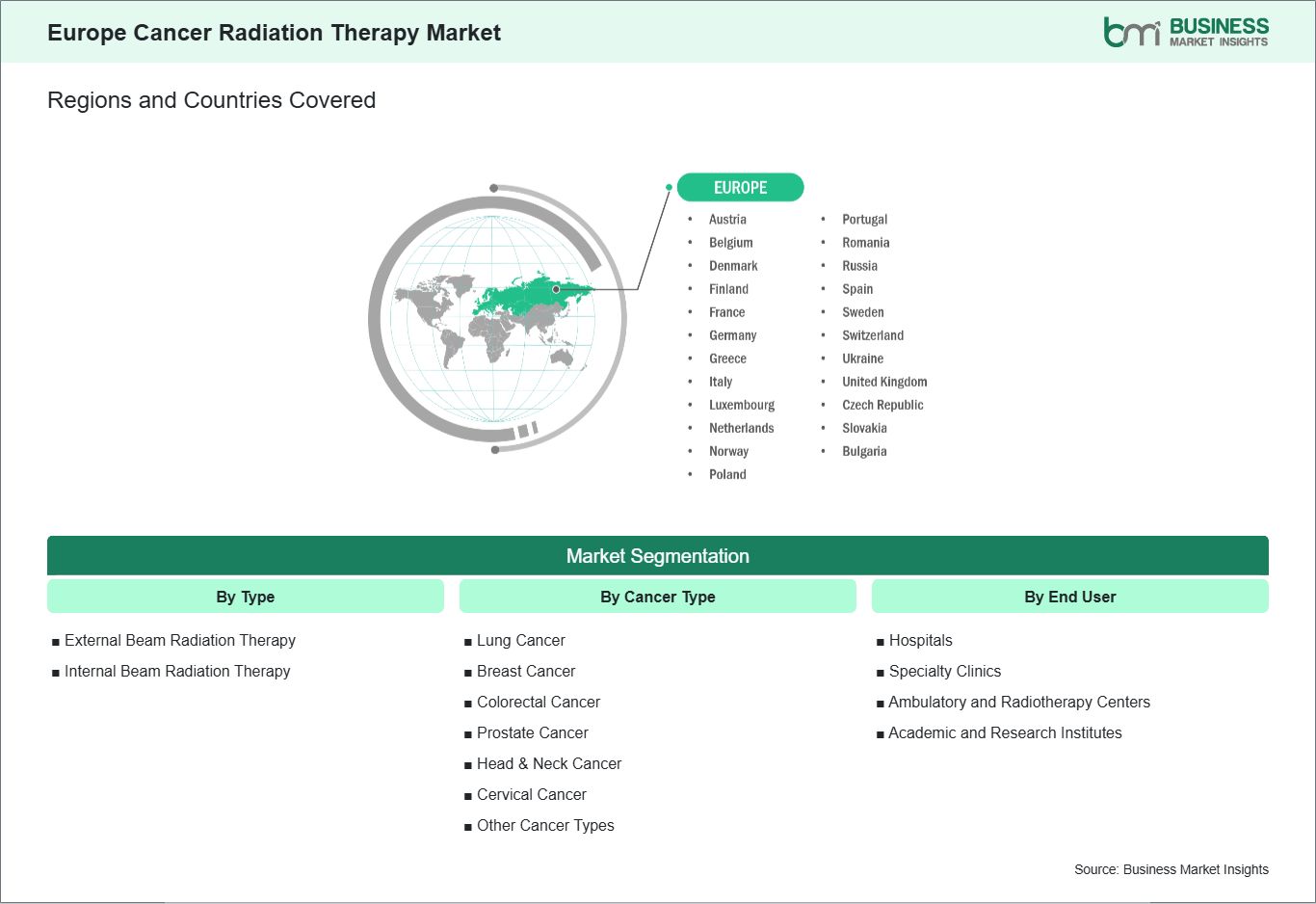
Key segments that contributed to the derivation of the Europe cancer radiation therapy market analysis are type, cancer type, and end user.
Cancer prevalence across Europe is steadily rising, driven by aging populations, lifestyle changes, and improved diagnostic capabilities. Breast, lung, colorectal, and prostate cancers remain the most frequently diagnosed, with Northern and Western Europe reporting particularly high incidence due to comprehensive screening programs. The increasing detection of early-stage cancers is boosting the number of patients eligible for radiation therapy, reinforcing its role as a key treatment modality.
European healthcare systems are well-developed, ensuring that most patients have access to both external beam and internal beam radiation therapy. External beam therapy dominates due to its versatility across multiple tumor types, while internal beam therapy is increasingly used for prostate, gynecological, and head & neck cancers. The availability of specialized oncology centers in urban areas is helping manage growing patient volumes, but demand continues to outpace capacity in some regions.
Government initiatives and private healthcare investment across Europe are strengthening oncology infrastructure. Expansion of radiation oncology departments, along with modern equipment adoption, is helping to address the rising number of patients. As a result, the increasing prevalence of cancer continues to act as a significant driver for the European cancer radiation therapy market.
Personalized medicine is becoming a central focus in Europe, with hospitals adopting patient-specific treatment strategies to improve outcomes. Advanced diagnostics, including genomic profiling and imaging, allow clinicians to customize radiation therapy based on tumor biology, location, and patient health status. This trend is creating opportunities for precision technologies such as intensity-modulated radiation therapy (IMRT) and image-guided radiation therapy (IGRT).
External beam radiation therapy in Europe is leveraging these technologies to deliver highly targeted doses, minimizing exposure to surrounding healthy tissues. Internal beam therapy is tailored to individual patients, particularly for prostate and gynecological cancers, enhancing both efficacy and safety. European oncology centers are at the forefront of integrating AI-driven planning tools to optimize treatment schedules and dosage.
Collaboration between hospitals, research institutes, and technology providers is driving rapid adoption of personalized radiation therapy. Patients are aware of treatment options and seek therapies that reduce side effects while improving outcomes. This rising demand for personalized care provides strong growth opportunities for equipment manufacturers, software developers, and service providers operating in the European cancer radiation therapy market.

The Europe cancer radiation therapy market demonstrates steady growth, with size and share analysis highlighting evolving trends and competitive dynamics among key players. The report further examines subsegments categorized within type, cancer type, and end user, offering insights into their contribution to overall market performance.
By type, the external beam radiation therapy subsegment dominated the market in 2024. Due to its widespread availability, precision targeting, noninvasive nature, and effectiveness in treating diverse cancers, it is the preferred choice across global oncology practices.
Based on cancer type, the lung cancer subsegment dominated the market in 2024. Due to its high incidence, strong link with smoking and pollution, late‑stage diagnoses, and reliance on advanced radiation techniques, it is the most treated cancer type globally.
In terms of end user, the hospitals subsegment dominated the market in 2024. Hospitals dominated the market since they provide comprehensive cancer care, advanced radiation infrastructure, skilled oncologists, and integrated treatment pathways, making them the primary setting for delivering radiation therapy services.
| Report Attribute | Details |
|---|---|
| Market size in 2024 | US$ 17,140.7 Million |
| Market Size by 2031 | US$ 37,469.4 Million |
| CAGR (2025 - 2031) | 11.9% |
| Historical Data | 2021-2023 |
| Forecast period | 2025-2031 |
| Segments Covered | By Type
|
| Regions and Countries Covered | Europe
|
| Market leaders and key company profiles |
|
The "Europe Cancer Radiation Therapy Market Size and Forecast (2021 - 2031)" report provides a detailed analysis of the market covering below areas:
The geographical scope of the Europe Cancer Radiation Therapy market report is divided into: Germany, Italy, France, the UK, Spain, Belgium, the Netherlands, Luxembourg, Norway, Finland, Denmark, Sweden, Austria, Switzerland, Russia, Romania, Greece, the Czech Republic, Portugal, Ukraine, Poland, Slovakia, and Bulgaria. Germany held the largest share in 2024.
Germany dominates the European cancer radiation therapy market due to its extensive hospital network, advanced clinical infrastructure, and strong research-driven approach to oncology. German cancer centers are recognized for their integration of cutting-edge radiotherapy solutions, including adaptive therapies, high‑precision imaging modalities, and highly automated planning platforms that support efficient and accurate treatment delivery. The country's medical universities and research institutes play a pivotal role in developing new techniques, refining clinical protocols, and conducting multi‑center trials that influence radiotherapy standards across Europe.
A major strength of Germany's leadership is its emphasis on rigorous quality assurance and structured clinical pathways, ensuring consistent care across university hospitals, specialized oncology centers, and regional facilities. The country's well-developed training ecosystem continues to produce highly skilled radiation oncologists, physicists, and technologists proficient in complex workflows and advanced treatment modalities. Germany also maintains strong partnerships with global technology manufacturers and European research consortia, enabling early adoption of innovative imaging solutions, AI‑driven tools, and next‑generation linear accelerator systems. Its combination of scientific depth, technological readiness, and commitment to quality positions Germany at the forefront of radiotherapy innovation and clinical excellence in Europe.

The Europe Cancer Radiation Therapy market is evaluated by gathering qualitative and quantitative data post primary and secondary research, which includes important corporate publications, association data, and databases. A few of the key developments in the Europe cancer radiation therapy market are:
The Europe Cancer Radiation Therapy Market is valued at US$ 17,140.7 Million in 2024, it is projected to reach US$ 37,469.4 Million by 2031.
As per our report Europe Cancer Radiation Therapy Market, the market size is valued at US$ 17,140.7 Million in 2024, projecting it to reach US$ 37,469.4 Million by 2031. This translates to a CAGR of approximately 11.9% during the forecast period.
The Europe Cancer Radiation Therapy Market report typically cover these key segments-
The historic period, base year, and forecast period can vary slightly depending on the specific market research report. However, for the Europe Cancer Radiation Therapy Market report:
The Europe Cancer Radiation Therapy Market is populated by several key players, each contributing to its growth and innovation. Some of the major players include:
The Europe Cancer Radiation Therapy Market report is valuable for diverse stakeholders, including:
Essentially, anyone involved in or considering involvement in the Europe Cancer Radiation Therapy Market value chain can benefit from the information contained in a comprehensive market report.
Please tell us your area of interest
(Market Segments/ Regions and Countries/ Companies)