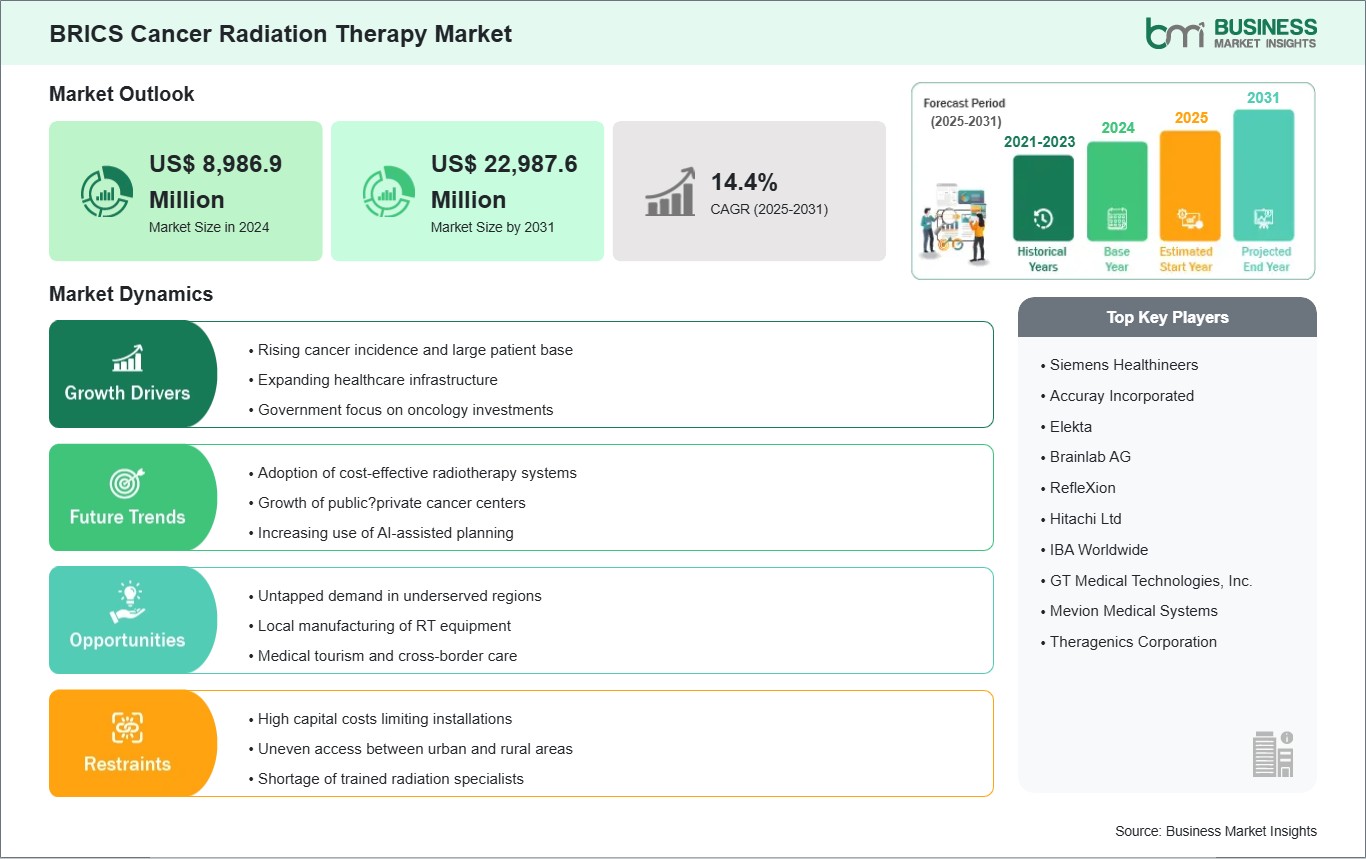
The BRICS cancer radiation therapy market size is expected to reach US$ 22,987.6 million by 2031 from US$ 8,986.9 million in 2024. The market is estimated to record a CAGR of 14.4% from 2025 to 2031.
The BRICS cancer radiation therapy market is shaped by rapidly evolving healthcare systems, increasing oncology investments, and strong national priorities that push for modernization of cancer treatment capabilities. Across Brazil, Russia, India, and China, governments are expanding radiotherapy access by upgrading public hospitals, improving referral pathways, and encouraging domestic manufacturing of radiotherapy equipment. Rising awareness of early cancer detection and increasing demand for precision‑based oncology care continue to support the adoption of advanced imaging‑guided radiotherapy and sophisticated treatment‑planning technologies. The presence of several high‑volume cancer centers within the BRICS region strengthens procedural demand and accelerates skill development in complex treatment techniques.
Infrastructure disparities between major urban centers and vast rural areas are a constrains. Long equipment replacement cycles, administrative delays in technology procurement, and variability in workforce capacity remain common across several BRICS countries. In some markets, access to specialized medical physicists and dosimetry teams limits uniform adoption of advanced workflows. Nevertheless, a major opportunity lies in the region's increasing focus on digital and AI‑enabled radiotherapy tools. Innovations in cloud‑based planning, automated contouring, and adaptive workflows can help streamline operations, improve consistency, and support scalability in resource‑dense and resource‑limited settings alike. As BRICS nations continue prioritizing cancer care expansion, radiotherapy stands at the core of their long-term oncology strategies.

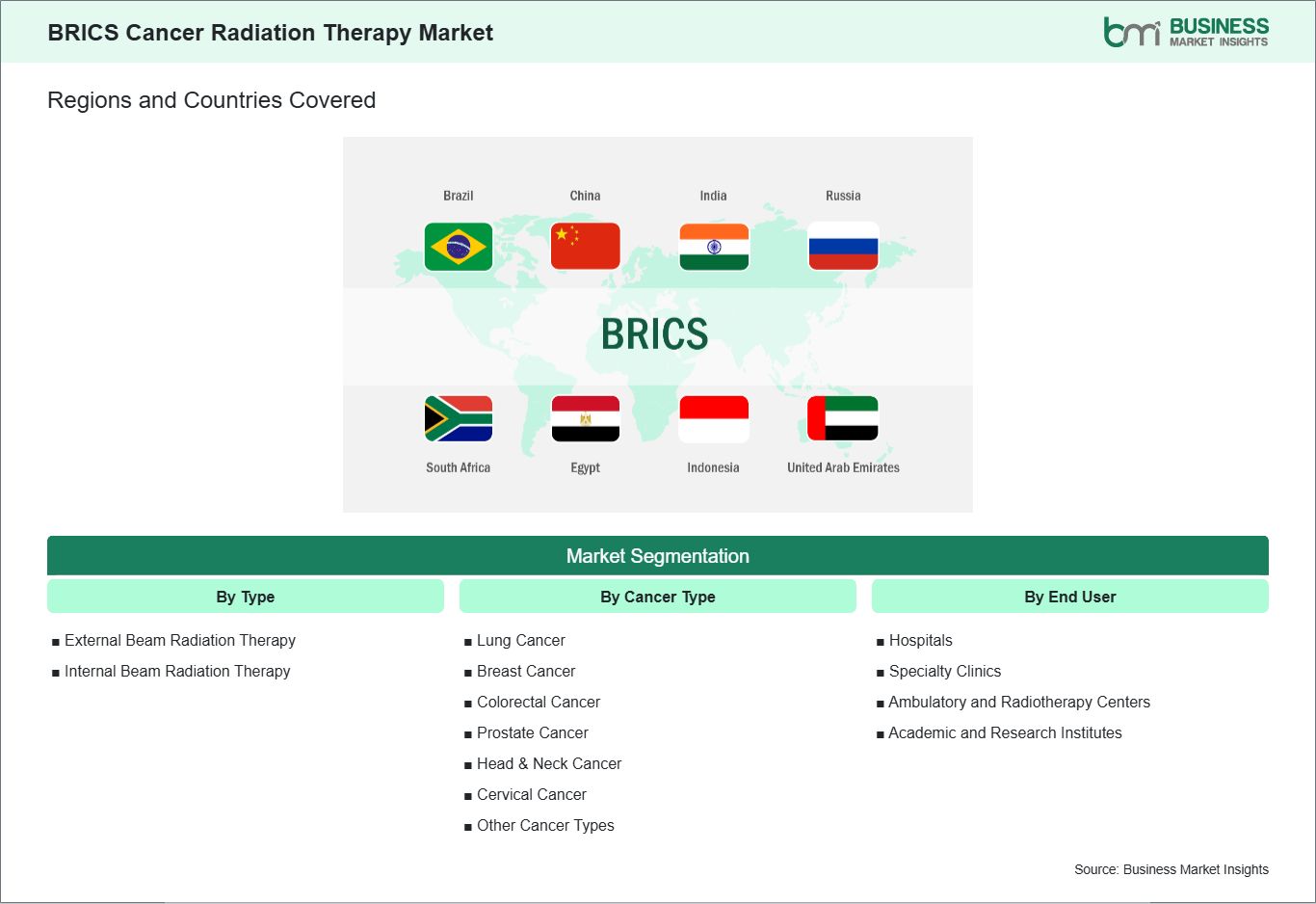
Key segments that contributed to the derivation of the BRICS cancer radiation therapy market analysis are type, cancer type, and end user.
Cancer incidence is rising rapidly across the BRICS countries due to aging populations, urbanization, and lifestyle shifts such as dietary changes, smoking, and reduced physical activity. Common cancers include lung, breast, colorectal, prostate, and cervical cancer, with significant regional variation. Lung and esophageal cancers are prevalent in China, while breast and cervical cancers are prominent in India. This growing disease burden is driving increased demand for effective cancer treatments, including both external and internal beam radiation therapy.
Healthcare infrastructure in BRICS countries is expanding, but disparities exist between urban centers and rural areas. Major cities have advanced oncology centers offering modern radiation therapy, while smaller towns face limited access. As more patients are diagnosed at stages where surgery is insufficient, radiation therapy becomes a critical component of comprehensive cancer care, both as a primary treatment and as adjuvant therapy alongside chemotherapy or surgery.
Governments and private healthcare providers are investing in oncology facilities to meet rising demand. External beam radiation therapy is widely adopted due to its versatility, while internal beam (brachytherapy) is used for prostate, cervical, and gynecological cancers, particularly in India and Brazil. The growing prevalence of cancer across BRIC countries continues to act as a strong market driver for radiation therapy adoption.
Personalized medicine is gaining traction across BRICS countries as patients and providers seek tailored cancer treatments that improve outcomes and reduce side effects. Precision approaches, including molecular profiling and image-guided radiation therapy, are being adopted in urban hospitals in Brazil, Russia, India, and China. These advancements allow clinicians to customize treatment doses based on tumor location, type, and patient-specific factors.
In external beam radiation therapy, technologies such as intensity-modulated radiation therapy (IMRT) and stereotactic body radiotherapy (SBRT) are expanding rapidly, particularly in China and Brazil, where large patient populations demand highly efficient and targeted treatments. Internal beam radiation therapy is being personalized, especially for cancers common in BRICS countries, including cervical, prostate, and head & neck cancers.
Collaborations with international oncology organizations, combined with government initiatives in India and China, are helping train specialists and upgrade existing treatment facilities. Patients are becoming informed and are actively seeking therapies that minimize side effects while maximizing efficacy. This rising demand for personalized medicine is creating significant opportunities for radiation therapy equipment manufacturers, software providers, and healthcare systems across the BRICS market.

The BRICS cancer radiation therapy market demonstrates steady growth, with size and share analysis highlighting evolving trends and competitive dynamics among key players. The report further examines subsegments categorized within type, cancer type, and end user, offering insights into their contribution to overall market performance.
By type, the external beam radiation therapy subsegment dominated the market in 2024. Due to its widespread availability, precision targeting, noninvasive nature, and effectiveness in treating diverse cancers, it is the preferred choice across global oncology practices.
Based on cancer type, the lung cancer subsegment dominated the market in 2024. Due to its high incidence, strong link with smoking and pollution, late‑stage diagnoses, and reliance on advanced radiation techniques, it is the most treated cancer type globally.
In terms of end user, the hospitals subsegment dominated the market in 2024. Hospitals dominated the market since they provide comprehensive cancer care, advanced radiation infrastructure, skilled oncologists, and integrated treatment pathways, making them the primary setting for delivering radiation therapy services.
| Report Attribute | Details |
|---|---|
| Market size in 2024 | US$ 8,986.9 Million |
| Market Size by 2031 | US$ 22,987.6 Million |
| CAGR (2025 - 2031) | 14.4% |
| Historical Data | 2021-2023 |
| Forecast period | 2025-2031 |
| Segments Covered | By Type
|
| Regions and Countries Covered | BRICS
|
| Market leaders and key company profiles |
|
The "BRICS Cancer Radiation Therapy Market Size and Forecast (2021 - 2031)" report provides a detailed analysis of the market covering below areas:
The geographical scope of the BRIC Cancer Radiation Therapy market report is divided into: Russia, Brazil, South Africa, India, China, Egypt, Indonesia, Saudi Arabia, and the UAE. China held the largest share in 2024.
China leads the BRIC cancer radiation therapy market due to its expansive oncology infrastructure, strong research momentum, and ability to scale advanced technologies across a wide healthcare network. The country has established numerous high-capacity cancer centers equipped with sophisticated linear accelerators, precision imaging systems, and advanced planning platforms, enabling efficient delivery of complex radiotherapy techniques. China's strong domestic manufacturing capabilities in medical equipment further strengthen its position, allowing faster deployment, local servicing, and more predictable technology lifecycle management.
A major advantage is China's integrated ecosystem that connects clinical practice, academic research, and technology development. The National Cancer Institute routinely collaborates with universities and technology companies to advance imaging algorithms, adaptive radiotherapy models, and AI‑driven planning tools. This environment accelerates innovation and supports standardized clinical protocols across disease sites. Additionally, China's extensive patient volume contributes to deep expertise across tumor types, reinforcing its ability to refine workflows and optimize treatment practices. Digital transformation remains a core strategic focus, with hospitals investing in data-driven oncology platforms, imaging archives, and automated quality systems. These capabilities—combined with strong government support, scale-driven efficiency, and research intensity—solidify China's dominant leadership in the BRIC radiotherapy landscape.

The BRICS Cancer Radiation Therapy market is evaluated by gathering qualitative and quantitative data post primary and secondary research, which includes important corporate publications, association data, and databases. A few of the key developments in the BRICS cancer radiation therapy market are:
The BRICS Cancer Radiation Therapy Market is valued at US$ 8,986.9 Million in 2024, it is projected to reach US$ 22,987.6 Million by 2031.
As per our report BRICS Cancer Radiation Therapy Market, the market size is valued at US$ 8,986.9 Million in 2024, projecting it to reach US$ 22,987.6 Million by 2031. This translates to a CAGR of approximately 14.4% during the forecast period.
The BRICS Cancer Radiation Therapy Market report typically cover these key segments-
The historic period, base year, and forecast period can vary slightly depending on the specific market research report. However, for the BRICS Cancer Radiation Therapy Market report:
The BRICS Cancer Radiation Therapy Market is populated by several key players, each contributing to its growth and innovation. Some of the major players include:
The BRICS Cancer Radiation Therapy Market report is valuable for diverse stakeholders, including:
Essentially, anyone involved in or considering involvement in the BRICS Cancer Radiation Therapy Market value chain can benefit from the information contained in a comprehensive market report.
Please tell us your area of interest
(Market Segments/ Regions and Countries/ Companies)