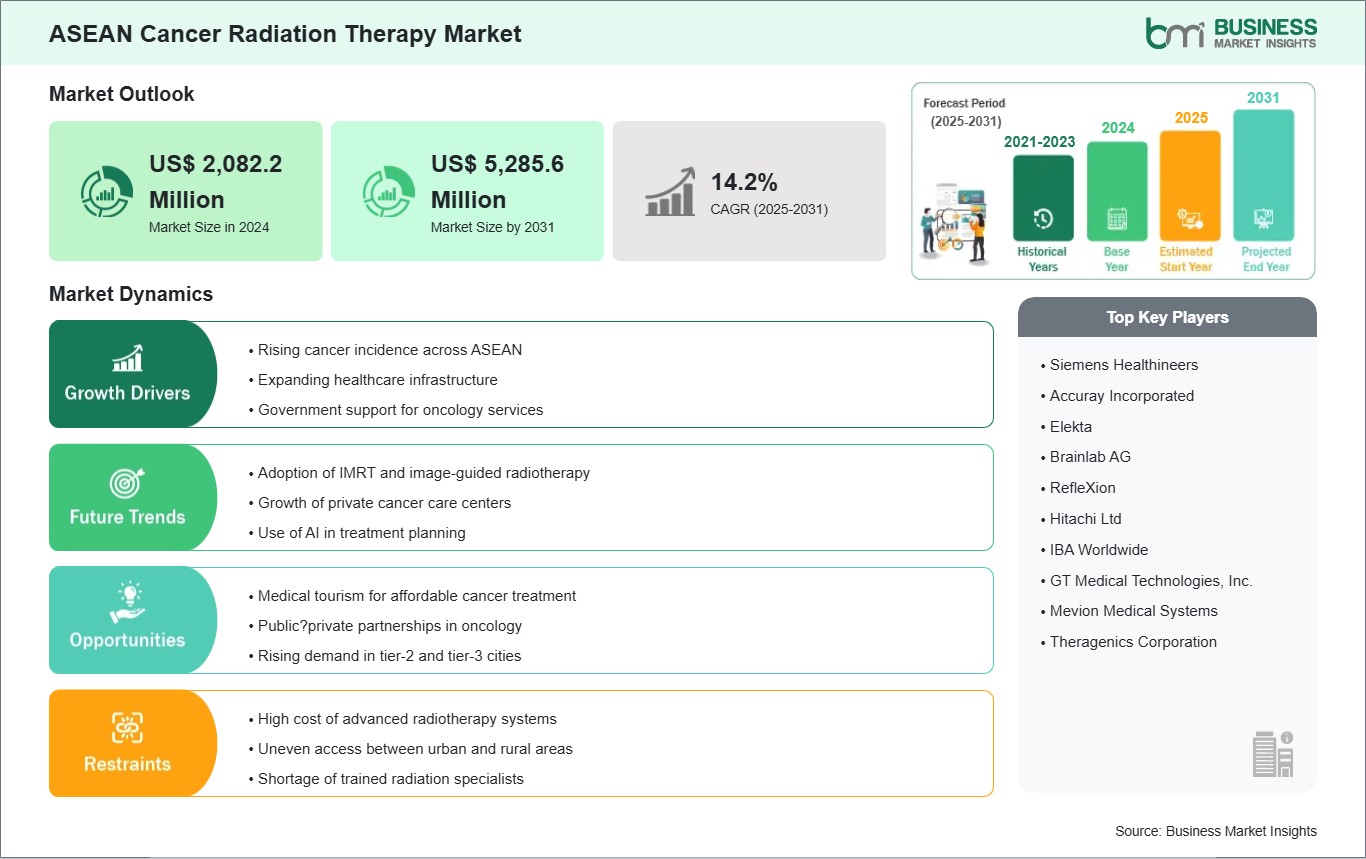
The ASEAN cancer radiation therapy market size is expected to reach US$ 5,285.6 million by 2031 from US$ 2,082.2 million in 2024. The market is estimated to record a CAGR of 14.2% from 2025 to 2031.
The ASEAN cancer radiation therapy market is progressing as governments and private providers scale oncology capacity, integrate precision radiotherapy, and expand multidisciplinary cancer care. Growth is propelled by rising clinical adoption of advanced treatment planning, integration of imaging‑guided modalities, and broader screening programs that channel patients into earlier, potentially curative radiotherapy pathways. Regional medical tourism corridors—particularly among Singapore, Malaysia, and Thailand—also reinforce procedural volumes and cross‑border referrals. Workforce development is gaining traction through fellowship exchanges and vendor‑led training on contouring, dosimetry, and quality assurance, which helps standardize care across institutions.
Key restraints persist: Service availability is uneven beyond capital cities, long replacement cycles delay technology refresh, and maintenance contracts can be difficult to sustain in price‑sensitive settings. Fragmented reimbursement and out‑of‑pocket exposure also influence case mix and machine utilization. Nevertheless, a compelling opportunity lies in scaling hub‑and‑spoke radiotherapy networks, where tertiary centers anchor complex techniques while satellite units deliver high‑throughput treatments. Cloud‑enabled planning, AI‑assisted contouring, and adaptive workflows tailored for constrained environments can raise throughput without compromising safety. As ASEAN health systems prioritize integrated cancer control, the market is set to shift toward more standardized protocols, stronger physics governance, and interoperable platforms that streamline planning‑to‑treatment cycles.

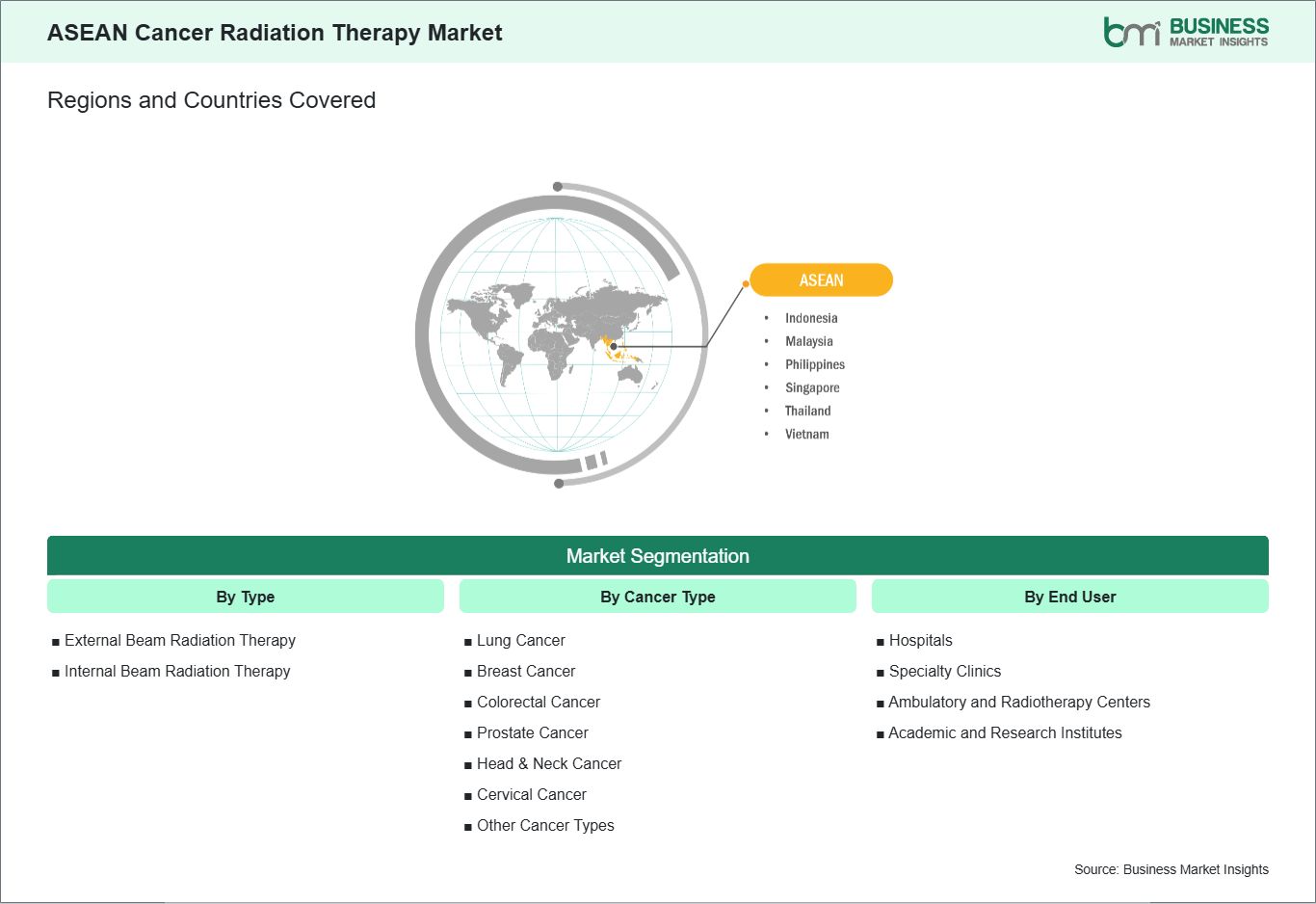
Key segments that contributed to the derivation of the ASEAN cancer radiation therapy market analysis are type, cancer type, and end user.
Cancer incidence is steadily increasing across ASEAN countries due to rapid urbanization, aging populations, and lifestyle changes such as higher tobacco use, sedentary behavior, and dietary shifts. Countries such as Indonesia, Thailand, Vietnam, and the Philippines are reporting rising cases of breast, colorectal, lung, and cervical cancers, while liver cancer remains highly prevalent in Vietnam and Thailand due to hepatitis infections. This growing cancer burden is driving greater demand for comprehensive treatment options, with radiation therapy playing a central role alongside surgery and systemic therapies.
Healthcare systems in ASEAN are improving cancer detection and referral networks, particularly in middle-income countries such as Malaysia, Thailand, and Vietnam. More patients are diagnosed at stages where radiation therapy is required either as a curative treatment or as adjuvant therapy. External beam radiation therapy is the most commonly used modality across the region due to its versatility and ability to treat a wide range of solid tumors, while brachytherapy is used for cervical and prostate cancers, especially in Thailand and Indonesia. This rising patient volume is placing pressure on public and private hospitals to expand radiation therapy capacity.
Governments across ASEAN are prioritizing oncology infrastructure as part of national cancer control programs. Investments in new cancer centers, linear accelerators, and regional referral hospitals are increasing, particularly in urban hubs such as Bangkok, Kuala Lumpur, and Jakarta. As cancer awareness campaigns and screening initiatives expand, especially for breast and cervical cancer, the number of patients requiring radiation therapy is expected to continue growing. This sustained increase in cancer prevalence remains a key driver for the ASEAN cancer radiation therapy market.
The ASEAN healthcare landscape is gradually shifting toward personalized medicine as clinicians and policymakers recognize the benefits of tailored cancer treatment. Personalized radiation therapy allows treatment plans to be customized based on tumor size, location, genetic characteristics, and patient-specific factors. This approach is important in ASEAN, where cancer presentation can vary widely due to genetic diversity and differences in environmental exposure. As a result, there is growing interest in advanced radiation techniques that improve precision and clinical outcomes.
Modern external beam radiation therapy technologies such as intensity-modulated radiation therapy (IMRT) and image-guided radiation therapy (IGRT) are gaining adoption in more advanced ASEAN markets, including Singapore, Malaysia, and Thailand. These systems enable highly individualized dose planning and real-time tumor tracking, reducing damage to surrounding healthy tissue. In brachytherapy, personalized dose delivery is emphasized for cervical cancer, which remains one of the most common cancers among women in several ASEAN countries. This trend is encouraging hospitals to invest in sophisticated planning software and imaging capabilities.
Rising healthcare spending, medical tourism, and international collaborations are supporting the shift toward personalized cancer care in ASEAN. Singapore and Thailand, in particular, are positioning themselves as regional hubs for advanced oncology treatment, attracting patients from neighboring countries. As training programs for radiation oncologists and medical physicists expand, more centers are becoming capable of delivering customized radiation therapy protocols. This growing demand for personalized medicine represents a significant opportunity for technology providers and service companies in the ASEAN cancer radiation therapy market.

The ASEAN cancer radiation therapy market demonstrates steady growth, with size and share analysis highlighting evolving trends and competitive dynamics among key players. The report further examines subsegments categorized within type, cancer type, and end user, offering insights into their contribution to overall market performance.
By type, the external beam radiation therapy subsegment dominated the market in 2024. Due to its widespread availability, precision targeting, noninvasive nature, and effectiveness in treating diverse cancers, it is the preferred choice across global oncology practices.
Based on cancer type, the lung cancer subsegment dominated the market in 2024. Due to its high incidence, strong link with smoking and pollution, late‑stage diagnoses, and reliance on advanced radiation techniques, it is the most treated cancer type globally.
In terms of end user, the hospitals subsegment dominated the market in 2024. Hospitals dominated the market since they provide comprehensive cancer care, advanced radiation infrastructure, skilled oncologists, and integrated treatment pathways, making them the primary setting for delivering radiation therapy services.
| Report Attribute | Details |
|---|---|
| Market size in 2024 | US$ 2,082.2 Million |
| Market Size by 2031 | US$ 5,285.6 Million |
| CAGR (2025 - 2031) | 14.2% |
| Historical Data | 2021-2023 |
| Forecast period | 2025-2031 |
| Segments Covered | By Type
|
| Regions and Countries Covered | ASEAN
|
| Market leaders and key company profiles |
|
The "ASEAN Cancer Radiation Therapy Market Size and Forecast (2021 - 2031)" report provides a detailed analysis of the market covering below areas:
The geographical scope of the ASEAN Cancer Radiation Therapy market report is divided into: Indonesia, Malaysia, the Philippines, Singapore, Thailand, and Vietnam. Singapore held the largest share in 2024.
Singapore leads ASEAN in cancer radiation therapy through its highly coordinated oncology ecosystem, rapid adoption of cutting‑edge modalities, and tight integration between academic research, clinical practice, and industry. Its centers emphasize precision—from motion management and image‑guided workflows to advanced treatment planning—supported by rigorous quality systems and robust physics oversight. The country's strong regulatory clarity accelerates technology introductions and lifecycle management, enabling consistent equipment performance and predictable clinical operations. Multidisciplinary tumor boards, standardized pathways, and comprehensive supportive care elevate outcomes and patient experience.
Singapore also functions as a regional anchor for training and translational research, disseminating best practices in contouring, adaptive planning, and stereotactic techniques across ASEAN. Its data infrastructure, including mature electronic medical records and analytics pipelines, supports evidence‑based protocol refinement and value‑oriented care models. Close collaborations with global vendors and universities foster clinical trials, early technology evaluations, and co‑development of software‑driven planning tools. As a medical tourism hub, Singapore attracts complex cases from neighboring markets, deepening expertise across disease sites. These combined strengths—precision infrastructure, skilled multidisciplinary teams, research intensity, and system‑level reliability—cement Singapore's role as the region's benchmark for high‑quality, modern radiotherapy.

The ASEAN Cancer Radiation Therapy market is evaluated by gathering qualitative and quantitative data post primary and secondary research, which includes important corporate publications, association data, and databases. A few of the key developments in the ASEAN cancer radiation therapy market are:
The ASEAN Cancer Radiation Therapy Market is valued at US$ 2,082.2 Million in 2024, it is projected to reach US$ 5,285.6 Million by 2031.
As per our report ASEAN Cancer Radiation Therapy Market, the market size is valued at US$ 2,082.2 Million in 2024, projecting it to reach US$ 5,285.6 Million by 2031. This translates to a CAGR of approximately 14.2% during the forecast period.
The ASEAN Cancer Radiation Therapy Market report typically cover these key segments-
The historic period, base year, and forecast period can vary slightly depending on the specific market research report. However, for the ASEAN Cancer Radiation Therapy Market report:
The ASEAN Cancer Radiation Therapy Market is populated by several key players, each contributing to its growth and innovation. Some of the major players include:
The ASEAN Cancer Radiation Therapy Market report is valuable for diverse stakeholders, including:
Essentially, anyone involved in or considering involvement in the ASEAN Cancer Radiation Therapy Market value chain can benefit from the information contained in a comprehensive market report.
Please tell us your area of interest
(Market Segments/ Regions and Countries/ Companies)