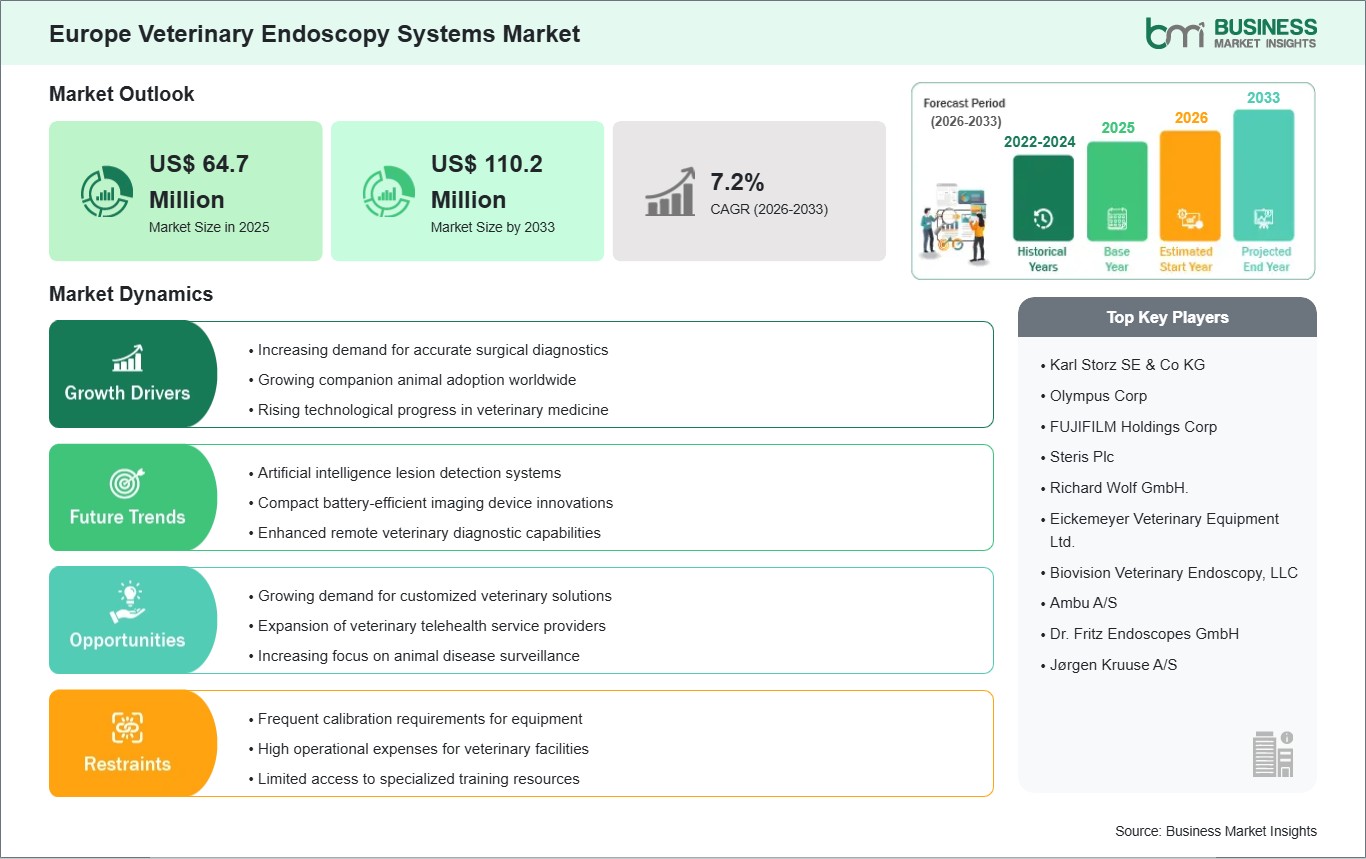
The Europe veterinary endoscopy systems market size is expected to reach US$ 110.2 million by 2033 from US$ 64.7 million in 2025. The market is estimated to record a CAGR of 7.2% from 2026 to 2033.
The Europe veterinary endoscopy systems market reflects a highly structured and efficiency-oriented environment where clinical precision and procedural standardization are central to veterinary practice. While in developing markets, the decision is made based on awareness, the European market is predominantly driven by protocols, since endoscopy systems are integrated in the existing diagnostics processes at multi-specialty veterinary hospitals. These are facilitated by robust clinical governance structures and evidence-based veterinary medicine practice. What distinguishes this market from other countries' markets is the specialization that has developed among veterinary practices. Specialty hospitals are increasingly specialized in terms of gastroenterology, pulmonology, and minimally invasive surgery where endoscopy systems are indispensable. This has created a need for specialized equipment that can be used for particular procedural purposes instead of diagnostic devices. In response to this trend, there is an increased emphasis by the manufacturers on product differentiation. The other significant trend is the increased use of evidence-based veterinary medicine. Modern endoscopic equipment can be connected to electronic medical record systems for the purpose of storing images and conducting consultations from afar. This will facilitate teamwork among clinicians and help in providing second opinions when dealing with cross-border cases in Europe. Furthermore, environmental issues are now starting to play a significant role in procurement choices, with clinics now favoring systems that are durable and cost-effective in their lifecycles as well as being less problematic from the point of view of maintenance. Another emerging trend is the rise of veterinary groups and clinic chains as a major buyer, which will impact how vendors approach these buyers. The strategy of bulk buying and the decision-making process itself will put more weight on vendors providing high-quality products as well as adequate training and after-sale services. However, even though the market is well-developed, innovations here are likely to be achieved by improving existing technology through gradual improvements in imaging, ergonomics, and work flow.

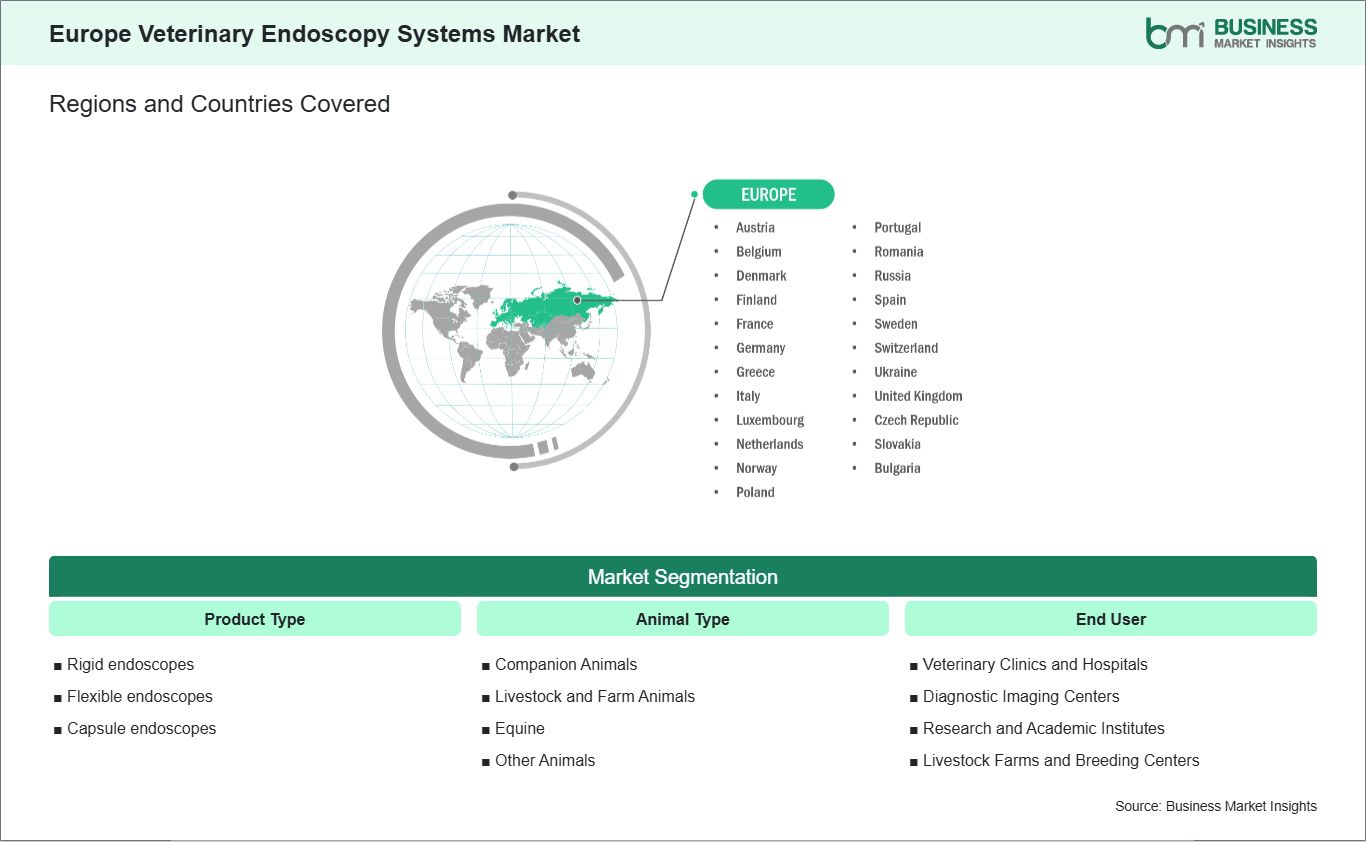
Key segments that contributed to the derivation of the Europe veterinary endoscopy systems market analysis are product type, animal type, and end user.
The Europe veterinary endoscopy systems market is strongly driven by increasing demand for precise and reliable diagnostic procedures across companion and livestock animal care. Veterinary practitioners are now focusing more on early and precise diagnosis, especially with regard to the diagnosis of internal diseases where there is no easy way to detect the disease from outside the body. Through endoscopic systems, veterinarians are able to view inside the bodies of their animal patients and make accurate diagnoses, without having to perform exploratory surgery.
In Western European nations like Germany, France, and the United Kingdom, there is an increasing trend of employing sophisticated diagnostic systems in order to fulfill the rising demands of the pet owners and also for ensuring compliance with animal welfare policies. There is a strong tradition of excellence in the delivery of veterinary services in this area; therefore, minimally invasive and imaging-assisted techniques are highly favored. It can be said that a considerable number of veterinary organizations within Europe make use of advanced endoscopy imaging for diagnosing small animals.
There has been a trend of development that is quite evident in Southern and Northern Europe in terms of developing interest in the provision of specialized diagnostics, be it in urban and semi-urban veterinary clinics. In places like Italy and Nordic countries, there has been the adoption of technology where digital imaging systems have been integrated with the endoscopy system to allow for efficient diagnosis of patients. With the continuous increase in demand for diagnostic procedures in Europe, the demand for endoscopy systems will remain high.
Collaboration with veterinary education institutions plays a crucial role in shaping the Europe veterinary endoscopy systems market by supporting skill development and technology adoption. Endoscopic training is one of the areas where European universities and teaching hospitals are contributing heavily by training veterinarians in modern diagnostic methods. Such organizations play a significant role in the transfer of knowledge, making sure that future veterinarians acquire skills in conducting minimally invasive operations as well as using imaging technologies. Academic engagement promotes use of endoscopy systems.
In nations like Germany, France, and the Netherlands, there exist robust links between schools of veterinary medicine and equipment suppliers and research organizations. Such collaboration helps in the creation and testing of novel diagnostic devices as well as introducing advanced technology in veterinary education. There are numerous veterinary education facilities in Europe that offer training in endoscopy, which promotes standardized procedures and successful procedures.
In addition, the academia is becoming an important player in upgrading veterinary care through providing more advanced techniques in diagnosis as well as increased research activities. The partnership between the universities and the private veterinary clinics can help address the issue of bridging theory and practice. With the increasing number of academic-clinical collaborations, innovations will continue and help increase the adoption of endoscopy systems. It will be one of the important factors that will contribute towards the sustained growth in the market for the foreseeable future.
The Europe veterinary endoscopy systems market demonstrates steady growth, with size and share analysis highlighting evolving trends and competitive dynamics among key players. The report examines subsegments categorized within product type, animal type, and end user, offering insights into their contribution to overall market performance.
By product type, the rigid endoscopes segment dominated the market in 2025, driven by widespread adoption of minimally invasive veterinary procedures and strong demand for high-precision, durable instruments across advanced clinical settings.
Based on animal type, the companion animals subsegment dominated the market in 2025, driven by high pet ownership rates, significant spending on animal healthcare, and increasing preference for advanced diagnostic and surgical procedures for dogs and cats.
In terms of end user, the veterinary clinics and hospitals subsegment dominated the market in 2025, driven by well-established veterinary infrastructure, high procedural volumes, and extensive adoption of advanced endoscopic systems for routine and specialized animal care across the region.
| Report Attribute | Details |
|---|---|
| Market size in 2025 | US$ 64.7 Million |
| Market Size by 2033 | US$ 110.2 Million |
| CAGR (2026 - 2033) | 7.2% |
| Historical Data | 2022-2024 |
| Forecast period | 2026-2033 |
| Segments Covered | By Product Type
|
|
Regions and Countries Covered
| |
| Europe | Belgium, Austria, Finland, Denmark, Greece, Poland, Romania, Russia, Ukraine, Czech Republic, Slovakia, Bulgaria, Italy, Luxembourg, Germany, Switzerland, France, Netherlands, Norway, Portugal, Spain, Sweden, United Kingdom |
| Market leaders and key company profiles |
|
The "Europe Veterinary Endoscopy Systems Market Size and Forecast (2022-2033)" report provides a detailed analysis of the market covering below areas:
The geographical scope of the Europe veterinary endoscopy systems market report is divided into Belgium, Austria, Finland, Denmark, Greece, Poland, Romania, Russia, Ukraine, Czech Republic, Slovakia, Bulgaria, Italy, Luxembourg, Germany, Switzerland, France, Netherlands, Norway, Portugal, Spain, Sweden, United Kingdom. Germany held the largest share in 2025.
Country-level insights in the European veterinary endoscopy systems market highlight clear differentiation in adoption drivers, reflecting unique healthcare structures and veterinary practice models across nations. Germany leads the market with a strong foundation in clinical research and veterinary specialization. The country’s veterinary ecosystem is heavily influenced by academic institutions and referral networks, where endoscopy is routinely used in complex case management rather than basic diagnostics, reinforcing demand for high-performance systems. In United Kingdom, the market is shaped by the consolidation of veterinary practices under corporate groups. This has resulted in standardized equipment procurement and increased investment in advanced diagnostic infrastructure across multi-location clinics. Endoscopy systems are widely deployed to ensure consistency in clinical service delivery, particularly in urban and suburban veterinary chains. France presents a distinct dynamic where regulatory oversight and agricultural priorities intersect. While companion animal care drives innovation in urban areas, rural regions emphasize endoscopy use in herd health monitoring and reproductive diagnostics, creating a dual-market structure within the country. In Italy, adoption is influenced by a fragmented veterinary clinic landscape. Independent practitioners dominate the market, leading to selective investment in endoscopy systems based on specialization and client demographics. This creates opportunities for mid-range, adaptable systems that balance performance with cost considerations. Spain is experiencing increased demand driven by tourism-related pet care services and rising standards in veterinary hospitality. Clinics are upgrading diagnostic capabilities, including endoscopy, to cater to international clients and higher service expectations. In Northern Europe, Sweden emphasizes preventive veterinary care, where endoscopy is used as part of early-stage diagnostic protocols rather than reactive treatment. This proactive approach supports steady demand for advanced systems. Lastly, Netherlands showcases strong integration of technology and veterinary education, with clinics often participating in pilot programs for new diagnostic tools. This positions the country as an early adopter market within Europe. Collectively, these countries illustrate a nuanced landscape where adoption is shaped less by access and more by clinical structure, procurement models, and specialization depth.

The Europe veterinary endoscopy systems market is evaluated by gathering qualitative and quantitative data post primary and secondary research, which includes important corporate publications, association data, and databases. A few of the key developments in the Europe veterinary endoscopy systems market are:
The Europe Veterinary Endoscopy Systems Market is valued at US$ 64.7 Million in 2025, it is projected to reach US$ 110.2 Million by 2033.
As per our report Europe Veterinary Endoscopy Systems Market, the market size is valued at US$ 64.7 Million in 2025, projecting it to reach US$ 110.2 Million by 2033. This translates to a CAGR of approximately 7.2% during the forecast period.
The Europe Veterinary Endoscopy Systems Market report typically cover these key segments-
The historic period, base year, and forecast period can vary slightly depending on the specific market research report. However, for the Europe Veterinary Endoscopy Systems Market report:
The Europe Veterinary Endoscopy Systems Market is populated by several key players, each contributing to its growth and innovation. Some of the major players include:
The Europe Veterinary Endoscopy Systems Market report is valuable for diverse stakeholders, including:
Essentially, anyone involved in or considering involvement in the Europe Veterinary Endoscopy Systems Market value chain can benefit from the information contained in a comprehensive market report.
Please tell us your area of interest
(Market Segments/ Regions and Countries/ Companies)