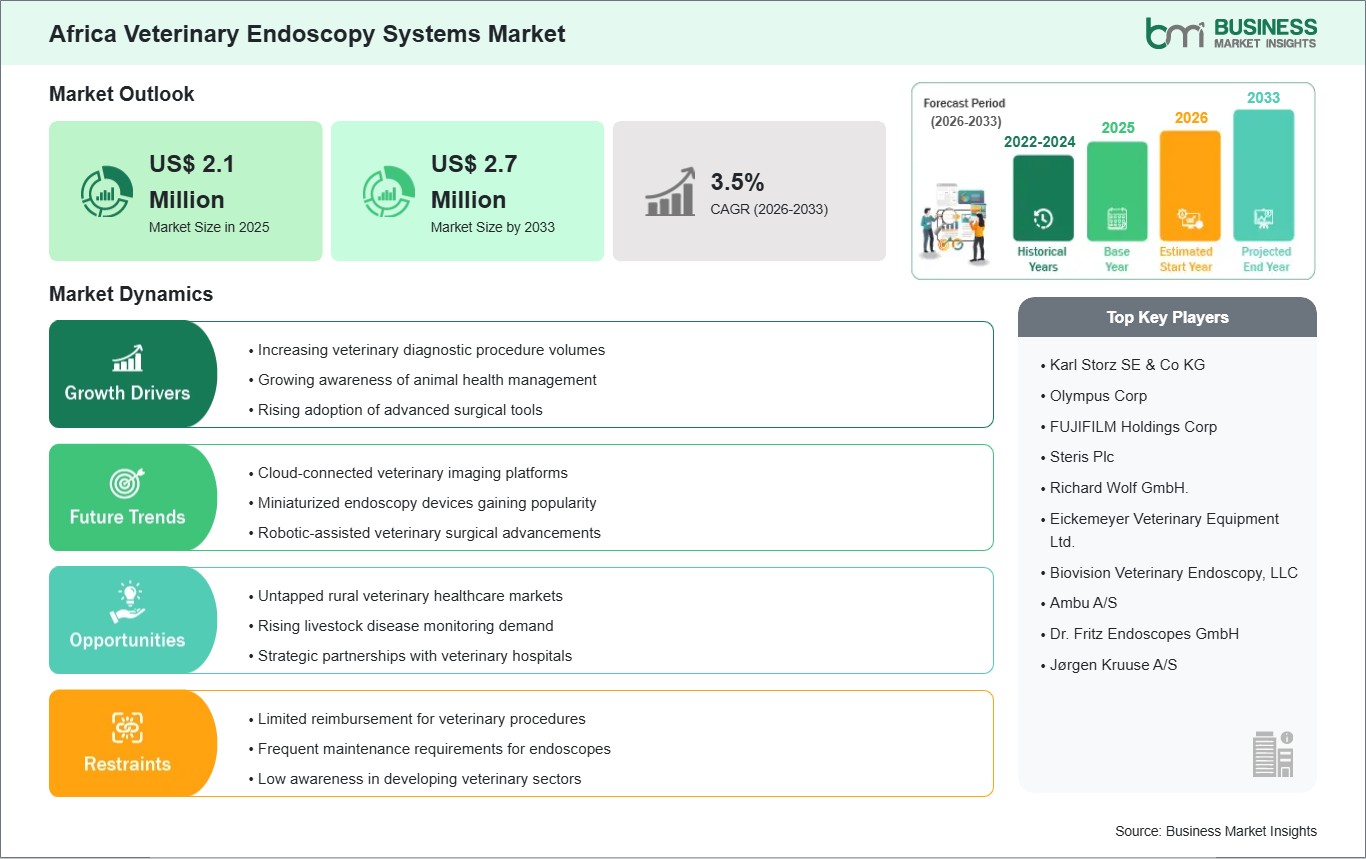
The Africa veterinary endoscopy systems market size is expected to reach US$ 2.7 million by 2033 from US$ 2.1 million in 2025. The market is estimated to register a CAGR of 3.5% from 2026 to 2033.
The Africa veterinary endoscopy systems market is undergoing a gradual yet structurally important transformation, driven by evolving veterinary practices, increasing awareness of minimally invasive procedures, and the modernization of animal healthcare infrastructure. The market features an increasing trend toward more precise methods compared to conventional diagnostic and surgical procedures that promote procedural efficiency, shorten the recovery period, and provide improved clinical results. The use of endoscopy by veterinary experts within important geographical locations as a vital instrument for diagnosis and treatment purposes has gained popularity in recent times, especially for small animals and specialty livestock. With regard to market dynamics, there exists demand based on the combination of the increasing scope of pet health care and the economic role of livestock in selected African nations. Meanwhile, private livestock farms are showing heightened interest in technology that reduces their losses through disease management. Thus, technological differentiation becomes important for gaining a competitive advantage, and vendors have emphasized portability, convenience, and affordability as the key features to meet the special needs of the African market. With the adoption of digital images, advanced visualization technologies, and versatile system designs, the products have become more attractive to veterinarians practicing in both urban facilities and semi-rural areas. Market penetration is uneven owing to a lack of qualified personnel, poor infrastructure, and tight budgets at veterinary institutions. From a strategic perspective, cooperation with local agents, targeted training programs, and affordable prices are the main drivers of growth. While the market is in a developing phase, it presents growth potential supported by incremental advancements in veterinary care standards and increasing alignment with global best practices.

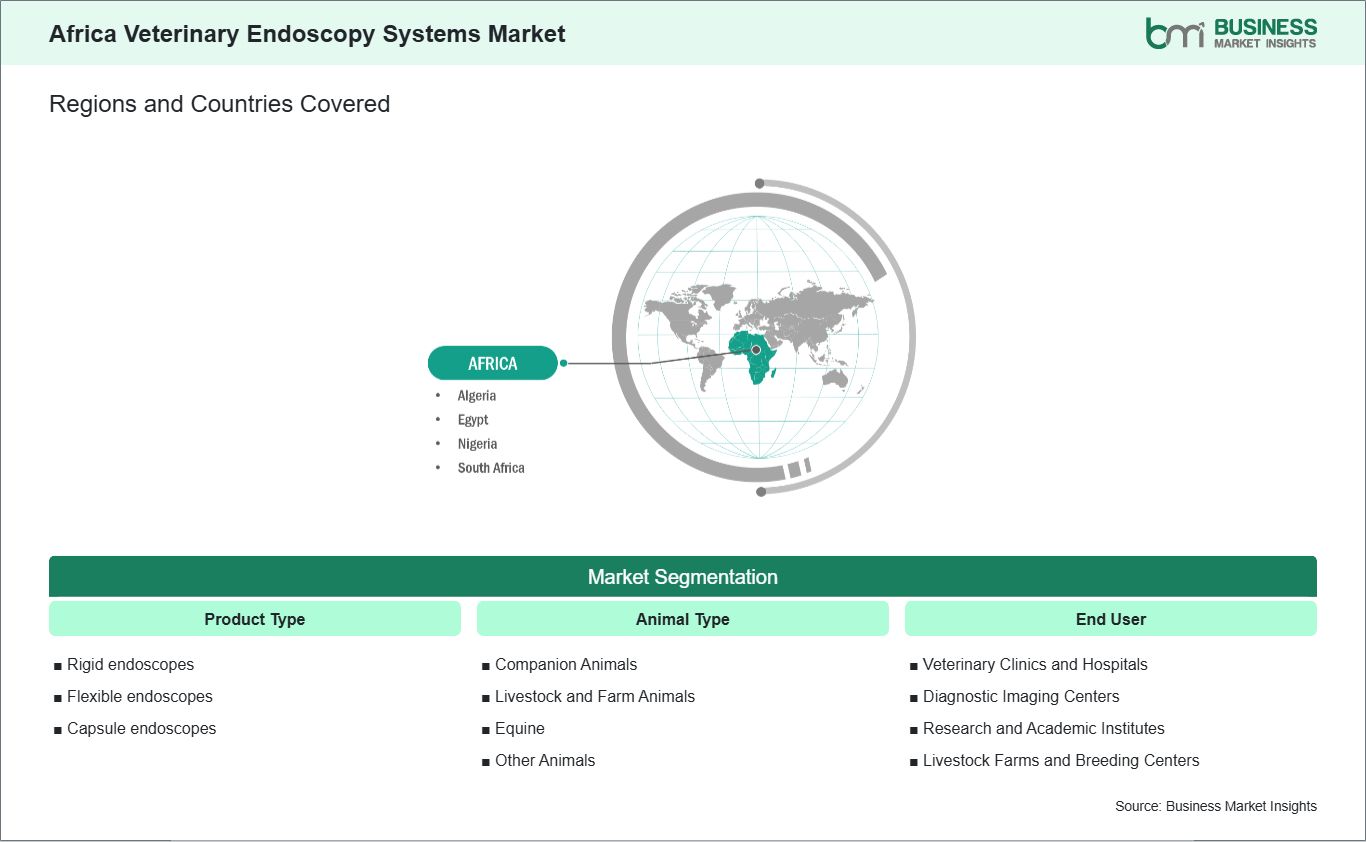
Key segments that contributed to the derivation of the Africa veterinary endoscopy systems market analysis are product type, animal type, and end user.
The Africa veterinary endoscopy systems market is shaped by a steady rise in companion animal ownership, particularly in urban centers such as South Africa, Egypt, and Nigeria. Although traditionally characterized by animal husbandry practices, there has been a gradual cultural change in terms of pet ownership, particularly within middle and high-socioeconomic classes. In metropolitan areas of Africa, greater sensitivity toward animal welfare and the increased humanization of pets are driving owners to employ advanced veterinary procedures such as endoscopy.
In Southern Africa, especially South Africa, relatively mature veterinary ecosystems and higher disposable incomes have accelerated pet adoption rates. The country has made contributions to the local veterinary endoscopy market owing to its referral clinics and specialty hospitals. In North Africa, there is growing pet ownership in urban centers that are driving veterinary clinics to offer more advanced medical procedures that involve the use of advanced imaging and minimal invasive techniques. This trend has contributed to increased demand for flexible and video endoscopy equipment designed for small animal practices such as cats and dogs.
Sub-Saharan Africa presents a more fragmented but high-growth opportunity. The trend in countries such as Kenya and Nigeria is that pet ownership is on the rise among young people in urban settings. However, the growth rate has started from a much lower base level. There is an existence of fast and slow-moving markets; while there is increasing demand for sophisticated veterinary services in urban settings, the application of such services is minimal in rural areas. With growing knowledge and disposable income levels, the care of companion animals will continue to drive the use of endoscopy systems.
The expansion of veterinary infrastructure across underserved regions of Africa is a critical enabler of growth in the veterinary endoscopy systems market. Efforts are made by governments, non-governmental organizations, and other private players to ensure that access to veterinary services is increased in rural and peri-urban settings, especially those that are concerned with the health of livestock.
East Africa exemplifies this trend, with countries such as Kenya investing in regional diagnostic centers and veterinary outreach programs. While such efforts may be associated with veterinary applications, there have been growing efforts directed toward small animals, which facilitate the wider use of diagnostic instruments. There is a need for portable and versatile endoscope systems due to increasing sophistication in veterinary practices, moving beyond simple treatment centers. This trend reflects growing demand within the industry for portable products at affordable prices in developing nations.
In West and Central Africa, infrastructure development is more nascent but is gaining traction through public-private partnerships and international funding programs. Nigeria is observing gradual improvements in veterinary education institutions and urban clinics, which are beginning to adopt advanced diagnostic tools. Meanwhile, North Africa benefits from a stronger healthcare system, where veterinary hospitals are integrating endoscopy into routine diagnostics. Across the continent, the expansion of veterinary infrastructure is not only increasing procedural volumes but also enhancing the feasibility of investing in endoscopy systems, supporting long-term market growth.

The Africa veterinary endoscopy systems market demonstrates steady growth, with size and share analysis highlighting evolving trends and competitive dynamics among key players. The report examines subsegments categorized within product type, animal type, and end user, offering insights into their contribution to overall market performance.
By product type, the rigid endoscopes segment dominated the market in 2025, driven by the rising adoption of minimally invasive surgical procedures such as laparoscopy, arthroscopy, and cystoscopy that require high precision and durability in veterinary practice.
Based on animal type, the companion animals subsegment dominated the market in 2025, driven by increasing pet ownership, higher spending on pet healthcare, and strong demand for advanced diagnostic procedures for dogs and cats.
In terms of end user, the veterinary clinics and hospitals subsegment dominated the market in 2025, driven by growing procedural volumes and wider adoption of endoscopic systems for routine diagnostics and minimally invasive treatments in clinical settings.
| Report Attribute | Details |
|---|---|
| Market size in 2025 | US$ 2.1 Million |
| Market Size by 2033 | US$ 2.7 Million |
| CAGR (2026 - 2033) | 3.5% |
| Historical Data | 2022-2024 |
| Forecast period | 2026-2033 |
| Segments Covered | By Product Type
|
|
Regions and Countries Covered
| |
| Africa | Egypt, South Africa, Nigeria, Algeria |
| Market leaders and key company profiles |
|
The "Africa Veterinary Endoscopy Systems Market Size and Forecast (2022-2033)" report provides a detailed analysis of the market covering below areas:
The geographical scope of the Africa veterinary endoscopy systems market report is divided into Egypt, South Africa, Nigeria, and Algeria. Egypt held the largest share in 2025.
Country-level performance in the Africa veterinary endoscopy systems market reflects varied adoption maturity, with Egypt emerging as the dominant contributor due to its structured veterinary ecosystem and strong government focus on animal health management. Egypt benefits from a well-established livestock sector and increasing institutional support for modern diagnostic technologies. Veterinary universities, research centers, and government-backed initiatives are promoting the use of minimally invasive tools, positioning endoscopy systems as part of broader efforts to enhance disease surveillance and treatment efficiency. The presence of centralized procurement mechanisms facilitates technology penetration in public veterinary services. South Africa represents a technologically advanced market within the region, driven by a sophisticated private veterinary sector and a high level of companion animal care awareness. Veterinary clinics and specialty hospitals in urban centers are integrating endoscopic procedures into routine practice, particularly for small animals. The country’s regulatory clarity and availability of skilled professionals support the adoption of premium systems, making it a key market for high-end product offerings and innovation-led competition. In Nigeria, market growth is fueled by expanding urbanization and a rising emphasis on improving livestock productivity. While the veterinary sector is developing, there is increasing interest among private practitioners and commercial farm operators in adopting efficient diagnostic solutions. However, cost sensitivity and limited access to advanced training continue to influence purchasing behavior, encouraging demand for cost-effective and easy-to-operate endoscopy systems. Algeria presents a moderately evolving market, supported by government initiatives aimed at strengthening agricultural output and veterinary services. The focus remains on livestock health, with gradual adoption of modern diagnostic tools in state-supported facilities. Although infrastructure constraints persist, ongoing investments in veterinary education and public health programs are expected to create incremental opportunities for endoscopy system providers. These countries highlight a spectrum of adoption levels, requiring tailored market entry and expansion strategies aligned with local economic priorities and veterinary care frameworks.

The Africa veterinary endoscopy systems market is evaluated by gathering qualitative and quantitative data post primary and secondary research, which includes important corporate publications, association data, and databases. A few of the key developments in the Africa veterinary endoscopy systems market are:
The Africa Veterinary Endoscopy Systems Market is valued at US$ 2.1 Million in 2025, it is projected to reach US$ 2.7 Million by 2033.
As per our report Africa Veterinary Endoscopy Systems Market, the market size is valued at US$ 2.1 Million in 2025, projecting it to reach US$ 2.7 Million by 2033. This translates to a CAGR of approximately 3.5% during the forecast period.
The Africa Veterinary Endoscopy Systems Market report typically cover these key segments-
The historic period, base year, and forecast period can vary slightly depending on the specific market research report. However, for the Africa Veterinary Endoscopy Systems Market report:
The Africa Veterinary Endoscopy Systems Market is populated by several key players, each contributing to its growth and innovation. Some of the major players include:
The Africa Veterinary Endoscopy Systems Market report is valuable for diverse stakeholders, including:
Essentially, anyone involved in or considering involvement in the Africa Veterinary Endoscopy Systems Market value chain can benefit from the information contained in a comprehensive market report.
Please tell us your area of interest
(Market Segments/ Regions and Countries/ Companies)