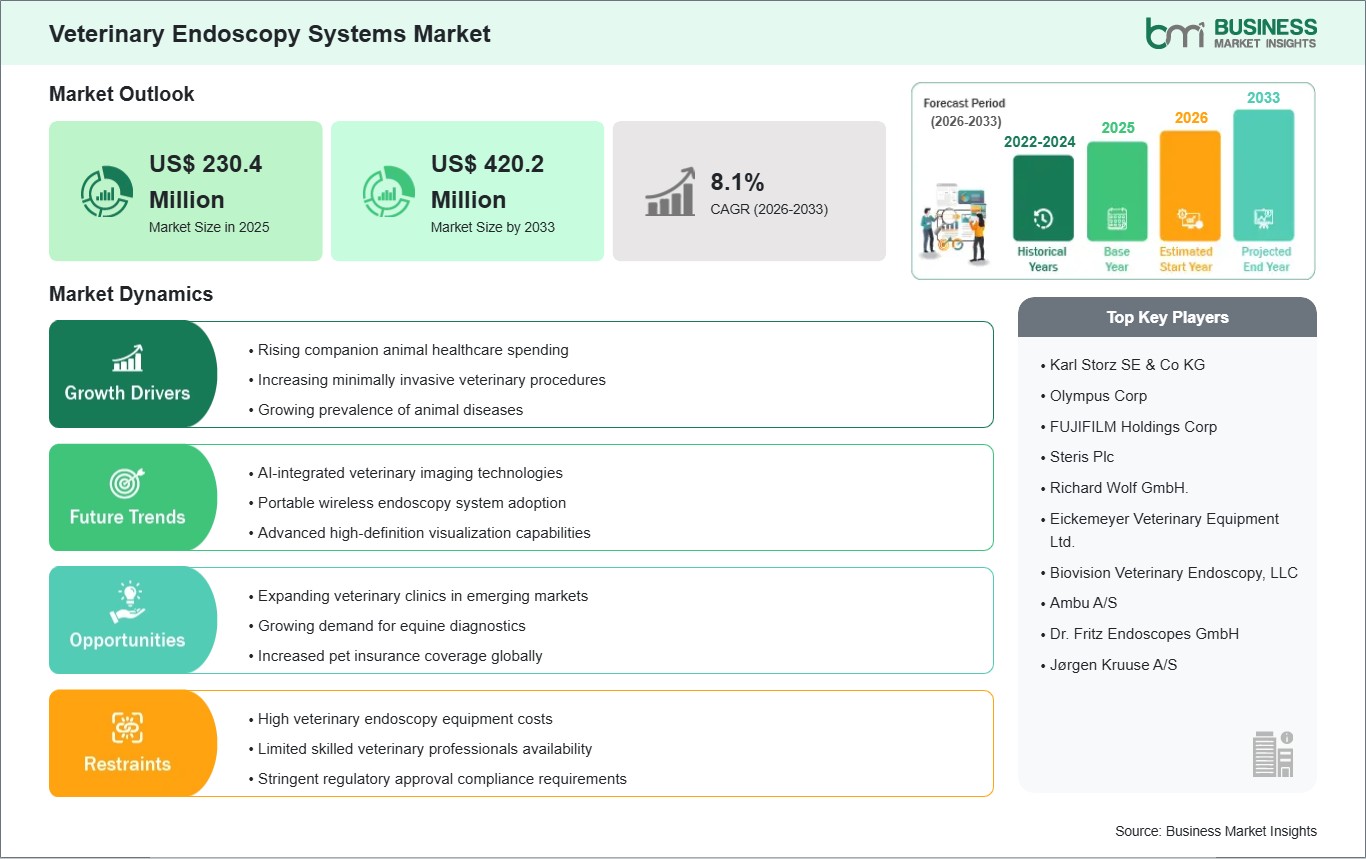
The veterinary endoscopy systems market size is expected to reach US$ 420.18 million by 2033 from US$ 230.38 million in 2025. The market is estimated to register a CAGR of 8.1% during 2026-2033.
The veterinary endoscopy systems market is experiencing a notable transformation owing to the increasing adoption of minimally invasive procedures across animal healthcare facilities. Veterinary hospitals and specialty clinics are prioritizing advanced diagnostic technologies that improve procedural accuracy, reduce surgical trauma, and shorten recovery periods for companion and production animals. The market is benefiting from the growing integration of high-resolution imaging systems, portable visualization equipment, and multifunctional endoscopic platforms designed to support clinical applications. Demand for efficient internal diagnostic procedures has accelerated due to rising incidences of gastrointestinal disorders, respiratory complications, and urological conditions in animals. Veterinary practitioners are emphasizing preventive healthcare approaches, encouraging earlier diagnosis and intervention through endoscopic examinations. Industry participants are strengthening their competitive positioning through continuous innovation in optics, digital imaging compatibility, and user-friendly instrument handling systems. The expansion of veterinary specialty services and referral networks has also contributed to higher procedural volumes in advanced care settings. Veterinary training institutions are incorporating endoscopic education modules and simulation technologies to improve practitioner expertise and procedural confidence. Manufacturers are developing compact and lightweight systems suited for smaller practices while introducing durable solutions for high-volume veterinary hospitals. Technological advancements involving artificial intelligence-assisted imaging interpretation and cloud-based procedural documentation are improving workflow efficiency and clinical decision-making capabilities. Market competition remains centered on product reliability, visualization quality, operational flexibility, and long-term maintenance support. As animal healthcare standards evolve, veterinary providers are investing in sophisticated endoscopy systems to enhance treatment precision, strengthen patient outcomes, and improve operational productivity across clinical environments.

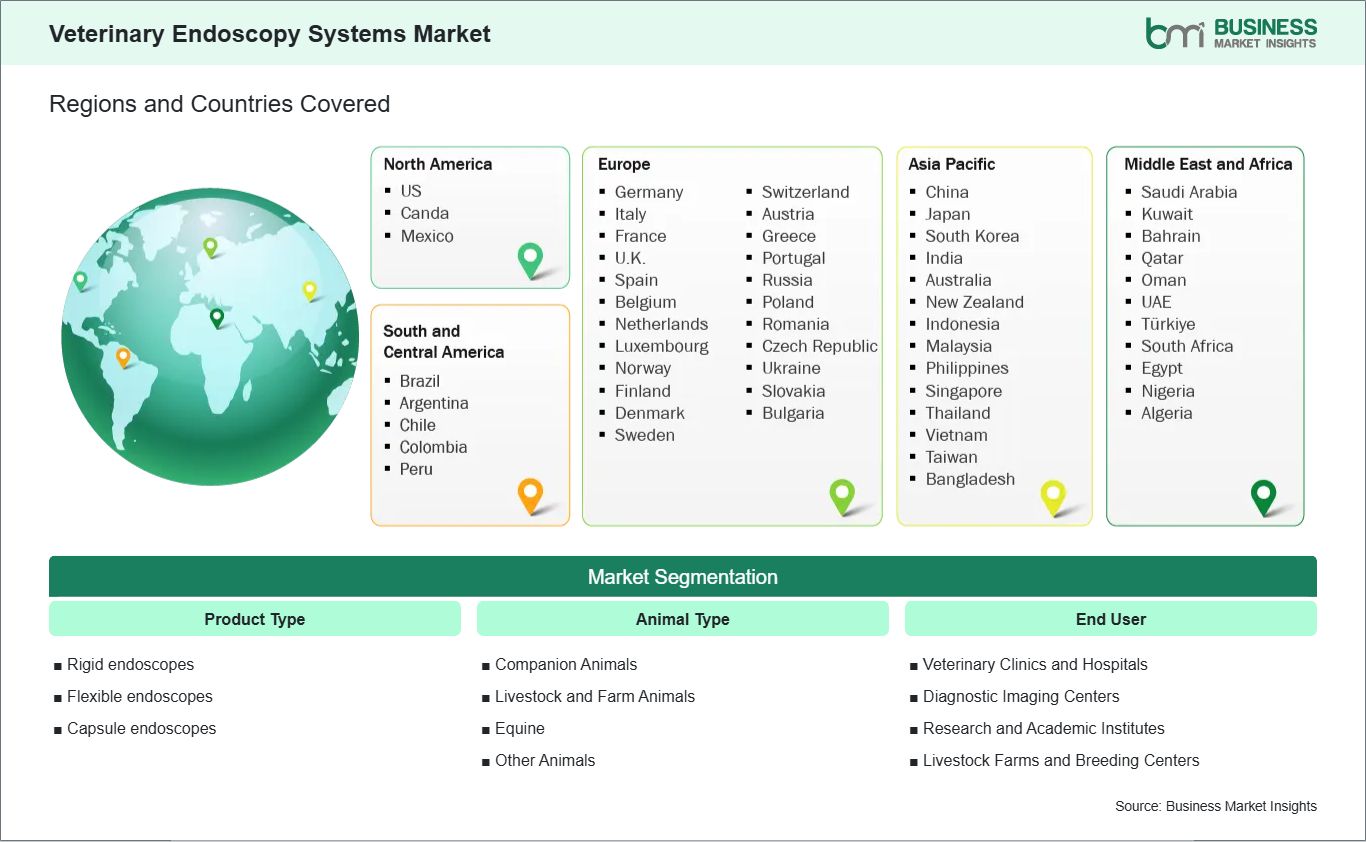
Key segments that contributed to the derivation of the Africa veterinary endoscopy systems market analysis are product type, animal type, and end user.
The veterinary endoscopy systems market is expanding owing to increasing demand for precise diagnostic procedures that enable early and accurate identification of internal animal health conditions. Veterinarians have shifted their focus from conventional methods to those that are minimally invasive, thus reducing risks during surgery and increasing diagnostic precision. An endoscope enables the observation of internal organs, and its use is imperative in identifying any diseases affecting the gastrointestinal tract, lungs, and the urinary system that are not detectable by external inspection.
In developed markets for veterinary services such as North America and Western Europe, precision diagnostics are part of advanced veterinary practices. In these locations, the inclusion of endoscopy in diagnosis has become a norm in the routine examinations of pets with chronic diseases. Endoscopy is used in Asia Pacific due to the increased number of pets in urban settings and enhanced veterinary facilities. Endoscopy devices are slowly but surely being adopted in Latin America, as well as the Middle Eastern and Africa, through specialist veterinary clinics and urban hospitals.
Rising complexities associated with animal illnesses, with the awareness among pet owners, are enhancing the demand for proper and precise diagnostics of these animals. There is an increasing pressure on veterinarians to provide quick and accurate diagnoses, resulting in the incorporation of advanced diagnostic tools such as imaging devices. In light of evolving trends in veterinary medicine, precise diagnostics are becoming important, paving the way for the gradual adoption of endoscopy devices in animal healthcare facilities.
The veterinary endoscopy systems market is also shaped by the integration of artificial intelligence-based interpretation tools that enhance diagnostic support and clinical decision-making. The technology is integrated into imaging devices to help veterinarians analyze images acquired from the endoscopy in a more efficient and consistent manner. AI technology will aid in recognizing abnormal areas and even classifying images, thus improving the efficiency of the process. It will be helpful in cases when there is a need to spot subtle changes in internal organs.
For technologically sophisticated settings where veterinary services are offered, such as North America, Western Europe, and some areas in Asia Pacific, there is an increasing trend toward integrating AI-enabled diagnostic solutions. Veterinary clinics in these settings are implementing digital technologies that incorporate endoscopy technology along with automatic image analysis and real-time guidance. This makes procedures more efficient by enabling veterinarians to make clinical decisions without spending much time analyzing images manually.
In terms of market development in veterinary applications, there is a rising use of AI technology to interpret these results. This is due to cloud-based diagnostics platforms that can allow viewing of such endoscopy images, providing the required specialist information for practitioners even when they are at remote locations. These technologies are proving effective in enhancing diagnostic consistency across different regions, depending on the level of infrastructure available.

The veterinary endoscopy systems market demonstrates steady growth, with size and share analysis highlighting evolving trends and competitive dynamics among key players. The report examines subsegments categorized within product type, animal type, and end user, offering insights into their contribution to overall market performance.
By product type, the rigid endoscopes segment dominated the market in 2025, driven by increasing adoption of minimally invasive veterinary procedures that require high-precision, durable instruments for effective diagnosis and treatment across animal healthcare settings.
Based on animal type, the companion animals subsegment dominated the market in 2025, driven by rising global pet ownership, growing awareness of animal health, and increasing expenditure on advanced veterinary diagnostics and surgical care for dogs and cats.
In terms of end user, the veterinary clinics and hospitals subsegment dominated the market in 2025, driven by expanding veterinary healthcare infrastructure, higher procedural volumes, and widespread adoption of advanced endoscopy systems for routine and specialized animal care.
| Report Attribute | Details |
|---|---|
| Market size in 2025 | US$ 230.4 Million |
| Market Size by 2033 | US$ 420.2 Million |
| Global CAGR (2026 - 2033) | 8.1% |
| Historical Data | 2022-2024 |
| Forecast period | 2026-2033 |
| Segments Covered | By Product Type
|
|
Regions and Countries Covered
| |
| North America | US, Canada, Mexico |
| Europe | Germany, Italy, France, U.K., Spain, Belgium, Netherlands, Luxembourg, Norway, Finland, Denmark, Sweden, Switzerland, Austria, Greece, Portugal, Russia, Poland, Romania, Czech Republic, Ukraine, Slovakia, Bulgaria |
| Asia-Pacific | China, Japan, South Korea, India, Australia, New Zealand, Indonesia, Malaysia, Philippines, Singapore, Thailand, Vietnam, Taiwan, Bangladesh |
| South and Central America | Brazil, Argentina, Chile, Colombia, Peru |
| Middle East and Africa | Saudi Arabia, United Arab Emirates, Kuwait, Bahrain, Qatar, Oman, Turkiye, South Africa, Egypt, Nigeria, Algeria |
| Market leaders and key company profiles |
|
The "Veterinary Endoscopy Systems Market Size and Forecast (2022-2033)" report provides a detailed analysis of the market covering below areas:
The geographical scope of the veterinary endoscopy systems market report is divided into North America, Asia Pacific, Europe, Middle East & Africa, and South & Central America. North America held the largest share in 2025.
North America represents the dominant region in the veterinary endoscopy systems market owing to the presence of advanced veterinary healthcare infrastructure, high companion animal ownership, and strong adoption of minimally invasive diagnostic technologies. Veterinary hospitals and specialty clinics are investing in sophisticated imaging and visualization systems to improve procedural efficiency and clinical accuracy. The availability of skilled veterinary professionals, favorable reimbursement environments, and increasing expenditure on animal healthcare support regional market leadership. Manufacturers introduce technologically advanced endoscopic solutions in North America, strengthening innovation-driven competition and product accessibility. Strict animal welfare regulations, established veterinary care standards, and an increasing focus on precision-based treatment procedures support Europe market. Veterinary institutions are emphasizing high-quality diagnostic systems that support improved surgical outcomes and operational reliability. Demand for advanced endoscopic equipment is also encouraged by the growing prevalence of companion animal healthcare services and expanding veterinary specialty practices. Asia Pacific is emerging as a rapidly developing region owing to rising urbanization, increasing pet adoption, and improving veterinary healthcare awareness. Expanding investments in veterinary infrastructure, particularly across developing economies, are supporting the adoption of advanced diagnostic technologies. The region is also witnessing growth in private veterinary clinics and specialty hospitals seeking modern minimally invasive treatment capabilities. The Middle East & Africa is progressing due to growing investments in veterinary healthcare modernization and increasing awareness regarding advanced animal treatment procedures. Demand remains particularly visible within equine healthcare and premium companion animal services in urban centers. South & Central America are experiencing steady market development supported by expanding livestock healthcare management practices and improving access to veterinary diagnostic technologies. Growing veterinary service networks and rising awareness of animal health monitoring are contributing to increased adoption of endoscopic systems.

The veterinary endoscopy systems market is evaluated by gathering qualitative and quantitative data post primary and secondary research, which includes important corporate publications, association data, and databases. A few of the key developments in the veterinary endoscopy systems market are:
The Veterinary Endoscopy Systems Market is valued at US$ 230.4 Million in 2025, it is projected to reach US$ 420.2 Million by 2033.
As per our report Veterinary Endoscopy Systems Market, the market size is valued at US$ 230.4 Million in 2025, projecting it to reach US$ 420.2 Million by 2033. This translates to a CAGR of approximately 8.1% during the forecast period.
The Veterinary Endoscopy Systems Market report typically cover these key segments-
The historic period, base year, and forecast period can vary slightly depending on the specific market research report. However, for the Veterinary Endoscopy Systems Market report:
The Veterinary Endoscopy Systems Market is populated by several key players, each contributing to its growth and innovation. Some of the major players include:
The Veterinary Endoscopy Systems Market report is valuable for diverse stakeholders, including:
Essentially, anyone involved in or considering involvement in the Veterinary Endoscopy Systems Market value chain can benefit from the information contained in a comprehensive market report.
Please tell us your area of interest
(Market Segments/ Regions and Countries/ Companies)