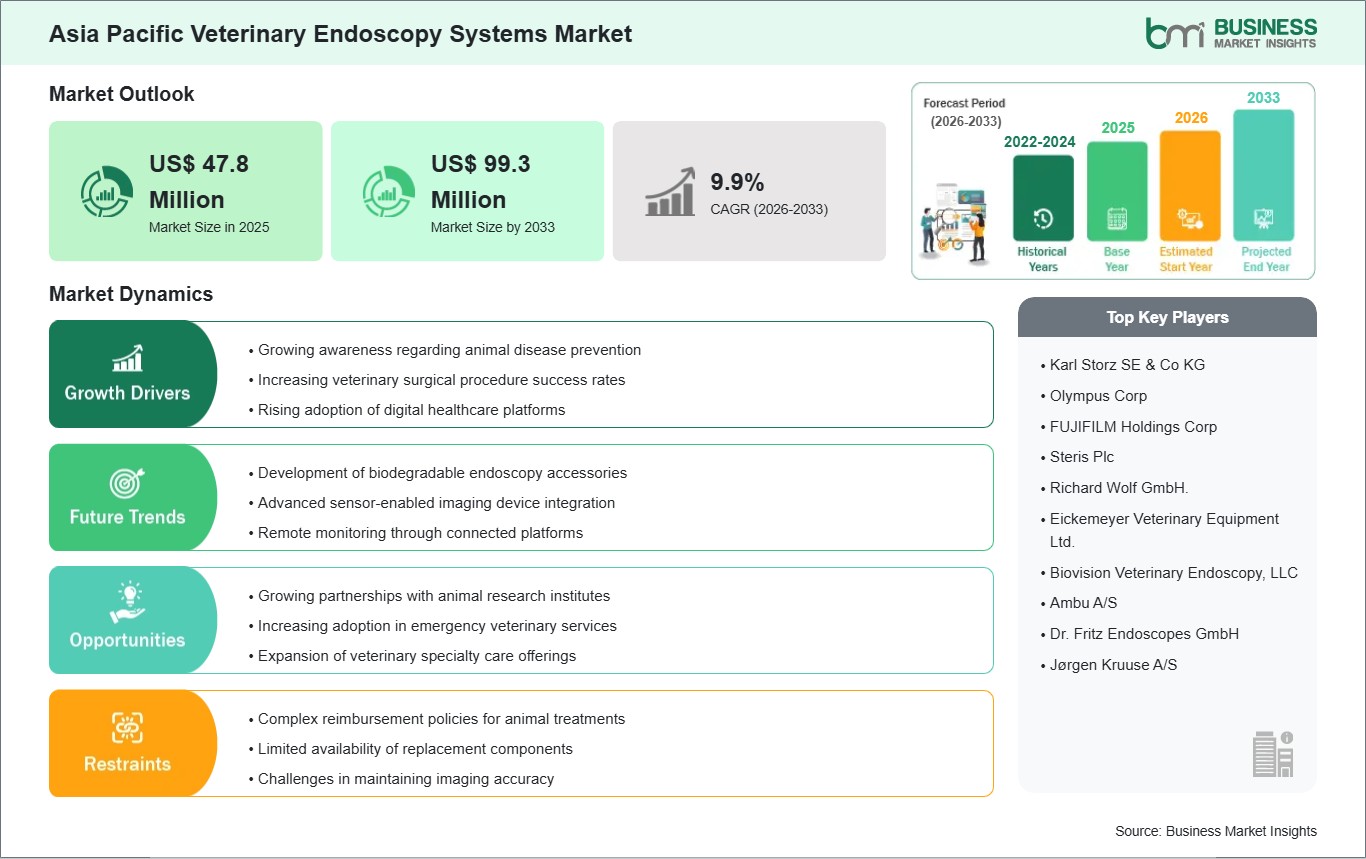
The Asia Pacific veterinary endoscopy systems market size is expected to reach US$ 99.3 million by 2033 from US$ 47.8 million in 2025. The market is estimated to record a CAGR of 9.9% from 2026 to 2033.
The Asia Pacific veterinary endoscopy systems market is evolving into a strategically significant segment within the global animal healthcare equipment landscape, supported by rapid modernization of veterinary services, rising investment in animal husbandry, and increasing demand for minimally invasive diagnostic and surgical procedures. The area is experiencing an evident shift from traditional veterinary approaches to sophisticated imaging modalities, which help increase the precision of diagnosis, minimize the risk of medical errors, and increase recovery chances among various companion and livestock species. The industry trends are largely driven by the two key drivers, namely commercial livestock proliferation and companion animal treatment innovations. Agricultural giants are focusing on increasing the efficiency of veterinarians to provide sufficient food supplies, optimize production, and prevent diseases within the industries of poultry, swine, and bovine farming. Meanwhile, growing urbanization and lifestyle changes have led to the rapid growth of pet ownership in cities, thus spurring the demand for veterinary services utilizing high-end diagnostic solutions such as endoscopy devices. The technology aspect sets apart the Asia Pacific market from other regions, with manufacturers placing emphasis on portability, high-resolution imaging, and multipurpose systems suitable for varied clinical settings. The ongoing incorporation of digital imaging and recording technologies has been adding value to procedures and assisting with educational and research purposes in the veterinary field. Nevertheless, the industry continues to operate under restrictions such as inadequate infrastructure development, low reach in rural veterinary networks, and affordability issues in poorer economies. Competition will continue to intensify among the world's leading veterinary equipment firms operating through local distributors and collaborating with veterinary institutions to enhance product knowledge and training on endoscopic procedures. Vendors are implementing a tiered strategy in response to the huge variations in income levels between countries within the region Asia Pacific veterinary endoscopy systems market is expected to experience continuous structural growth, buoyed by progressive veterinary reform policies and rising awareness of animal welfare practices.

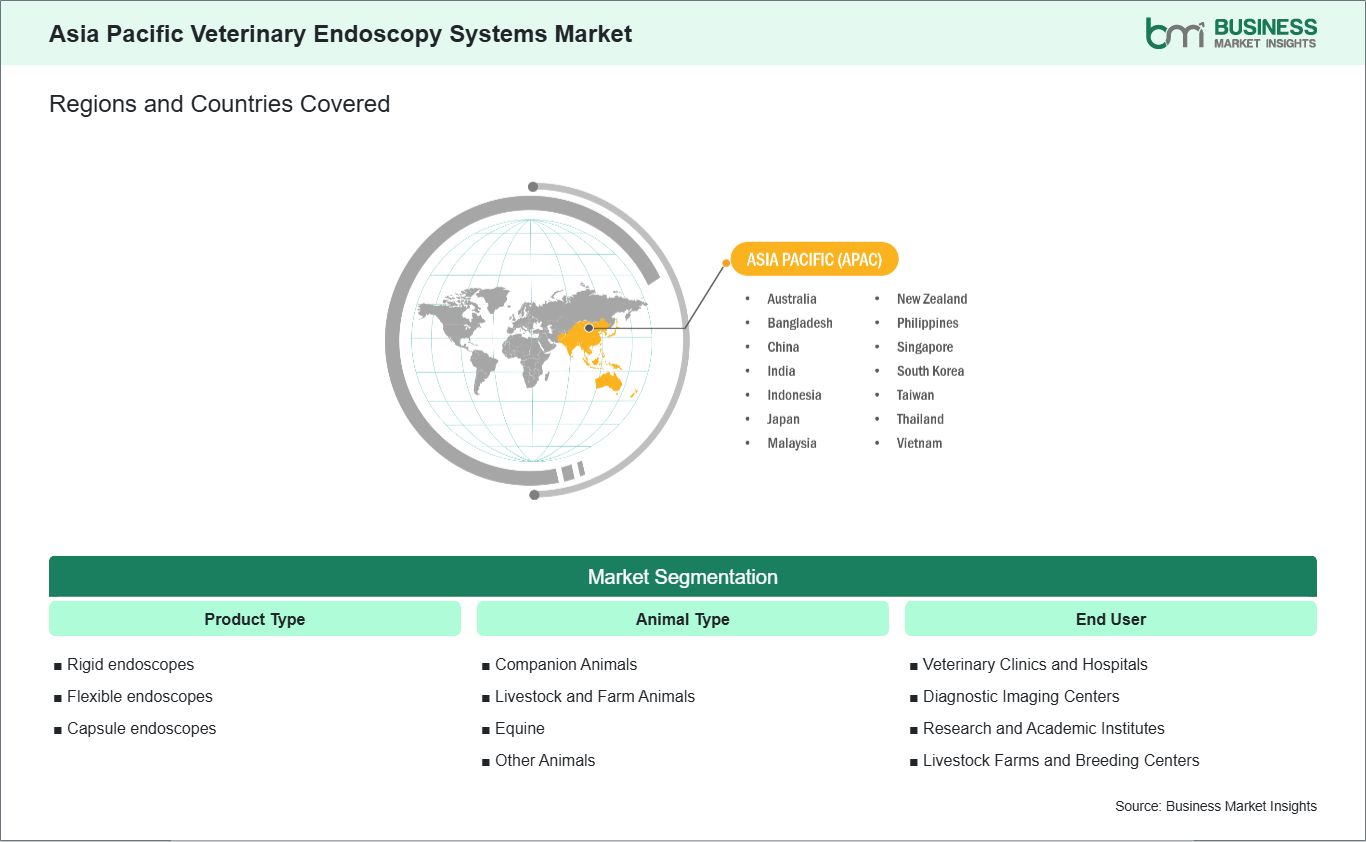
Key segments that contributed to the derivation of the Asia Pacific veterinary endoscopy systems market analysis are product type, animal type, and end user.
The Asia Pacific veterinary endoscopy systems market is experiencing steady growth driven by increasing awareness of minimally invasive diagnostic and surgical procedures in animal healthcare. The veterinarians working in this region are slowly making a shift from the conventional diagnostic technique to the newer endoscopic approach. Such a trend can be attributed to the increasing adoption of the new standard of veterinary medical practices, especially within the urban clinical settings. The importance of early diagnosis and treatment is also adding more value to the use of endoscopy in veterinary practice.
In the developed veterinary market sectors within Asia Pacific, like Australia, Japan, and South Korea, minimally invasive surgery is being widely adopted as an integral element of specialty veterinary practice. The use of endoscope systems in the diagnosis of gastrointestinal, respiratory, and abdominal problems is becoming common in clinics in such regions as there is increased expenditure on animal healthcare. Such developments are directly related to the existence of trained and experienced veterinarians who can perform the advanced procedures. Thus, endoscopy is no longer seen as an uncommon procedure.
However, in developing nations like India, Indonesia, and Vietnam, although awareness is just beginning to rise, its pace is increasing at an unprecedented rate thanks to professional training workshops and information sharing efforts. Endoscopy equipment is slowly being incorporated in veterinary colleges as well as private clinics as part of their improved diagnosis capabilities. With increasing awareness among pet and livestock owners of the advantages of minimal invasiveness, the demand for such a system is likely to become more pronounced.
The Asia Pacific veterinary endoscopy systems market is also being shaped by strong demand for portable and compact diagnostic equipment. Medical devices needed by animal medical service providers in the region will need to be versatile and compact since the veterinarians could be serving from different locations like small hospitals, mobile animal hospitals, and outreach programs, and this calls for versatility and portability. In addition to that, there has been a trend towards preference of compact endoscopy machines due to portability and ease of usage.
Compact technology is becoming popular in the more developed parts of Asia-Pacific for workflow efficiency in high-volume veterinary hospitals and specialty clinics. The systems help veterinarians perform quick diagnostic tests while avoiding the need for elaborate surgical systems. The trend is also helped by advances in technology, which have made it possible to develop smaller imaging equipment. With most veterinary firms using computerized record systems, there is a need to develop portable endoscopic systems that are capable of transferring information seamlessly to computers.
Portability is an essential consideration in creating veterinary markets, enabling more access to diagnostic tests that were previously only available in urban locations. In particular, mobile veterinary operations as well as clinics based in the field have started using portable endoscopy units, thus making it easier to diagnose animals in hard-to-reach rural locations where fully-equipped hospitals do not exist. It is noteworthy that this factor will be highly significant in the future development of Asia Pacific veterinary markets.

The Asia Pacific veterinary endoscopy systems market demonstrates steady growth, with size and share analysis highlighting evolving trends and competitive dynamics among key players. The report examines subsegments categorized within product type, animal type, and end user, offering insights into their contribution to overall market performance.
By product type, the rigid endoscopes segment dominated the market in 2025, driven by growing use in minimally invasive veterinary surgeries such as laparoscopy and arthroscopy that require precise and durable instruments.
Based on animal type, the companion animals subsegment dominated the market in 2025, driven by rising pet ownership, increasing spending on pet healthcare, and strong adoption of advanced diagnostic and surgical procedures for dogs and cats.
In terms of end user, the veterinary clinics and hospitals subsegment dominated the market in 2025, driven by high procedural volumes, expanding veterinary infrastructure, and increasing adoption of advanced endoscopy systems for routine and specialty care.
| Report Attribute | Details |
|---|---|
| Market size in 2025 | US$ 47.8 Million |
| Market Size by 2033 | US$ 99.3 Million |
| CAGR (2026 - 2033) | 9.9% |
| Historical Data | 2022-2024 |
| Forecast period | 2026-2033 |
| Segments Covered | By Product Type
|
|
Regions and Countries Covered
| |
| Asia Pacific | China, India, Japan, Australia, Bangladesh, Indonesia, Malaysia, New Zealand, Philippines, Singapore, South Korea, Taiwan, Thailand, Vietnam |
| Market leaders and key company profiles |
|
The "Asia Pacific Veterinary Endoscopy Systems Market Size and Forecast (2022-2033)" report provides a detailed analysis of the market covering below areas:
The geographical scope of the Asia Pacific veterinary endoscopy systems market report is divided into China, India, Japan, Australia, Bangladesh, Indonesia, Malaysia, New Zealand, Philippines, Singapore, South Korea, Taiwan, Thailand, Vietnam. China held the largest share in 2025.
Country-level dynamics within the Asia Pacific veterinary endoscopy systems market reflect a highly differentiated landscape shaped by varying levels of economic maturity, veterinary infrastructure development, and animal healthcare priorities. In China, the market is strongly influenced by large-scale livestock production systems and increasing government emphasis on animal disease control and food safety. Veterinary modernization programs are accelerating the adoption of advanced diagnostic tools, particularly in commercial farming and research institutions, where efficiency and biosecurity are critical operational priorities. India represents a rapidly expanding market driven by its vast livestock population and growing companion animal care sector. Veterinary infrastructure is evolving, with increasing private sector participation and rising awareness of advanced diagnostic procedures. However, adoption of endoscopy systems remains concentrated in urban veterinary hospitals and academic institutions due to cost sensitivity and uneven rural access. In Japan, the veterinary endoscopy systems market is highly mature, characterized by advanced clinical practices, strong technological integration, and a well-developed companion animal healthcare industry. Veterinary clinics routinely adopt minimally invasive procedures, supported by high levels of practitioner training and a strong focus on animal welfare and precision medicine. Australia exhibits a sophisticated veterinary ecosystem with strong demand from both livestock and companion animal segments. The country’s large-scale agricultural operations and export-oriented livestock industry encourage the use of advanced diagnostic technologies, while companion animal care in urban centers further supports steady adoption of endoscopic systems. Meanwhile, South Korea is experiencing increasing integration of veterinary endoscopy systems, driven by a technologically advanced veterinary sector and rising pet ownership rates. Veterinary clinics are progressively adopting high-precision diagnostic tools, supported by strong digital infrastructure and growing emphasis on specialized veterinary services. Asia Pacific presents a multi-tiered adoption environment, where advanced economies lead in technological integration, while emerging markets offer long-term growth potential driven by expanding veterinary care awareness and structural improvements in animal health systems.

The Asia Pacific veterinary endoscopy systems market is evaluated by gathering qualitative and quantitative data post primary and secondary research, which includes important corporate publications, association data, and databases. A few of the key developments in the Asia Pacific veterinary endoscopy systems market are:
The Asia Pacific Veterinary Endoscopy Systems Market is valued at US$ 47.8 Million in 2025, it is projected to reach US$ 99.3 Million by 2033.
As per our report Asia Pacific Veterinary Endoscopy Systems Market, the market size is valued at US$ 47.8 Million in 2025, projecting it to reach US$ 99.3 Million by 2033. This translates to a CAGR of approximately 9.9% during the forecast period.
The Asia Pacific Veterinary Endoscopy Systems Market report typically cover these key segments-
The historic period, base year, and forecast period can vary slightly depending on the specific market research report. However, for the Asia Pacific Veterinary Endoscopy Systems Market report:
The Asia Pacific Veterinary Endoscopy Systems Market is populated by several key players, each contributing to its growth and innovation. Some of the major players include:
The Asia Pacific Veterinary Endoscopy Systems Market report is valuable for diverse stakeholders, including:
Essentially, anyone involved in or considering involvement in the Asia Pacific Veterinary Endoscopy Systems Market value chain can benefit from the information contained in a comprehensive market report.
Please tell us your area of interest
(Market Segments/ Regions and Countries/ Companies)