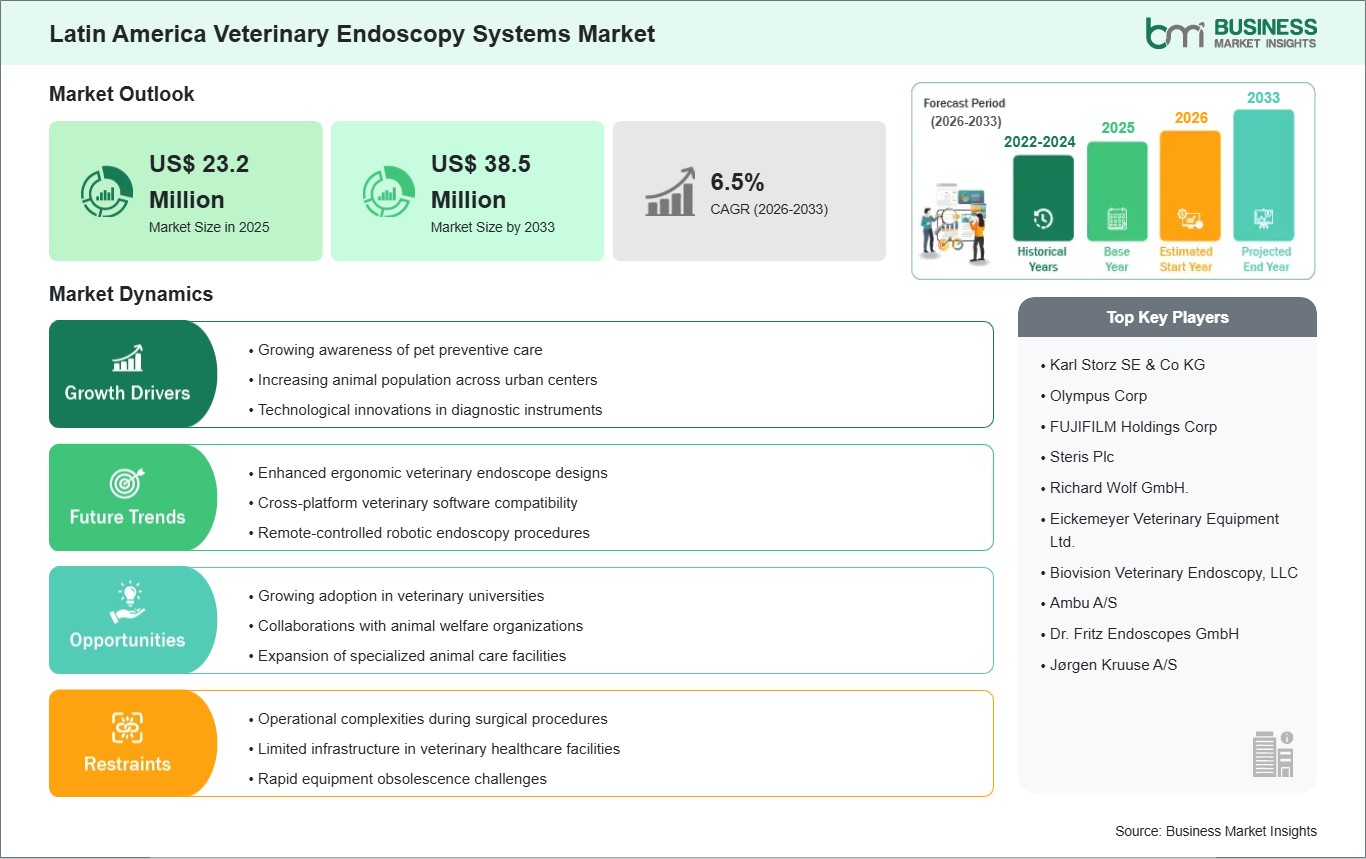
The Latin America veterinary endoscopy systems market size is expected to reach US$ 38.5 million by 2033 from US$ 23.2 million in 2025. The market is estimated to record a CAGR of 6.5% from 2026 to 2033.
The Latin America veterinary endoscopy systems market is progressing as a structurally developing segment within the broader animal healthcare industry, supported by expanding livestock production, rising companion animal ownership, and gradual modernization of veterinary infrastructure. The area highlights the shift from traditional diagnostic methods to minimally invasive approaches for diagnosing diseases, prompted by an increase in knowledge regarding clinical efficiency, animal welfare, and improved treatment outcomes. One of the primary factors driving the demand is the size and economic significance of livestock farming in major economies, where veterinarians rely on effective diagnosis as an integral aspect of production control, disease containment, and export-led agriculture. Endoscopy equipment is gaining recognition as an indispensable device in diagnostic procedures in the digestive tract, lungs, and reproductive system among cattle, swine, and poultry. Simultaneously, rising urbanization rates are affecting pet owners' behavior by making greater numbers of people in the middle class more likely to spend money on their pets. The market is characterized by a strong reliance on imported veterinary equipment, with global manufacturers dominating supply channels through regional distributors and local partners. Product demand is highly sensitive to cost, leading to increased adoption of mid-range and portable endoscopy systems that balance functionality with affordability. Veterinary clinics often prioritize durability, ease of maintenance, and multi-function capability when selecting equipment due to budget constraints and operational variability. Infrastructure disparities remain a key challenge, with advanced veterinary technologies primarily concentrated in urban centers and specialized clinics. Rural areas, despite their significant livestock activity, continue to face limitations in access to advanced diagnostic tools and trained veterinary professionals. However, gradual improvements in veterinary education and government-led animal health programs are supporting incremental market development. The Latin America veterinary endoscopy systems market is positioned for steady long-term expansion, driven by agricultural modernization, increasing pet healthcare awareness, and gradual improvements in veterinary service delivery frameworks across the region.

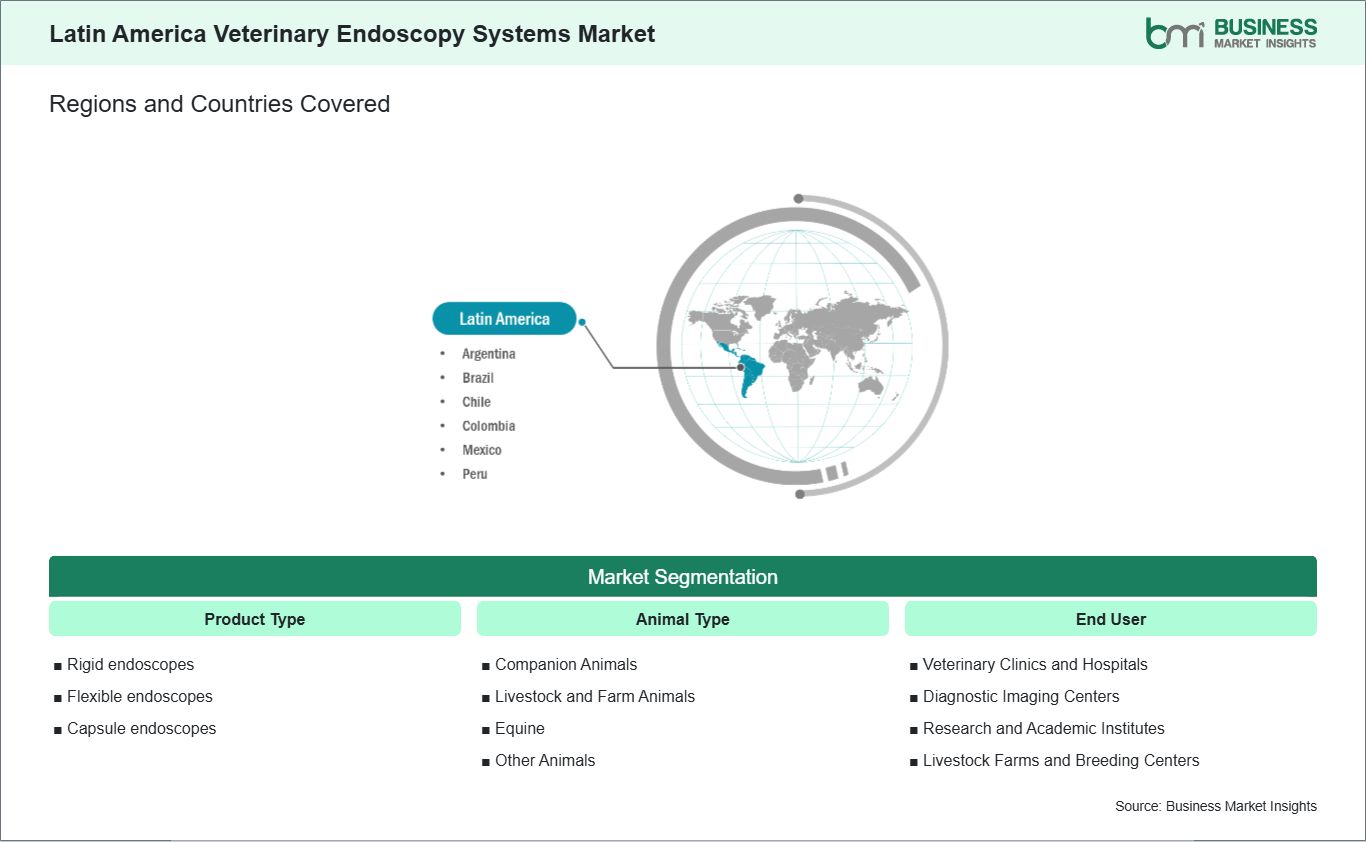
Key segments that contributed to the derivation of the Latin America veterinary endoscopy systems market analysis are product type, animal type, and end user.
The Latin America veterinary endoscopy systems market is gradually benefiting from the increasing adoption of pet insurance plans across key economies such as Brazil, Mexico, Argentina, Chile, and Colombia. With the increase in the cost of veterinary care, owners of pets are increasingly motivated to ensure that they have financial cover for diagnostic and therapeutic procedures that might be required. This trend has facilitated increased uptake of advanced veterinary services, some of which require high-cost diagnosis methods, such as endoscopic examinations. As a result, the provision of advanced veterinary services is being made more affordable through structured insurance programs.
Pet insurance is relatively new in Brazil and Mexico, where pet health care markets are the most developed in the region; however, it continues to develop progressively in urban areas. The rising popularity of pet insurance packages covering diagnostic imaging and consultation among pet owners from such cities as São Paulo, Mexico City, and Buenos Aires creates an increasing need for animal clinics with state-of-the-art diagnostic equipment, such as endoscopy systems. Additionally, pet insurance programs lead veterinarians to suggest additional diagnostic testing instead of just treatment of symptoms.
The awareness about pet insurance products and plans has been rising within the smaller markets of Latin America owing to digital channels, veterinary practices, and retailers who offer pet-related care. The level of adoption of these products is still rather low when compared with developed economies but the growth has been slow yet steady owing to growing disposable incomes and increased formalization of pet ownerships. In the longer run, higher availability of such facilities is likely to drive demand for veterinary endoscopy devices.
The Latin America veterinary endoscopy systems market is also shaped by strong demand for affordable and cost-effective diagnostic solutions. Providers of veterinary services in this part of the world face an environment of high costs, and affordability is an important determinant of the implementation of technology. There is a need to purchase endoscopy systems that provide good performance while keeping the cost of operation and maintenance low, thus enabling provision of sophisticated diagnostic services without increasing costs.
In Argentina, Colombia, and Peru, for example, there exists an uneven distribution of veterinary facilities ranging from sophisticated facilities in urban areas to limited facilities in rural regions. The differences have created a market demand for low-to-mid-range endoscopy solutions which are user-friendly and easy to maintain. This trend has led mobile veterinarians and smaller clinics to concentrate on more portable equipment which can be applied in diverse settings. In response, equipment manufacturers have adjusted their products to cater to this demand.
For large markets such as Brazil and Mexico, cost-effectiveness will continue to be a factor despite an increase in the uptake of sophisticated veterinary instruments. Diagnostic equipment that enables cost-efficient diagnosis among companion and livestock animals will continue to receive more investments. There are efforts towards achieving cost savings through the sharing of diagnostic centers and referrals, enabling smaller veterinary clinics to perform endoscopy tests without necessarily owning sophisticated machinery. Therefore, the need for affordable veterinary diagnostic tools will continue to shape the growth of the veterinary endoscopy systems market in Latin America.

The Latin America veterinary endoscopy systems market demonstrates steady growth, with size and share analysis highlighting evolving trends and competitive dynamics among key players. The report examines subsegments categorized within product type, animal type, and end user, offering insights into their contribution to overall market performance.
By product type, the rigid endoscopes segment dominated the market in 2025, driven by increasing adoption of minimally invasive veterinary procedures that require precise and durable instruments for effective diagnosis and treatment.
Based on animal type, the companion animals subsegment dominated the market in 2025, driven by rising pet ownership, growing awareness of animal health, and increasing expenditure on advanced veterinary care for dogs and cats.
In terms of end user, the veterinary clinics and hospitals subsegment dominated the market in 2025, driven by expanding veterinary healthcare infrastructure, higher patient inflow, and growing adoption of modern endoscopic systems in clinical practices across the region.
| Report Attribute | Details |
|---|---|
| Market size in 2025 | US$ 23.2 Million |
| Market Size by 2033 | US$ 38.5 Million |
| CAGR (2026 - 2033) | 6.5% |
| Historical Data | 2022-2024 |
| Forecast period | 2026-2033 |
| Segments Covered | By Product Type
|
|
Regions and Countries Covered
| |
| Latin America | Mexico, Brazil, Argentina, Peru, Chile, Colombia |
| Market leaders and key company profiles |
|
The "Latin America Veterinary Endoscopy Systems Market Size and Forecast (2022-2033)" report provides a detailed analysis of the market covering below areas:
The geographical scope of the Latin America veterinary endoscopy systems market report is divided into Mexico, Brazil, Argentina, Peru, Chile, Colombia. Mexico held the largest share in 2025.
Country-level dynamics in the Latin America veterinary endoscopy systems market reflect a heterogeneous but evolving landscape, where adoption is shaped by livestock scale, veterinary infrastructure development, and urban pet healthcare expansion. Mexico stands as the dominant market in the region, driven by its dual-strength veterinary ecosystem comprising a large livestock industry and a rapidly expanding companion animal care sector. Veterinary endoscopy systems are increasingly utilized in urban veterinary hospitals and specialty clinics, while agricultural applications are growing in cattle and swine health management to support productivity and disease prevention. Brazil represents a highly significant livestock-driven market, with strong demand for veterinary diagnostics in large-scale cattle and poultry production systems. Endoscopy adoption is concentrated in research institutions, export-oriented farming operations, and advanced veterinary service providers focused on herd health optimization. In Argentina, veterinary endoscopy systems are primarily used within the beef and livestock export sector. The country’s strong reliance on agricultural exports encourages adoption of diagnostic technologies that ensure compliance with international animal health standards and improve reproductive efficiency in cattle farming. Chile exhibits a more structured veterinary ecosystem, with relatively higher integration of advanced diagnostic tools. Companion animal care in urban areas and selective livestock applications contribute to steady demand for endoscopy systems, supported by improving veterinary service quality. Colombia is an emerging market where veterinary modernization is gradually advancing. Adoption of endoscopy systems remains limited but is increasing within private veterinary clinics and agricultural enterprises focused on improving disease control and operational efficiency. Peru reflects a developing veterinary landscape where livestock health remains central. Veterinary infrastructure is improving slowly, with growing exposure to advanced diagnostic tools in urban centers and institutional veterinary settings. Latin America presents a multi-speed adoption environment led by Mexico, where veterinary modernization is more balanced across companion animal and livestock segments, while other countries continue progressing through gradual infrastructure and technology integration cycles.

The Latin America veterinary endoscopy systems market is evaluated by gathering qualitative and quantitative data post primary and secondary research, which includes important corporate publications, association data, and databases. A few of the key developments in the Latin America veterinary endoscopy systems market are:
The Latin America Veterinary Endoscopy Systems Market is valued at US$ 23.2 Million in 2025, it is projected to reach US$ 38.5 Million by 2033.
As per our report Latin America Veterinary Endoscopy Systems Market, the market size is valued at US$ 23.2 Million in 2025, projecting it to reach US$ 38.5 Million by 2033. This translates to a CAGR of approximately 6.5% during the forecast period.
The Latin America Veterinary Endoscopy Systems Market report typically cover these key segments-
The historic period, base year, and forecast period can vary slightly depending on the specific market research report. However, for the Latin America Veterinary Endoscopy Systems Market report:
The Latin America Veterinary Endoscopy Systems Market is populated by several key players, each contributing to its growth and innovation. Some of the major players include:
The Latin America Veterinary Endoscopy Systems Market report is valuable for diverse stakeholders, including:
Essentially, anyone involved in or considering involvement in the Latin America Veterinary Endoscopy Systems Market value chain can benefit from the information contained in a comprehensive market report.
Please tell us your area of interest
(Market Segments/ Regions and Countries/ Companies)