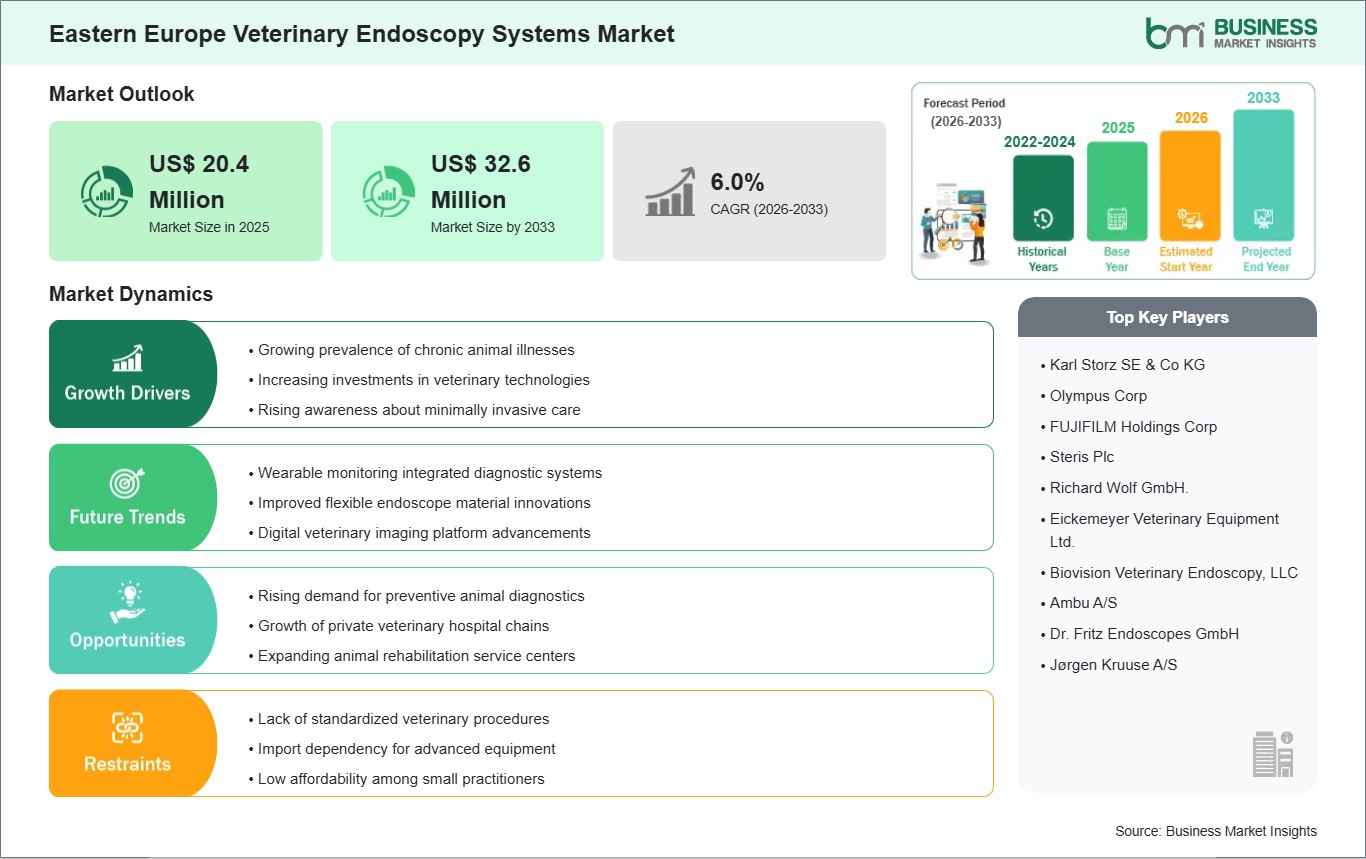
The Eastern Europe veterinary endoscopy systems market size is expected to reach US$ 32.6 million by 2033 from US$ 20.4 million in 2025. The market is estimated to record a CAGR of 6.0% from 2026 to 2033.
The Eastern Europe veterinary endoscopy systems market is undergoing a gradual transformation driven by rising modernization of veterinary infrastructure, increasing alignment with European Union animal health standards, and growing awareness of minimally invasive diagnostic and surgical techniques. This region is marked by a shift from traditional veterinary methods to technologically assisted clinical methods that increase diagnosis precision, improve efficiency, and reduce the time needed for animals to recover. The growth in this market is significantly driven by the growth in companion animal care, whereby owners in cities are willing to spend more money on veterinary services. At the same time, the livestock sub-sector remains a key driver of demand, especially in agricultural nations where diseases must be detected to maximize production and satisfy international standards. The adoption rate for technology is increasing, with veterinary hospitals and clinics now employing more flexible endoscopy devices, higher image resolution equipment, and digital connectivity for diagnostic testing. In addition, the move towards precise veterinary medicine is further facilitated by the increased availability of veterinarians and education opportunities within the industry. Nonetheless, adoption rates remain unequal in the region because of differences in healthcare facilities, limited budgets for the national veterinary service, and differences in regulatory harmonization. The competitive environment is changing with veterinary equipment companies from other countries gaining traction in the market through regional distributors and veterinary associations. Efforts are made with regard to affordable prices, durability, and user-friendliness for targeting the requirements of mid-range clinics that are quite prevalent in the market segment. Furthermore, training programs and workshops have played an important part in raising adoption rates as well as installing endoscopic equipment within the market segment. The future for the Eastern Europe veterinary endoscopy systems market lies in stable growth owing to the changes in the delivery mechanism of veterinary healthcare, along with investments made in animal welfare.

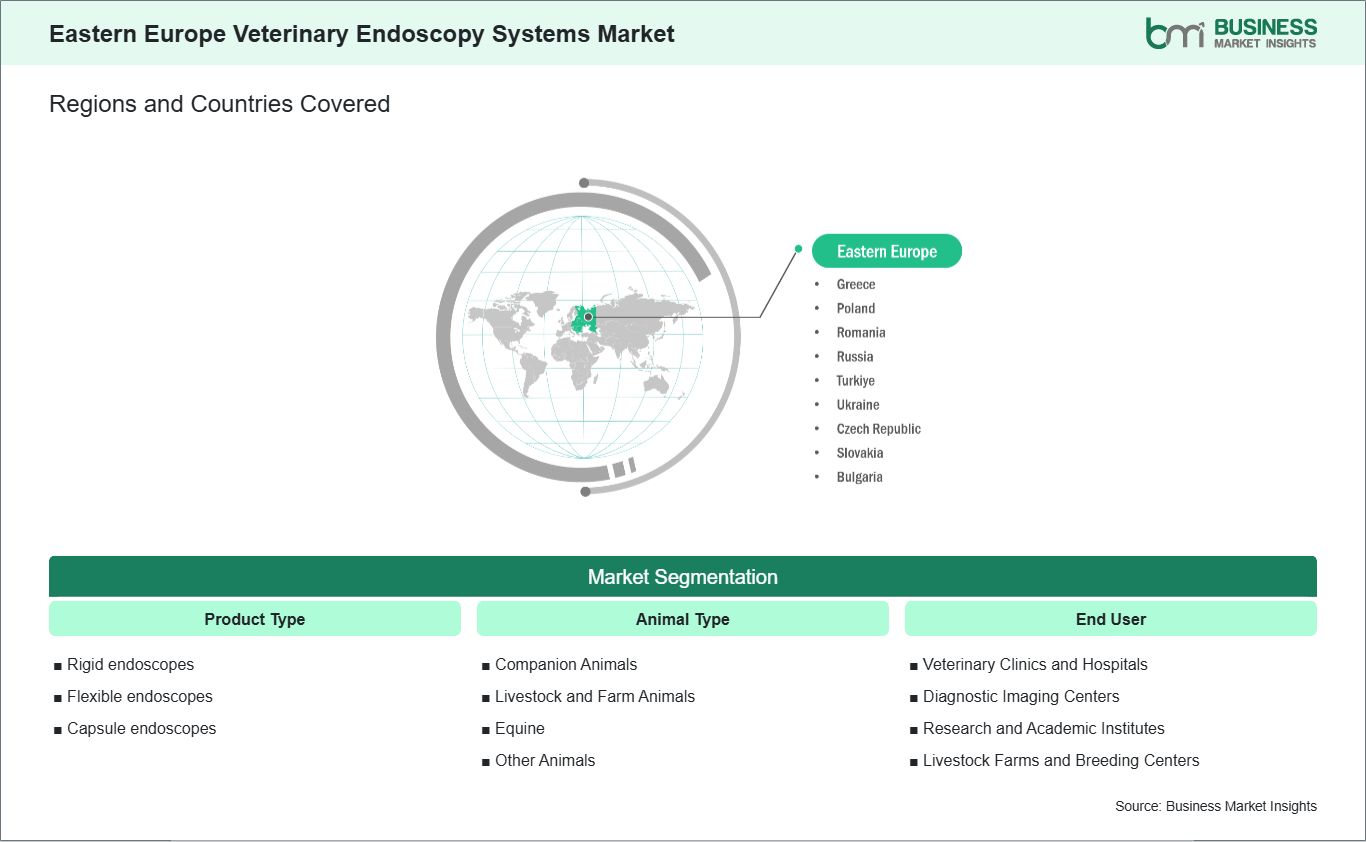
Key segments that contributed to the derivation of the Eastern Europe veterinary endoscopy systems market analysis are product type, animal type, and end user.
The Eastern Europe veterinary endoscopy systems market is experiencing gradual growth driven by the increasing establishment of specialty veterinary clinics across countries such as Poland, Romania, Hungary, Bulgaria, and the Czech Republic. This growth is enabled by the rising demand for specialized health-care services for companion animals, especially within urban areas where the number of pets is increasing and their owners are demanding high quality diagnosis services. Specialized clinics have become interested in minimally invasive techniques, with endoscopy playing an important role in the diagnosis of conditions affecting the GI tract, lungs, and soft tissues.
Poland and the Czech Republic can be considered countries with a relatively highly developed veterinary healthcare system in Eastern Europe, where the number of referral clinics with advanced diagnostic and surgical capacities is on the rise. There is an increase in spending on the acquisition of endoscopic systems by these clinics, which will allow them to set themselves apart from other clinics in terms of services and to target more profitable patients. The veterinary market in Hungary and Romania is also developing, where private clinics now offer not only standard but also diagnostic procedures.
In the wider Eastern European area, the development of specialty veterinary clinics will also be impacted by the cooperation between European veterinary networks and training institutions. Western European standards of clinical practice are motivating local veterinarians to use more modern technology such as flexible and rigid endoscopy devices. With better facility development and access to training programs, the use of endoscopy machines will become increasingly important in the future.
The Eastern Europe veterinary endoscopy systems market is also expanding through gradual penetration into rural veterinary service networks, although adoption levels remain lower compared to urban centers. Rural regions in countries like Romania, Bulgaria, and parts of Poland and Slovakia tend to be concerned with the well-being of animals and basic veterinary practices. Nevertheless, growing understanding about animal well-being, along with improving infrastructure in rural areas, is gradually leading to possibilities for using sophisticated equipment such as portable endoscopes.
The development of improved diagnostic capacities in mobile and regional veterinary clinics is taking place in Poland and Hungary. This is mostly due to initiatives by the government as well as the private sector. It is important to mention endoscope systems which are used in the field diagnostics for various animals. In particular, portable endoscope systems have been introduced in order to enhance the early diagnosis of any illness affecting the interior parts of the body of animals.
Penetration in rural veterinary networks is yet developing, although promising due to the development of veterinary education and training. The desire to increase livestock production and minimize losses from diseases is pushing toward the development of more efficient diagnostic tools, including less invasive ones. Although cost and lack of infrastructure still present some problems, the rising number of portable endoscopy devices is contributing to the bridging of gaps between urban and rural areas in Eastern Europe.

The Eastern Europe veterinary endoscopy systems market demonstrates steady growth, with size and share analysis highlighting evolving trends and competitive dynamics among key players. The report examines subsegments categorized within product type, animal type, and end user, offering insights into their contribution to overall market performance.
By product type, the rigid endoscopes segment dominated the market in 2025, driven by growing adoption of minimally invasive veterinary procedures requiring high-precision and durable instruments for effective diagnosis and treatment.
Based on animal type, the companion animals subsegment dominated the market in 2025, driven by increasing pet ownership, rising awareness of animal health, and higher spending on advanced veterinary care for dogs and cats.
In terms of end user, the veterinary clinics and hospitals subsegment dominated the market in 2025, driven by expanding veterinary infrastructure, rising procedural volumes, and greater adoption of modern endoscopy systems in clinical practice.
| Report Attribute | Details |
|---|---|
| Market size in 2025 | US$ 20.4 Million |
| Market Size by 2033 | US$ 32.6 Million |
| CAGR (2026 - 2033) | 6.0% |
| Historical Data | 2022-2024 |
| Forecast period | 2026-2033 |
| Segments Covered | By Product Type
|
|
Regions and Countries Covered
| |
| Eastern Europe | Russia, Poland, Ukraine, Romania, the Czech Republic, Slovakia, Bulgaria, Greece |
| Market leaders and key company profiles |
|
The "Eastern Europe Veterinary Endoscopy Systems Market Size and Forecast (2022-2033)" report provides a detailed analysis of the market covering below areas:
The geographical scope of the Eastern Europe veterinary endoscopy systems market report is divided into Russia, Poland, Ukraine, Romania, the Czech Republic, Slovakia, Bulgaria, Greece. Russia held the largest share in 2025.
Country-level dynamics in the Eastern Europe veterinary endoscopy systems market reflect a mixed maturity landscape, where adoption of advanced veterinary diagnostic technologies varies significantly based on economic structure, veterinary infrastructure depth, and the scale of livestock and companion animal sectors. Among these, Russia emerges as the dominant market due to its extensive livestock population, large geographic coverage of veterinary services, and increasing investment in modernization of animal healthcare systems. Veterinary endoscopy adoption in Russia is being supported by expanding private veterinary networks in urban centers and growing emphasis on disease surveillance and productivity improvement in large-scale agricultural operations. Poland represents one of the more advanced veterinary markets in the region, supported by strong EU regulatory alignment, high pet ownership rates, and well-developed veterinary education infrastructure. Endoscopy systems are increasingly integrated into small animal clinics, particularly in urban areas, where demand for minimally invasive procedures is steadily rising. In Czech Republic, the veterinary sector is characterized by high clinical standards and strong professional specialization. Veterinary hospitals are increasingly adopting advanced imaging and endoscopic technologies, driven by a focus on precision diagnostics and strong emphasis on animal welfare practices aligned with broader European veterinary norms. Slovakia exhibits a moderately developed veterinary ecosystem, where adoption of endoscopy systems is gradually increasing, particularly in companion animal care. Veterinary modernization is supported by incremental improvements in clinical infrastructure and growing access to specialized veterinary training programs. Romania shows an emerging adoption pattern, with demand primarily driven by livestock health management and gradual growth in urban pet care services. Veterinary infrastructure is still developing, but increasing private sector participation is contributing to wider awareness of advanced diagnostic tools. Bulgaria reflects a developing market where veterinary endoscopy adoption remains limited but is gradually expanding through modernization of livestock practices and growing exposure to EU-aligned veterinary standards. Greece demonstrates a relatively balanced veterinary market, where companion animal care is a key driver of demand, particularly in urban regions. Adoption of endoscopic systems is steadily increasing in private veterinary clinics focused on advanced diagnostic and surgical care. Ukraine presents a structurally evolving market influenced by ongoing healthcare system reconstruction and agricultural sector importance. Despite infrastructural constraints, veterinary modernization efforts and international collaborations are gradually improving access to advanced diagnostic technologies, including endoscopy systems. Europe reflects a tiered adoption structure led by Russia, while other countries progress through varying stages of veterinary modernization and technology integration.

The Eastern Europe veterinary endoscopy systems market is evaluated by gathering qualitative and quantitative data post primary and secondary research, which includes important corporate publications, association data, and databases. A few of the key developments in the Eastern Europe veterinary endoscopy systems market are:
The Eastern Europe Veterinary Endoscopy Systems Market is valued at US$ 20.4 Million in 2025, it is projected to reach US$ 32.6 Million by 2033.
As per our report Eastern Europe Veterinary Endoscopy Systems Market, the market size is valued at US$ 20.4 Million in 2025, projecting it to reach US$ 32.6 Million by 2033. This translates to a CAGR of approximately 6.0% during the forecast period.
The Eastern Europe Veterinary Endoscopy Systems Market report typically cover these key segments-
The historic period, base year, and forecast period can vary slightly depending on the specific market research report. However, for the Eastern Europe Veterinary Endoscopy Systems Market report:
The Eastern Europe Veterinary Endoscopy Systems Market is populated by several key players, each contributing to its growth and innovation. Some of the major players include:
The Eastern Europe Veterinary Endoscopy Systems Market report is valuable for diverse stakeholders, including:
Essentially, anyone involved in or considering involvement in the Eastern Europe Veterinary Endoscopy Systems Market value chain can benefit from the information contained in a comprehensive market report.
Please tell us your area of interest
(Market Segments/ Regions and Countries/ Companies)