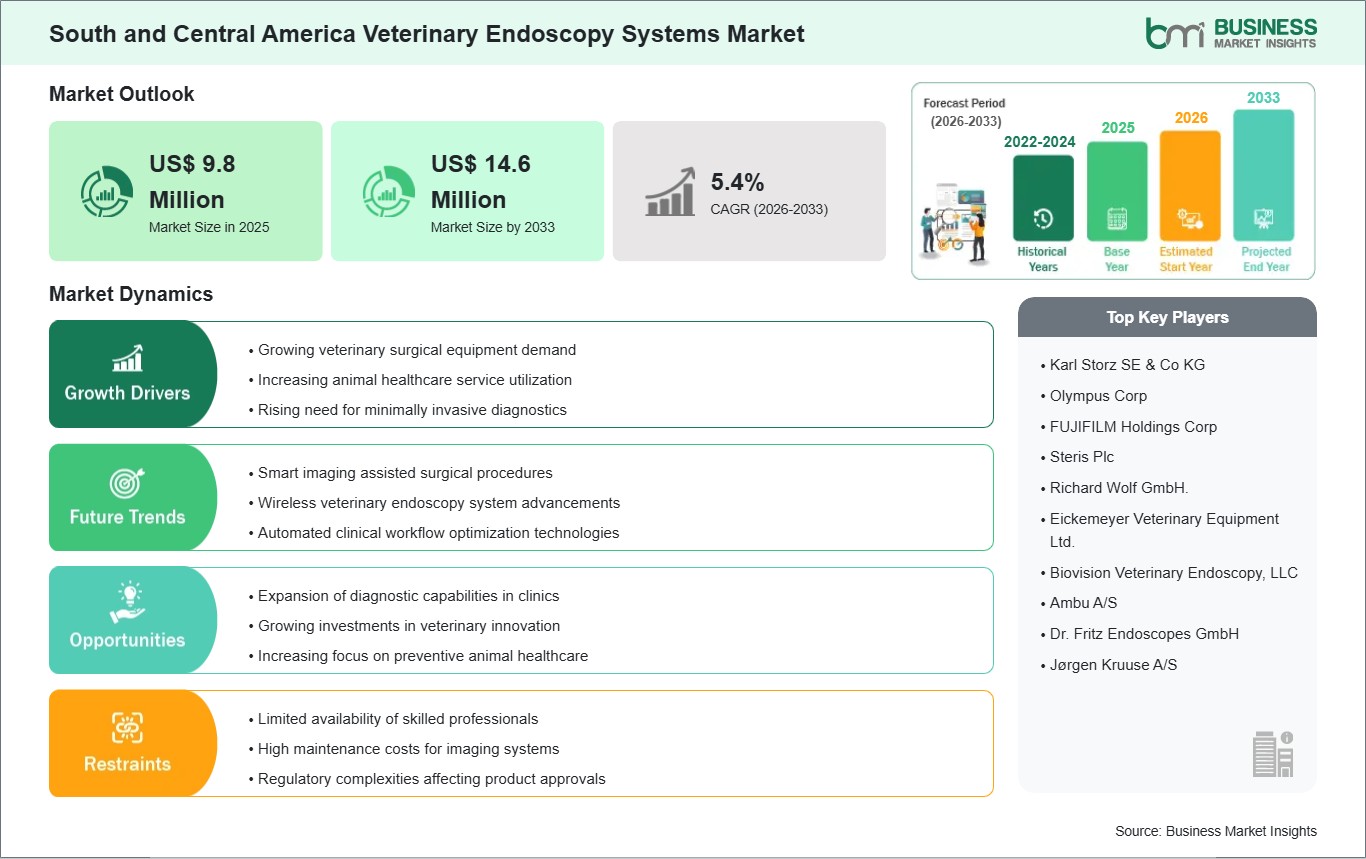
The South and Central America veterinary endoscopy systems market size is expected to reach US$ 14.6 million by 2033 from US$ 9.8 million in 2025. The market is estimated to record a CAGR of 5.4% from 2026 to 2033.
The South and Central America veterinary endoscopy systems market is an evolving and structurally diverse landscape, shaped by a combination of expanding livestock industries, rising companion animal healthcare awareness, and gradual modernization of veterinary infrastructure. The area is moving from conventional diagnostic practices to highly sophisticated and minimally invasive veterinary practices, with the emergence of endoscopy systems becoming pertinent in both laboratory and mobile settings. One of the drivers of demand is the heavy reliance on livestock farming for economic growth within the area. Diagnostic practices in veterinary science are increasingly being applied in the management of livestock herds to enhance their productivity and prevent any cases of infectious diseases and other issues that may affect their exportation into the international markets in the cattle, poultry, and pig industries. The rise in urbanization levels is also aiding in driving the demand for pet animal health services in metropolitan areas. Cost sensitivity is a prominent aspect, making it more likely that mid-level and portable equipment will be used, which is versatile and durable. Many veterinary centers prefer equipment that will work for different purposes because of cost considerations and variations in the degree of specialization. Differences in infrastructural development and the availability of veterinary training programs are still key in determining the uptake. High-level technology is mainly found in urban veterinary centers, universities, and large-scale farms, while other places still heavily depend on basic diagnostic techniques. Private veterinarians and training have been improving the disparities, while government animal health programs and agriculture exportation have also made improvements in the market. These efforts are improving disease surveillance capabilities and encouraging the adoption of modern diagnostic tools across selected segments. The South and Central America veterinary endoscopy systems market is positioned for steady long-term growth, driven by agricultural modernization, expanding pet healthcare demand, and gradual improvements in veterinary service delivery infrastructure.

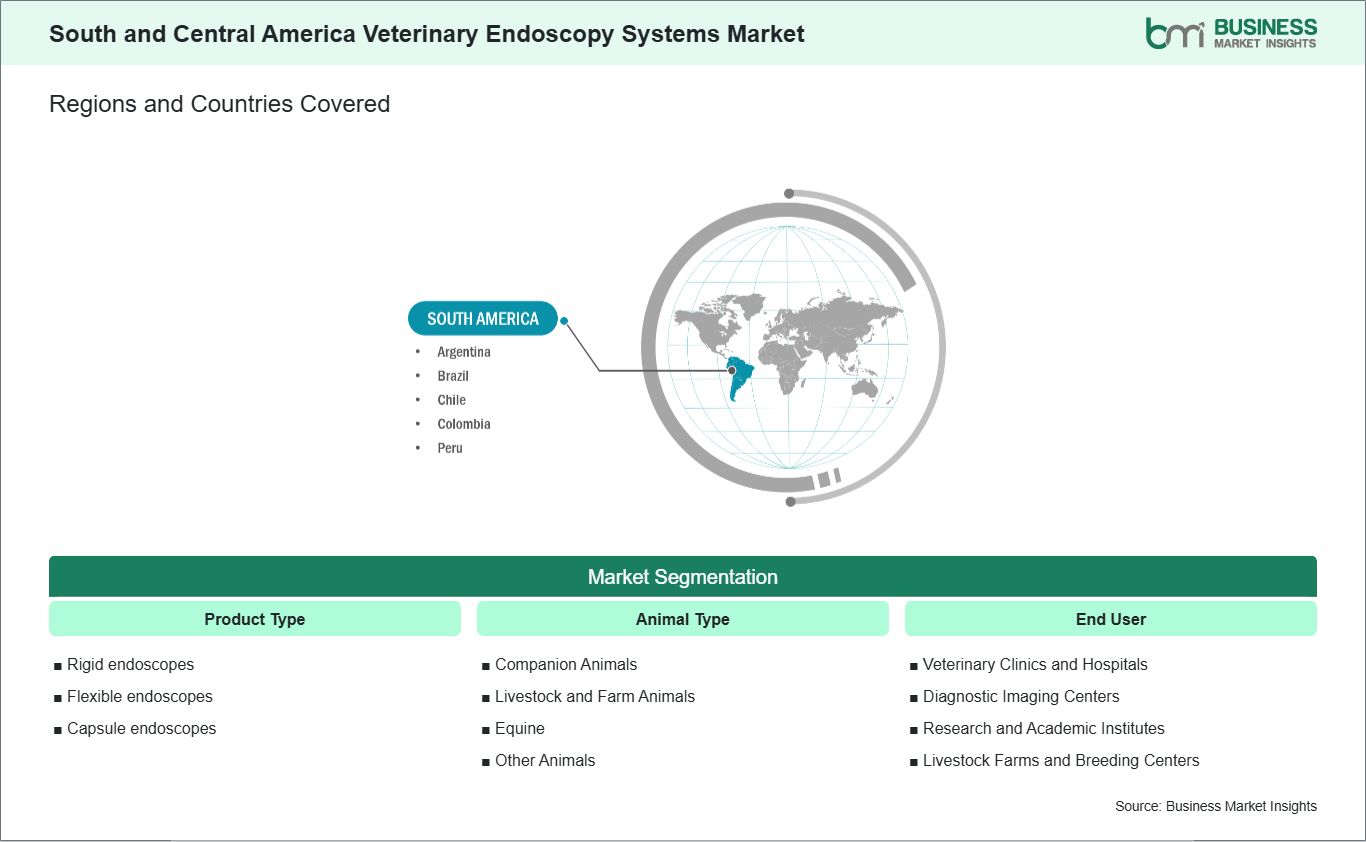
Key segments that contributed to the derivation of the South and Central America veterinary endoscopy systems market analysis are product type, animal type, and end user.
The South and Central America veterinary endoscopy systems market is increasingly influenced by urban lifestyle changes that are driving higher spending on pet healthcare across major cities such as São Paulo, Rio de Janeiro, Mexico City, Buenos Aires, Bogotá, and Santiago. The fast pace of urbanization and the increase in the number of middle-class people is responsible for creating a trend where pets have started being viewed in a different light and considered as an essential part of the family. This phenomenon has led to increased funding for high-tech veterinary care involving techniques such as endoscopy.
In Brazil and Mexico, which are the most developed veterinary markets in the region, there is a trend toward rising levels of urban pet ownership and the establishment of veterinary clinics in an organized way. There are cities in Brazil, such as São Paulo, and Mexico, like Mexico City, where there is an increasing presence of specialized veterinary hospitals with advanced imaging and endoscopy equipment. In these urban settings, pet owners are increasingly inclined towards high-end medical solutions, especially those related to digestive and respiratory problems, requiring an inspection from within.
In addition to larger markets, even smaller but fast-growing ones like Colombia, Chile, and Peru have seen improvements in the availability of better veterinary facilities due to the influence of urbanization. Modern diagnostic equipment is being utilized at more veterinary clinics operating in the capitals as people become increasingly concerned about their pets’ health. Retail pet care centers and online veterinary portals have also made significant contributions to this change in the market by providing greater access to information and consultations. With changing urban lifestyles, the need for modern veterinary diagnostics, such as endoscopy equipment, will only grow stronger.
The South and Central America veterinary endoscopy systems market is also benefiting from growing partnerships between veterinary service providers and animal research organizations. The partnerships aim at enhancing diagnostic skills, gaining more information in clinical settings and developing effective ways of treatment in companion and livestock animals. The research institutes as well as universities involved in veterinary medicine, have been contributing immensely towards promoting diagnostic techniques such as endoscopy.
In Brazil and Argentina, veterinary research institutions conduct various investigations on animal health and diseases, as well as diagnostic procedures. There are strong agricultural and veterinary research networks in these two nations, allowing the interaction between academic institutions and veterinary hospitals. The collaboration between academic institutions and veterinary hospitals is assisting in increasing the application of endoscopy, both for treatment purposes and research activities, especially in evaluating gastrointestinal diseases and reproduction in animals.
In Central America and some smaller areas in South America, collaboration with foreign research facilities and regional veterinary associations is facilitating better access to state-of-the-art diagnostic equipment. Training and research projects are incorporating new endoscopy methods for local veterinarians, thereby improving the clinical skills of practitioners and increasing their use. These activities are especially significant in regions where the veterinary sector is still evolving, as they are essential in closing the knowledge gap.

The South and Central America veterinary endoscopy systems market demonstrates steady growth, with size and share analysis highlighting evolving trends and competitive dynamics among key players. The report examines subsegments categorized within product type, animal type, and end user, offering insights into their contribution to overall market performance.
By product type, the rigid endoscopes segment dominated the market in 2025, driven by the rising adoption of minimally invasive surgical procedures such as laparoscopy, arthroscopy, and cystoscopy that require high precision and durability in veterinary practice.
Based on animal type, the companion animals subsegment dominated the market in 2025, driven by increasing pet ownership, higher spending on pet healthcare, and strong demand for advanced diagnostic procedures for dogs and cats.
In terms of end user, the veterinary clinics and hospitals subsegment dominated the market in 2025, driven by growing procedural volumes and wider adoption of endoscopic systems for routine diagnostics and minimally invasive treatments in clinical settings.
| Report Attribute | Details |
|---|---|
| Market size in 2025 | US$ 9.8 Million |
| Market Size by 2033 | US$ 14.6 Million |
| CAGR (2026 - 2033) | 5.4% |
| Historical Data | 2022-2024 |
| Forecast period | 2026-2033 |
| Segments Covered | By Product Type
|
|
Regions and Countries Covered
| |
| South and Central America | Brazil, Argentina, Peru, Chile, Colombia |
| Market leaders and key company profiles |
|
The "South and Central America Veterinary Endoscopy Systems Market Size and Forecast (2022-2033)" report provides a detailed analysis of the market covering below areas:
The geographical scope of the South and Central America veterinary endoscopy systems market report is divided into Brazil, Argentina, Peru, Chile, and Colombia. Brazil held the largest share in 2025.
Country-level dynamics in the South and Central America veterinary endoscopy systems market reflect a multi-tiered structure defined by differences in livestock scale, veterinary infrastructure maturity, and urban pet healthcare development. Brazil stands as the dominant market, supported by its extensive cattle, poultry, and swine industries. Veterinary endoscopy systems are increasingly used in large-scale agricultural operations and veterinary research institutions to enhance disease control, reproductive efficiency, and export compliance. Argentina is heavily influenced by its beef export industry, where veterinary diagnostics are essential for maintaining international quality standards. Endoscopy adoption is concentrated in livestock production systems and specialized veterinary service providers focused on reproductive and gastrointestinal diagnostics. Chile demonstrates a relatively more structured veterinary environment, with higher integration of advanced diagnostic technologies compared to many regional peers. Adoption is driven by both companion animal care in urban centers and selective use in livestock health management systems. Colombia represents an emerging veterinary market where adoption is gradually increasing, particularly in private clinics and commercial farming operations focused on improving animal health outcomes and productivity efficiency. Peru reflects a developing veterinary landscape where livestock health remains central. Veterinary modernization efforts are slowly improving access to advanced diagnostic equipment, although adoption is still concentrated in institutional and urban settings. The region presents a layered adoption structure led by Brazil, while other countries progress through varying stages of veterinary modernization, with growth driven by agricultural demand expansion and increasing investment in companion animal healthcare services.

The South and Central America veterinary endoscopy systems market is evaluated by gathering qualitative and quantitative data post primary and secondary research, which includes important corporate publications, association data, and databases. A few of the key developments in the South and Central America veterinary endoscopy systems market are:
The South and Central America Veterinary Endoscopy Systems Market is valued at US$ 9.8 Million in 2025, it is projected to reach US$ 14.6 Million by 2033.
As per our report South and Central America Veterinary Endoscopy Systems Market, the market size is valued at US$ 9.8 Million in 2025, projecting it to reach US$ 14.6 Million by 2033. This translates to a CAGR of approximately 5.4% during the forecast period.
The South and Central America Veterinary Endoscopy Systems Market report typically cover these key segments-
The historic period, base year, and forecast period can vary slightly depending on the specific market research report. However, for the South and Central America Veterinary Endoscopy Systems Market report:
The South and Central America Veterinary Endoscopy Systems Market is populated by several key players, each contributing to its growth and innovation. Some of the major players include:
The South and Central America Veterinary Endoscopy Systems Market report is valuable for diverse stakeholders, including:
Essentially, anyone involved in or considering involvement in the South and Central America Veterinary Endoscopy Systems Market value chain can benefit from the information contained in a comprehensive market report.
Please tell us your area of interest
(Market Segments/ Regions and Countries/ Companies)