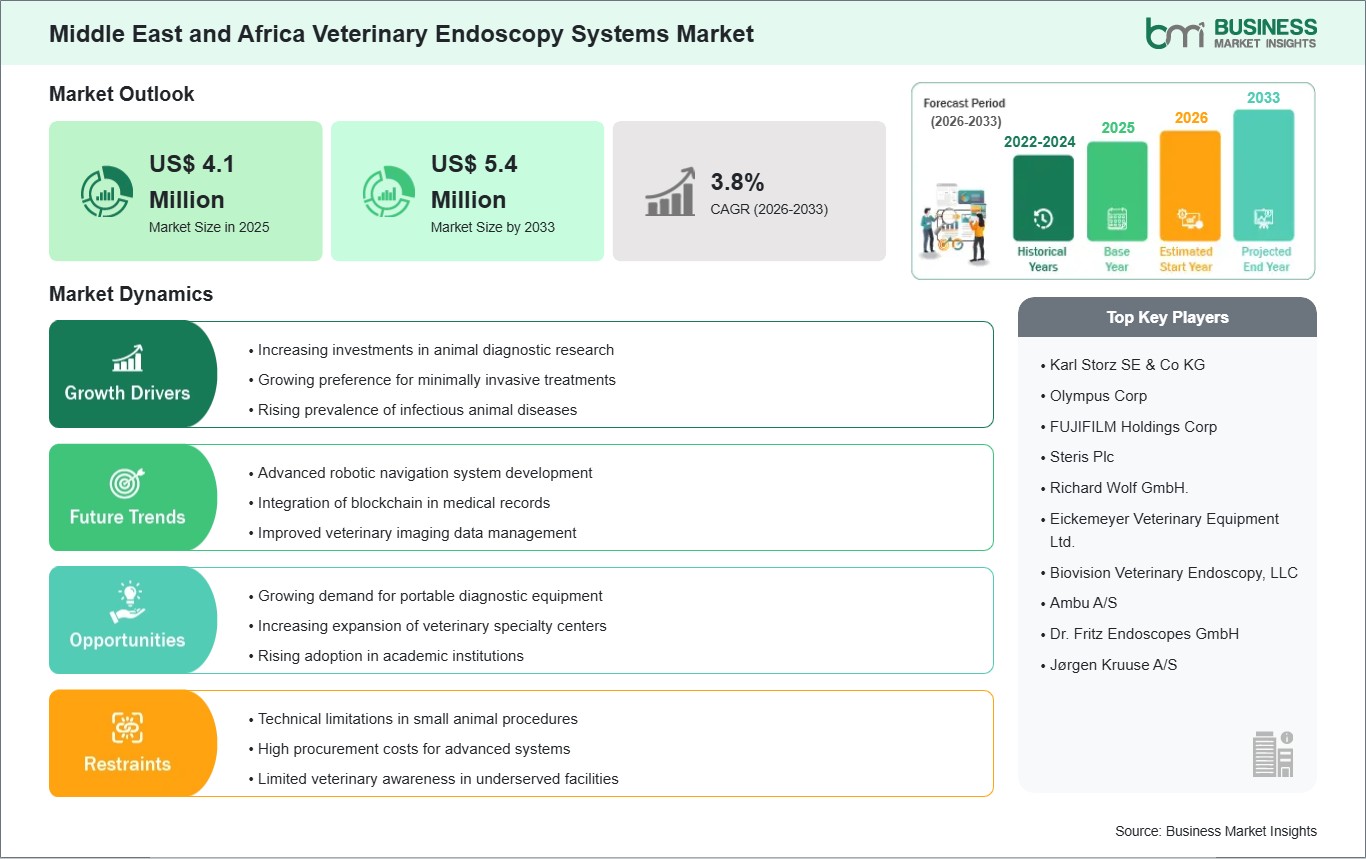
The Middle East and Africa veterinary endoscopy systems market size is expected to reach US$ 5.4 million by 2033 from US$ 4.1 million in 2025. The market is estimated to record a CAGR of 3.8% from 2026 to 2033.
The Middle East and Africa (MEA) veterinary endoscopy systems market is emerging as a structurally uneven but strategically important region, shaped by contrasting levels of veterinary infrastructure maturity, economic capacity, and animal healthcare priorities. There have been trends in favor of modernization driven by increased awareness regarding minimally invasive veterinary treatments, more investments made towards improving the health of animals, as well as higher demands for productivity improvement and improved companion animals' health and wellbeing. Among the major drivers behind the increase in demand in the Middle East is the fast-paced development of advanced veterinary health ecosystems in GCC states. High income levels and large-scale investments into the health infrastructure are fostering the implementation of state-of-the-art diagnostic tools, such as endoscopy systems used in specialized hospitals and clinics, particularly for companion animals. The level of development in the African market is defined primarily by livestock farming. Endoscopy technology in the diagnosis of animals has become increasingly important in disease management, animal productivity, and preventive treatment, especially in cattle, poultry, and small ruminant livestock farming. Nonetheless, the uptake of endoscopy technology has remained largely confined to urbanized areas as a result of infrastructure challenges and lack of access to sophisticated equipment in the rural areas. The market for veterinary equipment in this region relies heavily on equipment imported from other countries since there are no local producers. The pricing of the equipment has greatly influenced the type of equipment being adopted in the African markets compared to Middle Eastern markets. Despite disparities, the region is witnessing gradual improvement through government initiatives, international partnerships, and veterinary capacity-building programs. These efforts are enhancing diagnostic capabilities and expanding awareness of advanced veterinary procedures. The MEA veterinary endoscopy systems market is positioned for long-term, uneven but steady growth, driven by premiumization in the Middle East and structural veterinary modernization in Africa.

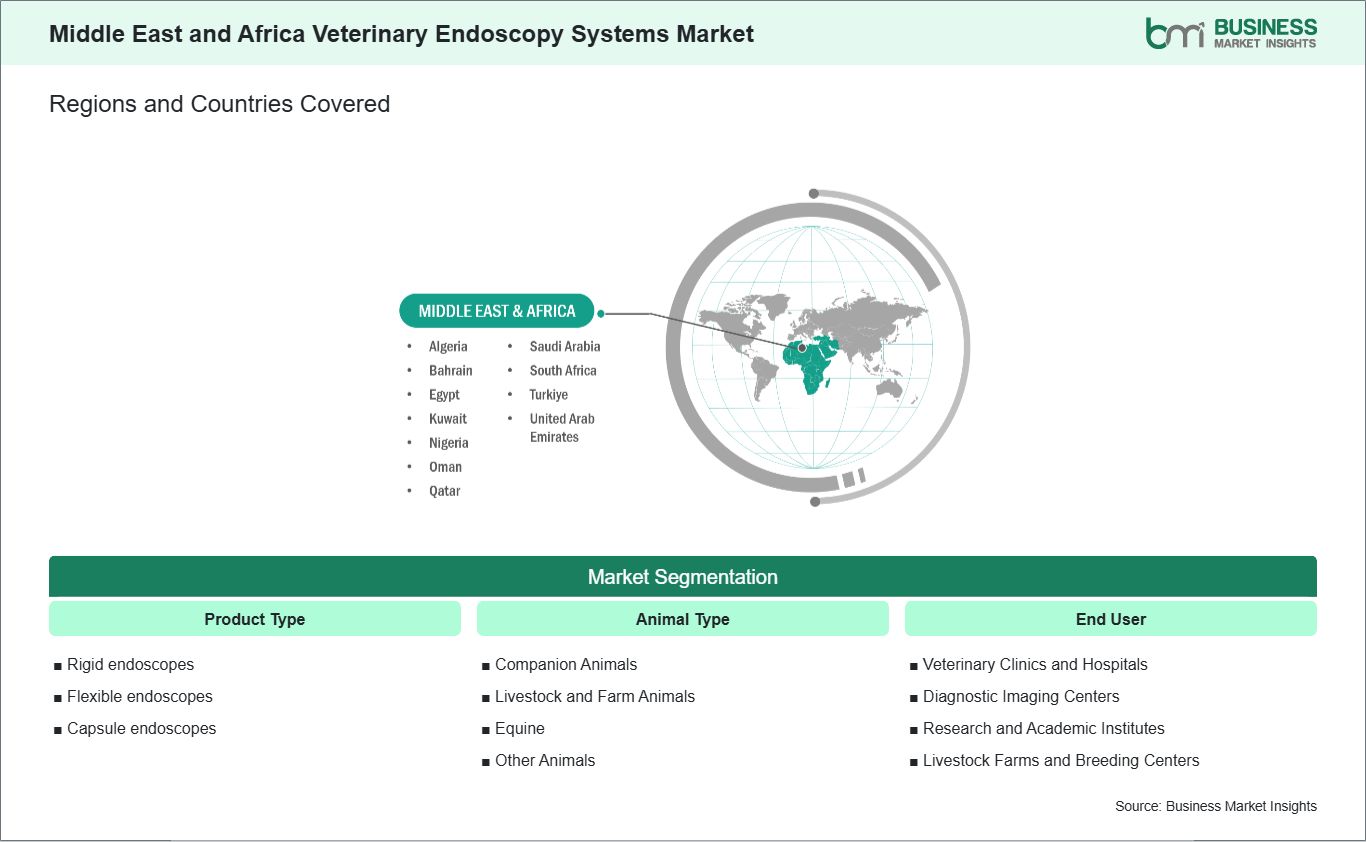
Key segments that contributed to the derivation of the Middle East and Africa veterinary endoscopy systems market analysis are product type, animal type, and end user.
The Middle East and Africa veterinary endoscopy systems market is being shaped by continuous innovation in endoscopic equipment, driven by gradual modernization of animal healthcare infrastructure across key countries such as the UAE, Saudi Arabia, South Africa, and Israel. The veterinary industry is making a move towards employing more sophisticated imaging tools that provide better imaging resolution, easier maneuverability, and better procedural efficiency. This development has special significance for a region where the development in veterinary service provision is from general to specialized.
In the Gulf Cooperation Council member states, which include the UAE, Saudi Arabia, Qatar, and Kuwait, there are veterinary clinics that have begun implementing the latest versions of endoscopy machines which allow for diagnostic and minimal surgical procedures. Endoscopy equipment is being developed with features such as improved digital imaging capabilities, increased lighting capability, and ergonomic designs to aid with usage. In South Africa, as well, there is an active involvement in technology development, with more advanced veterinary hospitals making use of endoscopic machines to treat their patients, whether they are domestic animals or wildlife.
In other parts of Africa, innovations are centered on flexibility and resilience due to the presence of different infrastructures and clinical facilities. The manufacturers have created strong endoscopic machines that can operate under difficult circumstances but still provide good diagnostic results. In some countries like Egypt, Kenya, and Nigeria, veterinary medicine is slowly adopting new imaging equipment as they become more knowledgeable about new diagnostic methods. With the innovations matching the local needs, it is anticipated that endoscopic machines will be made readily available for use in urban and semi-urban veterinary clinics.
The expansion of mobile veterinary service units is emerging as a key growth driver for the Middle East and Africa veterinary endoscopy systems market. There is a growing tendency towards the use of mobile animal veterinary units that can provide assistance to overcome difficulties in providing veterinary services in remote areas, especially rural, desert, or farmland zones. Mobile animal veterinarian services allow veterinarians to offer diagnoses and treatment facilities even away from their clinics.
Mobile veterinary units are increasingly being deployed in nations like Saudi Arabia and UAE for managing large herds of livestock, horses, and even animals in desert conditions. Such units contain portable diagnostic equipment like imaging devices and endoscopes, thus enabling veterinarians to conduct tests on the spot without transferring the animals to a hospital facility. In South Africa, mobile veterinary practices have gained prominence especially in wildlife parks and rural agricultural regions where access to specialized veterinary hospitals is scarce.
In Sub-Saharan Africa, mobile veterinary clinics have become vital in dealing with animal health issues and enhancing disease surveillance in rural communities. Nations like Kenya and Nigeria have been allocating resources towards developing mobile veterinary campaigns that incorporate the use of portable medical devices. Endoscopy units that are portable are increasingly becoming relevant in such cases, allowing for prompt diagnosis and treatment of animals. With continued development in mobile veterinary technology, it will be instrumental in promoting the use of endoscopic devices in the region.

The Middle East and Africa veterinary endoscopy systems market demonstrates steady growth, with size and share analysis highlighting evolving trends and competitive dynamics among key players. The report examines subsegments categorized within product type, animal type, and end user, offering insights into their contribution to overall market performance.
By product type, the rigid endoscopes segment dominated the market in 2025, driven by growing adoption of minimally invasive veterinary procedures and increasing demand for precise diagnostic and surgical instruments in animal healthcare.
Based on animal type, the companion animals subsegment dominated the market in 2025, driven by rising pet ownership, improving awareness of animal health, and increasing spending on advanced veterinary care for companion animals.
In terms of end user, the veterinary clinics and hospitals subsegment dominated the market in 2025, driven by expanding veterinary infrastructure, rising clinical caseloads, and gradual adoption of advanced endoscopy systems in animal healthcare facilities.
| Report Attribute | Details |
|---|---|
| Market size in 2025 | US$ 4.1 Million |
| Market Size by 2033 | US$ 5.4 Million |
| CAGR (2026 - 2033) | 3.8% |
| Historical Data | 2022-2024 |
| Forecast period | 2026-2033 |
| Segments Covered | By Product Type
|
|
Regions and Countries Covered
| |
| Middle East and Africa | Turkiye, the UAE, Saudi Arabia, Bahrain, Oman, Egypt, South Africa, Algeria, Nigeria, Kuwait, Qatar |
| Market leaders and key company profiles |
|
The "Middle East and Africa Veterinary Endoscopy Systems Market Size and Forecast (2022-2033)" report provides a detailed analysis of the market covering below areas:
The geographical scope of the Middle East and Africa veterinary endoscopy systems market report is divided into Turkiye, the UAE, Saudi Arabia, Bahrain, Oman, Egypt, South Africa, Algeria, Nigeria, Kuwait, Qatar. Turkiye held the largest share in 2025.
Country-level dynamics in the Middle East and Africa veterinary endoscopy systems market reflect a sharply segmented landscape, where adoption levels are closely tied to infrastructure development, clinical specialization, and economic capacity. Türkiye stands as the dominant market in the region, supported by its relatively advanced veterinary education system, strong livestock industry, and rapidly expanding companion animal healthcare sector. Veterinary endoscopy systems are increasingly integrated into both urban specialty clinics and university-affiliated veterinary hospitals, where there is growing emphasis on minimally invasive diagnostics and surgical precision. United Arab Emirates represents a highly premium-oriented veterinary market, where advanced diagnostic technologies are widely adopted in private specialty hospitals. The strong presence of high-income pet owners and internationally benchmarked veterinary services supports consistent demand for high-end endoscopy systems. Saudi Arabia is a strategically important market driven by large-scale investments in veterinary infrastructure and livestock health programs aligned with national food security objectives. Endoscopy adoption is expanding across both commercial farming operations and urban veterinary clinics. South Africa remains the most developed veterinary market in Sub-Saharan Africa, with relatively strong private veterinary networks and higher clinical specialization. Endoscopy systems are increasingly used in companion animal care, particularly in urban referral hospitals. Egypt plays a central role in North Africa, supported by a large livestock base and structured veterinary education framework. Adoption of endoscopy systems is gradually increasing in institutional and research environments focused on improving animal health outcomes. Nigeria represents a fast-emerging but infrastructure-constrained market, where veterinary modernization is concentrated in urban areas. Adoption of advanced diagnostic tools remains limited but is improving through private sector expansion and livestock productivity initiatives. Kenya reflects a developing veterinary ecosystem where livestock health management is a key priority. Veterinary endoscopy adoption is still in early stages but is gradually expanding through training programs and international support initiatives. MEA presents a dual-growth structure led by Türkiye, where veterinary modernization is more balanced across companion and livestock segments, while other countries advance through varying stages of infrastructure development and technology integration.

The Middle East and Africa veterinary endoscopy systems market is evaluated by gathering qualitative and quantitative data post primary and secondary research, which includes important corporate publications, association data, and databases. A few of the key developments in the Middle East and Africa veterinary endoscopy systems market are:
The Middle East and Africa Veterinary Endoscopy Systems Market is valued at US$ 4.1 Million in 2025, it is projected to reach US$ 5.4 Million by 2033.
As per our report Middle East and Africa Veterinary Endoscopy Systems Market, the market size is valued at US$ 4.1 Million in 2025, projecting it to reach US$ 5.4 Million by 2033. This translates to a CAGR of approximately 3.8% during the forecast period.
The Middle East and Africa Veterinary Endoscopy Systems Market report typically cover these key segments-
The historic period, base year, and forecast period can vary slightly depending on the specific market research report. However, for the Middle East and Africa Veterinary Endoscopy Systems Market report:
The Middle East and Africa Veterinary Endoscopy Systems Market is populated by several key players, each contributing to its growth and innovation. Some of the major players include:
The Middle East and Africa Veterinary Endoscopy Systems Market report is valuable for diverse stakeholders, including:
Essentially, anyone involved in or considering involvement in the Middle East and Africa Veterinary Endoscopy Systems Market value chain can benefit from the information contained in a comprehensive market report.
Please tell us your area of interest
(Market Segments/ Regions and Countries/ Companies)