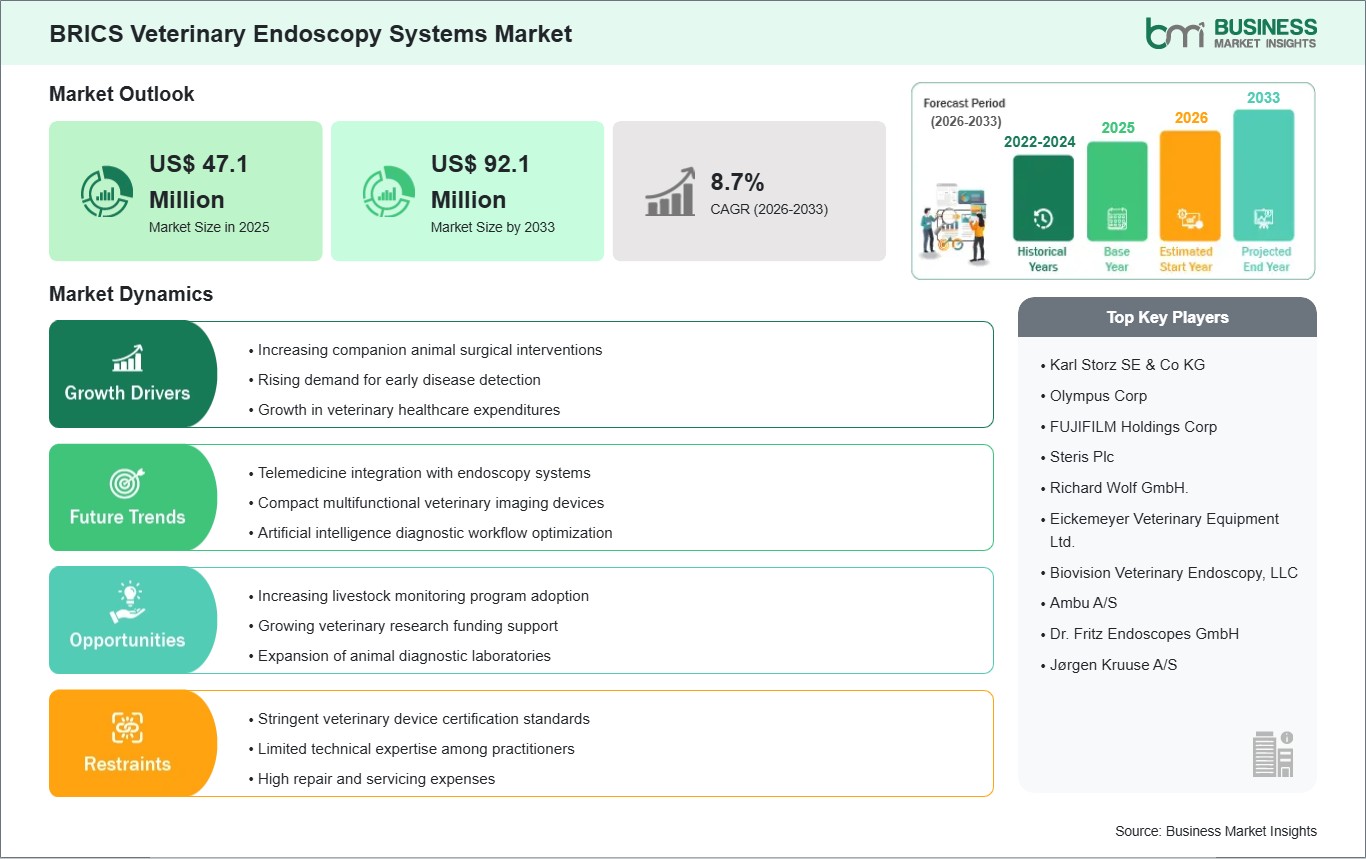
The BRICS veterinary endoscopy systems market size is expected to reach US$ 92.1 million by 2033 from US$ 47.1 million in 2025. The market is estimated to record a CAGR of 8.7% from 2026 to 2033.
The BRICS veterinary endoscopy systems market represents a high-potential and structurally diverse landscape shaped by rapid agricultural expansion, rising companion animal healthcare awareness, and increasing investments in veterinary modernization across member economies. The BRICS group, which consists of Brazil, Russia, India, China, and South Africa, demonstrates different levels of adoption maturity, from extremely advanced clinical ecosystem technologies to quickly emerging veterinary service delivery systems. The diversity brings both advantages and challenges to the marketing approach. One important factor driving the market is increasing relevance of livestock production and food security concerns, especially in agricultural economies belonging to the bloc. Veterinary endoscopy systems are becoming more commonly used to enhance diagnostic accuracy of herd management, reproduction, and GI examinations of livestock. In addition, changes in lifestyle due to urbanization trends have increased pet ownership rates, particularly in big cities, resulting in greater demand for advanced veterinary services that promote minimal invasiveness. Adoption of technology in the BRICS nations has been rather inconsistent but is gradually picking pace, thanks to efforts by leading global veterinary equipment producers to penetrate the market through strategic partnerships and distribution channels. The aspect of cost-sensitive innovations has received considerable attention in a bid for manufacturers to integrate highly sophisticated imaging technologies while remaining affordable. Multi-functionality, portability, and modularity have gained momentum because of their flexibility within the varying conditions at which veterinarians conduct their practices. However, despite the enormous prospects that the sector presents, there exist certain structural issues that affect its development. However, efforts by governments to improve animal health care systems and increase educational capacity in the field of veterinary medicine are beginning to close these gaps. BRICS countries have become identified as a frontier market for the veterinary endoscopy system market due to demographic strength, increased knowledge of veterinary medicine, and modernization of animal health care systems.

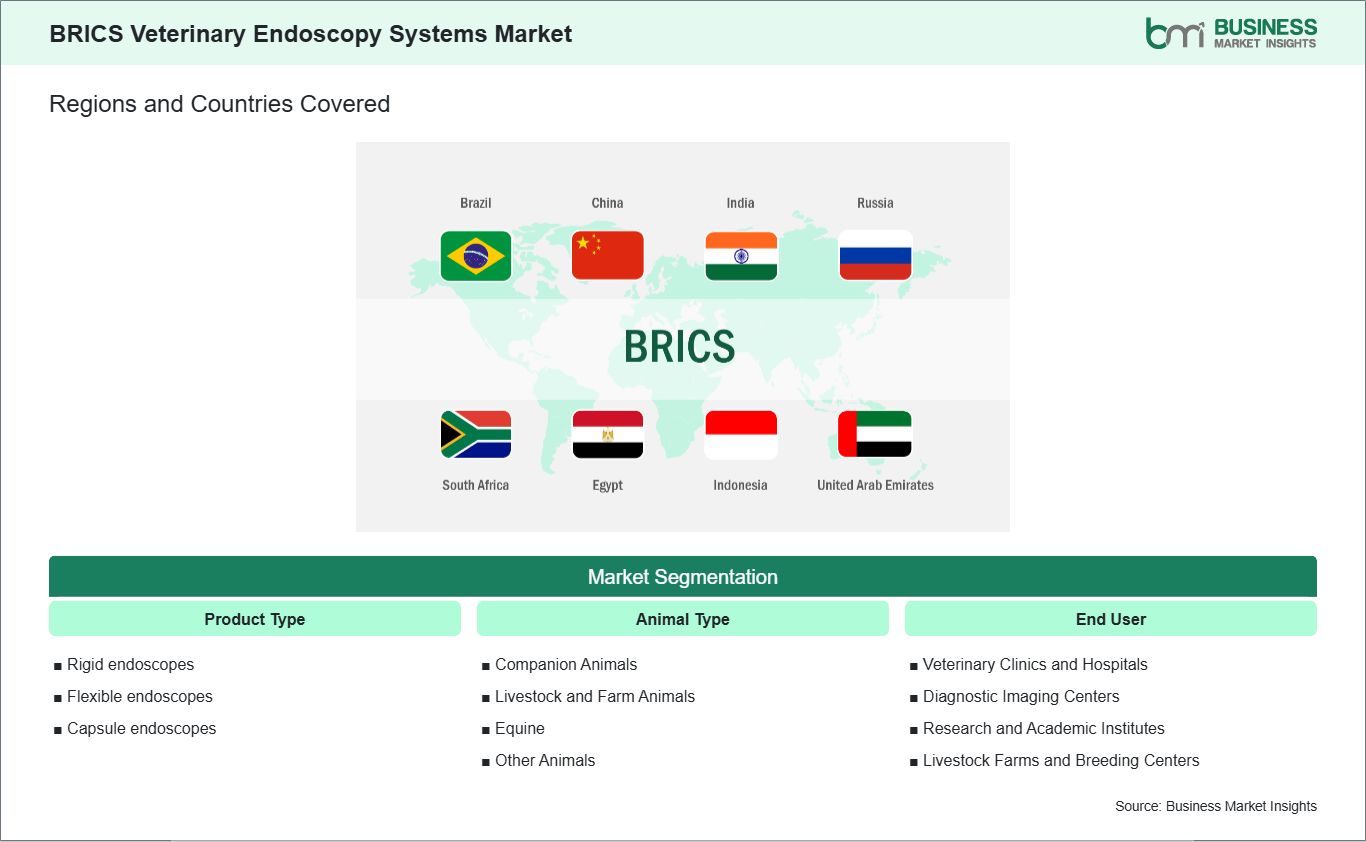
Key segments that contributed to the derivation of the BRICS veterinary endoscopy systems market analysis are product type, animal type, and end user.
The BRICS veterinary endoscopy systems market is being significantly influenced by the rising prevalence of chronic and long-term animal diseases across Brazil, Russia, India, China, and South Africa. The problems associated with the digestive tract, respiratory tract, and genitourinary tract are now being recognized among companion and livestock animals, leading to a continuous need for sophisticated diagnostic instruments. Veterinary endoscopy is emerging as an ideal option for examining the inside of the body since it enables direct visualization without resorting to any surgical procedure. This trend is consistent with the overall development of veterinary medical facilities within BRICS countries.
In both China and India, fast-paced urbanization and increasing numbers of pets have led to an increase in chronic disorders of the respiratory and digestive tracts among companion animals. On the other hand, meat-based economies like Brazil and Russia are experiencing ongoing problems with infectious and inflammatory diseases affecting their cattle and poultry populations. Endoscopic devices have found more widespread use in veterinary practices and animal hospitals in these regions as a way of facilitating early detection and lowering costs of prolonged treatment.
In South Africa and Brazil, Veterinary institutions are reporting an upsurge in the need for sophisticated diagnostic methods owing to growing awareness about animal wellness on the part of pet owners and livestock farmers. The occurrence of diseases such as inflammatory bowel disease and respiratory problems is becoming common with greater availability of veterinary care. Consequently, veterinary institutions are equipping themselves with the latest diagnostic tools where endoscope systems feature prominently in tackling chronic animal diseases in the BRICS countries.
The BRICS veterinary endoscopy systems market is also expanding due to the growing need for customized diagnostic solutions for exotic and non-traditional animal species. Exotic animals like reptiles, birds, zoo animals, and other wild species require specific equipment owing to the unusual anatomy possessed by these animals. Endoscopy instruments designed for veterinary application purposes are becoming increasingly versatile, featuring small-sized and highly precise parts that help diagnose conditions in exotic animals. This has been instrumental in diversifying the applications of endoscopy.
China and India have witnessed increased demand for veterinary diagnostics, owing to the growing establishment of zoos and wildlife preservation centers and increasing number of exotic pets being kept by individuals. There has been a significant rise in investment by veterinary organizations within the two nations towards the acquisition of high-quality endoscopes which will enable them to perform delicate surgical processes on birds, reptiles, and small animals. In Brazil, the country's vast biodiversity and efforts in wildlife conservation have resulted in an increase in demand for customized endoscopies among exotic animals.
In Russia and South Africa, Endoscopic devices have been gaining more usage among veterinarians operating in wildlife parks and conservation facilities when it comes to diagnosing and surgically treating exotic animals. The areas in question usually contain huge numbers of diverse animals, thus requiring the use of flexible and portable equipment that is usable both outdoors and indoors. As exotic animal services become more popular within the scope of veterinary services in BRICS nations, there will likely be a greater demand for customized endoscopy products.

The BRICS veterinary endoscopy systems market demonstrates steady growth, with size and share analysis highlighting evolving trends and competitive dynamics among key players. The report examines subsegments categorized within product type, animal type, and end user, offering insights into their contribution to overall market performance.
By product type, the rigid endoscopes segment dominated the market in 2025, driven by increasing adoption of minimally invasive veterinary surgeries and rising demand for precise diagnostic tools in large and small animal procedures across BRICS countries.
Based on animal type, the companion animals subsegment dominated the market in 2025, driven by growing pet ownership, rising disposable incomes, and increasing awareness of advanced veterinary care for dogs and cats in urban populations.
In terms of end user, the veterinary clinics and hospitals subsegment dominated the market in 2025, driven by expanding veterinary healthcare infrastructure, higher caseloads, and rapid adoption of advanced endoscopic technologies in both public and private animal healthcare facilities.
| Report Attribute | Details |
|---|---|
| Market size in 2025 | US$ 47.1 Million |
| Market Size by 2033 | US$ 92.1 Million |
| CAGR (2026 - 2033) | 8.7% |
| Historical Data | 2022-2024 |
| Forecast period | 2026-2033 |
| Segments Covered | By Product Type
|
|
Regions and Countries Covered
| |
| BRICS | Russia, Brazil, South Africa, India, the UAE, China |
| Market leaders and key company profiles |
|
The "BRICS Veterinary Endoscopy Systems Market Size and Forecast (2022-2033)" report provides a detailed analysis of the market covering below areas:
The geographical scope of the BRICS veterinary endoscopy systems market report is divided into Russia, Brazil, South Africa, India, the UAE, China. China held the largest share in 2025.
Country-level dynamics within the BRICS veterinary endoscopy systems market highlight significant variation in adoption maturity, infrastructure readiness, and veterinary care priorities across member economies. In China, the market is highly advanced relative to other BRICS members, supported by large-scale commercial livestock operations, strong government investment in animal disease control, and rapid modernization of veterinary diagnostic infrastructure. Veterinary endoscopy is increasingly integrated into both research institutions and high-volume livestock farms, particularly for disease surveillance and productivity optimization. India represents a rapidly expanding veterinary market driven by its vast livestock population and growing urban pet care segment. Adoption of endoscopy systems is gradually increasing in private veterinary hospitals and academic institutions, though rural penetration remains limited. Demand is largely influenced by cost considerations and increasing awareness of advanced diagnostic techniques among younger veterinary professionals. In Brazil, veterinary endoscopy adoption is strongly supported by its globally significant livestock industry, particularly cattle and poultry production. The country has a well-developed veterinary research ecosystem and a strong export-oriented agricultural sector, both of which encourage the use of advanced diagnostic tools to ensure animal health compliance and productivity efficiency. Russia demonstrates moderate but steadily evolving adoption, with veterinary endoscopy systems primarily used in specialized clinics and research facilities. The market is influenced by geographic dispersion and infrastructure variability, although increasing investment in veterinary modernization is gradually improving access to advanced diagnostic technologies. South Africa serves as the most developed veterinary market within the African segment of BRICS, with relatively strong companion animal care infrastructure and advanced private veterinary services. Endoscopy systems are increasingly used in urban veterinary hospitals, supported by higher clinical specialization and growing awareness of minimally invasive procedures. Collectively, BRICS countries reflect a highly stratified market structure where advanced economies lead in clinical adoption, while emerging markets offer substantial long-term growth potential driven by agricultural expansion and ongoing veterinary sector modernization.

The BRICS veterinary endoscopy systems market is evaluated by gathering qualitative and quantitative data post primary and secondary research, which includes important corporate publications, association data, and databases. A few of the key developments in the BRICS veterinary endoscopy systems market are:
The BRICS Veterinary Endoscopy Systems Market is valued at US$ 47.1 Million in 2025, it is projected to reach US$ 92.1 Million by 2033.
As per our report BRICS Veterinary Endoscopy Systems Market, the market size is valued at US$ 47.1 Million in 2025, projecting it to reach US$ 92.1 Million by 2033. This translates to a CAGR of approximately 8.7% during the forecast period.
The BRICS Veterinary Endoscopy Systems Market report typically cover these key segments-
The historic period, base year, and forecast period can vary slightly depending on the specific market research report. However, for the BRICS Veterinary Endoscopy Systems Market report:
The BRICS Veterinary Endoscopy Systems Market is populated by several key players, each contributing to its growth and innovation. Some of the major players include:
The BRICS Veterinary Endoscopy Systems Market report is valuable for diverse stakeholders, including:
Essentially, anyone involved in or considering involvement in the BRICS Veterinary Endoscopy Systems Market value chain can benefit from the information contained in a comprehensive market report.
Please tell us your area of interest
(Market Segments/ Regions and Countries/ Companies)