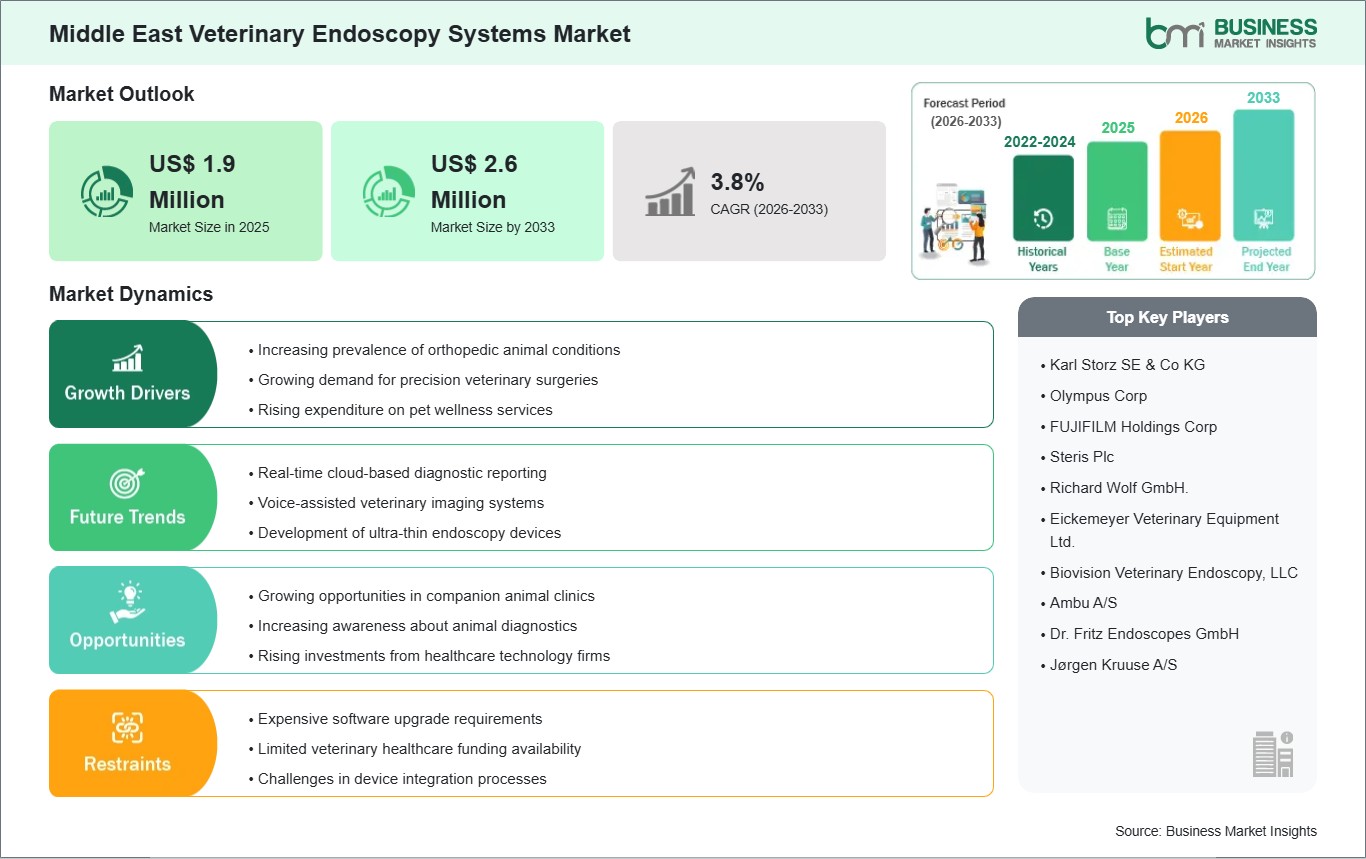
The Middle East veterinary endoscopy systems market size is expected to reach US$ 2.6 million by 2033 from US$ 1.9 million in 2025. The market is estimated to record a CAGR of 3.8% from 2026 to 2033.
The Middle East veterinary endoscopy systems market is shaped by a distinctive convergence of high-income healthcare consumption patterns, rapid veterinary service commercialization, and selective technological acceleration. Contrary to other emerging markets that have adopted based on volume, this market has seen competition based on differentiation, whereby veterinary clinics differentiate based on procedural expertise, facility name, and patient experience, not just price. This development has seen an increased need for sophisticated diagnostics such as endoscope systems, which have now found their way into clinical processes. The distinguishing characteristic of this market is its clustering of veterinary innovations into urban medical centers. These centers are seeing the rise of multispecialty veterinary centers that work in a similar way to human health care facilities. Such facilities have gastroenterology, orthopedic, and soft tissue surgery in one clinic. Another key characteristic is the significant role played by investment by the private sector in veterinary medicine. Most institutions are either founded or managed by investment firms or healthcare conglomerates, leading to uniform purchasing policies and frequent technology upgrades. This leads to quicker adoption of cutting-edge endoscopy systems that incorporate imaging, recording, and report-generation functions. Furthermore, the industry exhibits a distinctive reliance on foreign veterinary professionals, especially for sophisticated operations. This has led to more attention being paid to training collaborations with foreign educational bodies and equipment providers. Accordingly, purchases of equipment are made based on training packages and maintenance services along with equipment characteristics. The market demand segmentation for companion animals is trending towards preventive and elective procedures, while that for livestock is moving towards a systematic approach with government-backed veterinary surveillance schemes. Nevertheless, this is not a generalized trend, and small clinics are using diagnostic instruments that do not require high expertise and expense. The ME veterinary endoscopy systems market can be described as characterized by its high service orientation, concentration within institutions, and quick adoption in premium veterinary clinics.

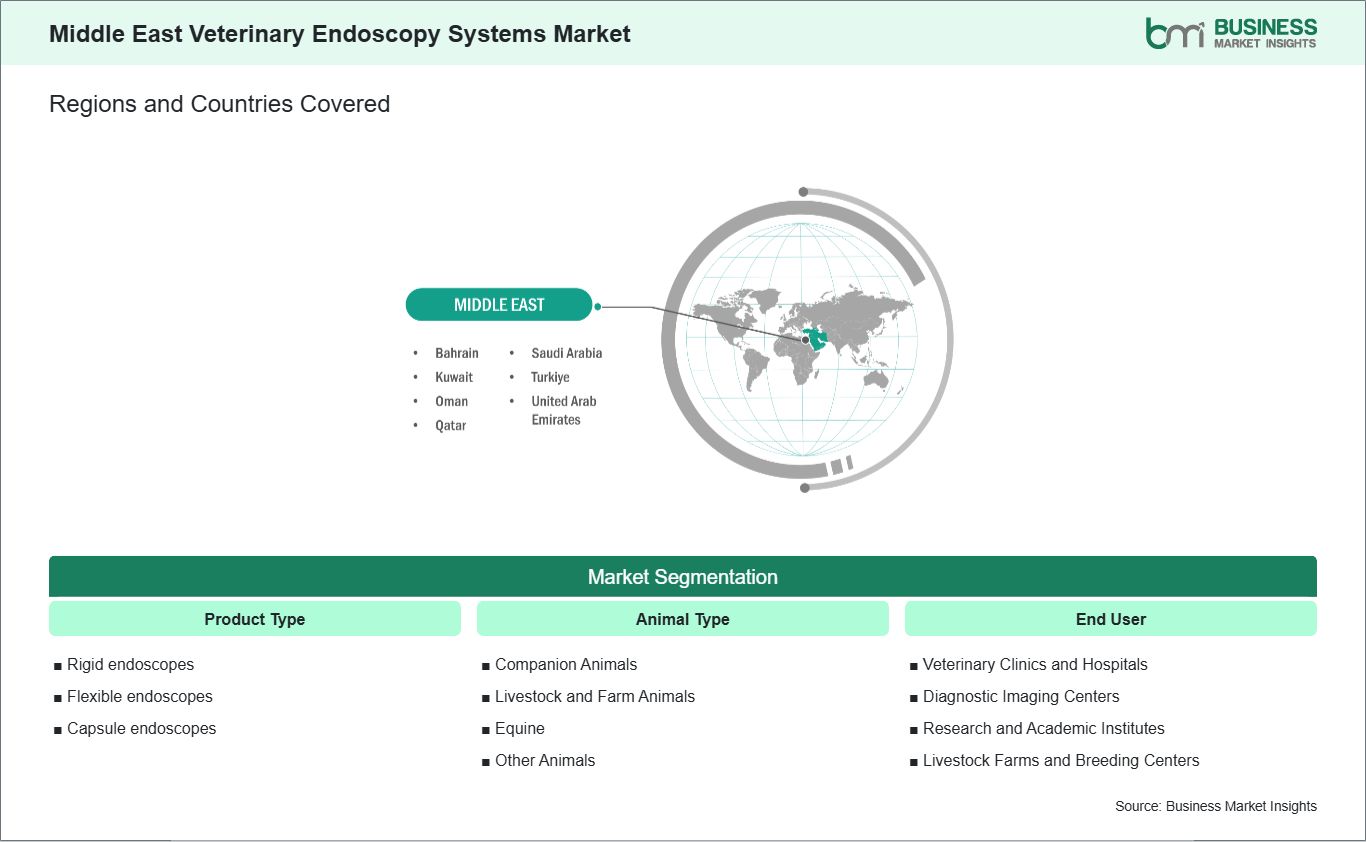
Key segments that contributed to the derivation of the Middle East veterinary endoscopy systems market analysis are product type, animal type, and end user.
The Middle East veterinary endoscopy systems market is strongly influenced by the rising need for structured livestock health monitoring across countries such as Saudi Arabia, the UAE, Oman, Qatar, and Egypt. Livestock continues to form an essential part of food security approaches in the region for species such as cattle, sheep, goats, poultry, and camels. The increasing trend of commercialization in animal production is creating a need for sophisticated technology that would assist in early disease detection and constant monitoring of herd health. The use of endoscopy systems has become more relevant because it offers internal viewing.
In Saudi Arabia and the UAE, livestock health monitoring is directly associated with their food security programs and agricultural modernization initiatives. In terms of veterinary care, there is increasing availability of sophisticated diagnostic equipment, such as imaging and endoscopy devices, that facilitate preventive healthcare. Another major sector is camel rearing, which has cultural significance in addition to being economically important, and where specialized veterinary practices help improve reproductive health, digestion problems, and overall animal efficiency. Improved veterinary diagnostics in this regard have resulted in increased demand for veterinary devices.
In North Africa and the smaller Gulf countries, veterinary endoscope system applications are growing due to veterinary services offered by government agencies and private investments made in animal production systems. The countries that are currently emphasizing disease surveillance and vaccination programs include Egypt and Oman, but these have started including advanced diagnostic assistance slowly. Since animal protein production is increasing due to the demand in the region, the importance of veterinary endoscope systems will increase.
The Middle East veterinary endoscopy systems market is also expanding due to increasing adoption in wildlife conservation and rehabilitation programs. Biodiversity conservation has become a major concern within the area, as various measures have been developed for conserving native species as well as controlling the population of wild animals in protected areas. The technique of veterinary endoscopy is employed for evaluating internal injuries, infections, as well as reproductive disorders among wild animals without resorting to any surgery.
At present, many wildlife conservation centers and zoological centers in Saudi Arabia and the UAE have begun incorporating the use of sophisticated veterinary technology in their clinical practices. Major wildlife conservation projects that involve oryx, gazelles, and birds depend heavily on advanced veterinary care services that employ modern diagnostic techniques. The use of endoscopic techniques has become common in many wildlife hospitals in the region for assessing the internal condition of animals for treatment purposes.
Across the wider Middle East and parts of North Africa, wildlife rehabilitation programs are expanding through collaboration between government agencies, environmental organizations, and veterinary institutions. Countries such as Qatar, Jordan, and Egypt are investing in wildlife protection zones and rescue centers where veterinary diagnostics play a critical role in treatment and recovery. The use of portable endoscopy systems is particularly important in these settings, as they allow veterinarians to perform examinations in field conditions. As conservation efforts continue to grow, the demand for specialized veterinary endoscopy systems in wildlife applications is expected to increase steadily across the region.

The Middle East veterinary endoscopy systems market demonstrates steady growth, with size and share analysis highlighting evolving trends and competitive dynamics among key players. The report examines subsegments categorized within product type, animal type, and end user, offering insights into their contribution to overall market performance.
By product type, the rigid endoscopes segment dominated the market in 2025, driven by increasing adoption of minimally invasive veterinary surgeries and rising demand for high-precision diagnostic tools in modern animal healthcare facilities.
Based on animal type, the companion animals subsegment dominated the market in 2025, driven by growing pet ownership, higher spending on premium veterinary services, and increasing awareness of advanced diagnostic and surgical care for pets.
In terms of end user, the veterinary clinics and hospitals subsegment dominated the market in 2025, driven by expanding veterinary healthcare infrastructure, rising procedural volumes, and growing integration of advanced endoscopy systems in clinical practice.
| Report Attribute | Details |
|---|---|
| Market size in 2025 | US$ 1.9 Million |
| Market Size by 2033 | US$ 2.6 Million |
| CAGR (2026 - 2033) | 3.8% |
| Historical Data | 2022-2024 |
| Forecast period | 2026-2033 |
| Segments Covered | By Product Type
|
|
Regions and Countries Covered
| |
| Middle East | UAE, Saudi Arabia, Bahrain, Oman, Kuwait, Qatar, and Turkiye |
| Market leaders and key company profiles |
|
The "Middle East Veterinary Endoscopy Systems Market Size and Forecast (2022-2033)" report provides a detailed analysis of the market covering below areas:
The geographical scope of the Middle East veterinary endoscopy systems market report is divided into UAE, Saudi Arabia, Bahrain, Oman, Kuwait, Qatar, and Turkiye. Turkiye held the largest share in 2025.
Country-level dynamics in the Middle East veterinary endoscopy systems market are defined by clear stratification in veterinary maturity, clinical specialization, and technology integration. Turkiye stands as the dominant market in the region due to its relatively large veterinary education ecosystem, strong domestic livestock base, and rapidly expanding companion animal healthcare sector. Veterinary endoscopy systems in Turkiye are increasingly used across both university hospitals and private specialty clinics, supported by growing clinical expertise and rising demand for advanced diagnostic procedures in urban centers. United Arab Emirates represents a highly advanced, premium-driven veterinary market where technology adoption is rapid and service quality expectations are high. Endoscopy systems are widely deployed in specialty animal hospitals, particularly in companion animal diagnostics and minimally invasive surgical applications, supported by strong investment in veterinary healthcare infrastructure. Saudi Arabia shows a large-scale but dual-structured veterinary market. Livestock health management programs are a major driver in rural and agricultural regions, while urban centers are witnessing strong growth in private veterinary clinics offering advanced diagnostic services, including endoscopy-based procedures. Qatar reflects a compact but technologically advanced veterinary environment, where adoption is concentrated in high-end companion animal clinics. The market is characterized by strong purchasing power and a preference for premium diagnostic systems integrated into specialized veterinary care models. Kuwait demonstrates gradual market expansion driven by rising pet ownership and incremental upgrades in private veterinary practices. Adoption of endoscopy systems is focused in urban clinics offering specialized diagnostic and surgical services. Oman represents a developing veterinary market where livestock health remains a central focus. Veterinary modernization efforts are gradually improving access to diagnostic technologies, though endoscopy adoption is still concentrated in institutional and urban facilities. Bahrain is a niche but high-quality veterinary market where advanced diagnostics are adopted selectively in a small number of specialized clinics focused on premium companion animal care. Turkiye leads the region due to its balanced veterinary ecosystem and broader clinical base, while other Middle Eastern countries progress through varying levels of specialization, infrastructure development, and technology adoption intensity.

The Middle East veterinary endoscopy systems market is evaluated by gathering qualitative and quantitative data post primary and secondary research, which includes important corporate publications, association data, and databases. A few of the key developments in the Middle East veterinary endoscopy systems market are:
The Middle East Veterinary Endoscopy Systems Market is valued at US$ 1.9 Million in 2025, it is projected to reach US$ 2.6 Million by 2033.
As per our report Middle East Veterinary Endoscopy Systems Market, the market size is valued at US$ 1.9 Million in 2025, projecting it to reach US$ 2.6 Million by 2033. This translates to a CAGR of approximately 3.8% during the forecast period.
The Middle East Veterinary Endoscopy Systems Market report typically cover these key segments-
The historic period, base year, and forecast period can vary slightly depending on the specific market research report. However, for the Middle East Veterinary Endoscopy Systems Market report:
The Middle East Veterinary Endoscopy Systems Market is populated by several key players, each contributing to its growth and innovation. Some of the major players include:
The Middle East Veterinary Endoscopy Systems Market report is valuable for diverse stakeholders, including:
Essentially, anyone involved in or considering involvement in the Middle East Veterinary Endoscopy Systems Market value chain can benefit from the information contained in a comprehensive market report.
Please tell us your area of interest
(Market Segments/ Regions and Countries/ Companies)