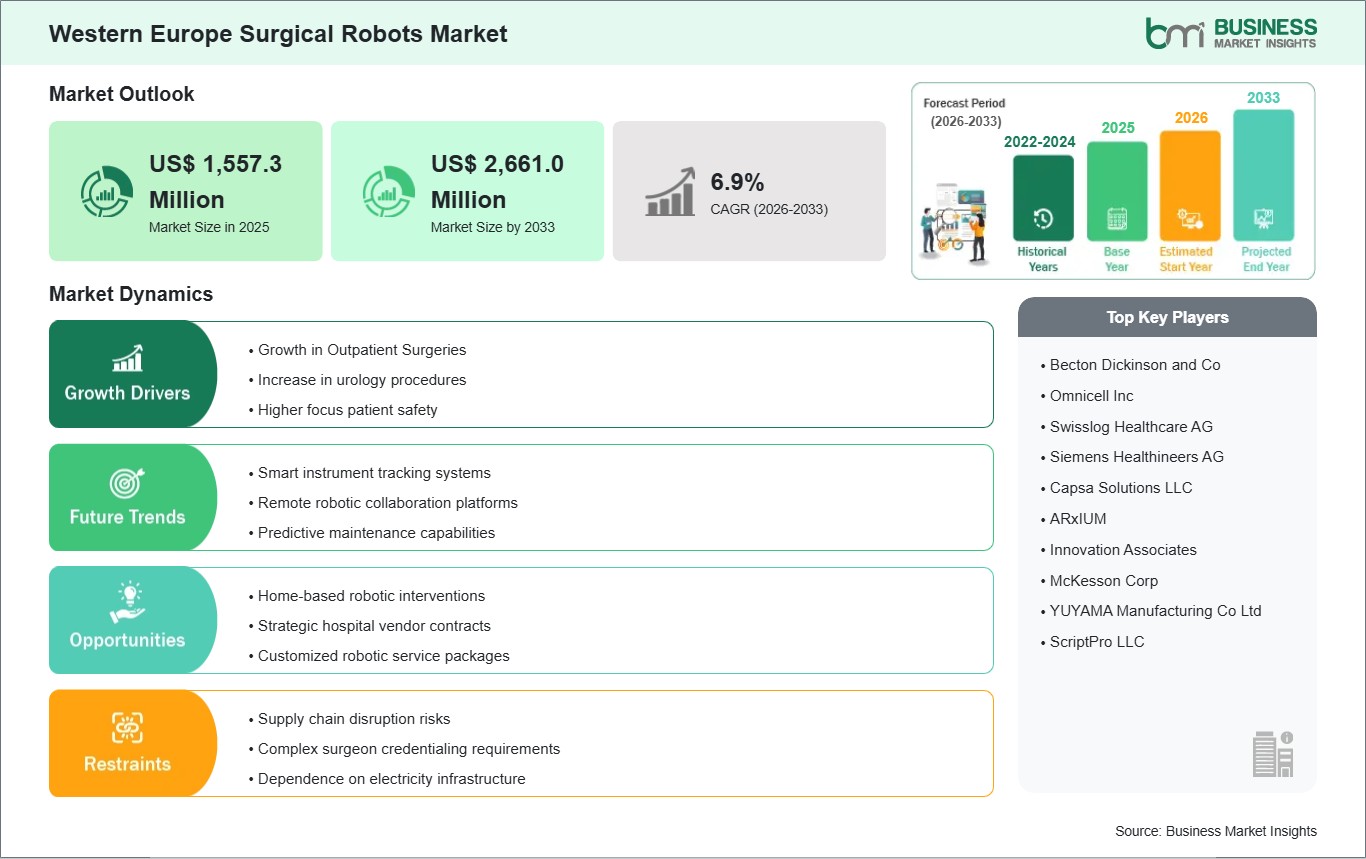
The Western Europe Surgical Robots Market size is expected to reach US$ 2,661.0 million by 2033 from US$ 1,557.3 million in 2025. The market is estimated to record a CAGR of 6.9% from 2026 to 2033.
The Western Europe surgical robots market is witnessing strategic growth driven by an emphasis on precision medicine, minimally invasive procedures, and hospital modernization initiatives. Adoption is largely concentrated in tertiary care hospitals, university medical centers, and specialty private clinics that perform high volumes of complex surgical procedures. The market is propelled by rising patient expectations for minimally invasive interventions, increasing procedural complexity in urology, gynecology, cardiothoracic, and oncological surgeries, and the need to enhance clinical outcomes while optimizing operational efficiency. Key drivers include technological advancements in robotic-assisted systems, integration with high-resolution imaging, and alignment with digital health infrastructure, which collectively improve surgical accuracy and support data-driven decision-making.
Hospitals are increasingly evaluating robotic systems based on multispecialty applicability, workflow efficiency, and postoperative outcome improvement, rather than purely on cost. Regulatory oversight in Western Europe ensures clinical efficacy and safety, which strengthens institutional confidence in robotics. Public and private hospitals adopt differentiated strategies: public institutions prioritize systems with long-term cost-effectiveness and broad clinical applications, whereas private hospitals focus on patient experience, service differentiation, and attracting international medical tourists. Barriers to adoption include the high upfront capital requirement, the need for specialized surgical training, and variability in reimbursement policies. Additionally, hospitals consider compatibility with existing hospital information systems, integration with surgical planning software, and the ability to collect outcome-based data for quality assessment. Overall, Western Europe represents a technologically mature and strategically evolving market where robotics adoption is shaped by clinical excellence, operational optimization, and competitive positioning in a highly regulated healthcare environment.

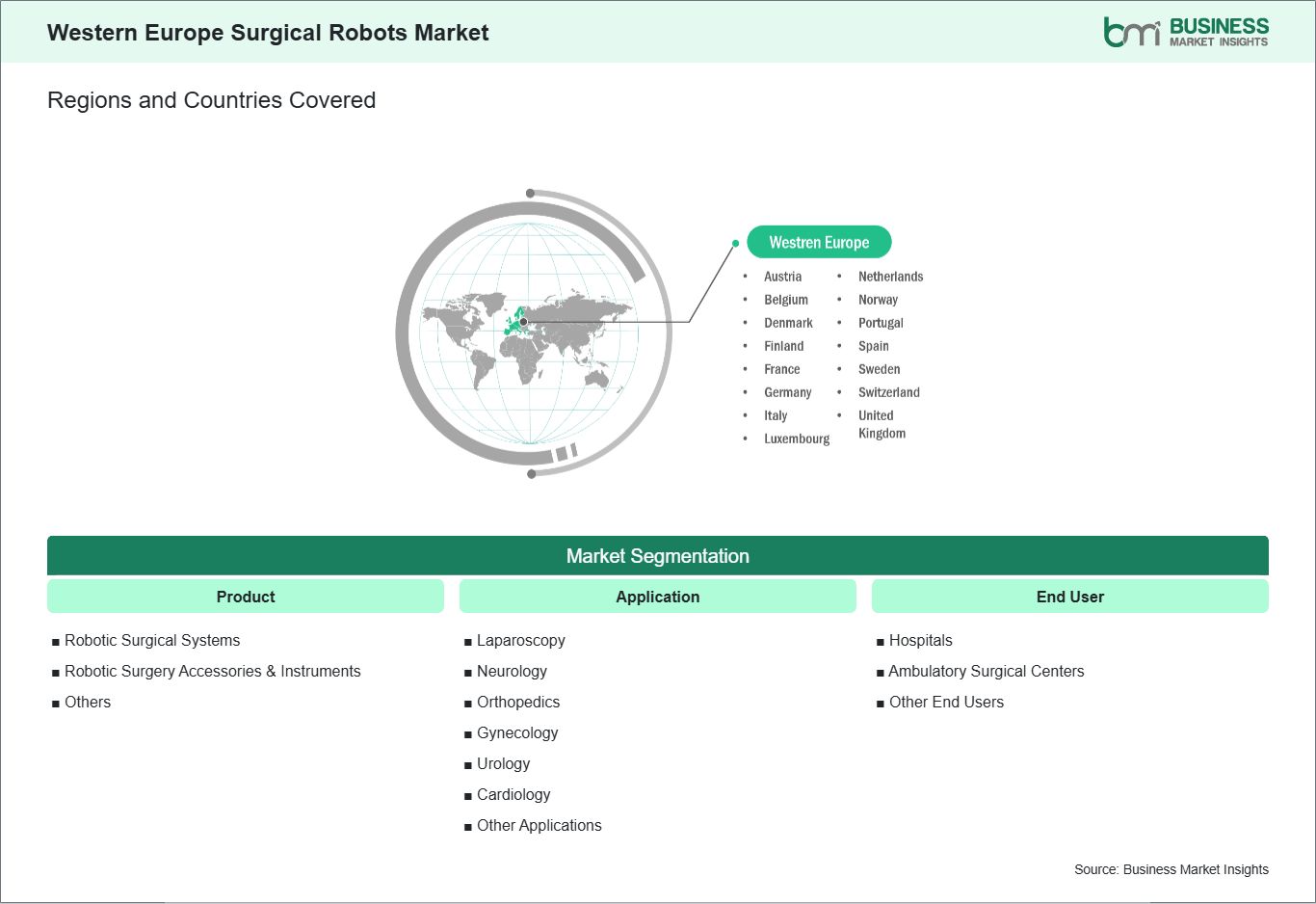
Key segments that contributed to the derivation of the Western Europe Surgical Robots Market analysis are product, application, and end user.
Healthcare systems in countries such as Germany, France, the Netherlands, Spain, and Belgium are increasingly shifting surgical procedures out of traditional inpatient settings and into dedicated outpatient or day‑surgery units. This transition reflects payer and provider priorities to optimize bed utilization, reduce hospital costs, and improve patient experience. Robotic systems are being evaluated and adopted specifically for procedures that can be safely performed without overnight stays, such as select hernia repairs, hysterectomies, and prostatectomies. Hospitals and specialized surgical centers in metropolitan regions—such as Berlin, Paris, Amsterdam, and Barcelona—are leading pilots of robotics‑enabled outpatient programs. These facilities are configuring operating theatres to accommodate compact robotic platforms that facilitate minimally invasive access, precise instrument control, and quicker recovery, all of which support discharge on the same day.
Surgeons and perioperative teams report that robotics helps reduce operative trauma and postoperative pain, making it easier to meet clinical criteria for outpatient release. Patient demand is also accelerating uptake, as individuals in Western European countries become more informed about the benefits of outpatient surgical options. Public health insurance schemes in nations such as France and the Netherlands are incentivizing value‑based care, supporting broader adoption of robotics for outpatient procedures. As protocols mature and clinical evidence grows, robotics is increasingly becoming a strategic enabler of outpatient surgical expansion in Western Europe, supporting efficiency and high standards of surgical quality.
Pilot programs in countries such as Sweden, Denmark, the UK, and Switzerland are exploring how robotics can support remote procedural assistance, rehabilitation, and follow‑up care delivered at or near the patient's home. These initiatives reflect broader regional priorities to reduce hospital congestion and extend care continuity beyond traditional clinical settings. In the UK, some research institutions are evaluating how robotic systems can assist clinicians in guiding minor interventions or procedural support remotely. This includes technologies that combine teleoperation with real‑time imaging and communication tools, enabling specialists to advise or collaborate on procedures without requiring patients to travel to large urban hospitals. Such approaches are seen as especially valuable for rural populations in Scotland and Wales, where access to specialist surgical care can be constrained by distance.
Meanwhile, rehabilitation and follow‑up care supported by robotic devices are emerging in Sweden and Denmark as complementary components of home‑based intervention strategies. Robotic systems designed for physical therapy and motor function support help patients recover postoperatively in their own environments, reducing readmissions and supporting long‑term functional improvement. These technologies are being integrated with regional telehealth services and physiotherapy programs to improve accessibility and continuity of care. Thus, evolving regulatory frameworks and reimbursement models support home‑centered robotics in Western Europe.

The Western Europe Surgical Robots Market demonstrates steady growth, with size and share analysis highlighting evolving trends and competitive dynamics among key players. The report examines subsegments categorized within product, application, and end user, offering insights into their contribution to overall market performance.
By product, the robotic surgery accessories & instruments segment dominated the market in 2025, driven by the recurring and high replacement demand for consumable, procedure‑specific tools required in every robotic surgery, which must be regularly procured as surgical volumes increase.
In terms of application, the laparoscopy segment dominated the market in 2025, driven by the strong adoption of minimally invasive laparoscopic robotic procedures in Western Europe, due to enhanced precision, reduced recovery times, and growing surgeon preference for MIS techniques.
Based on end user, the hospitals segment dominated the market in 2025, driven by their advanced healthcare infrastructure, high surgical volumes, financial capacity to invest in cutting‑edge robotic systems, and access to skilled surgical teams that maximize technology utilization.
| Report Attribute | Details |
|---|---|
| Market size in 2025 | US$ 1,557.3 Million |
| Market Size by 2033 | US$ 2,661.0 Million |
| CAGR (2026 - 2033) | 6.9% |
| Historical Data | 2022-2024 |
| Forecast period | 2026-2033 |
| Segments Covered | By Product
|
|
Regions and Countries Covered
| |
| Western Europe | Belgium, the Netherlands, Luxembourg, Germany, France, Italy, Spain, Switzerland, Sweden, Austria, the United Kingdom, Denmark, Portugal, Norway, Finland |
| Market leaders and key company profiles |
|
The "Western Europe Surgical Robots Market Size and Forecast (2022 - 2033)" report provides a detailed analysis of the market covering below areas:
The geographical scope of the Western Europe Surgical Robots Market report is divided into Belgium, the Netherlands, Luxembourg, Germany, France, Italy, Spain, Switzerland, Sweden, Austria, the UK, Denmark, Portugal, Norway, and Finland. Germany held the largest share in 2025.
Country-level adoption patterns in Western Europe reveal significant heterogeneity influenced by healthcare system structure, reimbursement frameworks, and hospital modernization strategies. Germany leads regional deployment, with high-volume tertiary hospitals and university medical centers integrating robotic systems across urology, oncology, and cardiothoracic surgery to improve outcomes and procedural efficiency. France demonstrates growing adoption in public and private hospitals, emphasizing multispecialty robotic platforms that facilitate minimally invasive procedures while supporting research and surgical education initiatives. The UK prioritizes deployment in teaching hospitals and specialist referral centers, integrating robotics with digital surgical planning tools and workflow management systems to optimize operational efficiency.
In Italy, adoption is concentrated in metropolitan hospitals performing high-complexity procedures, with an emphasis on postoperative outcomes and reduced hospital stays. Spain is gradually expanding its robotic surgical programs, leveraging government-supported training initiatives and pilot programs in leading tertiary care institutions. Across Western Europe, adoption is influenced by hospital capital allocation, surgeon expertise, regulatory compliance, and patient demand for minimally invasive surgery. Germany's leadership sets a benchmark for technological integration, while other countries follow phased and strategic deployment models that balance clinical excellence with operational efficiency. Overall, Western Europe presents a structured and mature market for surgical robotics, combining regulatory rigor, technological sophistication, and evidence-based clinical strategies to support widespread adoption.

The Western Europe Surgical Robots Market is evaluated by gathering qualitative and quantitative data post primary and secondary research, which includes important corporate publications, association data, and databases. A few of the key developments in the Western Europe Surgical Robots Market are:
The Western Europe Surgical Robots Market is valued at US$ 1,557.3 Million in 2025, it is projected to reach US$ 2,661.0 Million by 2033.
As per our report Western Europe Surgical Robots Market, the market size is valued at US$ 1,557.3 Million in 2025, projecting it to reach US$ 2,661.0 Million by 2033. This translates to a CAGR of approximately 6.9% during the forecast period.
The Western Europe Surgical Robots Market report typically cover these key segments-
The historic period, base year, and forecast period can vary slightly depending on the specific market research report. However, for the Western Europe Surgical Robots Market report:
The Western Europe Surgical Robots Market is populated by several key players, each contributing to its growth and innovation. Some of the major players include:
The Western Europe Surgical Robots Market report is valuable for diverse stakeholders, including:
Essentially, anyone involved in or considering involvement in the Western Europe Surgical Robots Market value chain can benefit from the information contained in a comprehensive market report.
Please tell us your area of interest
(Market Segments/ Regions and Countries/ Companies)