Market Summary
Executive Summary and Market Analysis
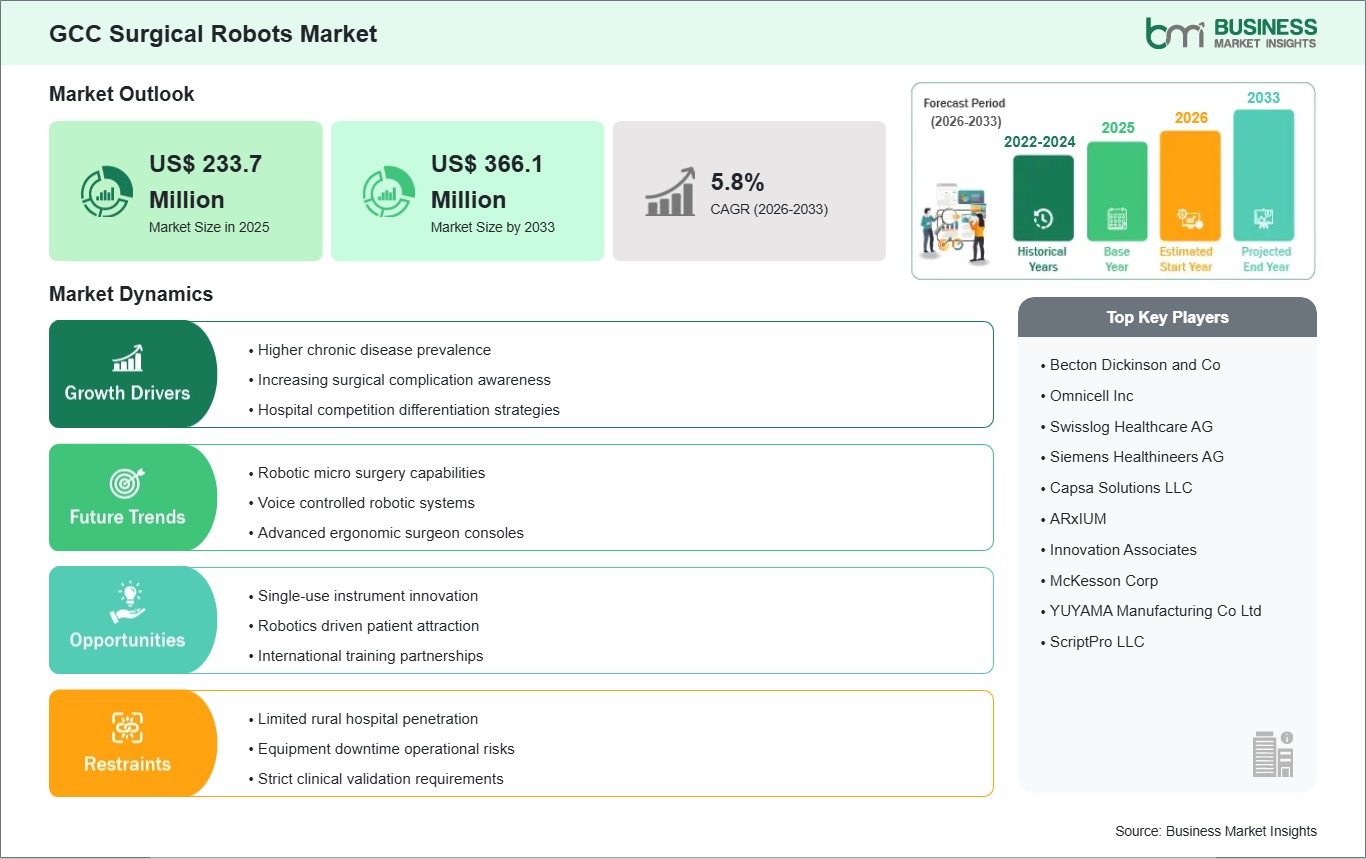
The GCC surgical robots market is advancing rapidly, supported by strong government-backed healthcare transformation agendas, high per capita healthcare expenditure, and a strategic push toward world-class tertiary care services. Countries across the Gulf Cooperation Council are investing heavily in hospital infrastructure modernization as part of broader national development visions, positioning robotic-assisted surgery as a flagship capability within premium healthcare facilities. Adoption is primarily concentrated in multi-specialty hospitals and academic medical centers that aim to deliver high-precision minimally invasive procedures across urology, bariatrics, gynecology, and oncology. Strategic procurement is often centralized, with public health authorities and large private hospital groups leading capital allocation decisions. Global manufacturers such as Intuitive Surgical, Medtronic, and CMR Surgical maintain strong distributor partnerships and regional service hubs to support training and technical maintenance. The competitive landscape is influenced by hospital branding initiatives aimed at strengthening international accreditation status and attracting medical tourists. Despite high financial capacity, adoption barriers include reliance on expatriate surgical expertise, variability in case volumes across smaller states, and the need for structured robotic surgery credentialing programs. Overall, the GCC market is characterized by premium positioning, policy-driven investment, and a focus on integrating advanced surgical technologies into next-generation smart hospital ecosystems.
Segment Analysis
GCC Surgical Robots Market Segmentation
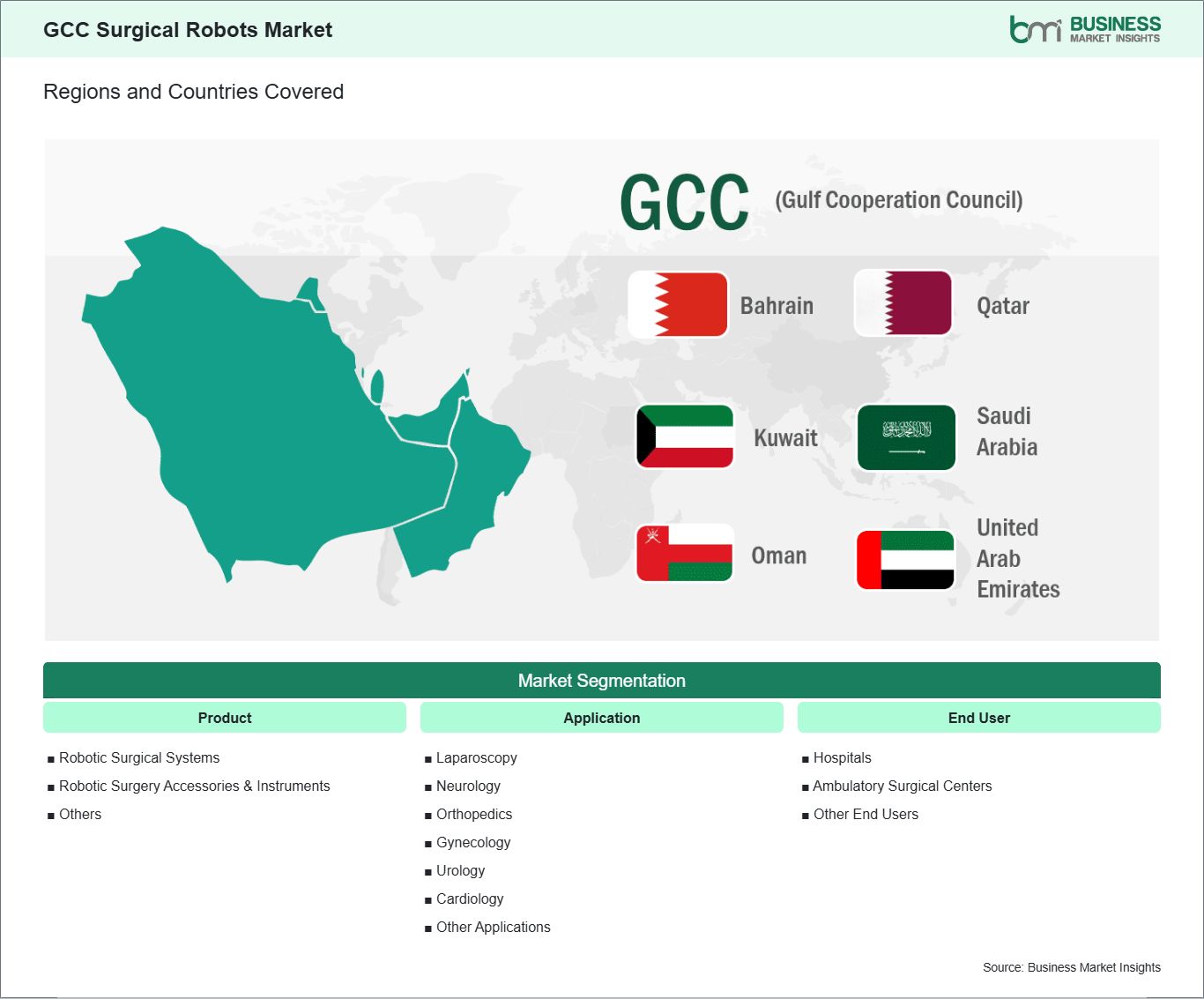
Key segments that contributed to the derivation of the GCC Surgical Robots Market analysis are product, application, and end user.
- By product, the surgical robots market is segmented into robotic surgical systems, robotic surgery accessories & instruments and others. The robotic surgery accessories & instruments segment dominated the market in 2025.
- In terms of application, the surgical robots market is categorized into laparoscopy, neurology, orthopedics, gynecology, urology, cardiology and other applications. The laparoscopy segment dominated the market in 2025.
- Based on end user, the surgical robots market is classified into hospitals, ambulatory surgical centers and other end users. The hospitals segment dominated the market in 2025.
Market Forces
GCC Surgical Robots Market Drivers and Opportunities
Higher chronic disease prevalence
In the GCC surgical robots market, rising rates of chronic diseases are significantly influencing healthcare priorities and technology adoption. Countries in the Gulf Cooperation Council such as Saudi Arabia, United Arab Emirates, Qatar, Kuwait, Bahrain, and Oman are experiencing growing burdens of non-communicable conditions including diabetes, cardiovascular disease, and certain cancers. These conditions often require surgical intervention as part of long-term management, prompting healthcare providers to seek technologies that can improve outcomes while managing procedural complexity. Surgical robots are increasingly seen as tools that help clinicians deliver consistent, precise care for patients with chronic health challenges. Healthcare systems across the GCC are also under pressure to deliver advanced care locally, reducing the need for patients to travel abroad for specialized surgeries. Chronic disease prevalence has led to higher demand for procedures in areas like urology, bariatric surgery, and oncology, where robotic assistance can support minimally invasive approaches. Hospitals in metropolitan centers such as Riyadh, Dubai, and Doha are responding by incorporating robotic platforms into surgical departments, not only to improve clinical performance but also to strengthen regional healthcare self-sufficiency. This trend aligns with broader government strategies focused on enhancing quality of care and expanding high-complexity services within national health frameworks. Furthermore, the economic impact of chronic disease on healthcare expenditure is motivating GCC providers to explore solutions that can improve efficiency without compromising quality. Robotic surgery’s potential to reduce complication rates, shorten hospital stays, and support enhanced recovery is increasingly valued in health planning discussions. As chronic conditions continue to rise with changing lifestyles and demographic shifts across the Gulf region, the integration of surgical robotics is expected to grow in tandem with healthcare investment priorities and clinical demand patterns.
Single-use instrument innovation
Innovation in single-use instruments is emerging as a distinctive driver in the GCC surgical robots market, reflecting regional emphasis on efficiency, safety, and streamlined operations. Healthcare facilities throughout the Gulf are placing higher value on disposable robotic accessories that minimize cross-contamination risk, simplify logistics, and reduce instrument turnaround time. In environments such as high-volume surgical centers in Saudi Arabia and the UAE, single-use instrument solutions help address sterilization challenges and support infection control protocols that are critical to patient safety. Single-use instrument advancements are also appealing to hospitals looking to control lifecycle costs and improve workflow predictability. Instruments designed for one-time use eliminate the need for complex reprocessing infrastructure, which can be particularly attractive for facilities aiming to expand robotic surgery without proportionately increasing support services. Providers in Qatar and Kuwait have cited operational simplicity as a meaningful benefit of adopting disposables, especially in specialties that generate high instrument turnover such as gynecology and colorectal surgery. This trend supports broader adoption of robotic systems by aligning them with local operational priorities. In addition, single-use instrument innovation is enabling surgical robotics to become more accessible to a wider range of institutions across the GCC. Smaller hospitals and private surgical centers, which may lack large reprocessing departments, find that disposable options lower barriers to entry and make it easier to integrate robotics into existing surgical workflows. As manufacturers continue to refine instrument designs and align them with regional procedural preferences, single-use solutions are expected to play an increasingly important role in how robotic surgery is deployed across the Gulf healthcare landscape, reinforcing both clinical and operational value.
Size and Share Analysis
GCC Surgical Robots Market Size and Share Analysis
The GCC Surgical Robots Market demonstrates steady growth, with size and share analysis highlighting evolving trends and competitive dynamics among key players. The report examines subsegments categorized within product, application, and end user, offering insights into their contribution to overall market performance.
By product, the robotic surgery accessories & instruments segment dominated the market in 2025, driven by the essential and recurring demand for consumables and procedure-specific tools required in every robotic surgery, which must be regularly replaced as surgical volumes rise.
In terms of application, the laparoscopy segment dominated the market in 2025, driven by the increasing adoption of minimally invasive laparoscopic robotic-assisted procedures in the region, owing to benefits like enhanced precision, reduced recovery time, and growing preference for MIS techniques.
Based on end user, the hospitals segment dominated the market in 2025, driven by their advanced infrastructure, high patient throughput, strong investments in advanced surgical technologies, and government-led healthcare modernization supporting robotic system adoption.
Report Coverage
GCC Surgical Robots Market Report Coverage and Deliverables
The "GCC Surgical Robots Market Size and Forecast (2022 - 2033)" report provides a detailed analysis of the market covering below areas:
- GCC Surgical Robots Market size and forecast at regional and country levels for all market segments covered under the scope
- GCC Surgical Robots Market trends, as well as drivers, restraints, and opportunities
- GCC Surgical Robots Market analysis covering key trends, regional framework, major players, regulations, and recent developments
- Industry landscape and competition analysis covering market concentration, heat map analysis, prominent players, and recent developments for the GCC Surgical Robots Market
- Detailed company profiles, including SWOT analysis
Geographic Insights
GCC Surgical Robots Market Geographic Insights
The geographical scope of the GCC Surgical Robots Market report is divided into UAE, Bahrain, Saudi Arabia, Oman, Qatar, and Kuwait. UAE held the largest share in 2025.
Country-level dynamics within the GCC reveal varied adoption patterns aligned with national healthcare strategies. Saudi Arabia leads the region, driven by Vision 2030 healthcare reforms, large-scale hospital expansion projects, and strong public-sector procurement programs integrating robotics into tertiary and military hospitals. United Arab Emirates demonstrates high adoption within Dubai and Abu Dhabi, where private hospital groups and internationally accredited institutions deploy robotic systems to enhance medical tourism competitiveness. Qatar integrates robotics within state-funded specialty hospitals, focusing on precision oncology and complex surgical care aligned with national health strategies. Kuwait shows targeted deployment in public referral hospitals, with emphasis on upgrading minimally invasive surgical capacity. Oman and Bahrain exhibit gradual adoption, primarily within leading urban hospitals seeking technological differentiation. Across the GCC, deployment is influenced by centralized healthcare governance, infrastructure readiness, and strategic ambition to establish regional centers of surgical excellence.
Industry Activity
Recent Developments
The GCC Surgical Robots Market is evaluated by gathering qualitative and quantitative data post primary and secondary research, which includes important corporate publications, association data, and databases. A few of the key developments in the GCC Surgical Robots Market are:
- In January 2026, American Hospital Dubai became the first hospital in the UAE and wider Middle East to install the next-generation Intuitive da Vinci 5 robotic surgical system, advancing region-wide access to cutting-edge minimally invasive surgery. The platform enhances precision with improved vision and control and complements prior systems like da Vinci Xi and da Vinci SP. Its arrival strengthens Dubai’s position as a regional hub for advanced surgical robotics. This launch expands clinical options in urology, general, and complex procedures throughout the GCC.
- In September 2025, American Hospital Dubai also introduced the Intuitive da Vinci SP single-port robotic surgery system — the first of its kind in the Middle East, offering ultra-precise surgery through a single small incision. This system significantly reduces patient trauma and scarring compared with multi-port approaches. It sets a new standard for minimally invasive robotic surgical care in the GCC region. The SP system’s launch highlights the UAE’s leadership in adopting advanced surgical technologies.
Trust & Transparency
Research Methodology
The market analysis combines proprietary research with secondary data from government agencies, company disclosures, regulatory filings, industry databases and expert interviews. Market estimates are validated through data triangulation, cross-market benchmarking and analyst
review.
View Full Research Methodology
Key Sources Referred:
World Health Organization (WHO) Organisation for Economic Cooperation and Development (OECD) The World Bank Group Worldometer The Lancet International Bar Association International Trade Administration