Market Summary
Executive Summary and Market Analysis
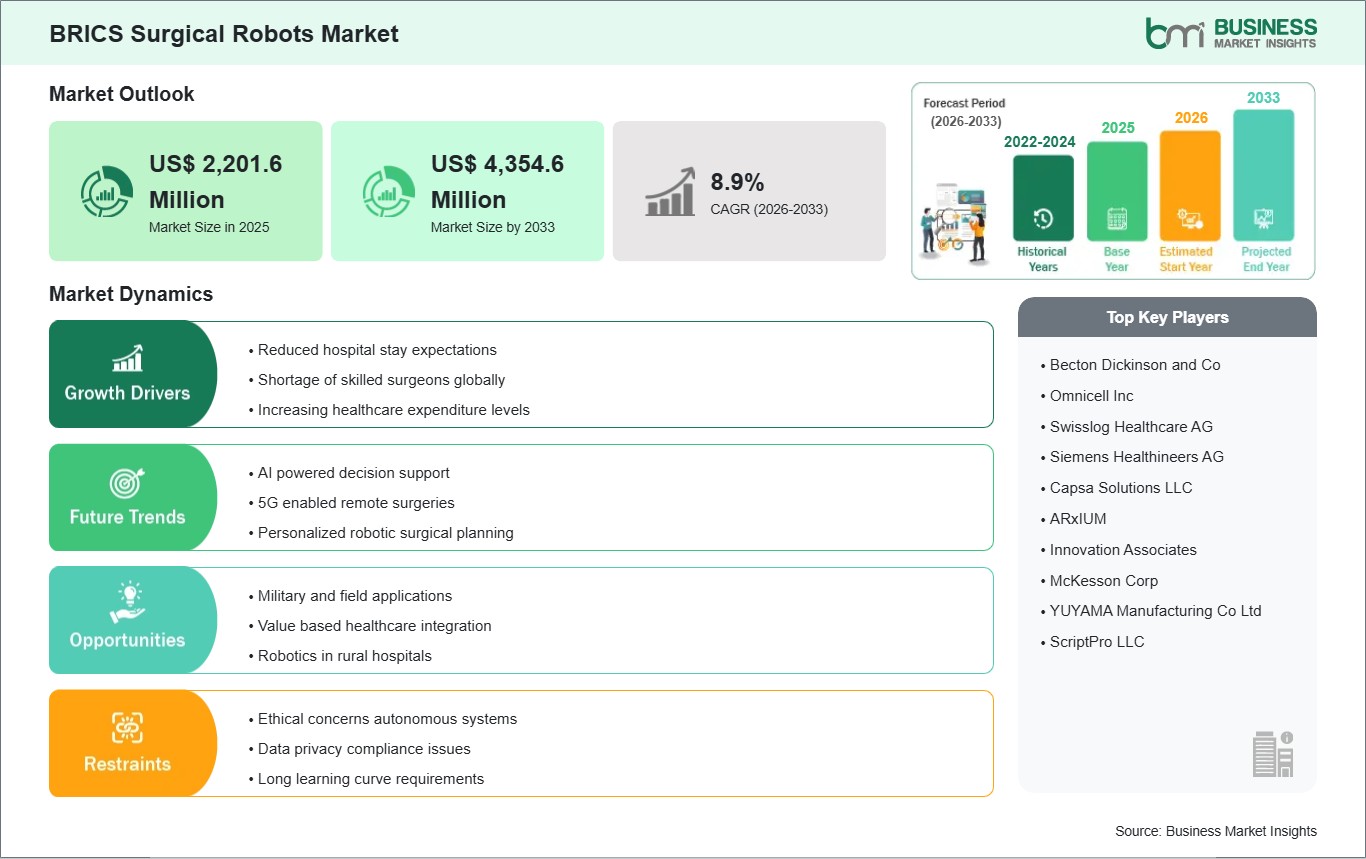
The BRICS surgical robots market is evolving as a critical segment of advanced medical technologies, fueled by the increasing demand for precision-based surgery, growing urban hospital networks, and a rise in complex chronic disease cases. Hospitals in Brazil, Russia, India, China, and South Africa are investing in robotic-assisted platforms not only to improve surgical accuracy but also to enhance patient safety and reduce postoperative complications. A growing emphasis on minimally invasive procedures, particularly in urology, gynecology, and cardiothoracic surgery, has positioned robotic systems as a key differentiator in high-end medical services. Strategic partnerships between local healthcare providers and global technology leaders such as Intuitive Surgical, Medtronic, and Stryker Corporation facilitate knowledge transfer, advanced surgeon training, and long-term equipment maintenance, helping overcome the barriers posed by limited local expertise. Market penetration varies significantly, with high adoption in metropolitan private hospitals and slower uptake in public hospitals due to budget constraints and infrastructure gaps. In addition, medical tourism hubs are leveraging robotics to enhance hospital branding and attract international patients. Competitive strategies increasingly focus on the provision of multi-specialty robotic systems, digital surgery integration, and AI-enabled analytics to optimize operational efficiency. Nevertheless, challenges remain, including high capital expenditure, regulatory variability across countries, and a scarcity of certified robotic surgeons. Overall, the BRICS surgical robots market is positioned for long-term strategic growth, driven by institutional priorities toward improving clinical outcomes, operational efficiency, and patient satisfaction.
Segment Analysis
BRICS Surgical Robots Market Segmentation
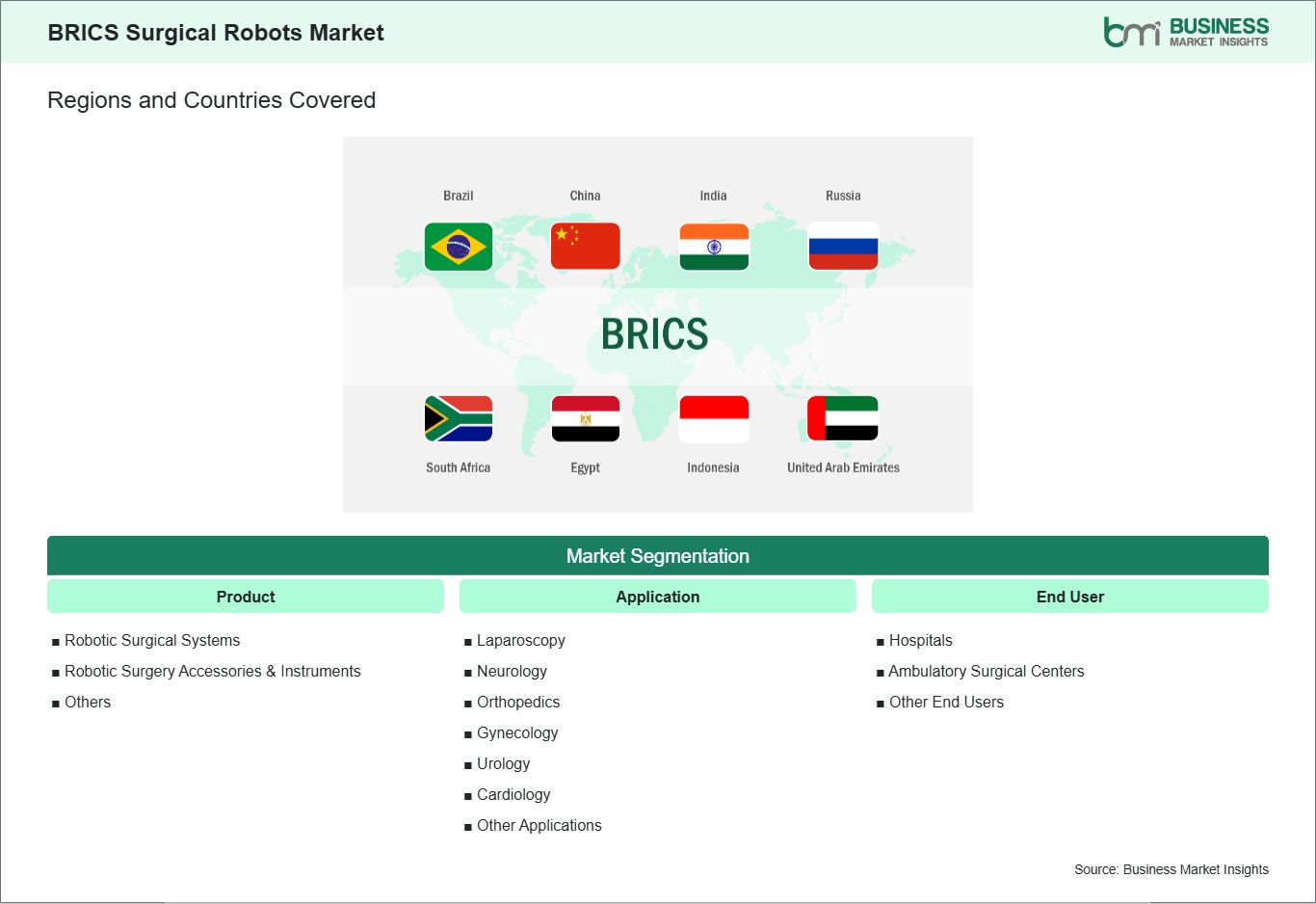
Key segments that contributed to the derivation of the BRICS Surgical Robots Market analysis are product, application, and end user.
- By product, the surgical robots market is segmented into robotic surgical systems, robotic surgery accessories & instruments and others. The robotic surgery accessories & instruments segment dominated the market in 2025.
- In terms of application, the surgical robots market is categorized into laparoscopy, neurology, orthopedics, gynecology, urology, cardiology and other applications. The laparoscopy segment dominated the market in 2025.
- Based on end user, the surgical robots market is classified into hospitals, ambulatory surgical centers and other end users. The hospitals segment dominated the market in 2025.
Market Forces
BRICS Surgical Robots Market Drivers and Opportunities
Reduced hospital stay expectations
In the BRICS region, hospitals are increasingly driven by patient demand for faster recovery and reduced inpatient stays. In countries like India and China, where high population density places immense pressure on healthcare infrastructure, hospitals are actively seeking technologies that optimize bed turnover without compromising surgical outcomes. Robotic-assisted surgeries are particularly attractive because they allow for smaller incisions, minimal tissue damage, and precise maneuvering, which collectively help patients recover more quickly. Faster discharge times not only improve patient satisfaction but also enhance operational efficiency, allowing hospitals to manage growing surgical volumes more effectively. In Brazil and South Africa, reduced hospital stays are seen as both a quality metric and a financial imperative. Private and public institutions are increasingly investing in robotic systems to shorten post-operative monitoring periods and reduce the incidence of complications that could prolong hospital admission. The use of robotics for minimally invasive procedures in orthopedics, urology, and general surgery has been shown to decrease recovery times, enabling healthcare providers to serve more patients with the same resources. This efficiency is especially valuable in urban centers where surgical demand frequently outpaces capacity. Additionally, hospitals in Russia are leveraging robotic platforms to enhance patient flow management. By integrating robotics with advanced surgical planning and data analytics, institutions can better predict recovery trajectories and optimize discharge planning. Patients benefit from quicker return to daily life, while hospitals can allocate resources more strategically. Across the BRICS markets, reducing hospital stay durations has become a key justification for adopting surgical robots, aligning clinical excellence with economic efficiency, and establishing robotics as a core component of modern healthcare delivery.
Military and field applications
Surgical robotics in BRICS countries is increasingly being explored for military and field use, highlighting the adaptability of these technologies beyond conventional hospital environments. In China, research institutions and defense hospitals are evaluating teleoperated robotic systems capable of performing surgeries in remote or hazardous locations. These systems aim to bridge the gap between front-line care and specialist intervention, enabling critical trauma procedures without requiring a fully equipped operating theater. The focus is on portability, rapid deployment, and real-time remote guidance, which can improve survival rates in combat or disaster scenarios. India has also started exploring robotic-assisted field medicine, particularly in challenging terrains where conventional surgical support is limited. The Indian armed forces are considering mobile robotic units for trauma stabilization and emergency procedures in border or conflict zones. These robots can supplement trained surgeons on-site or allow experienced specialists to operate remotely, reducing reliance on physical presence in high-risk areas. Such capabilities are seen as enhancing operational readiness and medical resilience in diverse environments. In Brazil, Russia, and South Africa, military collaborations with universities and technology firms are testing compact robotic platforms for rapid deployment during humanitarian crises or disaster relief. These initiatives focus on lightweight, transportable systems capable of functioning in field hospitals or temporary clinics. While large-scale implementation remains in development, these programs demonstrate the growing interest in extending surgical robotics to emergency and defense applications. For BRICS nations, military and field applications not only expand the functional scope of surgical robots but also strengthen strategic medical capabilities in environments where traditional surgical infrastructure is unavailable.
Size and Share Analysis
BRICS Surgical Robots Market Size and Share Analysis
The BRICS Surgical Robots Market demonstrates steady growth, with size and share analysis highlighting evolving trends and competitive dynamics among key players. The report examines subsegments categorized within product, application, and end user, offering insights into their contribution to overall market performance.
By product, the robotic surgery accessories & instruments segment dominated the market in 2025, driven by their recurring, procedure‑specific demand across all robotic surgeries, providing steady revenue as consumables are regularly replaced and upgraded.
In terms of application, the laparoscopy segment dominated the market in 2025, driven by the rising adoption of laparoscopic and other minimally invasive surgeries in BRICS countries due to faster recovery, reduced trauma, and growing surgeon preference for precision techniques.
Based on end user, the hospitals segment dominated the market in 2025, driven by their high surgical volumes, advanced infrastructure, and capacity to invest in and utilize robotic systems for complex procedures across specialties.
Report Coverage
BRICS Surgical Robots Market Report Coverage and Deliverables
The "BRICS Surgical Robots Market Size and Forecast (2022 - 2033)" report provides a detailed analysis of the market covering below areas:
- BRICS Surgical Robots Market size and forecast at regional and country levels for all market segments covered under the scope
- BRICS Surgical Robots Market trends, as well as drivers, restraints, and opportunities
- BRICS Surgical Robots Market analysis covering key trends, regional framework, major players, regulations, and recent developments
- Industry landscape and competition analysis covering market concentration, heat map analysis, prominent players, and recent developments for the BRICS Surgical Robots Market
- Detailed company profiles, including SWOT analysis
Geographic Insights
BRICS Surgical Robots Market Geographic Insights
The geographical scope of the BRICS Surgical Robots Market report is divided into into Russia, Brazil, South Africa, India, the UAE, and China. China held the largest share in 2025
Country-level trends in the BRICS region reveal highly varied adoption patterns influenced by healthcare infrastructure, surgeon availability, and funding mechanisms. China is at the forefront, with large urban hospitals integrating robotic systems to support high-volume procedures and drive research in surgical innovation. The Chinese government’s support for precision healthcare and investment in smart hospital technologies further accelerates adoption. In India, deployment is concentrated in metro private hospitals, leveraging robotics to enhance procedural efficiency, attract international patients, and improve outcomes in oncology and cardiac care. Brazil shows selective adoption in top-tier hospitals in São Paulo and Rio de Janeiro, where surgical robotics is increasingly used for complex procedures in cardiology and urology, with private insurers gradually supporting reimbursements. Russia is adopting robotic platforms primarily in urban academic hospitals, supported by government initiatives to modernize surgical care and improve minimally invasive surgical capabilities. Meanwhile, South Africa focuses on robotic integration within private hospitals in urban centers, where high-income patients demand advanced surgical solutions, and specialized surgeons are available. Across the BRICS region, factors such as urbanization, hospital modernization initiatives, medical tourism potential, and increasing digital integration influence adoption. These country-level trends highlight the heterogeneous yet strategically advancing nature of the BRICS surgical robots market, with long-term potential for expanded coverage and deeper integration across public and private healthcare institutions.
Industry Activity
Recent Developments
The BRICS Surgical Robots Market is evaluated by gathering qualitative and quantitative data post primary and secondary research, which includes important corporate publications, association data, and databases. A few of the key developments in the BRICS Surgical Robots Market are:
- In September 2025, Indian med‑tech firm Meril Life Sciences unveiled the Mizzo Endo 4000, an advanced soft‑tissue surgical robotic system designed for precision in multi‑specialty procedures including urology, gynecology, gastrointestinal, and oncology surgeries. The platform features AI‑enhanced 3D visualisation, an open console, and 5G‑enabled telesurgery capabilities to improve surgical control and connectivity. This launch positions India as a growing hub for high‑end robotic surgery innovation and global competition. The Mizzo Endo 4000 reflects the increasing role of domestically developed surgical robots in BRICS healthcare markets.
- In December 2024, MicroPort MedBot’s Toumai® Laparoscopic Surgical Robot received market approval from Brazil’s National Health Surveillance Agency (ANVISA), marking a key expansion of Chinese‑origin robotic systems into Latin America. The approval enables Brazilian hospitals to begin adopting the Toumai platform for minimally invasive procedures, broadening access to cost‑effective robotic surgery. This milestone underscores the role of BRICS cross‑market technology flows, especially between China and Brazil. Wider clinical deployment is anticipated to boost robot‑assisted surgical capabilities across multiple Brazilian specialties.
Trust & Transparency
Research Methodology
The market analysis combines proprietary research with secondary data from government agencies, company disclosures, regulatory filings, industry databases and expert interviews. Market estimates are validated through data triangulation, cross-market benchmarking and analyst
review.
View Full Research Methodology
Key Sources Referred:
World Health Organization (WHO) Organisation for Economic Cooperation and Development (OECD) The World Bank Group Worldometer The Lancet International Bar Association International Trade Administration