Market Summary
Executive Summary and Market Analysis
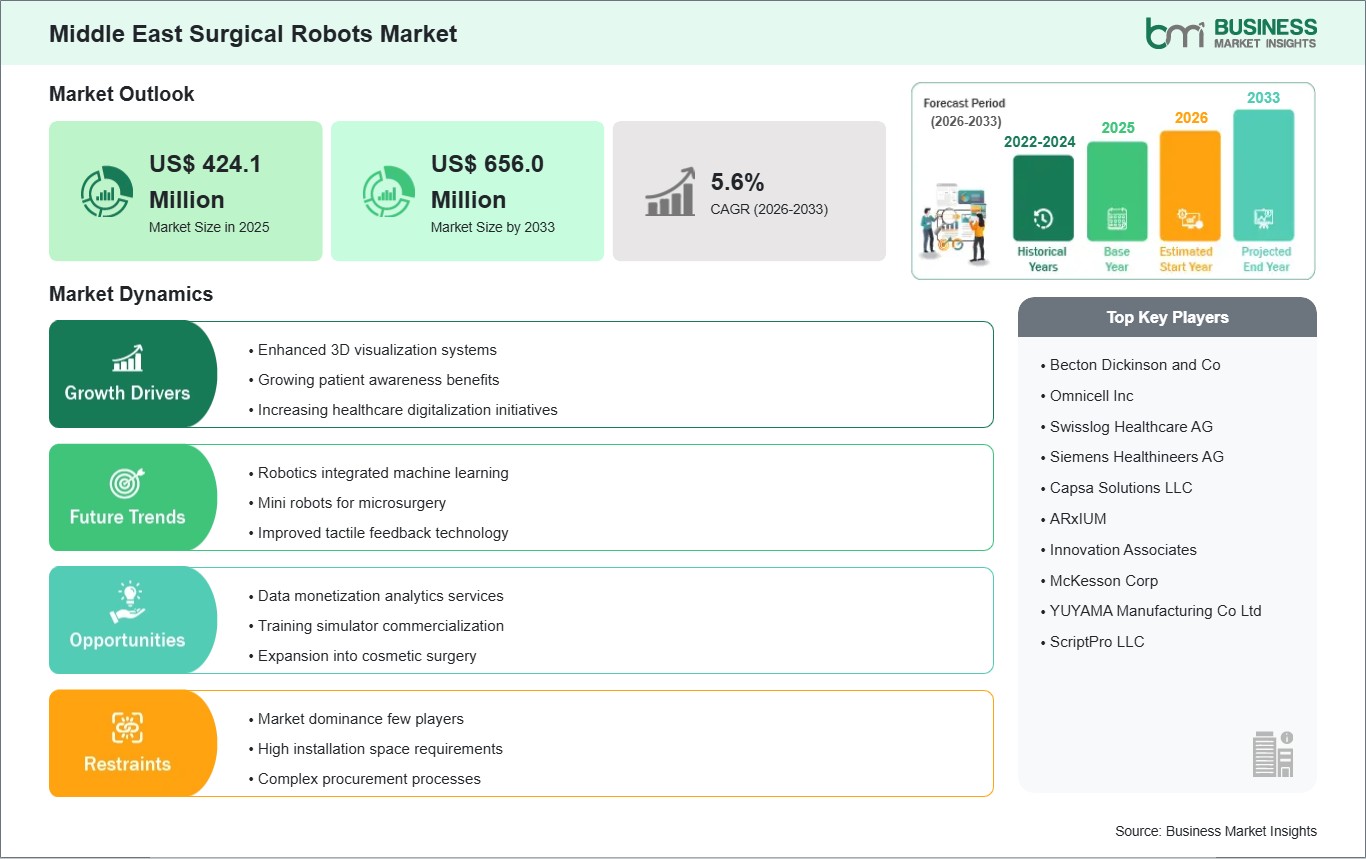
The Middle East surgical robots market has emerged as a strategic segment within the region’s healthcare modernization initiatives, fueled by strong government investments, rising healthcare expenditure, and the growing emphasis on minimally invasive procedures. The market is concentrated in urban centers and tertiary hospitals with sufficient procedural volumes to justify the capital-intensive nature of robotic-assisted platforms. Leading private hospital networks and academic medical centers are deploying surgical robots across specialties such as urology, cardiothoracic surgery, oncology, and gynecology to enhance precision, reduce intraoperative complications, and improve postoperative recovery times. Global manufacturers, including Intuitive Surgical, Medtronic, and CMR Surgical, have established strong distribution and service networks across the region, providing technical maintenance, surgeon training, and integration support. Hospitals are increasingly evaluating robotic systems not only for their clinical capabilities but also for their ability to support multi-specialty use, enhance operational efficiency, and align with international accreditation standards. The competitive landscape is driven by strategic investments in advanced surgical technologies to differentiate institutions in high-income patient segments and medical tourism markets. Adoption is influenced by regulatory approvals, infrastructure readiness, and availability of trained surgeons, with private hospitals typically leading implementation due to more flexible capital allocation. Public-sector adoption, while slower, is gradually increasing in countries pursuing national healthcare modernization and high-complexity care strategies. Overall, the Middle East surgical robots market is positioned for strategic growth, emphasizing technological excellence, improved clinical outcomes, and operational optimization as hospitals aim to strengthen competitive positioning and patient-centric care.
Segment Analysis
Middle East Surgical Robots Market Segmentation
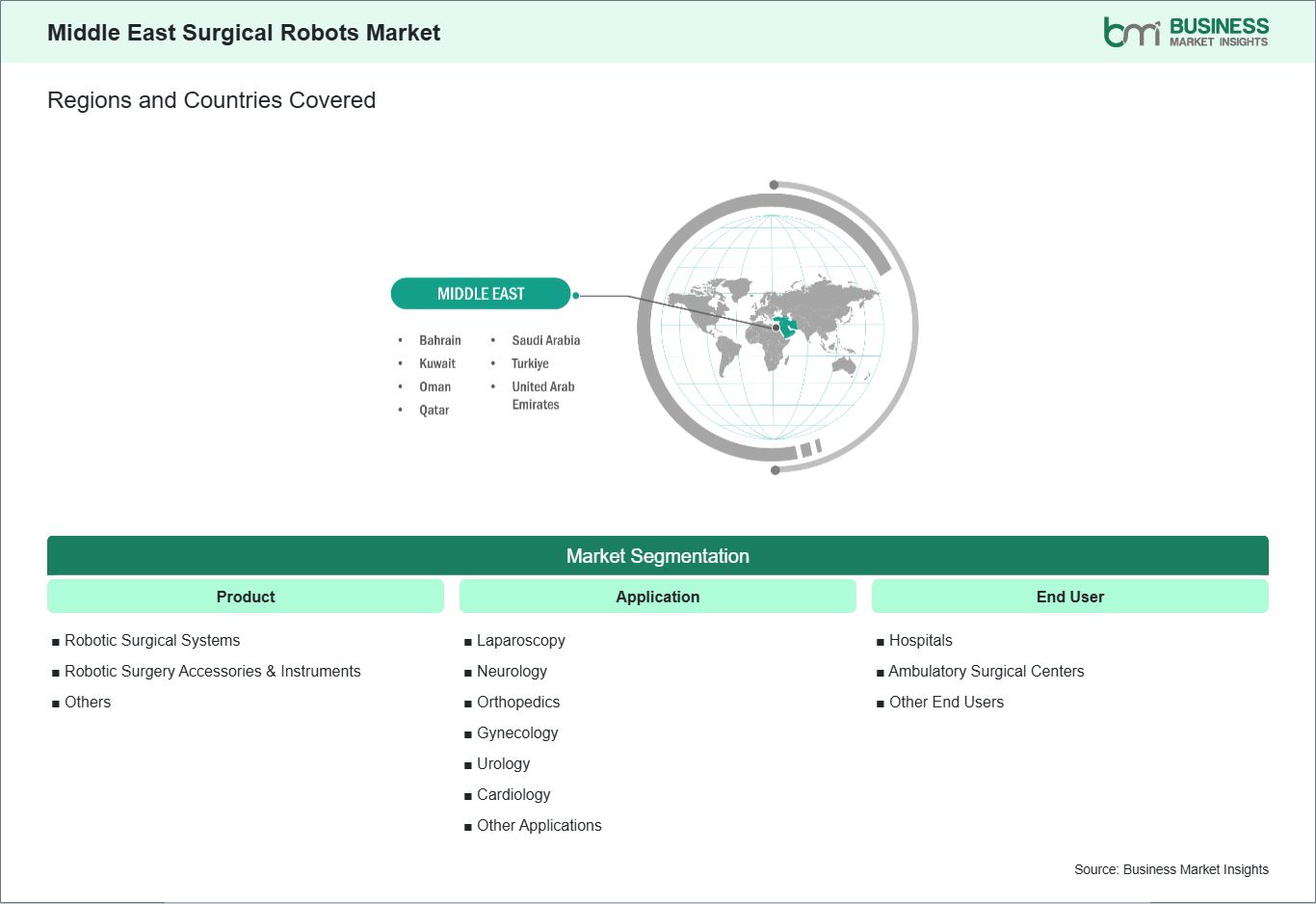
Key segments that contributed to the derivation of the Middle East Surgical Robots Market analysis are product, application, and end user.
- By product, the surgical robots market is segmented into robotic surgical systems, robotic surgery accessories & instruments and others. The robotic surgery accessories & instruments segment dominated the market in 2025.
- In terms of application, the surgical robots market is categorized into laparoscopy, neurology, orthopedics, gynecology, urology, cardiology and other applications. The laparoscopy segment dominated the market in 2025.
- Based on end user, the surgical robots market is classified into hospitals, ambulatory surgical centers and other end users. The hospitals segment dominated the market in 2025.
Market Forces
Middle East Surgical Robots Market Drivers and Opportunities
Enhanced 3D visualization systems
In the Middle East surgical robots market, enhanced 3D visualization systems are becoming a cornerstone of clinical investment decisions, particularly within advanced tertiary care centers across Saudi Arabia, the United Arab Emirates, and Qatar. Hospitals in these markets are prioritizing next‑generation visualization technologies that provide high‑definition, stereoscopic views of the surgical field, enabling surgeons to perceive depth and anatomical detail with greater clarity. This capability is especially valuable in procedures such as urology, gynecology, and complex soft tissue surgeries where visual precision directly influences clinical outcomes. Healthcare executives are emphasizing 3D visualization as a competitive differentiator in regional centers of excellence. For example, major medical facilities in Dubai and Riyadh are incorporating robotic systems with integrated 3D imaging platforms into surgical suites to support minimally invasive procedures and reduce reliance on traditional open surgery. For patient populations with higher prevalence of conditions such as prostate and gynecologic cancers, enhanced visualization is seen as critical to improving surgical accuracy and reducing complication rates. These systems also support surgeons in navigating complex anatomy, which can be particularly variable in diverse Middle Eastern populations. Adoption of enhanced 3D visualization is further supported by surgeon training initiatives and academic collaborations. Regional medical universities and surgical societies in the Middle East are hosting hands‑on workshops and simulation labs that leverage these advanced imaging systems, helping clinicians build proficiency before deploying technology in live surgery. This focus on skill development not only accelerates surgeon confidence but also strengthens institutional justification for investing in premium visualization capabilities. As a result, enhanced 3D systems are playing an increasingly strategic role in how hospitals in the Middle East plan and scale their surgical robotics programs.
Data monetization analytics services
Data monetization analytics services are beginning to emerge as a distinct market opportunity within the Middle East surgical robots ecosystem. As hospitals in Saudi Arabia, the UAE, and Kuwait adopt robotic platforms, they are generating significant volumes of procedural, performance, and outcomes data. Healthcare organizations and technology vendors are recognizing the potential value of this data when aggregated and analyzed at scale, particularly for insights that can inform clinical best practices, supply chain optimization, and predictive maintenance of surgical assets. Advanced analytics services are being designed to package de‑identified surgical data into performance dashboards, benchmarking tools, and outcome prediction models that can be shared across hospital networks. For example, large multi‑hospital systems in Dubai and Abu Dhabi are partnering with analytics firms to transform raw robotics usage metrics into actionable insights that inform staffing, instrument utilization, and patient risk stratification. These analytics services help hospitals reduce costs and improve workflow efficiency, while also creating opportunities for data‑driven consulting arrangements that extend beyond the initial technology sale. Beyond operational improvements, data monetization analytics services are enabling new revenue streams for both healthcare providers and technology partners. With appropriate governance and patient privacy safeguards, anonymized datasets are being used to support research collaborations, medical device refinement, and third‑party software development. In Qatar and Bahrain, public‑private initiatives are exploring frameworks that allow surgical outcome data to contribute to regional health research consortia and quality registries. As analytics capabilities continue to mature, data monetization services are positioned to enhance the economic value of surgical robotics investment, supporting evidence‑based decision‑making and long‑term sustainability for healthcare organizations across the Middle East.
Size and Share Analysis
Middle East Surgical Robots Market Size and Share Analysis
The Middle East Surgical Robots Market demonstrates steady growth, with size and share analysis highlighting evolving trends and competitive dynamics among key players. The report examines subsegments categorized within product, application, and end user, offering insights into their contribution to overall market performance.
By product, the robotic surgery accessories & instruments segment dominated the market in 2025, driven by the recurring and high replacement demand for consumable tools required in robotic procedures, ensuring continuous revenue as surgical volumes grow.
In terms of application, the laparoscopy segment dominated the market in 2025, driven by the increasing adoption of minimally invasive laparoscopic robotic surgeries in the Middle East due to their enhanced precision, reduced trauma, and improved patient outcomes.
Based on end user, the hospitals segment dominated the market in 2025, driven by their advanced infrastructure, high surgical volumes, and increased investment in cutting‑edge robotic technologies to meet rising demand for precision and minimally invasive procedures.
Report Coverage
Middle East Surgical Robots Market Report Coverage and Deliverables
The "Middle East Surgical Robots Market Size and Forecast (2022 - 2033)" report provides a detailed analysis of the market covering below areas:
- Middle East Surgical Robots Market size and forecast at regional and country levels for all market segments covered under the scope
- Middle East Surgical Robots Market trends, as well as drivers, restraints, and opportunities
- Middle East Surgical Robots Market analysis covering key trends, regional framework, major players, regulations, and recent developments
- Industry landscape and competition analysis covering market concentration, heat map analysis, prominent players, and recent developments for the Middle East Surgical Robots Market
- Detailed company profiles, including SWOT analysis
Geographic Insights
Middle East Surgical Robots Market Geographic Insights
The geographical scope of the Middle East Surgical Robots Market report is divided into UAE, Saudi Arabia, Bahrain, Oman, Kuwait, Qatar, and Turkiye. Turkiye held the largest share in 2025.
Country-level adoption within the Middle East shows a heterogeneous landscape, shaped by national healthcare strategies, infrastructure maturity, and capital availability. Turkey is the dominant market, with robotic systems deployed extensively across tertiary hospitals and specialized centers in metropolitan hubs such as Istanbul and Ankara. The focus is on high-volume procedures in urology, oncology, cardiothoracic, and gynecology, supported by public healthcare modernization initiatives and strong private hospital investments. United Arab Emirates demonstrates high adoption in Dubai and Abu Dhabi, driven by medical tourism ambitions, international hospital accreditation, and investment in smart hospital technologies. Qatar integrates robotics in state-funded specialty hospitals, emphasizing complex surgical care aligned with national health priorities. Kuwait shows selective deployment in urban referral hospitals, focusing on high-precision interventions to optimize patient outcomes. Oman and Bahrain are gradually introducing robotics in leading private hospitals and tertiary care centers, leveraging partnerships with global vendors for surgeon training and system maintenance. Adoption across the region is influenced by capital availability, surgeon expertise, patient demand for advanced surgical outcomes, and regulatory frameworks. Turkey’s leadership sets a benchmark for the region, while other countries follow phased, strategic integration, creating a heterogeneous but steadily advancing Middle East surgical robotics landscape.
Industry Activity
Recent Developments
The Middle East Surgical Robots Market is evaluated by gathering qualitative and quantitative data post primary and secondary research, which includes important corporate publications, association data, and databases. A few of the key developments in the Middle East Surgical Robots Market are:
- In September 2025, American Hospital Dubai introduced the Intuitive da Vinci SP (Single Port) robotic surgical system to the Middle East, offering ultra‑precise surgery through a single incision and minimal scarring. This launch marked a major innovation for region‑wide access to advanced minimally invasive robotic care across multiple specialties. The system builds on earlier da Vinci generations already in use locally, strengthening Dubai’s role as a hub for surgical tech. It also supports faster patient recovery and improved outcomes with cutting‑edge robotics.
- In October 2025, Dubai Hospital under Dubai Health celebrated over 145 successful robotic‑assisted surgeries since launching its robotic surgery programme in late 2022. The multi‑specialty procedures, using robotic platforms like the da Vinci Xi, highlight the integration of robotics into routine clinical care. This milestone underscores the growing adoption and scale‑up of surgical robotics across general, urological and gynaecological operations in the UAE. It reflects robust regional infrastructure and surgeon training to support advanced robotic procedures.
Trust & Transparency
Research Methodology
The market analysis combines proprietary research with secondary data from government agencies, company disclosures, regulatory filings, industry databases and expert interviews. Market estimates are validated through data triangulation, cross-market benchmarking and analyst
review.
View Full Research Methodology
Key Sources Referred:
World Health Organization (WHO) Organisation for Economic Cooperation and Development (OECD) The World Bank Group Worldometer The Lancet International Bar Association International Trade Administration