Market Summary
Executive Summary and Market Analysis
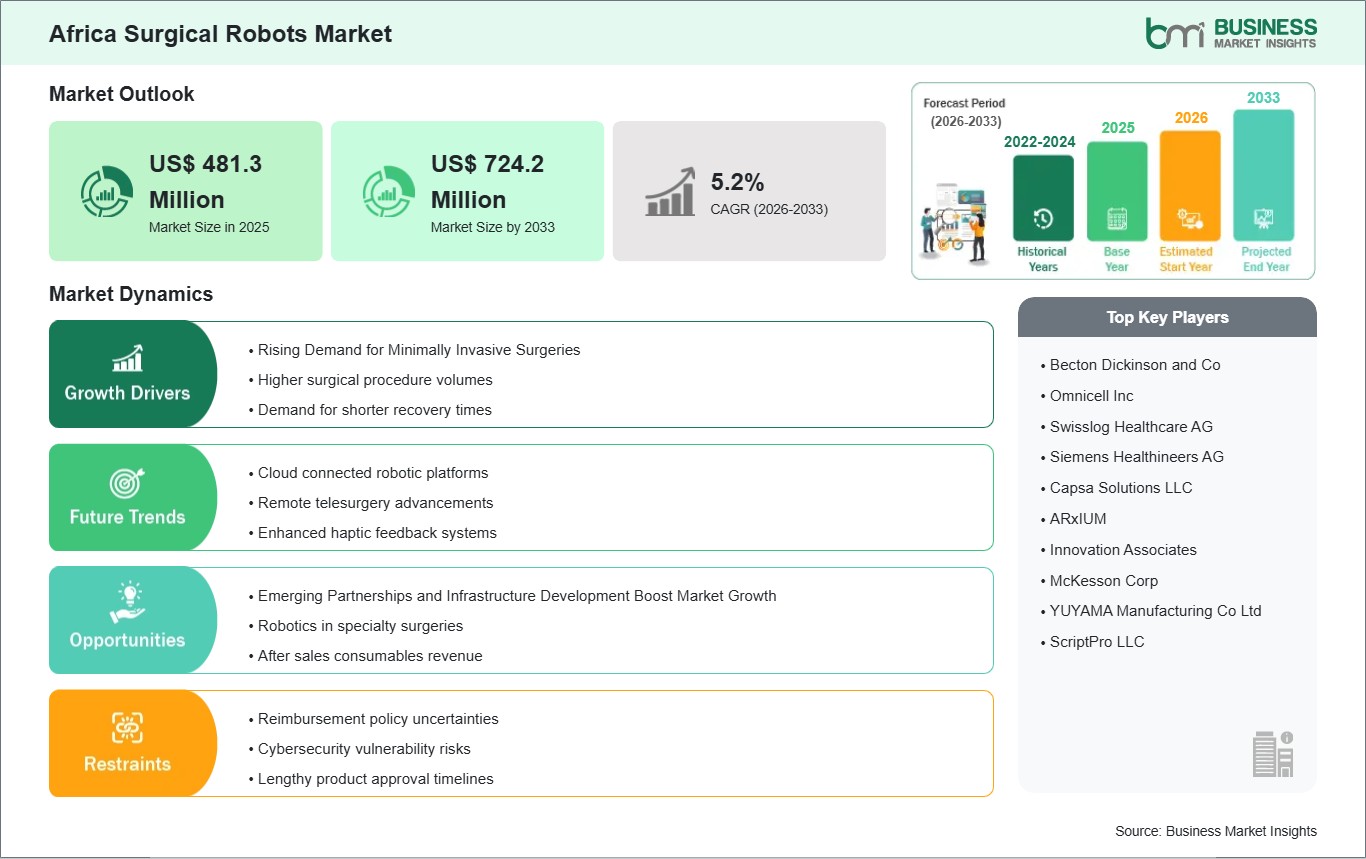
The Africa surgical robots market is undergoing a structural transformation driven by the modernization of tertiary healthcare institutions, rising procedural volumes in minimally invasive surgery, and growing demand for precision-based clinical outcomes. Adoption remains concentrated within leading private hospital networks and academic medical centers, where capital expenditure capacity and specialist availability support integration of robotic-assisted platforms. Increased prevalence of urological, gynecological, colorectal, and cardiothoracic disorders is accelerating interest in robotic interventions that reduce postoperative complications and hospital stays. Strategic collaborations between African healthcare providers and global manufacturers such as Intuitive Surgical, Medtronic, and Stryker Corporation are strengthening technology transfer, clinical training, and after-sales support infrastructure. Market activity is further shaped by regulatory harmonization efforts, evolving reimbursement discussions in select private insurance segments, and hospital branding strategies focused on attracting medical tourism. Adoption barriers include high procurement costs, limited robotic surgery certification programs, inconsistent power infrastructure in certain regions, and constrained public-sector funding. Competitive positioning increasingly hinges on service contracts, surgeon training ecosystems, system versatility, and digital integration capabilities. As procurement decisions shift toward value-based healthcare models, vendors are aligning offerings with long-term cost efficiency, improved surgical throughput, and data-driven performance analytics, reinforcing the market's gradual but strategic expansion trajectory.
Segment Analysis
Africa Surgical Robots Market Segmentation
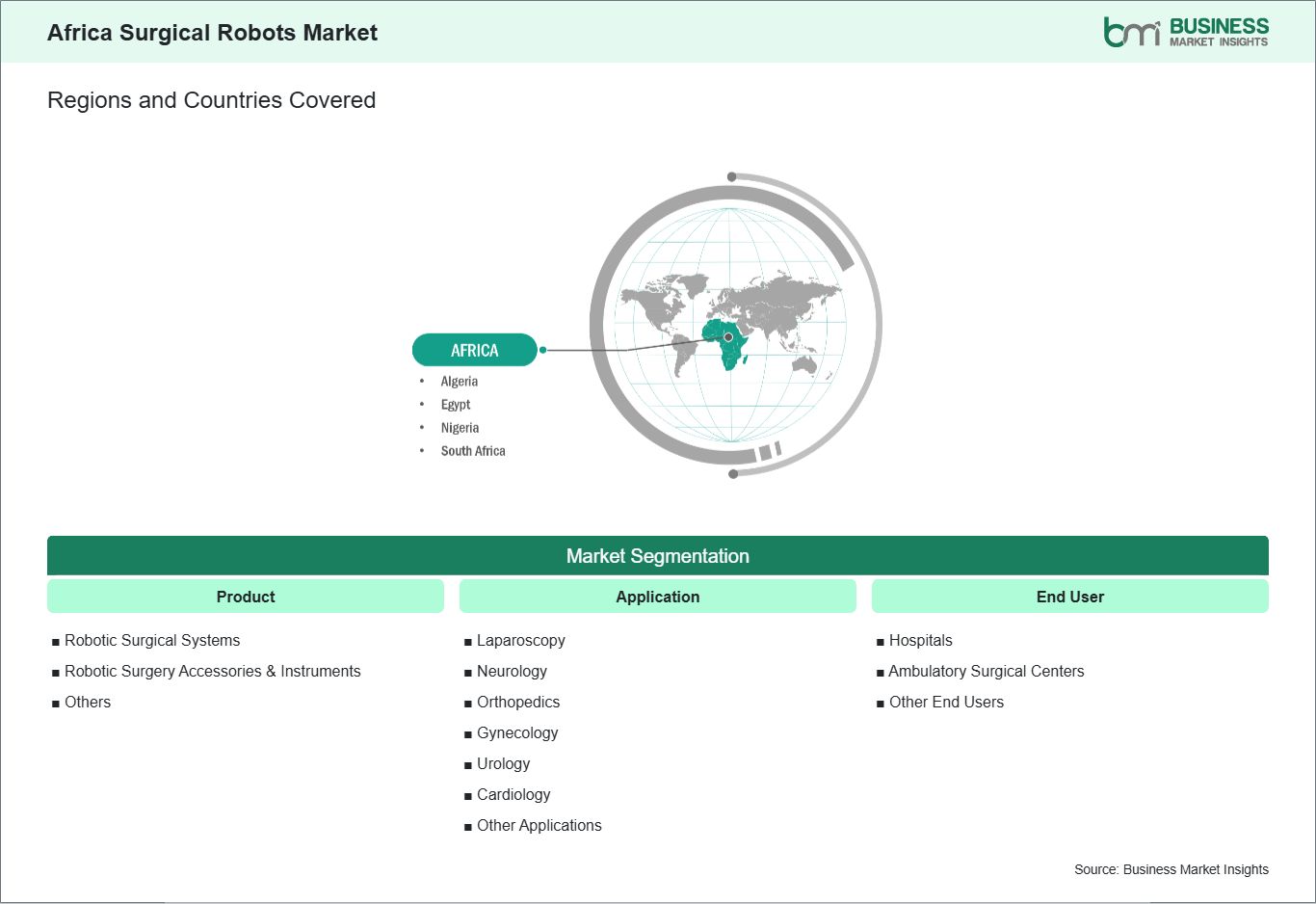
Key segments that contributed to the derivation of the Africa Surgical Robots Market analysis are product, application, and end user.
- By product, the surgical robots market is segmented into robotic surgical systems, robotic surgery accessories & instruments, and others. The robotic surgery accessories & instruments segment dominated the market in 2025.
- In terms of application, the surgical robots market is categorized into laparoscopy, neurology, orthopedics, gynecology, urology, cardiology, and other applications. The laparoscopy segment dominated the market in 2025.
- Based on end user, the surgical robots market is classified into hospitals, ambulatory surgical centers, and other end users. The hospitals segment dominated the market in 2025.
Market Forces
Africa Surgical Robots Market Drivers and Opportunities
Rising Demand for Minimally Invasive Surgeries
Patients across major urban centers in Africa are getting increasingly aware of advanced treatment options. They are actively seeking surgical solutions that offer reduced pain, shorter hospital stays, and faster recovery times. This shift in patient expectations is encouraging healthcare providers to explore robotic-assisted technologies that enhance surgical precision and improve clinical outcomes. Private hospitals in countries such as South Africa, Egypt, and Kenya are positioning themselves as centers of excellence by integrating robotic systems into their operating theaters. These facilities are leveraging robotic platforms to strengthen their competitive advantage, attract medical tourism, and retain skilled surgeons who prefer working with advanced technologies. As a result, robotic-assisted procedures are gradually becoming part of standard surgical offerings in well-equipped metropolitan hospitals. In addition, the rising burden of chronic diseases requiring surgical intervention is contributing to the demand for advanced surgical solutions. Healthcare providers are recognizing that robotic systems can support complex procedures with greater consistency and control. Although adoption remains concentrated in higher-income urban areas, the overall trend indicates steady growth in interest for minimally invasive robotic surgery across the continent.
Emerging Partnerships and Infrastructure Development Boost Market Growth
Healthcare systems across Africa are undergoing structural improvements, creating a more favorable environment for advanced medical technologies. Governments and private investors are expanding hospital infrastructure, modernizing surgical departments, and strengthening specialty care services. These developments are opening opportunities for the integration of robotic systems into newly established and upgraded facilities. Emerging economies within the region are also encouraging partnerships between healthcare institutions and international medical technology providers. Such collaborations support knowledge transfer, clinical training, and technical support, which are essential for the sustainable adoption of surgical robotics. As training capabilities improve, hospitals are better positioned to incorporate robotic platforms into routine surgical workflows. Furthermore, private providers are more agile in adopting innovative technologies and are responding to growing demand from middle-income populations seeking high-quality surgical care. As healthcare access broadens and institutional capabilities strengthen, the Africa surgical robots market is expected to witness continued, gradual expansion across both public and private sectors.
Size and Share Analysis
Africa Surgical Robots Market Size and Share Analysis
The Africa Surgical Robots Market demonstrates steady growth, with size and share analysis highlighting evolving trends and competitive dynamics among key players. The report examines subsegments categorized within product, application, and end user, offering insights into their contribution to overall market performance.
By product, the robotic surgery accessories & instruments segment dominated the market in 2025, driven by the recurring need for consumables and replacement parts required for every robotic procedure, ensuring steady demand and revenue growth.
In terms of application, the laparoscopy segment dominated the market in 2025, driven by the increasing preference for minimally invasive surgeries across surgical specialties, which is expanding the use of laparoscopic robotic systems due to benefits such as reduced recovery time and improved precision.
Based on end user, the hospitals segment dominated the market in 2025, driven by the higher procedure volumes, availability of infrastructure and trained surgical teams, and investment capacity in advanced technologies compared with other care settings.
Report Coverage
Africa Surgical Robots Market Report Coverage and Deliverables
The "Africa Surgical Robots Market Size and Forecast (2022 - 2033)" report provides a detailed analysis of the market covering below areas:
- Africa Surgical Robots Market size and forecast at regional and country levels for all market segments covered under the scope
- Africa Surgical Robots Market trends, as well as drivers, restraints, and opportunities
- Africa Surgical Robots Market analysis covering key trends, regional framework, major players, regulations, and recent developments
- Industry landscape and competition analysis covering market concentration, heat map analysis, prominent players, and recent developments for the Africa Surgical Robots Market
- Detailed company profiles, including SWOT analysis
Geographic Insights
Africa Surgical Robots Market Geographic Insights
The geographical scope of the Africa Surgical Robots Market report is divided into Egypt, South Africa, Nigeria, and Algeria. Nigeria held the largest share in 2025.
Country-level performance across the surgical robots landscape in Africa reflects varying degrees of healthcare infrastructure maturity, capital investment capacity, and institutional readiness. South Africa remains the regional frontrunner, driven by a sophisticated private healthcare sector, well-established tertiary referral centers, and structured specialist training pathways. The presence of internationally accredited hospitals and a competitive private insurance environment has accelerated the integration of robotic-assisted surgical systems, particularly in urology, gynecology, and colorectal specialties. In Egypt, growth is supported by large-scale public healthcare transformation initiatives and increasing investment in smart hospital infrastructure within major metropolitan areas. The country's expanding network of academic medical institutions is fostering surgeon upskilling and research collaborations, strengthening long-term technology adoption capacity. Nigeria represents a high-potential but selective market, where adoption is largely concentrated in premium private hospitals serving high-income patient segments. Procurement decisions are closely tied to foreign exchange dynamics, import regulations, and access to internationally trained surgeons. Meanwhile, Algeria is gradually progressing through government-led healthcare modernization programs aimed at enhancing specialized surgical services within public university hospitals. Although deployment remains at an early stage relative to regional leaders, strategic investments in medical equipment upgrades and physician training initiatives are laying the foundation for future robotic integration. Across these four markets, growth trajectories are shaped by regulatory frameworks, healthcare funding models, and institutional commitment to advanced surgical innovation.
Industry Activity
Recent Developments
The Africa Surgical Robots Market is evaluated by gathering qualitative and quantitative data post primary and secondary research, which includes important corporate publications, association data, and databases. A few of the key developments in the Africa Surgical Robots Market are:
- In November 2025, Nigeria unveiled West Africa's first Toumai robotic surgical system at Nisa Premier Hospital in Abuja, marking a major leap in regional surgical innovation. The platform supports multispecialty procedures, including urology, gynecology, oncology, and general surgery, improving precision and outcomes. This launch was part of a collaboration between Robomed Global (USA) and local partners to train surgeons and reduce reliance on overseas care. The milestone symbolises Nigeria's growing role as a hub for advanced surgical technology in West Africa.
- In March 2025, the University of the Free State in South Africa introduced the Versius surgical robotic system, the first of its kind in this part of Southern Africa. Installed at Universitas Academic Hospital in Bloemfontein, the robot has already been used for several complex procedures, improving precision and reducing recovery time. The deployment highlighted public-private collaboration to enhance access to cutting-edge surgical tech in South Africa's healthcare system. This initiative sets a benchmark for expanding robotic surgery capabilities in sub-Saharan Africa.
Trust & Transparency
Research Methodology
The market analysis combines proprietary research with secondary data from government agencies, company disclosures, regulatory filings, industry databases and expert interviews. Market estimates are validated through data triangulation, cross-market benchmarking and analyst
review.
View Full Research Methodology
Key Sources Referred:
World Health Organization (WHO) Organisation for Economic Cooperation and Development (OECD) The World Bank Group Worldometer The Lancet International Bar Association International Trade Administration