Market Summary
Executive Summary and Global Market Analysis
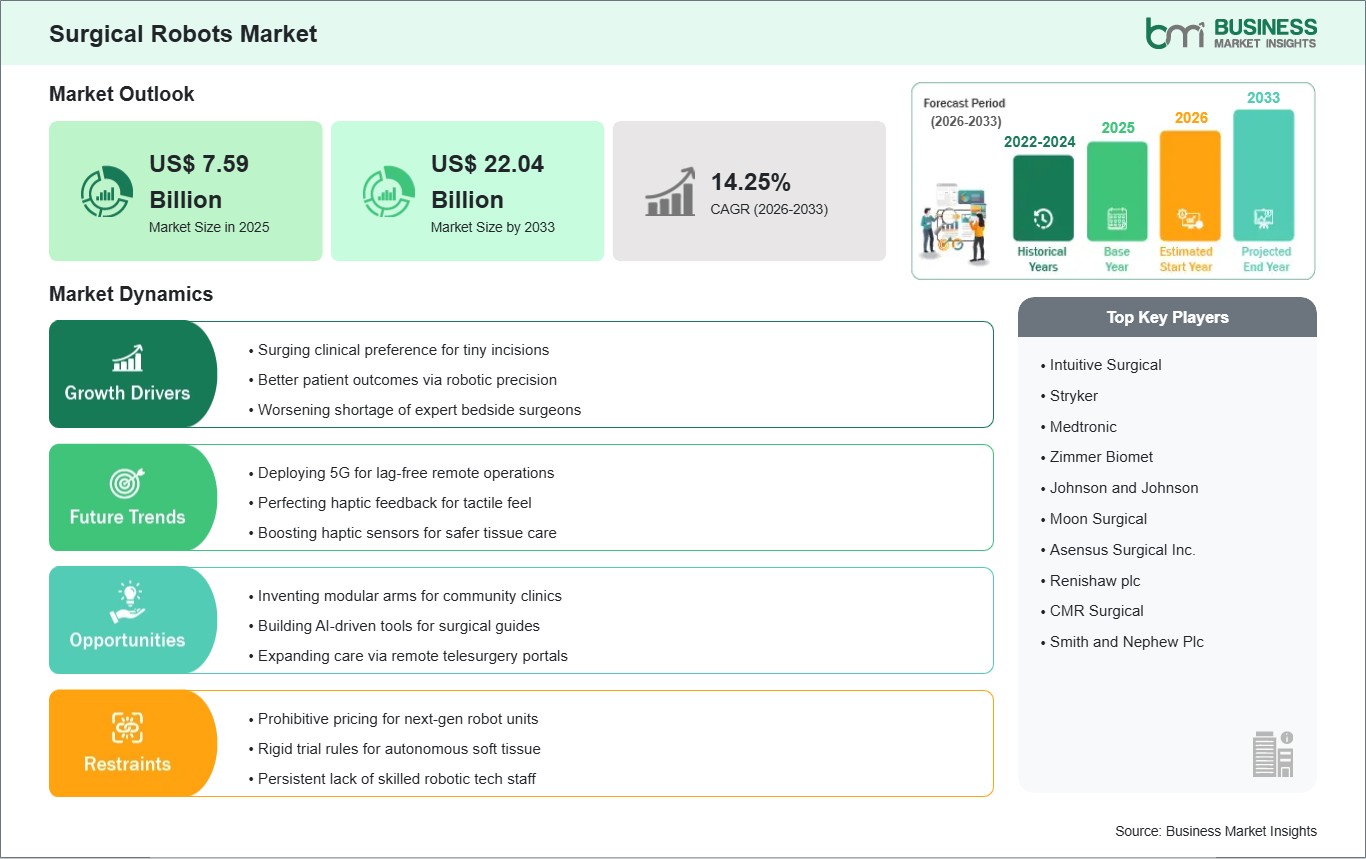
Surgical robots are advanced, computer-controlled systems that assist surgeons in performing procedures with enhanced precision, flexibility, and control compared to conventional techniques. These systems typically consist of a surgeon's console, a patient-side cart with robotic arms, and a high-definition 3D vision system. Robotic-assisted surgery is a form of minimally invasive surgery (MIS) that is increasingly adopted across a multitude of specialties.
The Surgical Robots market is experiencing rapid growth, primarily driven by the increasing global demand for minimally invasive surgical procedures, which offer benefits such as smaller incisions, reduced blood loss, decreased post-operative pain, and shorter hospital stays. Market expansion is further fueled by the rising prevalence of chronic diseases (like cancer and cardiovascular ailments) requiring surgical intervention, the increasing geriatric population prone to such conditions, and continuous technological advancements in robotic systems, including the integration of Artificial Intelligence (AI) and improved visualization.
Segment Analysis
Surgical Robots Market Segmentation
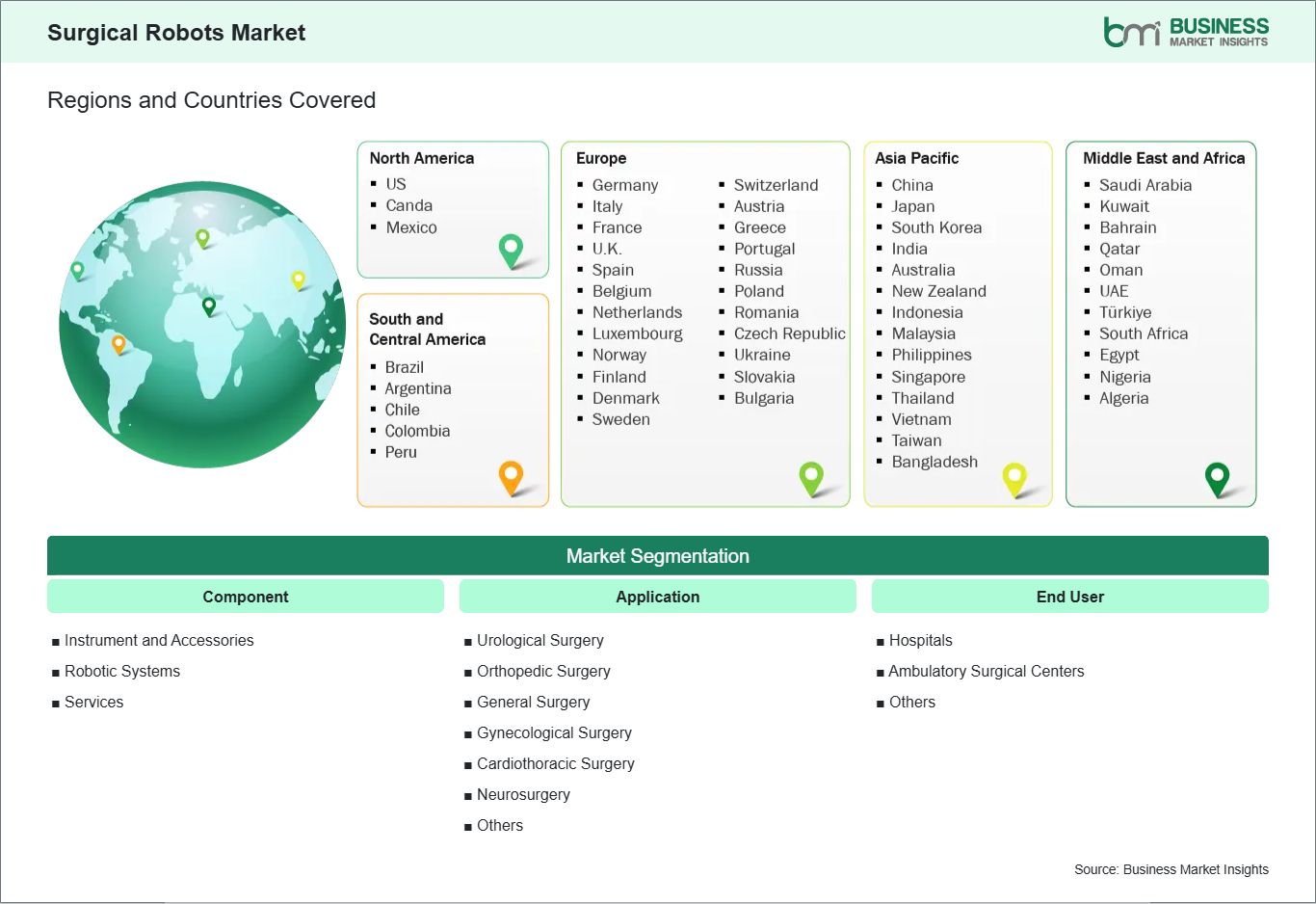
Key segments that contributed to the derivation of the Surgical Robots Market analysis are component, application, and end user.
- By Component, the market is segmented into Instrument and Accessories, Robotic Systems, and Services.
- By Application, the market is segmented into Urological Surgery, Orthopedic Surgery, General Surgery, Gynecological Surgery, Cardiothoracic Surgery, Neurosurgery, and Others.
- By End User, the market is segmented into Hospitals, Ambulatory Surgical Centers, and Others.
Market Forces
Surgical Robots Market Drivers and Opportunities
Rising Demand for Minimally Invasive Surgical Procedures
The paramount driver propelling the Surgical Robots Market is the global trend of shifting from traditional open surgeries to minimally invasive surgical (MIS) procedures. This shift is dramatically amplified by robotic assistance. Patients and healthcare providers increasingly prefer MIS due to its proven clinical advantages, including faster patient recovery times, significantly shorter hospital stays, reduced scarring, and lower risk of complications or hospital-acquired infections. Surgical robots enhance these benefits by providing surgeons with superior visualization through 3D high-definition imaging, greater dexterity, and a wider range of motion than the human wrist, which allows for more complex and precise maneuvers in confined anatomical spaces. This combination of better patient outcomes and improved surgical precision solidifies robotic-assisted surgery as the gold standard for many procedures, thereby driving consistent demand for new systems and recurring purchases of instruments and accessories.
Integration of Artificial Intelligence and Machine Learning
A significant market opportunity lies in the deeper integration of Artificial Intelligence (AI) and Machine Learning (ML) into surgical robotic platforms, transforming them into "smart" autonomous or semi-autonomous systems. This integration goes beyond simple automation and involves using AI to process real-time surgical data, provide predictive analytics, and assist in critical decision-making during an operation. For instance, AI can be used for pre-operative planning, automated image recognition to highlight critical anatomical structures (like nerves or blood vessels), and to correct subtle movements or tremors, significantly enhancing the surgeon's capabilities. Furthermore, ML algorithms can analyze a vast library of past surgical videos to offer real-time, evidence-based guidance to the surgeon, potentially reducing variability in outcomes and steepening the learning curve for new robotic surgeons. This technological frontier promises to expand the application of surgical robotics, particularly in complex and delicate procedures like neurosurgery and cardiovascular surgery, by offering a higher degree of safety and precision.
Size and Share Analysis
Surgical Robots Market Size and Share Analysis
The Surgical Robots Market demonstrates robust growth, with size and share analysis revealing the strong competitive positioning of established players and the emergence of new technologies. The report further examines subsegments categorized within component, application, and end user, offering insights into their contribution to overall market performance.
For instance, Instruments & Accessories is the dominant sub-segment in the market by component. Their popularity stems from the fact that these are recurring purchases, often disposable or having a limited lifespan, creating a steady and lucrative revenue stream for manufacturers, unlike the one-time capital expense of the robotic system itself. Urological Surgery and General Surgery are the largest revenue-generating application segments due to the high volume of procedures like prostatectomy, hernia repair, and cholecystectomy that have successfully adopted robotic assistance. Hospitals remain the largest end-user segment, driven by the high volume of procedures, the need for advanced infrastructure, and the high initial capital investment required for robotic systems.
Report Coverage
Surgical Robots Market Report Coverage and Deliverables
The "Surgical Robots Market Size and Forecast (2022 - 2033)" report provides a detailed analysis of the market covering below areas:
- Surgical Robots Market size and forecast at global, regional, and country levels for all the key market segments covered under the scope
- Surgical Robots Market trends, as well as market dynamics such as drivers, restraints, and key opportunities
- Surgical Robots Market analysis covering key market trends, global and regional framework, major players, regulations, and recent market developments
- Industry landscape and competition analysis covering market concentration, heat map analysis, prominent players, and recent developments for the Surgical Robots Market
- Detailed company profiles, including SWOT analysis
Geographic Insights
Surgical Robots Market Geographic Insights
The geographical scope of the Surgical Robots Market report is divided into five regions: North America, Asia Pacific, Europe, Middle East & Africa, and South & Central America.
North America is the dominant region in the Surgical Robots Market, holding the largest revenue share, owing to advanced healthcare infrastructure, high healthcare expenditure (both public and private), a high concentration of key market players, and the early and widespread adoption of robotic-assisted procedures in clinical practice.
Asia Pacific is projected to be the fastest-growing region, driven by rapidly improving healthcare infrastructure, increasing disposable incomes, government initiatives to promote medical technology adoption, a growing patient pool requiring complex surgeries, and increasing medical tourism.
Industry Activity
Recent Developments
The Surgical Robots Market is evaluated by gathering qualitative and quantitative data post-primary and secondary research, which includes important corporate publications, association data, and databases. A few of the key developments in the Surgical Robots Market are:
- In December 2025, Medtronic, a global leader in surgical innovation, announced the U.S. Food and Drug Administration (FDA) had cleared the Hugo™ robotic-assisted surgery (RAS) system for use in urologic surgical procedures. The Hugo RAS system's clearance brings a versatile robotic-assisted platform to U.S. surgeons and health systems seeking to expand soft-tissue robotic surgery programs and access to minimally invasive care.
- In October 2025, Johnson & Johnson MedTech, a global leader in surgical technologies and solutions, announced advancements in developing the company’s robotics systems with physical artificial intelligence (AI) technologies that create simulated environments to accelerate future product innovation, optimize clinical workflows, and improve training for clinical teams.
- In October 2025, Intuitive, a global technology leader in minimally invasive care and the pioneer of robotic-assisted surgery, announced that the U.S. Food & Drug Administration (FDA) had cleared software advancements for the Ion endoluminal system (Ion). Ion, Intuitive’s robotic-assisted bronchoscopy platform, features an ultra-thin, shape-sensing catheter designed to navigate deep into the lung. This advanced technology enables physicians to access small, hard-to-reach nodules and precisely position biopsy tools to sample potentially cancerous tissue.
Trust & Transparency
Research Methodology
The market analysis combines proprietary research with secondary data from government agencies, company disclosures, regulatory filings, industry databases and expert interviews. Market estimates are validated through data triangulation, cross-market benchmarking and analyst
review.
View Full Research Methodology
Key Sources Referred:
World Bank - Global Trade Indicators World Trade Organization (WTO) International Monetary Fund (IMF) International Trade Administration (ITA) Company Websites Company Annual Reports Company Investor Presentations