Market Summary
Executive Summary and Market Analysis
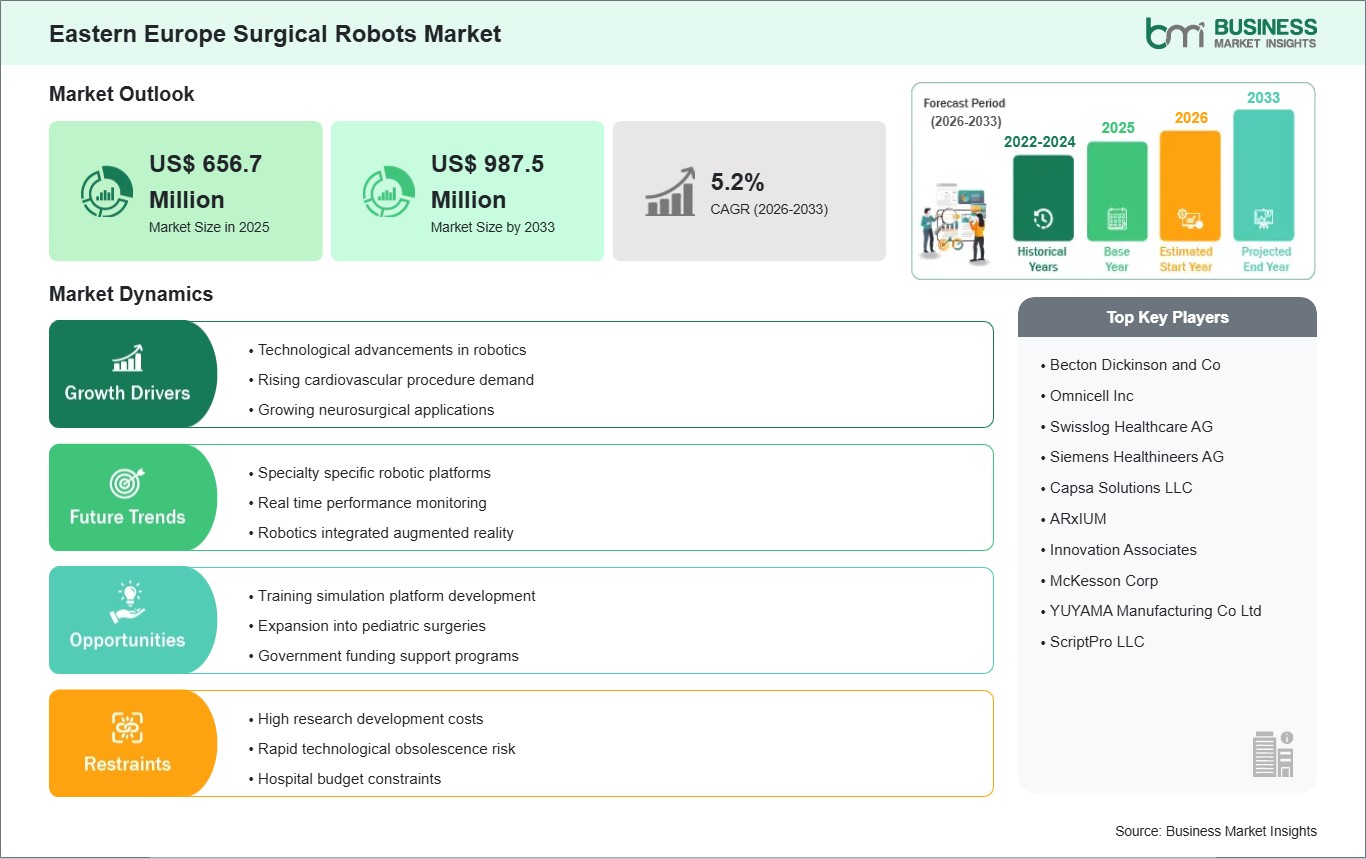
The Eastern Europe surgical robots market is gradually maturing, driven by increasing hospital modernization initiatives, rising prevalence of chronic and lifestyle-related diseases, and the growing demand for precision-based surgical care. Adoption is concentrated in urban tertiary care hospitals and private specialty centers that can support the significant capital investment required for robotic-assisted surgical systems. The market is characterized by a focus on urology, gynecology, cardiothoracic, and colorectal procedures, where robotic platforms provide high dexterity and reduce intraoperative variability, improving patient outcomes and shortening hospital stays. Leading global manufacturers such as Intuitive Surgical, Medtronic, and Stryker Corporation have strengthened their presence through regional distributors, training programs, and service agreements, ensuring operational continuity and skill development. Market growth is also influenced by healthcare institutions seeking to attract international patients and position themselves as centers of surgical excellence. However, barriers remain in the form of limited reimbursement frameworks, budgetary constraints in public hospitals, and inconsistent surgeon training availability across Eastern Europe. Competitive strategies increasingly rely on bundled solutions that integrate imaging systems, AI-enabled surgical planning, and tele-mentoring capabilities. Additionally, hospitals are emphasizing long-term return on investment by selecting platforms capable of supporting multiple surgical specialties. Overall, the Eastern Europe surgical robots market is in a phase of strategic adoption, with growth focused on combining clinical precision, operational efficiency, and the capacity to meet evolving patient expectations.
Segment Analysis
Eastern Europe Surgical Robots Market Segmentation
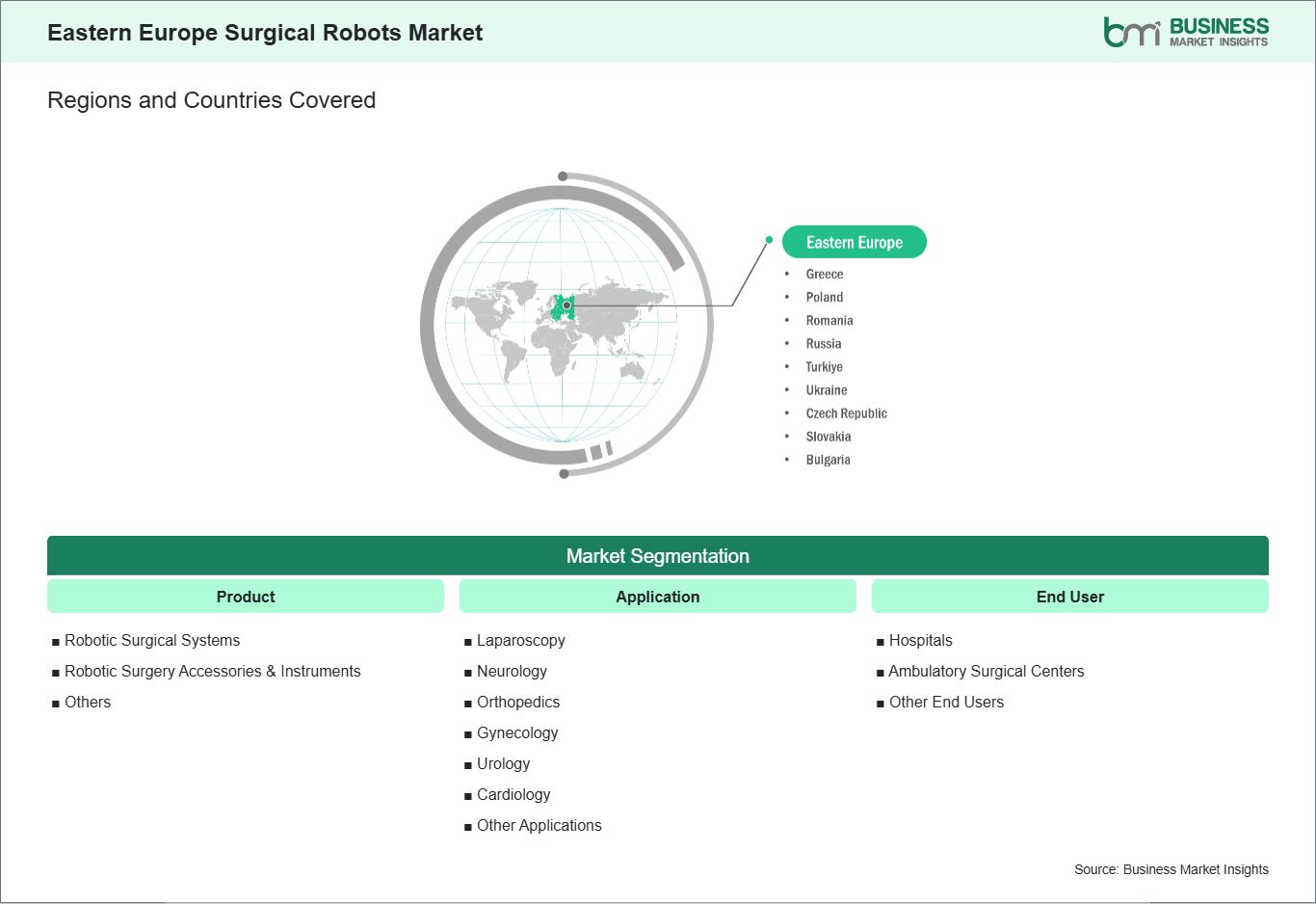
Key segments that contributed to the derivation of the Eastern Europe Surgical Robots Market analysis are product, application, and end user.
- By product, the surgical robots market is segmented into robotic surgical systems, robotic surgery accessories & instruments and others. The robotic surgery accessories & instruments segment dominated the market in 2025.
- In terms of application, the surgical robots market is categorized into laparoscopy, neurology, orthopedics, gynecology, urology, cardiology and other applications. The laparoscopy segment dominated the market in 2025.
- Based on end user, the surgical robots market is classified into hospitals, ambulatory surgical centers and other end users. The hospitals segment dominated the market in 2025.
Market Forces
Eastern Europe Surgical Robots Market Drivers and Opportunities
Technological advancements in robotics
In the Eastern Europe surgical robots market, technological advancements are rapidly reshaping clinical capabilities and healthcare delivery. Countries such as Poland, Czech Republic, Hungary, Romania, and Ukraine are witnessing increased interest in next‑generation robotic systems that offer superior precision, multi‑instrument flexibility, and enhanced imaging integration. Healthcare leaders in these markets recognize that innovation in robotics can address longstanding challenges in surgical accuracy and operative efficiency, especially for complex procedures in urology, gynecology, and oncology where precision directly influences patient outcomes. Hospitals in Eastern Europe are progressively adopting robotic platforms that incorporate artificial intelligence, improved haptic feedback, and automated motion scaling to support surgeons in demanding clinical environments. These enhancements help reduce surgeon fatigue during prolonged operations and enable more consistent procedural performance across diverse case types. For example, tertiary care centers in Warsaw and Budapest are deploying systems equipped with advanced end‑effectors and superior visualization to support minimally invasive surgery. The growing focus on improved ergonomics and data‑driven surgical support is strengthening confidence among clinicians who have historically relied more heavily on traditional surgical techniques. Moreover, partnerships between Eastern European medical institutions and international robotics developers are accelerating the pace of technological integration. Collaborative research projects, pilot programs, and localized customization of robotic platforms are enabling hospitals to tailor solutions to regional caseloads and clinical preferences. This emphasis on innovation is also encouraging local supply chain development for robotics accessories and software tools, supporting broader ecosystem maturity. As Eastern Europe continues to invest in cutting‑edge surgical technology, the market is positioned for steady growth, with advanced robotics becoming central to modern surgical strategy across both public and private sectors.
Training simulation platform development
Training simulation platforms are increasingly recognized as essential enablers of successful surgical robotics adoption in Eastern Europe. As hospitals introduce advanced robots into clinical practice, the need for structured training pathways that build surgeon competence and confidence is becoming paramount. Simulation technologies, including virtual reality (VR) and augmented reality (AR) modules, are being used more frequently in surgical education programs at major medical universities in Krakow, Prague, and Bucharest, helping to close the skills gap between traditional surgical techniques and robot‑assisted procedures. Simulation platforms allow surgeons to rehearse complex interventions in risk‑free environments, accelerating their learning curve and improving proficiency before working with patients. In Poland and Hungary, healthcare institutions are collaborating with robotics vendors to develop tailored simulation curricula that reflect regional procedural priorities and case mixes. These programs often include standardized performance benchmarks and objective assessment tools, enabling participants to monitor improvement and certification readiness. By embedding simulation into core training pathways, Eastern European providers are strengthening workforce capabilities that support safe, effective robotic surgery adoption. In addition, training simulation development is fostering broader educational ecosystems within the region. Simulation centers are emerging as hubs of surgical excellence, attracting trainees from neighboring countries and facilitating cross‑institutional knowledge exchange. These centers often partner with surgical societies and academic bodies to host workshops, hands‑on labs, and multidisciplinary training events focused on robotics, further building regional expertise. As simulation platforms continue to expand, Eastern Europe is establishing a sustainable foundation for high‑quality robotic surgical practice that supports long‑term clinical growth and improved patient care.
Size and Share Analysis
Eastern Europe Surgical Robots Market Size and Share Analysis
The Eastern Europe Surgical Robots Market demonstrates steady growth, with size and share analysis highlighting evolving trends and competitive dynamics among key players. The report examines subsegments categorized within product, application, and end user, offering insights into their contribution to overall market performance.
By product, the robotic surgery accessories & instruments segment dominated the market in 2025, driven by the recurring, procedure‑specific demand for consumables and precision tools required in nearly all robotic surgical procedures, ensuring continuous revenue growth.
In terms of application, the laparoscopy segment dominated the market in 2025, driven by the increasing adoption of minimally invasive laparoscopic robotic procedures, which offer enhanced precision, smaller incisions, reduced complications, and faster patient recovery.
Based on end user, the hospitals segment dominated the market in 2025, driven by their advanced infrastructure, high surgical volumes, financial capacity to invest in robotic systems, and the presence of skilled multidisciplinary surgical teams.
Report Coverage
Eastern Europe Surgical Robots Market Report Coverage and Deliverables
The "Eastern Europe Surgical Robots Market Size and Forecast (2022 - 2033)" report provides a detailed analysis of the market covering below areas:
- Eastern Europe Surgical Robots Market size and forecast at regional and country levels for all market segments covered under the scope
- Eastern Europe Surgical Robots Market trends, as well as drivers, restraints, and opportunities
- Eastern Europe Surgical Robots Market analysis covering key trends, regional framework, major players, regulations, and recent developments
- Industry landscape and competition analysis covering market concentration, heat map analysis, prominent players, and recent developments for the Eastern Europe Surgical Robots Market
- Detailed company profiles, including SWOT analysis
Geographic Insights
Eastern Europe Surgical Robots Market Geographic Insights
The geographical scope of the Eastern Europe Surgical Robots Market report is divided into Russia, Poland, Ukraine, Romania, the Czech Republic, Slovakia, Bulgaria, and Greece. Russia held the largest share in 2025.
Country-level dynamics in Eastern Europe reveal a highly varied adoption of surgical robots, driven by differences in healthcare infrastructure, funding models, and institutional priorities. Russia is the dominant market in the region, with high-volume urban hospitals and academic medical centers leading deployment. Robotic-assisted systems are primarily used for urology, oncology, cardiothoracic, and gynecological procedures, supported by government-led hospital modernization programs, robust capital investments, and a strong network of trained surgeons. Poland demonstrates strong adoption within private hospitals and tertiary care centers, focusing on high-complexity procedures such as minimally invasive oncological and urological surgeries, often backed by partnerships with global manufacturers for training and maintenance. Ukraine shows selective integration in urban hospitals, leveraging pilot programs and international collaborations to develop local surgeon expertise while managing capital constraints. In Romania, adoption is concentrated in leading university hospitals and private specialty centers, with robotics used to enhance surgical precision in cardiology, oncology, and gynecology. Czech Republic and Slovakia are gradually expanding robotics in public teaching hospitals and private urban centers, focusing on high-demand procedures and leveraging government incentives for infrastructure modernization. Bulgaria is an emerging market with limited adoption, mostly in private hospitals in Sofia and Plovdiv, where advanced surgical services are prioritized for high-income patients. Finally, Greece shows selective deployment in tertiary hospitals, driven by urban private institutions and specialized surgical centers. Across these markets, adoption is influenced by regulatory clarity, hospital funding models, surgeon expertise, and strategic prioritization of advanced surgical care. Russia’s leadership in adoption establishes it as the benchmark for regional deployment, while other countries follow phased, strategic integration reflecting local healthcare capacity and investment priorities.
Industry Activity
Recent Developments
The Eastern Europe Surgical Robots Market is evaluated by gathering qualitative and quantitative data post primary and secondary research, which includes important corporate publications, association data, and databases. A few of the key developments in the Eastern Europe Surgical Robots Market are:
- In August 2025, Polish surgeons used the EDGE MP1000 surgical robot to perform a remote coronary bypass and prostatectomy, operating on patients in Warsaw while controlling the robot from Gdańsk. The procedures spanning over 350 km were reported as Europe’s first remote robotic heart and urology surgeries with ultra‑low latency control. This milestone demonstrated next‑generation robotic telesurgery capabilities in Eastern Europe. It also showcased how emerging platforms like EDGE MP1000 can expand advanced care beyond traditional operating rooms.
- In December 2025, the Wielkopolskie Oncology Centre in Poznań began using the latest Intuitive da Vinci 5 surgical robot for routine operations. The introduction of this fifth‑generation platform marks a significant upgrade in robotic surgery technology available within Poland, particularly for complex cancer and soft‑tissue procedures. Hospital teams reported improved precision and surgical ergonomics compared with older systems. This launch signals broader adoption of cutting‑edge robotic platforms in Eastern European surgical care.
Trust & Transparency
Research Methodology
The market analysis combines proprietary research with secondary data from government agencies, company disclosures, regulatory filings, industry databases and expert interviews. Market estimates are validated through data triangulation, cross-market benchmarking and analyst
review.
View Full Research Methodology
Key Sources Referred:
World Health Organization (WHO) Organisation for Economic Cooperation and Development (OECD) The World Bank Group Worldometer The Lancet International Bar Association International Trade Administration