Market Summary
Executive Summary and Market Analysis
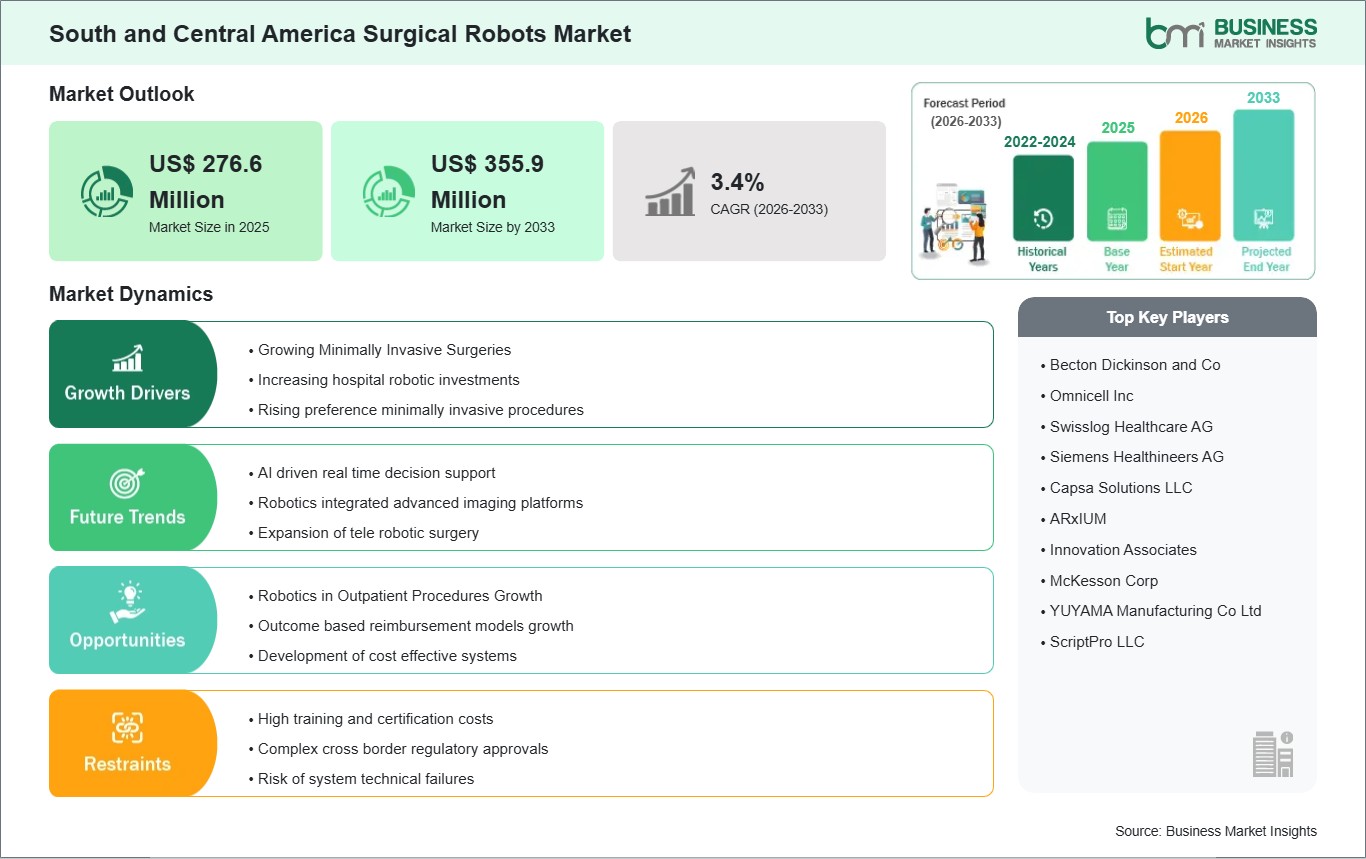
The surgical robots market in South and Central America is experiencing gradual adoption, largely concentrated in urban tertiary hospitals and private healthcare institutions with advanced surgical infrastructure. The market is driven by rising demand for minimally invasive procedures across specialties such as urology, oncology, gynecology, and cardiothoracic surgery. Hospitals are increasingly investing in robotic-assisted surgery to enhance procedural accuracy, minimize complications, and improve patient recovery timelines. Beyond clinical outcomes, robotic systems are leveraged as a strategic differentiator, enhancing hospital reputation and attracting both domestic and international patients seeking high-quality surgical care. Key factors influencing adoption include availability of trained surgeons, institutional readiness, procedural volume, and alignment with national healthcare priorities. Public hospitals face slower integration due to budgetary limitations, infrastructure constraints, and fragmented procurement processes, whereas private hospitals often lead adoption due to flexible capital allocation and a focus on competitive positioning. The region’s healthcare landscape is also influenced by the growing popularity of medical tourism, which incentivizes hospitals to invest in advanced surgical technologies. Decision-makers prioritize robotic platforms that offer multi-specialty functionality, operational efficiency, and compatibility with imaging and hospital management systems to maximize return on investment. Challenges include limited surgeon training programs, high upfront costs, and heterogeneous regulatory frameworks across countries. Despite these hurdles, the market shows steady growth potential, supported by increasing patient awareness of minimally invasive procedures, ongoing modernization of hospital infrastructure, and demographic trends, including aging populations and rising incidence of chronic diseases. Overall, the South and Central America surgical robots market is evolving into a strategically important segment, combining clinical innovation with operational and marketing benefits for leading hospitals.
Segment Analysis
South and Central America Surgical Robots Market Segmentation
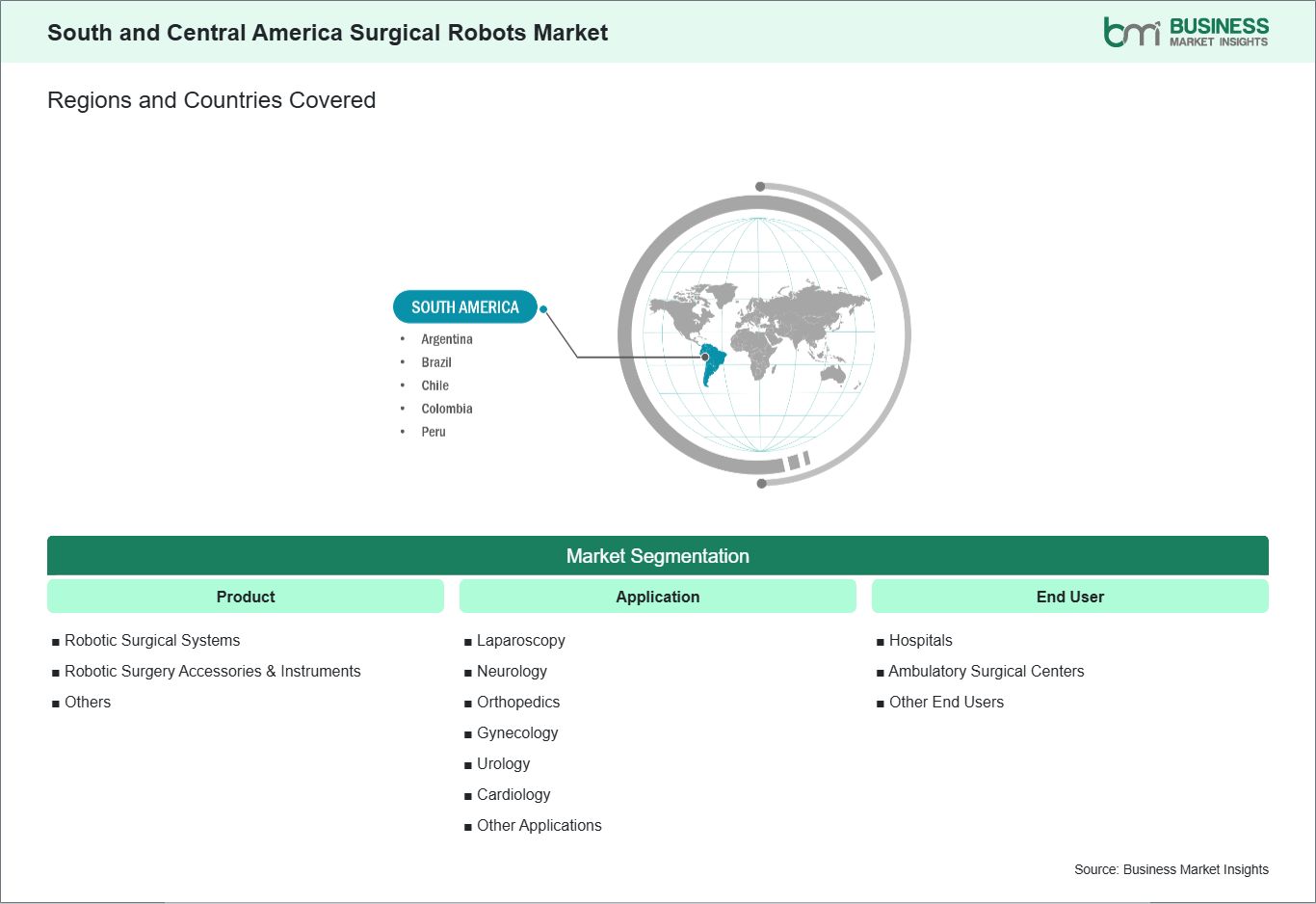
Key segments that contributed to the derivation of the South and Central America Surgical Robots Market analysis are product, application, and end user.
- By product, the surgical robots market is segmented into robotic surgical systems, robotic surgery accessories & instruments, others. The robotic surgery accessories & instruments segment dominated the market in 2025.
- In terms of application, the surgical robots market is categorized into laparoscopy, neurology, orthopedics, gynecology, urology, cardiology, other applications. The laparoscopy segment dominated the market in 2025.
- Based on end user, the surgical robots market is classified into hospitals, ambulatory surgical centers, other end users. The hospitals segment dominated the market in 2025.
Market Forces
South and Central America Surgical Robots Market Drivers and Opportunities
Growing Minimally Invasive Surgeries
In the South and Central America surgical robots market, growth in minimally invasive surgeries is one of the most influential trends driving adoption of robotic systems. Across urban centers in Brazil, Argentina, Chile, Colombia, and Mexico, there is rising demand among patients and surgeons for procedures that reduce postoperative pain, minimize scarring, and shorten hospital stays. Minimally invasive techniques are becoming increasingly preferred for conditions such as gynecologic disorders, urologic diseases, and bariatric indications, encouraging hospitals to adopt robotics that support these approaches. Healthcare providers in the region are placing particular emphasis on improving clinical outcomes while managing capacity constraints. Large institutions in cities such as São Paulo, Buenos Aires, Santiago, and Bogotá are investing in robotic platforms that can consistently deliver precision in laparoscopic environments, even for complex cases. This focus is supported by a growing community of surgeons trained in advanced minimally invasive techniques, who view robotics as a way to elevate procedural quality and expand the types of surgeries offered locally without referring patients abroad. Educational and promotional efforts are reinforcing awareness of the benefits of minimally invasive surgery across South and Central America. Professional societies and centers of excellence are hosting regional conferences and skills‑based workshops to increase clinician familiarity with robotics‑assisted procedures. Hospitals are also sharing case outcomes publicly to demonstrate reduced complication rates and enhanced recovery profiles, which helps build patient trust and drives demand. As clinical confidence continues to strengthen and infrastructure matures, minimally invasive surgery is expanding its role as a core driver of surgical robotics market growth throughout the region.
Robotics in Outpatient Procedures Growth
Robotics in outpatient procedures is gaining momentum across South and Central America as healthcare systems seek ways to expand surgical capacity beyond traditional hospitals. Ambulatory surgical centers and specialized clinics in Mexico City, Sao Paulo metropolitan area, and Buenos Aires suburbs are beginning to adopt compact robotic solutions optimized for outpatient settings. These systems support procedures that do not require overnight hospitalization, including select general surgery, gynecologic, and urological interventions, allowing providers to treat more patients with greater efficiency. The shift toward robotics in outpatient environments is supported by changing patient expectations and surgical care pathways that emphasize convenience and recovery at home. Patients increasingly prefer surgical options that allow them to return to daily activities more quickly, and robotic technologies are well‑positioned to deliver on this expectation by promoting less invasive access and enhanced precision. Clinics that invest in robotic systems are marketing these capabilities to attract a broader patient base and differentiate their services in competitive local markets. Funding models and procedural reimbursement structures are also evolving to support outpatient robotics adoption. Private insurers and patient financing options in countries like Chile, Colombia, and Peru are beginning to recognize the value of robotics when used in appropriate outpatient contexts, reducing financial barriers for smaller facilities. Collaboration between outpatient centers and larger referral hospitals is helping ensure surgeon training and case selection support safe, high‑quality care. As healthcare delivery continues to decentralize in the region, robotics in outpatient procedures is poised to become an important growth segment within the broader surgical robots market.
Size and Share Analysis
South and Central America Surgical Robots Market Size and Share Analysis
The South and Central America Surgical Robots Market demonstrates steady growth, with size and share analysis highlighting evolving trends and competitive dynamics among key players. The report examines subsegments categorized within product, application, and end user, offering insights into their contribution to overall market performance.
By product, the robotic surgery accessories & instruments segment dominated the market in 2025, driven by the recurring and high replacement demand for consumable tools required in every robotic procedure, creating continuous revenue as surgical adoption grows.
In terms of application, the laparoscopy segment dominated the market in 2025, driven by the increasing preference for minimally invasive robotic‑assisted laparoscopic procedures that offer reduced recovery time and improved clinical outcomes.
Based on end user, the hospitals segment dominated the market in 2025, driven by their advanced infrastructure, higher surgical volumes, and financial capacity to invest in and support complex robotic systems.
Report Coverage
South and Central America Surgical Robots Market Report Coverage and Deliverables
The "South and Central America Surgical Robots Market Size and Forecast (2022 - 2033)" report provides a detailed analysis of the market covering below areas:
- South and Central America Surgical Robots Market size and forecast at regional and country levels for all market segments covered under the scope
- South and Central America Surgical Robots Market trends, as well as drivers, restraints, and opportunities
- South and Central America Surgical Robots Market analysis covering key trends, regional framework, major players, regulations, and recent developments
- Industry landscape and competition analysis covering market concentration, heat map analysis, prominent players, and recent developments for the South and Central America Surgical Robots Market
- Detailed company profiles, including SWOT analysis
Geographic Insights
South and Central America Surgical Robots Market Geographic Insights
The geographical scope of the South and Central America Surgical Robots Market report is divided into Brazil, Argentina, Peru, Chile, and Colombia. Brazil held the largest share in 2025.Adoption patterns across South and Central America reveal a heterogeneous market shaped by healthcare infrastructure, hospital funding models, and government priorities. Brazil dominates regional deployment, with robotic-assisted systems primarily concentrated in metropolitan private hospitals and tertiary care centers. Adoption emphasizes high-volume procedures in urology, oncology, and bariatric surgery, while also supporting medical tourism initiatives. Mexico has witnessed rapid adoption in leading urban hospitals, focusing on minimally invasive general surgery and gynecology, complemented by structured surgeon training programs to ensure proficiency. In Argentina, robotic systems are integrated into university hospitals and select private institutions, supporting research, clinical trials, and multi-specialty applications. Chile maintains selective adoption in tertiary hospitals, prioritizing procedural precision and operational workflow optimization. Colombia is gradually expanding robotic surgery programs in major urban centers, emphasizing high-complexity interventions and collaborative training initiatives. Across the region, public hospitals often face adoption constraints due to infrastructure and financial limitations, whereas private hospitals lead in integrating robotics into their service offerings. Factors influencing adoption include hospital capital availability, surgeon expertise, patient demand, and regional policies. Collectively, South and Central America presents a dynamic market where adoption is concentrated in leading urban hospitals, with phased integration strategies shaping growth across secondary centers, positioning the region for long-term expansion in robotic-assisted surgical services.
Industry Activity
Recent Developments
The South and Central America Surgical Robots Market is evaluated by gathering qualitative and quantitative data post primary and secondary research, which includes important corporate publications, association data, and databases. A few of the key developments in the South and Central America Surgical Robots Market are:
- In December 2024, MicroPort MedBots Toumai laparoscopic surgical robot received market approval from Brazil’s National Health Surveillance Agency (ANVISA), enabling its clinical use for robot‑assisted surgeries across Brazil. The approval marked a major step for robotic surgery technology in Latin America and was celebrated with a launch event in São It set the stage for broader commercial deployment and training in the region. This regulatory milestone catalyzed robotic surgery adoption in South America.
- In January 2025, the MicroPort MedBot SkyWalker orthopaedic robotic system completed its first clinical total knee arthroplasty (TKA) at Vera Cruz Hospital in São Paulo. This launch brought advanced AI‑assisted orthopaedic robotics to the South American market and enhanced precision in joint replacement surgery. The procedure highlighted the growing role of robotic systems in specialty surgical applications across Latin America. It underlined a new era for orthopaedic robotic care in the region.
Trust & Transparency
Research Methodology
The market analysis combines proprietary research with secondary data from government agencies, company disclosures, regulatory filings, industry databases and expert interviews. Market estimates are validated through data triangulation, cross-market benchmarking and analyst
review.
View Full Research Methodology
Key Sources Referred:
World Health Organization (WHO) Organisation for Economic Cooperation and Development (OECD) The World Bank Group Worldometer The Lancet International Bar Association International Trade Administration