Market Summary
Executive Summary and Market Analysis
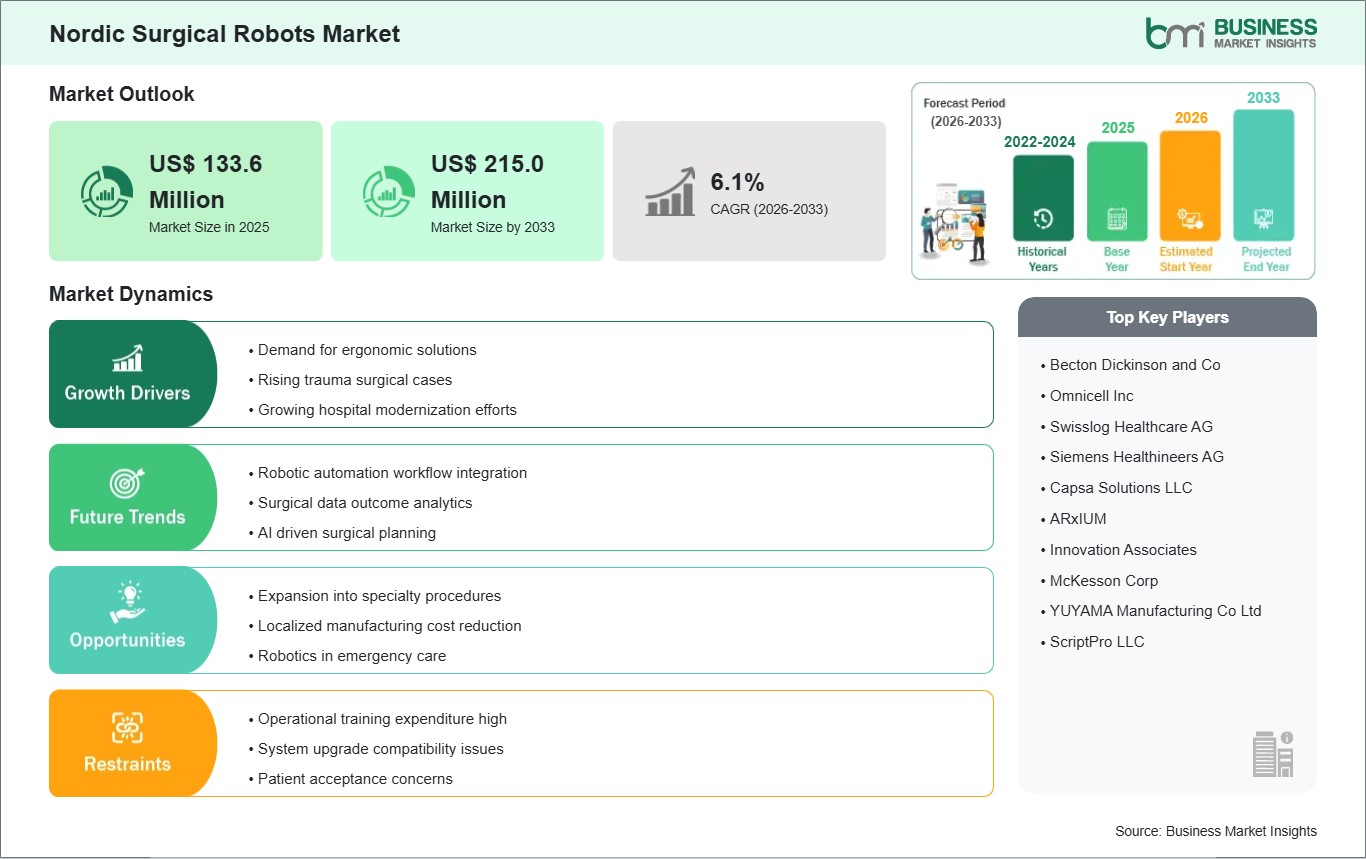
The Nordic surgical robots market has emerged as one of the most advanced and innovation-driven segments in Europe, supported by high healthcare expenditure, well-structured public healthcare systems, and a strong emphasis on clinical research and technological integration. Adoption is primarily concentrated in tertiary hospitals, university medical centers, and specialized private hospitals, where procedural volumes justify the substantial investment in robotic platforms. The market is driven by increasing demand for minimally invasive surgery across urology, cardiothoracic, gynecology, and oncology specialties, where robotic systems enable enhanced surgical precision, reduced complication rates, and shorter recovery periods. Key global players such as Intuitive Surgical, Medtronic, and CMR Surgical have established strong partnerships with hospitals across Sweden, Denmark, Norway, Finland, and Iceland, providing local training, maintenance, and clinical support. Hospitals in the region are increasingly adopting multi-specialty robotic systems capable of supporting various surgical disciplines, optimizing capital utilization and operational efficiency. Regulatory frameworks in the Nordic countries emphasize patient safety, clinical efficacy, and robust post-market surveillance, influencing adoption timelines and hospital procurement strategies. Market growth is also being influenced by strong national investments in digital health and telemedicine, which complement robotic surgery initiatives by enabling remote mentorship, data-driven surgical planning, and outcome tracking. While adoption is high in urban and academic centers, smaller hospitals are gradually integrating robotics through collaborative networks and regional centers of excellence. Overall, the Nordic surgical robots market reflects a combination of clinical innovation, operational efficiency, and strategic investment in advanced surgical technologies, positioning the region as a benchmark for robotic-assisted surgical care.
Segment Analysis
Nordic Surgical Robots Market Segmentation
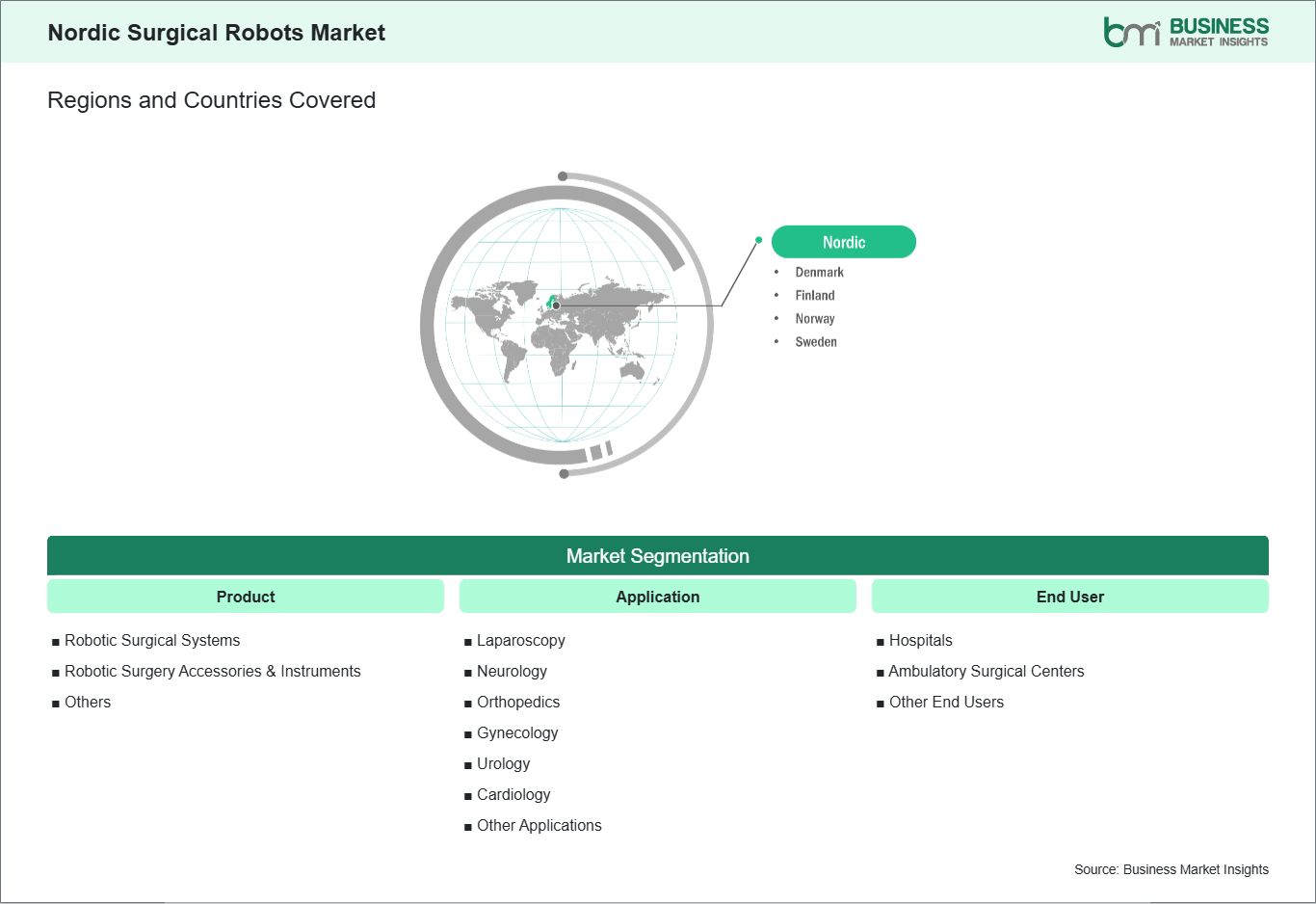
Key segments that contributed to the derivation of the Nordic Surgical Robots Market analysis are product, application, and end user.
- By product, the surgical robots market is segmented into robotic surgical systems, robotic surgery accessories & instruments and others. The robotic surgery accessories & instruments segment dominated the market in 2025.
- In terms of application, the surgical robots market is categorized into laparoscopy, neurology, orthopedics, gynecology, urology, cardiology and other applications. The laparoscopy segment dominated the market in 2025.
- Based on end user, the surgical robots market is classified into hospitals, ambulatory surgical centers and other end users. The hospitals segment dominated the market in 2025.
Market Forces
Nordic Surgical Robots Market Drivers and Opportunities
Demand for ergonomic solutions
In the Nordic surgical robots market, demand for ergonomic solutions is increasingly shaping procurement and surgical practice trends across Sweden, Norway, Denmark, Finland, and Iceland. Surgeons in these countries have a strong focus on workplace health and long‑term career sustainability, and ergonomic robotic platforms are seen as a way to reduce physical strain during complex procedures. Robotic systems with adjustable consoles, intuitive controls, and optimized instrument handling help surgeons maintain comfort and precision even in lengthy operations, aligning closely with the Nordics’ broader emphasis on occupational well‑being. Hospitals and surgical centers in major urban hubs such as Stockholm, Oslo, Copenhagen, and Helsinki are actively evaluating robotic platforms that can minimize musculoskeletal fatigue for surgeons. This demand is especially pronounced in specialties like urology and general surgery, where surgeons may otherwise spend many hours in static postures. By adopting ergonomically designed robotic systems, institutions seek to improve surgeon satisfaction and retention, acknowledging that advanced technology can be a key factor in creating a positive professional environment. Suppliers that address ergonomic criteria are often prioritized in tenders and strategic purchase plans. Additionally, Nordic healthcare systems are leveraging ergonomic robotics to support multi‑disciplinary surgical teams. In facilities where surgeons rotate between subspecialties, ergonomic platforms help standardize operating room comfort across different procedure types. Clinics in Denmark and Finland, for instance, are integrating robotic solutions that reduce physical strain for both lead surgeons and assisting staff, enhancing overall workflow efficiency. This focus on ergonomics not only benefits clinicians but also aligns with national healthcare goals to maintain high standards of care delivery while safeguarding workforce health.
Expansion into specialty procedures
The Nordic region is also witnessing a notable expansion of surgical robotics into specialty procedures beyond traditional applications. In leading centers across Sweden and Norway, robotic systems are being adopted for increasingly complex interventions in thoracic surgery, colorectal procedures, and advanced gynecologic oncology. Clinicians in these specialties are seeking robotics not just for minimally invasive access but for the precision and control needed in anatomically challenging areas, supporting better outcomes in procedures that were traditionally done via open surgery. In Finland and Iceland, smaller but highly specialized hospitals are integrating robotic assistance into niche areas such as pediatric surgery and reconstructive procedures. These applications require fine motor control and stability that robotic platforms can uniquely deliver. Nordic surgical teams are collaborating with technology partners to tailor robotic systems to the specific demands of these specialty fields, including instrument customization and workflow adaptations that respect the region’s procedural preferences and patient population characteristics. Furthermore, the expansion into specialty procedures is supported by structured training and cross‑institutional collaboration. Nordic surgical societies and academic hospitals host workshops and simulation courses focused on specialty robotics, helping clinicians gain confidence and proficiency in new applications. This educational ecosystem supports diffusion beyond early adopters in capital cities to regional medical centers seeking to elevate their procedural capabilities. As a result, surgical robotics in the Nordic market is evolving from core applications like urology and general surgery into a broader set of specialty procedures that reflect both clinical ambition and a commitment to advancing high‑quality care across the region.
Size and Share Analysis
Nordic Surgical Robots Market Size and Share Analysis
The Nordic Surgical Robots Market demonstrates steady growth, with size and share analysis highlighting evolving trends and competitive dynamics among key players. The report examines subsegments categorized within product, application, and end user, offering insights into their contribution to overall market performance.
By product, the robotic surgery accessories & instruments segment dominated the market in 2025, driven by the recurring and high replacement demand for consumable, procedure‑specific tools across increasing robotic surgical procedures, creating consistent revenue streams.
In terms of application, the laparoscopy segment dominated the market in 2025, driven by the strong regional preference for minimally invasive laparoscopic robotic procedures due to improved precision and faster patient recovery, which aligns with broader global surgery trends.
Based on end user, the hospitals segment dominated the market in 2025, driven by their advanced healthcare infrastructure, high surgical volumes, and capacity to invest in and integrate sophisticated robotic systems into multidisciplinary surgical programs.
Report Coverage
Nordic Surgical Robots Market Report Coverage and Deliverables
The "Nordic Surgical Robots Market Size and Forecast (2022 - 2033)" report provides a detailed analysis of the market covering below areas:
- Nordic Surgical Robots Market size and forecast at regional and country levels for all market segments covered under the scope
- Nordic Surgical Robots Market trends, as well as drivers, restraints, and opportunities
- Nordic Surgical Robots Market analysis covering key trends, regional framework, major players, regulations, and recent developments
- Industry landscape and competition analysis covering market concentration, heat map analysis, prominent players, and recent developments for the Nordic Surgical Robots Market
- Detailed company profiles, including SWOT analysis
Geographic Insights
Nordic Surgical Robots Market Geographic Insights
The geographical scope of the Nordic Surgical Robots Market report is divided into Sweden, Denmark, Norway, and Finland. Sweden held the largest share in 2025.
Country-level insights reveal unique adoption patterns across the Nordic region, shaped by healthcare infrastructure, public funding, and institutional priorities. Sweden leads adoption with multiple tertiary hospitals and university medical centers deploying robotic platforms for urology, oncology, and general surgery, supported by strong government healthcare investment and national digital health initiatives. Denmark demonstrates high penetration in metropolitan and university hospitals, leveraging centralized procurement policies and international accreditation to ensure consistent adoption of advanced surgical technologies. Norway integrates robotics primarily in public teaching hospitals and private specialty centers, focusing on high-volume procedures with strong emphasis on surgeon training and clinical research. Finland shows adoption concentrated in leading tertiary care centers and university hospitals, emphasizing multi-specialty use and integration with telemedicine and digital surgical planning tools. Finally, Iceland exhibits selective deployment in Reykjavik’s main tertiary hospitals, prioritizing precision in complex urological and oncological procedures due to smaller population sizes and centralized healthcare services. Across the Nordic region, adoption is driven by operational efficiency, clinical innovation, and strong alignment with national healthcare policy, with urban academic hospitals leading the market while smaller regional facilities gradually integrate robotic-assisted surgery through centralized support and collaborative networks. This results in a highly structured and evidence-based approach to surgical robotics adoption, reinforcing the Nordic region’s position as a global benchmark for advanced surgical care.
Industry Activity
Recent Developments
The Nordic Surgical Robots Market is evaluated by gathering qualitative and quantitative data post primary and secondary research, which includes important corporate publications, association data, and databases. A few of the key developments in the Nordic Surgical Robots Market are:
- In March 2024, Norra Älvsborgs Sjukhus (NAL) in Sweden became the first hospital in the Nordics to conduct clinical robotic‑assisted procedures with the CMR Surgical Versius surgical robot, marking the system’s debut in the region. The modular Versius platform supports multispecialty minimally invasive surgery, including general and gynaecological cases, helping surgeons improve precision and access. Its introduction represents one of the earliest robotic product launches in Nordic healthcare, expanding choices beyond legacy systems. This milestone also helps set the stage for broader Scandinavian adoption.
- In May 2024, CMR Surgical partnered with Kebomed Nordic to bring the Versius surgical robot into hospitals in Denmark, Norway, and Finland, extending access to advanced robotic‑assisted minimal access surgery beyond Sweden. The agreement supports regional deployment of the modular robotic platform for general, colorectal, urology, and gynaecology procedures. This partnership represents a significant expansion of surgical robotics infrastructure across the Nordic countries. The move underscores a coordinated regional adoption strategy for next‑generation robotic systems.
Trust & Transparency
Research Methodology
The market analysis combines proprietary research with secondary data from government agencies, company disclosures, regulatory filings, industry databases and expert interviews. Market estimates are validated through data triangulation, cross-market benchmarking and analyst
review.
View Full Research Methodology
Key Sources Referred:
World Health Organization (WHO) Organisation for Economic Cooperation and Development (OECD) The World Bank Group Worldometer The Lancet International Bar Association International Trade Administration