Market Summary
Executive Summary and Market Analysis
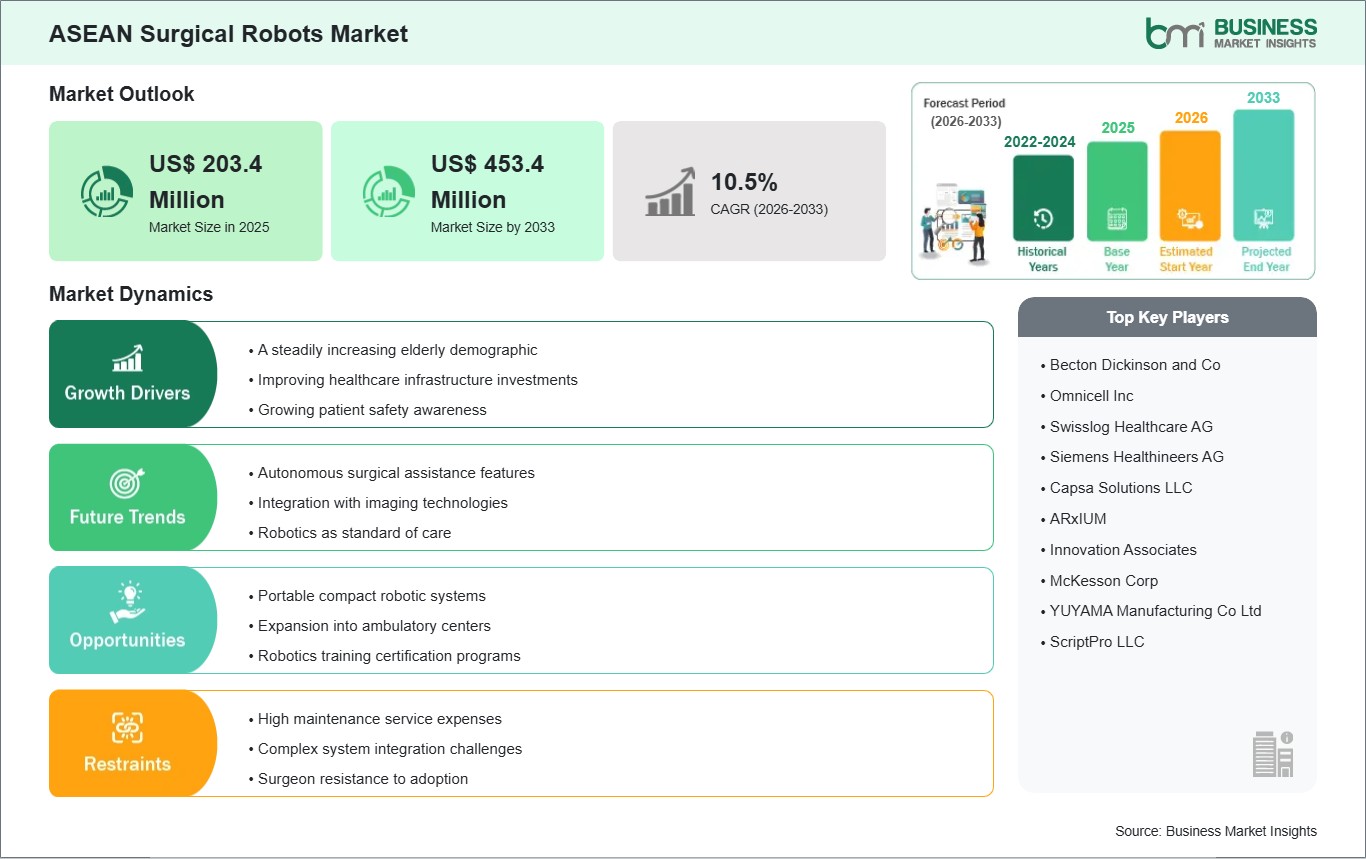
The ASEAN surgical robots market is evolving into a strategically significant segment within Southeast Asia’s advanced medical technology landscape, supported by expanding private healthcare investments and growing demand for minimally invasive procedures. Urban tertiary hospitals across major metropolitan hubs are increasingly incorporating robotic-assisted surgical systems to enhance precision, reduce intraoperative variability, and strengthen institutional branding. Rising incidences of oncological, urological, and gastrointestinal disorders are contributing to procedural diversification, prompting hospitals to differentiate through technology-enabled care pathways. Regional procurement patterns indicate preference for multi-specialty robotic platforms capable of supporting high procedural throughput and integration with digital imaging ecosystems. Leading manufacturers such as Intuitive Surgical, Medtronic, and CMR Surgical are actively strengthening distributor networks and clinical training partnerships within ASEAN to improve market penetration. Adoption is further facilitated by medical tourism inflows in key economies, where advanced surgical capabilities serve as a competitive differentiator. However, capital intensity, uneven reimbursement structures, and disparities in surgeon credentialing standards continue to limit broader public-sector uptake. Regulatory harmonization efforts under regional economic cooperation frameworks are gradually simplifying product registration processes, encouraging multinational participation. Overall, the ASEAN market demonstrates a transition from early adoption to structured expansion, with hospitals aligning robotic investments to long-term operational efficiency, patient outcome optimization, and cross-border referral growth strategies.
Segment Analysis
ASEAN Surgical Robots Market Segmentation
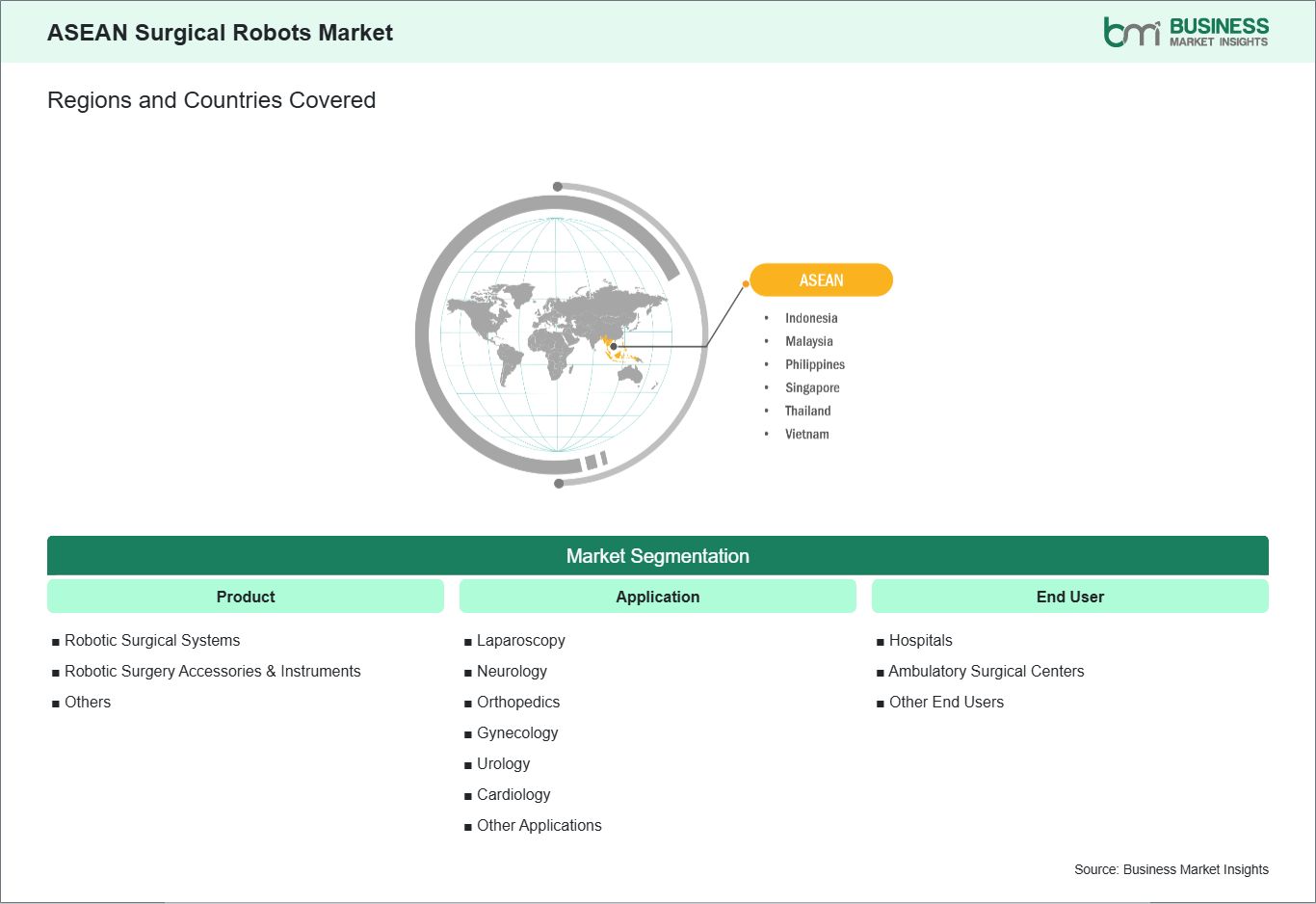
Key segments that contributed to the derivation of the ASEAN Surgical Robots Market analysis are product, application, and end user.
- By product, the surgical robots market is segmented into robotic surgical systems, robotic surgery accessories & instruments and others. The robotic surgery accessories & instruments segment dominated the market in 2025.
- In terms of application, the surgical robots market is categorized into laparoscopy, neurology, orthopedics, gynecology, urology, cardiology and other applications. The laparoscopy segment dominated the market in 2025.
- Based on end user, the surgical robots market is classified into hospitals, ambulatory surgical centers and other end users. The hospitals segment dominated the market in 2025.
Market Forces
ASEAN Surgical Robots Market Drivers and Opportunities
A steadily increasing elderly demographic
The ASEAN surgical robots market is increasingly shaped by demographic shifts, especially the growth of elderly populations across Southeast Asia. Countries such as Singapore, Thailand, Malaysia, and Indonesia are experiencing rising proportions of older adults, which in turn places greater demand on surgical services for age-related conditions like orthopedic degeneration, cardiovascular disease, and cancer. This demographic imperative is encouraging healthcare providers in the region to consider advanced technologies that support more precise, less invasive procedures, helping to meet the clinical needs of aging patients effectively. As more people live longer, the prevalence of surgical interventions requiring high degrees of accuracy and consistency also increases. Robotic systems are valued in this context because they can potentially reduce the surgical trauma associated with complex operations, improve recovery profiles for older patients, and lower the risk of post-operative complications. Southeast Asian hospitals that aim to offer premium and world-class care increasingly assess robotic platforms as part of their long-term service strategies, particularly in urban medical centers where demand is most concentrated. Moreover, the aging demographic is driving broader policy and investment shifts within regional healthcare systems. Governments and private healthcare groups are emphasising modernization efforts that encompass surgical robotics, positioning these technologies as tools to improve outcomes in a landscape where age-related chronic diseases are becoming more common. The cumulative effect of these demographic forces is a strengthening value proposition for surgical robots in ASEAN, anchored in the need to serve older populations with better surgical care.
Portable compact robotic systems
In the ASEAN context, interest is growing not only in traditional large-scale surgical platforms but also in portable and compact robotic systems tailored to more flexible clinical settings. Hospitals and surgical centers in countries like Vietnam, the Philippines, and Malaysia are exploring smaller, modular robotics that can be integrated into existing operating theaters without extensive infrastructure overhaul. As these systems are easier to install and operate, they offer a practical entry point for facilities that might otherwise be deterred by space and cost constraints. Compact robotic systems also align with the operational needs of ambulatory surgical centers and specialized procedure suites that handle high patient volumes. Their reduced footprint and adaptability make them attractive options for minimally invasive procedures such as laparoscopic or endoscopic interventions, where space is at a premium. This trend supports broader adoption across a spectrum of healthcare facilities beyond flagship tertiary hospitals, helping extend access to robot-assisted surgery throughout the region. In addition, portable robotic platforms support strategic objectives tied to medical tourism and regional healthcare competitiveness. ASEAN nations that promote medical travel often highlight advanced surgical offerings as part of their value proposition, and compact robots enable differentiation without prohibitive capital outlays. Partnerships between regional healthcare institutions and global med-tech firms are facilitating the introduction of these systems, helping to build local clinical expertise and reinforcing the relevance of versatile robotic solutions in diverse surgical environments.
Size and Share Analysis
ASEAN Surgical Robots Market Size and Share Analysis
The ASEAN Surgical Robots Market demonstrates steady growth, with size and share analysis highlighting evolving trends and competitive dynamics among key players. The report examines subsegments categorized within product, application, and end user, offering insights into their contribution to overall market performance.
By product, the robotic surgery accessories & instruments segment dominated the market in 2025, driven by the recurring demand for consumable tools and replacement components required for every robotic procedure, creating steady repeat purchases as surgical robot adoption grows.
In terms of application, the laparoscopy segment dominated the market in 2025, driven by the increasing adoption of minimally invasive laparoscopic procedures across multiple specialties in the region, supported by surgeon preference for enhanced precision and patient recovery outcomes.
Based on end user, the hospitals segment dominated the market in 2025, driven by the greater financial capacity, established surgical infrastructure, and higher volume of advanced procedures in hospital settings compared with other care facilities, making them primary purchasers of robotic technology.
Report Coverage
ASEAN Surgical Robots Market Report Coverage and Deliverables
The "ASEAN Surgical Robots Market Size and Forecast (2022 - 2033)" report provides a detailed analysis of the market covering below areas:
- ASEAN Surgical Robots Market size and forecast at regional and country levels for all market segments covered under the scope
- ASEAN Surgical Robots Market trends, as well as drivers, restraints, and opportunities
- ASEAN Surgical Robots Market analysis covering key trends, regional framework, major players, regulations, and recent developments
- Industry landscape and competition analysis covering market concentration, heat map analysis, prominent players, and recent developments for the ASEAN Surgical Robots Market
- Detailed company profiles, including SWOT analysis
Geographic Insights
ASEAN Surgical Robots Market Geographic Insights
The geographical scope of the ASEAN Surgical Robots Market report is divided into Indonesia, Malaysia, the Philippines, Singapore, Thailand, and Vietnam. Indonesia held the largest share in 2025.
Country-level dynamics across ASEAN highlight differentiated adoption patterns shaped by healthcare financing models and institutional maturity. Indonesia is emerging as a key market due to its large population base and growing middle-class healthcare demand. Adoption remains concentrated in Jakarta and other major urban centers, where premium private hospitals are investing in robotic-assisted platforms to enhance surgical precision and attract high-income patients. Thailand demonstrates robust uptake driven by its well-established medical tourism sector and internationally accredited private hospitals seeking technological differentiation. In Malaysia, expansion is supported by growing private healthcare networks and government initiatives to enhance tertiary care services, particularly in metropolitan corridors. Meanwhile, Vietnam is witnessing gradual integration within leading public hospitals through state-supported modernization programs and international training collaborations. Across ASEAN, procurement drivers vary from urban healthcare sophistication and private-sector investment to medical tourism competitiveness, reflecting diverse yet converging pathways toward robotic-assisted surgical adoption.
Industry Activity
Recent Developments
The ASEAN Surgical Robots Market is evaluated by gathering qualitative and quantitative data post primary and secondary research, which includes important corporate publications, association data, and databases. A few of the key developments in the ASEAN Surgical Robots Market are:
- In February 2025, Malaysia saw its first robotic‑assisted surgery performed using the Japanese‑designed hinotori™ Surgical Robot System at Mahkota Medical Centre in Malacca, marking the first clinical use of this platform in the country outside Japan. This deployment expanded access to advanced minimally invasive procedures and positioned Malaysia as an early adopter of next‑generation robotic surgery in Southeast Asia. The system had already been introduced in Singapore in 2024, and its Malaysia use underscores growing regional adoption of Asian robotic technology. Hospitals are now using the platform to support a range of specialties, improving surgical precision and patient recovery.
- In Mar 2025, LifeSync Robotics, a Singapore‑based surgical robotics developer, joined co11ab Novena, Singapore’s pioneering biomedical tech incubator, to accelerate innovation around its Asclepius™ Robotic System for orthopedic surgery. While not a clinical launch, this move signals Singapore’s commitment to nurturing homegrown robotic surgical platforms and strengthening ASEAN’s medtech ecosystem. The incubator affiliation provides access to clinical collaborators, prototyping facilities and research networks, helping the startup push toward future commercial deployment. This development shows how ASEAN is investing in local robotic R&D alongside adopting international systems.
Trust & Transparency
Research Methodology
The market analysis combines proprietary research with secondary data from government agencies, company disclosures, regulatory filings, industry databases and expert interviews. Market estimates are validated through data triangulation, cross-market benchmarking and analyst
review.
View Full Research Methodology
Key Sources Referred:
World Health Organization (WHO) Organisation for Economic Cooperation and Development (OECD) The World Bank Group Worldometer The Lancet International Bar Association International Trade Administration