Market Summary
Executive Summary and Market Analysis
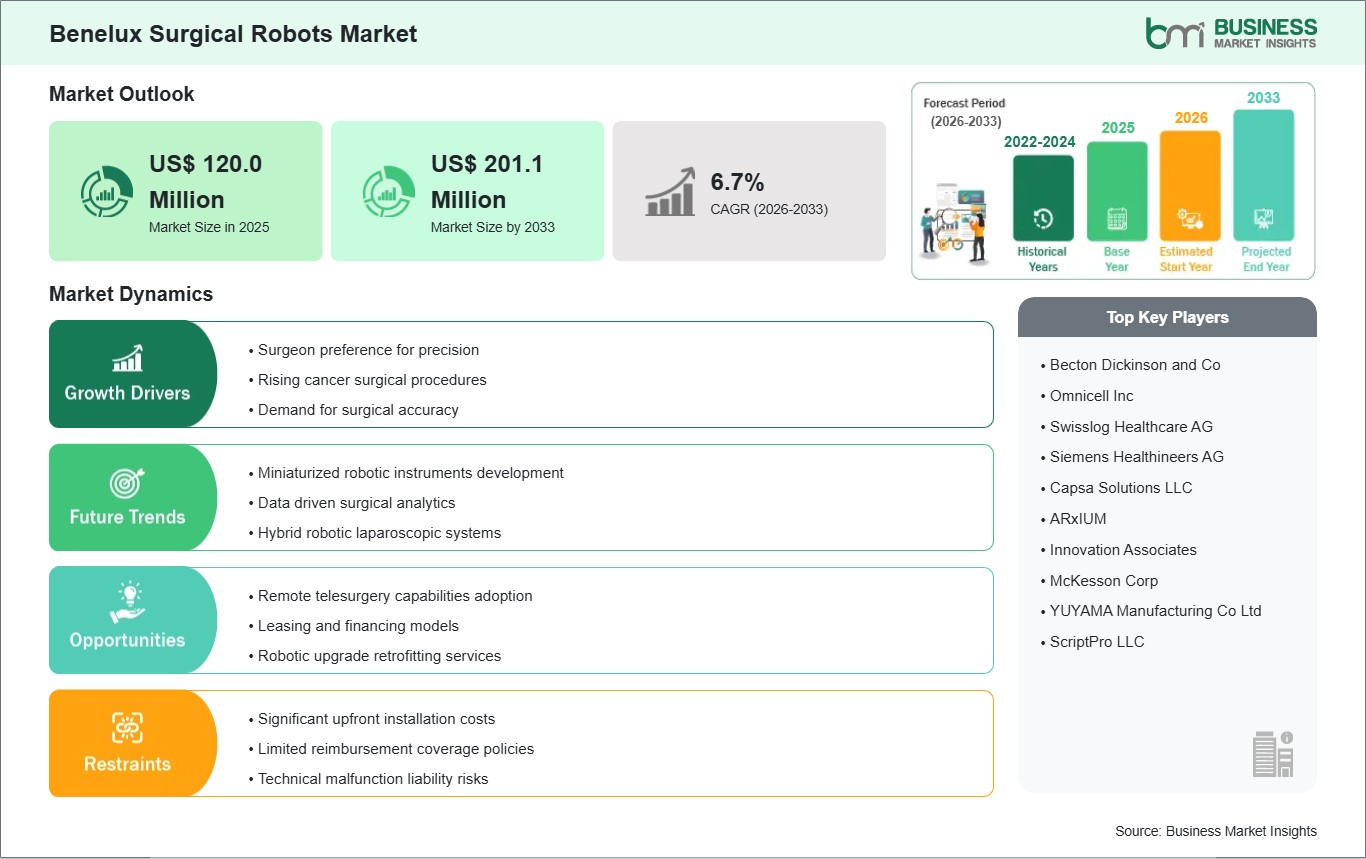
The Benelux surgical robots market is experiencing steady growth driven by high adoption of advanced medical technologies, well-established healthcare systems, and a strong focus on minimally invasive surgery. Hospitals across Belgium, the Netherlands, and Luxembourg are increasingly deploying robotic-assisted platforms to enhance precision, reduce intraoperative variability, and improve patient outcomes across urology, gynecology, and gastrointestinal procedures. Market activity is influenced by collaborations between regional healthcare providers and global manufacturers such as Intuitive Surgical, Medtronic, and Stryker Corporation, which support technology transfer, clinical training, and long-term service contracts. Adoption is concentrated in major urban hospitals and academic medical centers, where patient volumes and surgeon expertise justify capital-intensive investments. Strategic factors driving market growth include hospital branding initiatives, the increasing emphasis on patient-centric care, and regional expertise in robotic-assisted procedures. Despite high adoption, challenges remain, including operational cost management, integration with existing hospital workflows, and regulatory compliance across multiple jurisdictions within the Benelux region. Vendors are increasingly differentiating themselves through flexible financing models, advanced system features such as AI-assisted navigation, and comprehensive training programs for surgical teams. Furthermore, the market is seeing a shift toward value-based healthcare models, with institutions seeking solutions that optimize surgical throughput, reduce length of stay, and support long-term clinical outcome tracking. Overall, the Benelux surgical robots market is positioned for gradual expansion, leveraging a combination of technological sophistication, skilled human resources, and strong institutional commitment to high-quality surgical care.
Segment Analysis
Benelux Surgical Robots Market Segmentation
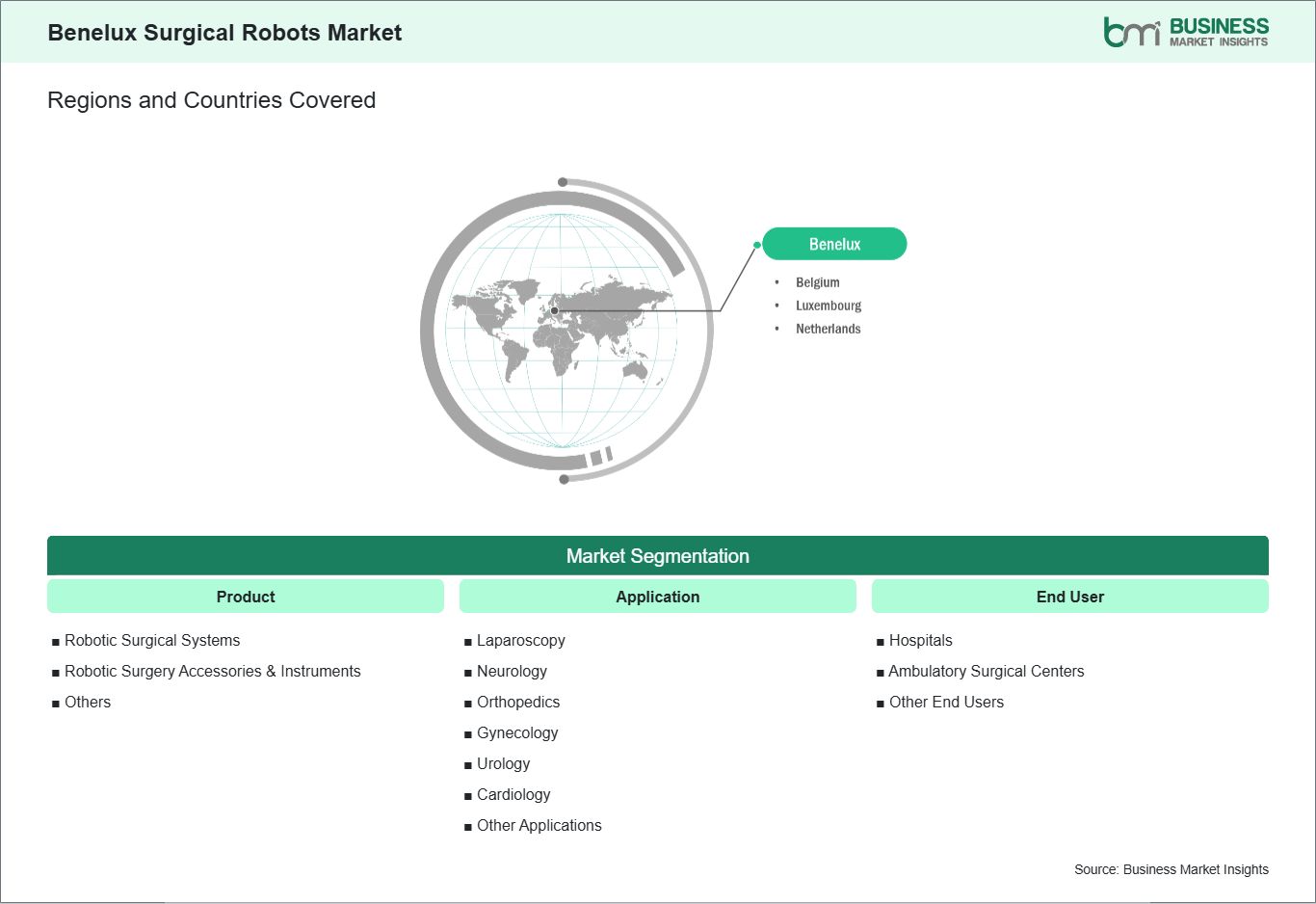
Key segments that contributed to the derivation of the Benelux Surgical Robots Market analysis are product, application, and end user.
- By product, the surgical robots market is segmented into robotic surgical systems, robotic surgery accessories & instruments and others. The robotic surgery accessories & instruments segment dominated the market in 2025.
- In terms of application, the surgical robots market is categorized into laparoscopy, neurology, orthopedics, gynecology, urology, cardiology and other applications. The laparoscopy segment dominated the market in 2025.
- Based on end user, the surgical robots market is classified into hospitals, ambulatory surgical centers and other end users. The hospitals segment dominated the market in 2025.
Market Forces
Benelux Surgical Robots Market Drivers and Opportunities
Surgeon preference for precision
In the Benelux surgical robots market, surgeon preference for precision is a key driver shaping technology adoption. Healthcare professionals in Belgium, the Netherlands, and Luxembourg are increasingly advocating for robotic systems that enhance dexterity, control, and visual clarity during complex procedures. Precision has become especially important in specialties such as urology, gynecology, and oncology, where even minor improvements in surgical accuracy can translate into better patient outcomes and reduced complication rates. Leading academic and tertiary hospitals in the region are positioning themselves as centers of excellence by integrating advanced robotic platforms into their surgical suites. Many surgeons in Benelux value the ergonomic benefits and magnified 3D views that robotic systems provide, enabling finer movements than traditional laparoscopy. This emphasis on technical precision aligns with the region’s broader focus on high‑quality, patient‑centered care and supports efforts to maintain clinical competitiveness with other advanced healthcare systems in Europe. Furthermore, surgeon preference for precision is influencing training and professional development across the Benelux. Medical institutions and surgical societies are expanding robotics‑focused education to ensure clinicians can maximize the capabilities of robotic platforms. This trend not only fosters confidence among existing surgeons but also attracts new talent who view precision technologies as integral to the future of surgical practice in the region.
Remote telesurgery capabilities adoption
Remote telesurgery capabilities are gaining attention within the Benelux as hospitals explore ways to extend specialist expertise and improve care accessibility. With strong digital infrastructure and widespread high‑speed connectivity in Belgium, the Netherlands, and Luxembourg, healthcare providers are uniquely positioned to pilot telesurgery initiatives that connect surgeons across locations. This trend reflects growing interest in leveraging robotics to support collaborative surgical care, particularly for complex cases that require subspecialty input. Regional health systems are also evaluating remote capabilities as a strategic response to workforce challenges in certain surgical domains. By enabling expert surgeons to support procedures virtually, hospitals can optimize resource utilization and reduce the need for patient travel. Clinics in urban centers are collaborating with more peripheral facilities to assess remote guidance models, using robotics as the enabling technology for these partnerships. In addition, the forward‑looking policy environments in Benelux countries support continued exploration of telesurgery and telemedicine integration. Regulatory and reimbursement frameworks are evolving to accommodate innovation, encouraging providers to test remote surgical applications within controlled settings. As adoption progresses, remote telesurgery is expected to play an emerging role in how surgical robotics enhance access to specialized care across the Benelux region.
Size and Share Analysis
Benelux Surgical Robots Market Size and Share Analysis
The Benelux Surgical Robots Market demonstrates steady growth, with size and share analysis highlighting evolving trends and competitive dynamics among key players. The report examines subsegments categorized within product, application, and end user, offering insights into their contribution to overall market performance.
By product, the robotic surgery accessories & instruments segment dominated the market in 2025, driven by the recurring demand for consumable tools required in nearly every robotic procedure, leading to consistent revenue and broad clinical use.
In terms of application, the laparoscopy segment dominated the market in 2025, driven by the strong adoption of minimally invasive procedures, where robotic assistance enhances precision, reduces trauma, and shortens recovery times.
Based on end user, the hospitals segment dominated the market in 2025, driven by their advanced infrastructure, financial capacity, and high surgical volumes that support investment in and utilization of robotic systems.
Report Coverage
Benelux Surgical Robots Market Report Coverage and Deliverables
The "Benelux Surgical Robots Market Size and Forecast (2022 - 2033)" report provides a detailed analysis of the market covering below areas:
- Benelux Surgical Robots Market size and forecast at regional and country levels for all market segments covered under the scope
- Benelux Surgical Robots Market trends, as well as drivers, restraints, and opportunities
- Benelux Surgical Robots Market analysis covering key trends, regional framework, major players, regulations, and recent developments
- Industry landscape and competition analysis covering market concentration, heat map analysis, prominent players, and recent developments for the Benelux Surgical Robots Market
- Detailed company profiles, including SWOT analysis
Geographic Insights
Benelux Surgical Robots Market Geographic Insights
The geographical scope of the Benelux Surgical Robots Market report is divided into Belgium, the Netherlands, and Luxembourg. The Netherlands held the largest share in 2025.
Country-level dynamics in the Benelux region reveal differentiated adoption patterns driven by healthcare system sophistication, institutional priorities, and capital availability. Netherlands leads regional adoption with a strong network of private and public hospitals investing in robotic-assisted platforms across urology, oncology, and cardiovascular specialties. Advanced reimbursement frameworks and high patient volumes facilitate early adoption of innovative systems. In Belgium, uptake is concentrated in academic medical centers and leading private hospitals, with growth supported by national initiatives promoting minimally invasive procedures and healthcare excellence. Hospitals focus on integrating robotics to improve surgical outcomes and attract international patients. Meanwhile, Luxembourg exhibits selective adoption due to its smaller population and limited hospital network, though investment in high-end tertiary hospitals is driving targeted deployment in urology and gynecology. Across the region, adoption is influenced by factors such as surgeon expertise, hospital funding models, and operational efficiency priorities. Cross-country knowledge sharing and training programs further support regional growth, positioning the Benelux market as a mature, innovation-driven segment within Europe’s broader surgical robotics landscape.
Industry Activity
Recent Developments
The Benelux Surgical Robots Market is evaluated by gathering qualitative and quantitative data post primary and secondary research, which includes important corporate publications, association data, and databases. A few of the key developments in the Benelux Surgical Robots Market are:
- In June 2025, the MicroPort Toumai Surgical Robot was used to perform the first intra‑European telesurgery cases between Orsi Academy (Melle) and AZ ORG Hospital (Aalst) in Belgium. Surgeons conducted a radical prostatectomy and a hysterectomy remotely, marking a European milestone in remote robotic‑assisted surgery. The procedures demonstrated the robot’s low‑latency control over standard hospital networks, paving the way for expanded telesurgical programs. This achievement positions Belgium as an innovation hub for advanced robotic surgery modalities in Europe.
- In September 2025, the BeNeLux Healthcare Innovation Summit showcased live streamed procedures using the da Vinci SP single‑port surgical robot at Maria Middelares (Belgium), emphasising next‑generation minimally invasive techniques. The single‑port iteration of Intuitive’s da Vinci platform allows complex surgery through one incision, reducing pain and scarring. Surgeons and international experts gathered to exchange expertise on robotic and data‑driven surgical innovations. This event underscores adoption of advanced robotic platforms like da Vinci SP and collaborative clinical training in the Benelux region.
Trust & Transparency
Research Methodology
The market analysis combines proprietary research with secondary data from government agencies, company disclosures, regulatory filings, industry databases and expert interviews. Market estimates are validated through data triangulation, cross-market benchmarking and analyst
review.
View Full Research Methodology
Key Sources Referred:
World Health Organization (WHO) Organisation for Economic Cooperation and Development (OECD) The World Bank Group Worldometer The Lancet International Bar Association International Trade Administration