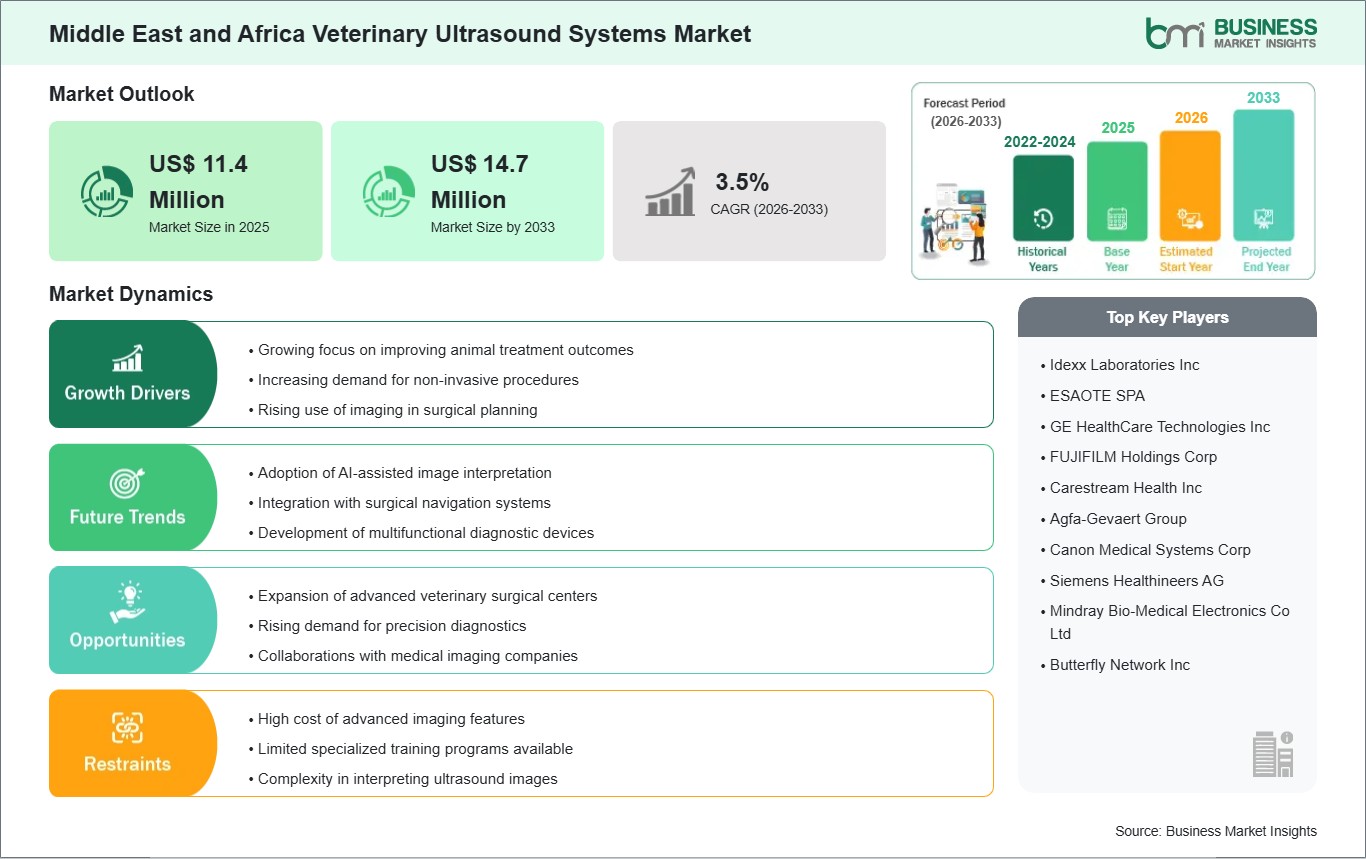
The Middle East and Africa veterinary ultrasound systems market size is expected to reach US$14.7 million by 2033 from US$11.4 million in 2025. The market is estimated to record a CAGR of 3.5% from 2026 to 2033.
The Middle East and Africa (MEA) veterinary ultrasound systems market is witnessing steady growth, driven by expanding livestock operations, rising awareness of animal health management, and increasing companion animal care demand. For the region of the Middle East, there has been a rapid increase in modernization of farms, especially in nations such as Saudi Arabia and the UAE, thus increasing the number of ultrasound systems being employed for monitoring the reproductive health, herd management, and disease control among others. For Africa, the government has been working on measures to enhance the level of productivity in livestock, leading to an increased demand for low-cost diagnostic veterinary instruments that can be used even in remote areas. The main drivers for growth include innovation with portable, hand-held and high resolution ultrasound machines. Training initiatives and veterinary education programs across the region further facilitate adoption, ensuring effective utilization of imaging systems. The competitive landscape comprises international manufacturers and regional distributors, with procurement decisions influenced by after-sales service, technical support, pricing, and accessibility. While challenges such as price sensitivity, infrastructure disparities, and uneven technical expertise persist, the MEA region offers strong long-term potential due to increasing livestock commercialization, urbanization, and rising consumer demand for companion animal care.

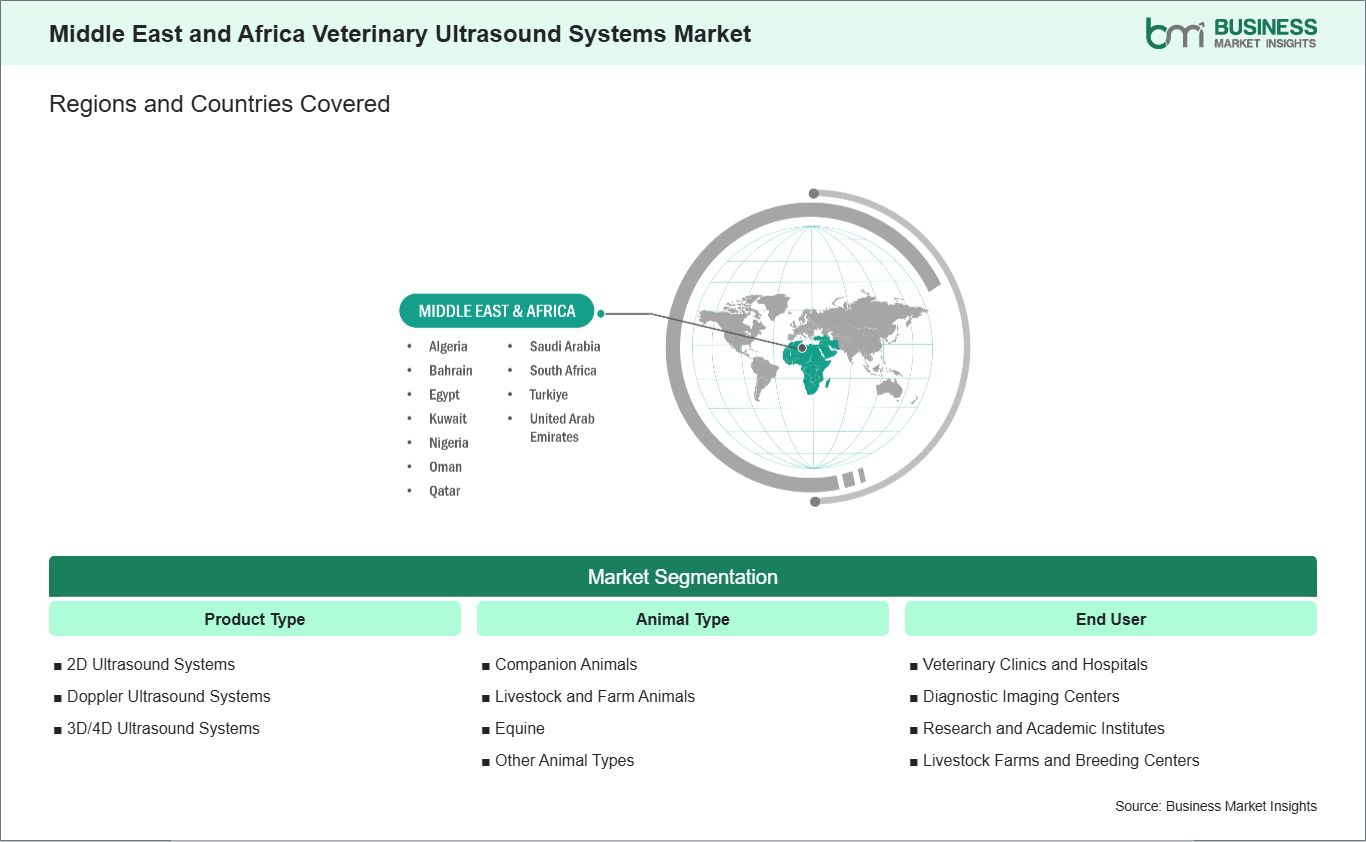
Key segments that contributed to the derivation of the Middle East and Africa veterinary ultrasound systems market analysis are product type, animal type, and end user.
The MEA veterinary ultrasound systems market is being driven by the growing need for effective livestock disease surveillance. A number of countries like Saudi Arabia, Egypt, Kenya, and South Africa have huge numbers of cattle, goats, sheep, and camels whose significance cannot be overlooked when it comes to food and economic security. Frequent occurrence of diseases such as Rift Valley Fever, Foot and Mouth Disease, and Peste Des Petits Ruminants necessitated the need for early detection and herd health monitoring.
The use of veterinary ultrasound machines helps immensely in the provision of preventative care as this technology can help in early detection of reproductive problems, organ problems, and other illnesses. This is evidenced by the fact that farmers in East Africa have used early intervention using veterinary ultrasounds to help curb the problem of livestock loss within their herds.
Furthermore, government and regional initiatives to strengthen disease surveillance are boosting awareness and adoption of diagnostic tools. Livestock health programs supported by ministries of agriculture and animal health organizations encourage routine monitoring, which directly increases the demand for veterinary ultrasound systems. As disease surveillance becomes a priority across MEA, ultrasound diagnostics are expected to see sustained growth, improving livestock health and overall productivity.
The adoption of portable and rugged ultrasound systems presents a significant opportunity in the MEA veterinary market. There are many farms in rural areas where veterinary clinics are not readily available. These portable machines will enable the veterinarian to examine, monitor, diagnose, and treat animals right at the spot without having to move them.
The portable nature of such devices is especially useful when applied in veterinary practice that involves mobile teams. It becomes more important when such mobile units are employed in Nigeria, Kenya, and Saudi Arabia where such rugged machinery can help assess herd health quickly, detect diseases, and manage reproduction.
Additionally, veterinary training programs in the MEA are gradually incorporating portable ultrasound technologies into curricula, enhancing professional skills and confidence in field applications. As awareness grows and infrastructure for mobile veterinary services expands, portable and rugged ultrasound systems are expected to become essential tools, supporting disease management, herd monitoring, and improved livestock productivity throughout the Middle East and Africa.

The Middle East and Africa veterinary ultrasound systems market demonstrates steady growth, with size and share analysis highlighting evolving trends and competitive dynamics among key players. The report examines subsegments categorized within product type, animal type, and end user, offering insights into their contribution to overall market performance.
By product type, the 2d ultrasound systems subsegment dominated the market in 2025, driven by their widespread clinical utility, cost‑effectiveness, ease of use and strong adoption in routine veterinary diagnostics across MEA veterinary practices.
Based on animal type, the companion animals subsegment dominated the market in 2025, driven by increasing pet ownership, growing awareness of animal healthcare, and rising expenditure on veterinary diagnostic services in MEA.
In terms of end user, the veterinary clinics and hospitals subsegment dominated the market in 2025, driven by expansion of veterinary facilities and investment in modern diagnostic imaging equipment across clinics and hospitals in MEA.
| Report Attribute | Details |
|---|---|
| Market size in 2025 | US$ 11.4 Million |
| Market Size by 2033 | US$ 14.7 Million |
| CAGR (2026 - 2033) | 3.5% |
| Historical Data | 2022-2024 |
| Forecast period | 2026-2033 |
| Segments Covered | By Product Type
|
|
Regions and Countries Covered
| |
| Middle East and Africa | Turkiye, the UAE, Saudi Arabia, Bahrain, Oman, Egypt, South Africa, Algeria, Nigeria, Kuwait, Qatar |
| Market leaders and key company profiles |
|
The "Middle East and Africa Veterinary Ultrasound Systems Market Size and Forecast (2022–2033)" report provides a detailed analysis of the market covering below areas:
The geographical scope of the Middle East and Africa Veterinary Ultrasound Systems Market report is divided into Turkiye, the UAE, Saudi Arabia, Bahrain, Oman, Egypt, South Africa, Algeria, Nigeria, Kuwait, Qatar. The Turkiye held the largest share in 2025.
Country-level insights in the Middle East and Africa reveal varied adoption patterns influenced by livestock density, companion animal care, and veterinary infrastructure. Turkiye emerges as the dominant market, supported by its large-scale livestock industry, well-established veterinary services, and government-backed animal health programs. Ultrasound systems are widely used for reproductive monitoring, herd health management, and early disease detection, while urban veterinary clinics increasingly integrate advanced imaging technologies for companion animals. Institutional support, strong technical expertise, and modernization of farm practices reinforce Turkiye’s leading position in the region. Saudi Arabia shows strong adoption, driven by large-scale livestock operations, government initiatives for food security, and high demand for companion animal diagnostics. Portable and high-resolution ultrasound systems are increasingly used in both field and clinical settings. The UAE demonstrates significant growth, fueled by urban veterinary clinics, livestock modernization programs, and rising awareness of animal welfare and preventive care. Bahrain, Oman, Kuwait, and Qatar represent smaller, niche markets, with demand largely concentrated in companion animal care and selective livestock applications. In Africa, Egypt emerges as a leading market, supported by well-developed veterinary infrastructure, government-backed livestock productivity initiatives, and strong import channels for diagnostic equipment. South Africa demonstrates advanced adoption due to commercial livestock operations and a sophisticated companion animal care sector. Nigeria exhibits growing potential, driven by its large livestock population and agricultural programs, while Algeria is gradually expanding adoption through herd health and reproductive monitoring initiatives. Across the Middle East and Africa, market growth is shaped by regulatory frameworks, veterinary infrastructure, technical expertise, and increasing awareness of preventive veterinary care. Turkiye’s dominance is reinforced by its scale, institutional support, and high integration of diagnostic technologies, establishing it as the primary hub for veterinary ultrasound system adoption in the region.

The Middle East and Africa Veterinary Ultrasound Systems Market is evaluated by gathering qualitative and quantitative data post primary and secondary research, which includes important corporate publications, association data, and databases. A few of the key developments in the Middle East and Africa veterinary ultrasound systems market are:
The Middle East and Africa Veterinary Ultrasound Systems Market is valued at US$ 11.4 Million in 2025, it is projected to reach US$ 14.7 Million by 2033.
As per our report Middle East and Africa Veterinary Ultrasound Systems Market, the market size is valued at US$ 11.4 Million in 2025, projecting it to reach US$ 14.7 Million by 2033. This translates to a CAGR of approximately 3.5% during the forecast period.
The Middle East and Africa Veterinary Ultrasound Systems Market report typically cover these key segments-
The historic period, base year, and forecast period can vary slightly depending on the specific market research report. However, for the Middle East and Africa Veterinary Ultrasound Systems Market report:
The Middle East and Africa Veterinary Ultrasound Systems Market is populated by several key players, each contributing to its growth and innovation. Some of the major players include:
The Middle East and Africa Veterinary Ultrasound Systems Market report is valuable for diverse stakeholders, including:
Essentially, anyone involved in or considering involvement in the Middle East and Africa Veterinary Ultrasound Systems Market value chain can benefit from the information contained in a comprehensive market report.
Please tell us your area of interest
(Market Segments/ Regions and Countries/ Companies)